The Early Settlers of Pleasant Point

Pleasant Point’s summer colony in South Wellfleet marks the beginning of the change of Wellfleet’s economy from maritime pursuits to tourism. The land developers Robert Howard and Edward Reed simultaneously promoted land sales on Lieutenant’s Island and the Old Wharf, but lot buyers did not build as many cottages there as were developed on Pleasant Point from 1890 to 1910. Pleasant Point and the Cannon Hill developments — perhaps because they were closer to the South Wellfleet Depot — created groups of summertime residents who began to have an impact on Wellfleet’s economy and its residents who provided services to them. Wellfleet’s population was at its lowest level in these years, with barely 800 people left in the town that had been abandoned by its maritime population.

By 1910, there were 25 cottages at Pleasant Point. Middle-class families began to come either for the summer — or the women and children did — while the men commuted. Some owners rented their cottages to families that began to make annual visits, establishing another group of summer visitors who appreciated Wellfleet’s summer charms. In contrast, up to 1910, Lieutenant’s Island had only six cottages developed, and there were four out on the Old Wharf, with only one, my great grandfather’s, on Prospect Hill.

This twenty-year period of cottage building came just before the development of automobile tourism, when day-trippers in automobiles added another layer to the servicing of visitors, with tourist camps for motorists. Of course, not everyone who sought a summer residence built a cottage. Many purchased old Cape homesteads from families whose children could no longer make a living in the town.

The social changes that made a “vacation” possible for many more people came after the Civil War, as Massachusetts industrialized in its urban locations. Even the conservative clergy came to recognize that humans needed a break from work, preferably in the fresh air of the mountains, on a farm, or at the seaside. By the 1870s and 1880s, other parts of New England and the upper Cape were developing the facilities — hotels, tours, trains — that got people out of the cities and to their countryside destinations. A growing middle class began to accept that this break in routine was needed, and they had the funds to pursue it. The Old Colony Railroad’s extension all the way to Provincetown was an important precursor to the Cape’s tourism development.

While the leafy towns on the upper Cape developed their hotels and Methodist camps in the 1870s and 1880s, the outer Cape towns – those past Orleans — took a bit longer to gain appeal. When Thoreau took his outer Cape walk in 1849, he wasn’t the first to describe the barrenness of the landscape, the poor soil, and the lack of trees. In the early postcard views of Pleasant Point offered here, the lack of green in the landscape seems not to have mattered to the cottage owners, as they faced their summer cottages toward the tidal Blackfish Creek. Like other Cape towns, Wellfleet developed its “vibe” – the fishing village with elderly sea captains, the industrious people that represented Yankee thrift and hardiness, and even the salty characters that lived there. I’ve written about “The Little Man” of South Wellfleet previously.

Pleasant Point’s Walker Plan

It is in this context that Howard and Reed established their Cape Cod Bay Land Company around Wellfleet’s bayside, with plans of cottage lots laid out for each area. Pleasant Point’s plan was named the “Walker Plan” for the previous owner, Thomas Walker, Jr. Thomas’ father, Thomas Sr., settled in Wellfleet after growing up in Maine, marrying Wellfleet girl Mary Hatch, daughter of James Brown Hatch and Jane King. Thomas was a fisherman, and perhaps selected his land, purchased in 1829 from the Doanes, because he was just across Blackfish Creek from the South Wharf. Later, he purchased woodland from Nathaniel Bell. The 1829 purchase refers to the “Old Mill Pond” which is today’s Drummer’s Pond, the site of a fulling mill that I’ve written about previously.

There isn’t a map that would show the site of the Walker homestead. The lives of the Walker children are a sad tale, but somewhat typical of 19th century childhood. Thomas Jr. was born in 1824. A sister, Jane King Walker, was born in 1821 and died in 1822. John Wesley Walker was born in 1830, but died in 1832. Like other families, the same name was given to another male child, born in 1835, but he died in 1838. Sally Walker, born in 1839, died at age 25 in 1846. All of them are buried in Pleasant Hill Cemetery in Wellfleet, the Methodist Cemetery. Their mother, Mary, died in 1867 and is buried there also, as are both Thomas Walker Sr. and Jr.

The Walker family is listed in the Federal censuses in Wellfleet in 1830 and 1840; in 1838, a newspaper article lists Mr. Walker as one of Wellfleet’s Democrats. By 1850, the family is living in Boston, with Thomas as the only child. In Thomas Jr.’s obituary, it mentions the successful firm of Walker & Rich, fish dealers, at the Quincy Market, established in 1842. Leaving Wellfleet to become a fish dealer in Boston was a common choice for Wellfleet men. According to the Boston City Directory of 1872 and 1879 the Walkers were in business with an Abram Rich who was from the Truro Rich family.

After Mary died, Thomas Sr. married again, to a woman named Susan, who appears in the 1870 census. In 1868, Thomas Walker Jr. married Emma Stidder. His prosperity as a Boston fish dealer supported his purchase of two cottages at the Lakeview Association in South Framingham, part of the New England Chautauqua organization, affiliated with the Methodist Church.

In August, 1890, when Thomas Walker Jr. signed over the land that became Pleasant Point, his wife Emma signed the deed, as well as his stepmother, Susan R. Walker.

Pleasant Point Develops

In the early 1890s, Howard and Reed purchased the adjoining land east of the “Walker Land,” from the Paine family, and created a second area of cottage lots, “The Walker Plan Addition,” and another portion, “The Paine Plan.” These lots are part of the Pleasant Point community today.

The 1890 “Walker Plan” laid out by Tully Crosby, like the other South Wellfleet development plans, gives street names to the area that are a bit more creative than the numbered and lettered streets on Lieutenant’s Island. One of the main streets, Pleasant Point Avenue, ran behind the lots on the bluff where several cottages were built. This street name soon gave the growing colony its overall name. In newspaper reports in the earlier years, it’s referred to as “Point Pleasant;” but the designation of Pleasant Point was given pretty much after 1910.

The Cape Cod Bay Land Company ran advertisements in print publications in the Boston area, with their Boston office listed at 230 Washington Street. “Sea Shore Cottage Lots” were advertised at $25, or $5 down, and $5 per month for a lot of 2800 square feet. They advertised “fine gunning” for hunters, and boating, fishing and bathing. The lots were near the depot, the post office and a store. Applicants got a “testimonial from well-known businessmen who have bought lots and from the town’s Selectmen.” Of course, not everyone traveled to South Wellfleet to make their purchase. One writer has commented that for those who did travel to the Cape on the train, and subsequently purchased land, their rail fare would be reimbursed.

Sales of lots on the Walker Plan began in 1890. Earliest sales were closest to the water — the bluff with the seven houses that are still there today where the grandest house was built. The large Queen Anne-style house on the western end deserves its own story, which I’ll write about in my next post.

There is no evidence of which cottage was built first. By studying deeds of early purchasers and noting their transfers of property, the existence of a building is noted, telling us that the owners built a structure. On the 1907-1910 map of Wellfleet, a map detail, shown here, notes on which lot a cottage occupied; there are 25 structures, including three to the east, where the owners must have enjoyed a view of Drummer’s Pond.

Detail of 1907-1910 map showing cottage lots with owners

Detail of 1907-1910 map showing cottage lots with owners

Most early cottage builders chose a simple wood-shingled style of one and sometimes two stories. From time to time, a little “tower section” made the cottage distinctive. Very often, names were bestowed upon the small building: Gull Cottage, Valley View, Sea Breeze, Bay Vista, Bay Pines, and so on.

The early cottages were lit with kerosene lamps, had outhouses, and used ice to keep food cool — one step away from camping, for the most part. Bathing, boating, and fishing were daily activities, and perhaps reading for leisure, playing games, and visiting with neighboring families. The key was to relax, to enjoy the sea air, the release from the work day, and the constraints of city living.

Bathing Costumes turn of the century. Photo courtesy Museum of the City of New York

Bathing Costumes, turn of the century. Photo courtesy Museum of the City of New York


Just after 1900, a Pleasant Point Water Company association was formed and it purchased a small triangular lot from Mr. Reed, and gaining his permission to put up a windmill and another small building. The lot was turned over to Wellfleet resident James Chandler in the summer of 1897. A news report from 1904 mentions Frank Fisher “erecting” a galvanized water tank for the “water system” at Pleasant Point. There is still a “pump house” lot listed under “Pleasant Water” on the Wellfleet Assessor’s Database. Today, the Pleasant Point Water system serves about forty cottages.

Early summer visitors to Pleasant Point had access to supplies both at the General Store at the Railroad Station, as well as a seasonal store that Mr. Newcomb eventually established at “Hinckley’s Corner” which is where “Way 112” is today. Wellfleet purveyors came around with wagons to sell meat, fish and fresh vegetables. The South Wellfleet Congregational Church was pretty much out of operation by the time Pleasant Point was developed, but churchgoers may have found the remaining congregants meeting at the nearby Pond Hill School. The Ladies Social Union was in operation at Pond Hill during those early years, and they developed a summer sale of homemade items to generate a bit of income from summer visitors. In 1914 the South Wellfleet Public Library was established on the second floor of the Pond Hill School, thanks to Mary Paine, perhaps in response to the burgeoning summer community. The Wellfleet Public Library made it an official branch in 1923.

South Wellfleet Congregational Church early 1900s

South Wellfleet Congregational Church early 1900s

Starting in 1902, and led by Edward Reed, there were petitions to the Town to layout, build, and harden a road to Pleasant Point. The records of road making are a bit sketchy, but in the 1914 Town Report, an appropriation was spent and reported on to create a “Pleasant Point Road.”

William and Carrie Hill

Another way to determine if a cottage was built on a purchased lot is to rely on news accounts in the South Wellfleet column in the Barnstable Patriot. The paper’s earliest mention of the Hill cottage is in 1894. William Hill, an engineer from Springfield, Massachusetts, and his wife, Carrie, purchased a lot on Lieutenant’s Island in 1889. In 1892, he sold that lot back to Edward Reed, and instead purchased a Pleasant Point lot from him, not on the bluff, but a bit further back. The Hills are mentioned again in 1900. In 1903, they sold the cottage, and it passed from one buyer to another in 1913, 1917, 1927, and 1955. One of the owners purchased additional land and settled elsewhere in the summer colony. The “Hill cottage” is still there, with a family enjoying it today.

Another post card view of the smaller cottages set back from the bluff

Another post card view of the smaller cottages set back from the bluff

Miss Marsh and The Trueworthys

Another early cottage owner is Miss Matilda Marsh from Lowell, Massachusetts, who purchased her land in 1892. One of the news articles mentions her cottage in 1903. By 1908, she had passed away and her property passed on to the Trueworthy family, Alden and Helen, a married couple from Lowell with a number of children. They may have had a connection to Miss Marsh, as there is a record of her loaning money to Alden in 1894; that loan was backed up by additional property he owned north of Pleasant Point. Mr. Trueworthy was a carpenter and is said to have built a number of summer cottages in South Wellfleet; I plan to write more about him in a separate post. He remained in South Wellfleet throughout the year, while his wife was in Lowell, raising their numerous children. She came to the Pleasant Point cottage in the summer.

A Byron Trueworthy also purchased two properties on the bluff at Pleasant Point but sold them to others before 1900. Mr. Trueworthy was from Ellsworth, Maine, as was Alden Trueworthy, so they may have been brothers. Byron Trueworthy returned to Maine and is listed there in the Federal censuses of the early 20th century.

Miss Martha Orne and The Knowles Family

Another summer visitor was Miss Martha Orne, a teacher, who purchased her lot in 1891 with Adeline Jordan, a dressmaker. Miss Orne is mentioned in numerous news articles. She adopted a girl, Ethel Herrick, first taking her in as her “ward” and then apparently formalizing her adoption. Ethel married Walter Davis in 1912, and, after Miss Orne died in 1915, inherited the Pleasant Point property. Tucked away behind the seven “bluff houses” the property today is owned by the same family that owns the cottage developed by Nancy Goodwin, described further on.

Postcard of Pleasant Point Cottages

Postcard of Pleasant Point Cottages

The Reeds

Mr. Howard’s partner, Edward F. Reed and his wife, Mary, and their three children, Edward, Arthur and Carlotta, soon established their cottage on the bluff at Pleasant Point, as did Edward’s brother James and his wife, Ida. Edward F. Reed was born in 1843, and, as a young man, apprenticed to a West Bridgewater cabinetmaker, where he can be found in 1860. In 1880, he was working in a shoe factory and living with Mary in his in-laws home. We don’t have evidence of how he switched to selling real estate, or how he met Mr. Howard, but by 1900, when the census taker came to his home in Chelsea, his occupation became “capitalist.” Eventually, the Reed property came to one of Carlotta’s children, Dorothy LePage, whose name appears on deeds on Lieutenant Island in the 1950s. The two Reed cottages on the bluff are still there.

Frank Stacy Family

Another lively character in the Pleasant Point summer community was Frank Stacy of Springfield, Massachusetts. His parents bought their first Wellfleet property on Lieutenant Island and must have built a cottage there because, in 1903, Mr. Trueworthy moved it to Pleasant Point. Their son, Frank, eventually became the owner of the Stacy Pleasant Point property. From news reports of his career, Mr. Stacy appears to have had a “day job” of running the family hardware business, although he also directed the DeSoto Orchestra. He became a City Councilmember, and then an Alderman in Springfield. In 1910, when minstrel shows were still in vogue, he performed as “Bones” in the Men’s League of the Waverly Congregational Church at the New England Hardware Dealer’s Convention. He was elected President of the New England Hardware Dealers (perhaps due to his minstrel performance?) and then used his role to bring the convention to Springfield in their new convention hall.

The seven houses on the bluff

The seven houses on the bluff

Stacy’s political career was helped by his boosting his hometown, and, in 1914, he was elected Mayor of Springfield, with a campaign costing $637.64. The “genial Mayor” was reported as sending bushels of Wellfleet oysters back to Springfield. In 1919, six weeks after leaving office, Frank Stacy died. However, his wife and children continued annual summer visits to Pleasant Point, with their daughters and son maintaining their contact through the 1950s. Their youngest daughter, Madeline Stacy, must have had some of her father’s personality, as she organized dance classes in 1929 and a season-ending show at the South Wellfleet Ladies Social Union – the building we again call “The Pond Hill School” today.

Louise Shepard

Mrs. Shepard was a widow with two children from Lowell, Massachusetts, the city where many early Wellfleet buyers came from. She purchased one of the bluff lots in 1897, next to the Reeds. In the 1900 census, she describes herself as a “real estate agent,” an unusual occupation for a woman at the turn of the century. In 1914, she sold the Pleasant Point land and its buildings — evidence that she’d built a cottage —to Frank and Jennie Rogers of Springfield, and they owned it until 1938.

The Lovejoys and The Bracketts

In 1897 John and Grace Lovejoy bought two lots on the Blackfish Creek shore in the Paine Plan. Mr. Lovejoy was a grocer in Hyde Park, Massachusetts, although later he bought a farm in Franklin, Massachusetts. The Lovejoys purchased two adjoining lots from Mr. Reed in 1898, but sold them soon after. By 1903, the Barnstable Patriot was regularly reporting their arrivals and departures from the Pleasant Point community, usually mentioning their son, Sefton. In 1901 and 1904 they had two more children, Clarice and Richard. One of the early plans to create a road to the summer community mentions “Hinckley’s Corner to the Lovejoy Cottage.”

The Lovejoys must have enjoyed many years of Wellfleet summers, because it wasn’t until 1950 that Grace Lovejoy passed the property on to her son, Sefton, and his wife, Ethel, who then enjoyed more years there with their daughters Mabel and Priscilla. In 1972 Sefton sold to the family that now owns the property, located on Crest Avenue. Today the remodeled structure is called “Sandune” cottage.

The Bracketts were close by to the Lovejoys — their cottage was called “Camp Norton” — Mrs. Lyman Brackett’s maiden name. The family’s visits were often mentioned in The Barnstable Patriot. They purchased from Robert Howard in 1902 — land and buildings, the same structures he referenced in the deed as purchased from the Paine family. In the deed, Alma Norton Brackett was charged with paying for the repairs Howard had put into the buildings. The Bracketts owned the home until the 1940s, when it passed on to others; notes on the structure indicate that a Reverend John Williams renamed it “Wide Horizons” after extensive remodeling in the 1960s.

Daniel and Jennie Runnels, The Dodges, Jeremiah F. Rich, and Professor and Mrs. Merrill

Another of the more distinctive structures I’ve watched on Pleasant Point for many years is the farthest house on Pleasant Point Road (now labeled Pleasant Point Landing) – a road that was originally named Pond Avenue. The house always seemed to be dangerously close to Blackfish Creek, especially when there was a big storm, with waves breaking against the seawall there. The Runnels were from Lowell, Massachusetts, and he was a house painter. The Runnels purchased many parcels, including the one at the Pleasant Point Landing. In 1903, they sold a bluff lot to the Stacy family, and another to the Trueworthy family. Their own cottage was further back from the water’s edge, on what became Chief Street. Jennie died in the 1920s, and Daniel sold the cottage to Charles Pillsbury, who was his sister’s husband.

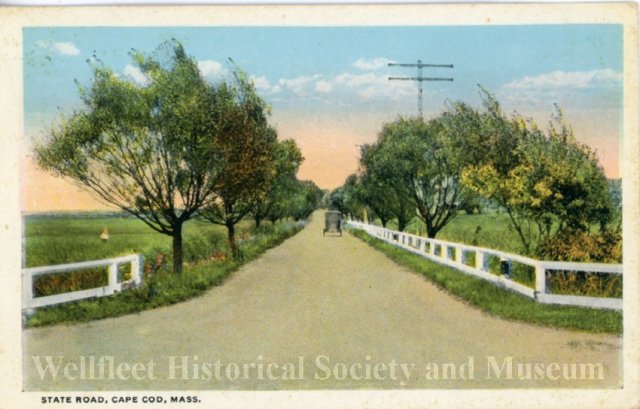
Post card of the road approaching Pleasant Point

Post card of the road approaching Pleasant Point

In 1911 the Runnels sold the waterfront land to Winifred and Hayward Dodge who then built a cottage, because later deeds refer to a building. Mr. Dodge was a hardware dealer in Dorchester, Massachusetts. The Dodges only stayed for five years, and sold their property in 1916 to a “J. Frank Rich,” who turned out to be Jeremiah Franklin Rich who, with his wife Euphemia Adelaide Rich, were longtime residents of South Wellfleet, perhaps affected by the loss of fishing. Perhaps they thought they might enjoy a bit of profit from the growing Pleasant Point community. The Richs only owned it for a year, and then it passed to Professor and Mrs. Merrill. By the 1920s, Mr. Rich was supplying ice in the summer months. Interesting to me, the Richs were housing Frank Fisher in 1920, one of the South Wellfleet characters I remember from my childhood — “Frankie” pumped gas at Mr. Davis’s General Store.
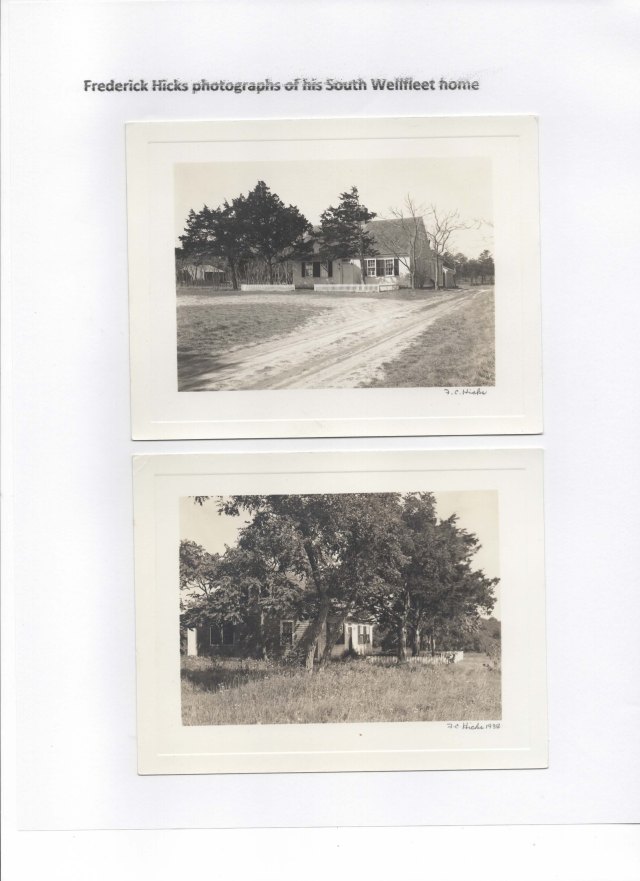
Professor Alleyn Merrill was a senior professor in the Department of Mechanical Engineering at MIT. The Merrills became a fixture in the Pleasant Point community for years, until he retired in 1934, and they moved to Maine. In 1937, Mrs. Merrill, then a widow, sold the Wellfleet property. From there, the property changed hands several times until the present owners purchased it.

The Moodys and the Sacketts

Lillian and Frank Moody built another of the original cottages sometime after they purchased Pleasant Point land from Reed in 1895. The Moodys sold a portion of their lots with a building to George and Ellen Sackett of West Springfield, Massachusetts in 1911 and 1913. Meanwhile, the Moodys purchased land in South Wellfleet near Doctor’s Hill and retired there.

The Sacketts with their two children, Charles and Elizabeth, appear to have enjoyed many years at Pleasant Point. George Sackett died in 1939, and his daughter must have died as well, since it was her husband, Murray Root, who sold the property to the next owner in 1945. The cottage is still there today.

The Oxfords

Mary and Joseph Oxford lived in Cambridge, Massachusetts where Joseph was a furniture dealer. In addition to purchasing their Pleasant Point lot, in the Paine Land Addition, they also bought lots in the Ocean Plan and the Nauset Beach Plan. Their cottage is further back from the shore, and is still there, although extensively renovated in the 1940s.

The Davenports

The Davenports of Ludlow, Massachusetts, purchased lots of land from Mr. Reed in the late 1890s and held it in trust for their son and daughter, Edwin and Alice Davenport. News reports as early as 1904 mention their summer visits. Their cottage remains today, called Gull Cottage, and known for its unusual hip roof.

The David Buitekans

Annie Ross Buitekan and David Buitekan came to Wellfleet sometime between 1910 and 1920. In the 1910 Census they are living in Brooklyn, New York, where David was a printer. David was born in 1872 in Boston to parents born in Holland; Annie Ross has Scottish parents. They were married in Manhattan in 1903; they did not have children. Their earliest purchase of property in Wellfleet was in 1908, when they bought an older home in South Wellfleet. In 1912, George Sackett sold them Walker Plan land near the shore at Pleasant Point Landing. David Buitekan built a cottage that’s still there, offering it for summer rentals. Eventually, the Buitekans settled in South Wellfleet and became the owners of Isaac Paine’s general store in 1923, as I’ve written about in an earlier post.

Nancy Goodwin

I’ve been looking at a white cottage with green shutters on the shore of Blackfish Creek all of my life, and now know who built it. In 1897, Nancy Goodwin, a widow from Wrenthem, Massachusetts, bought her first lots of land to the east of the bluff, on the nearby shore, from Howard and Reed’s Cape Cod Bay Land Company. She added to her holdings in 1917. Nancy Goodwin lived with her sister Ella, and her brother-in-law as listed in the censuses from 1900. Since women’s abilities to earn money were limited, I thought that her purchase might have been funded from a family legacy or from her husband. However, in 1880, I found her with her brother and sister, already a widow, living in Providence, Rhode Island, where both she and her sister listed their occupation as “waitressing in a restaurant.” However she did it, Nancy Goodwin she was able to buy this summer place, and keep it until 1923 when she sold it to Lillian Givan.

An added note: thanks to a note from Jude Ahern, here’s a 1934 photo of Pleasant Point Cottages with the “water shed” in the foreground.

Cottages at Pleasant Point 1934 -- note water shed in foreground

Cottages at Pleasant Point 1934 — note water shed in foreground

My photograph of Pleasant Point in the 1970s

My photograph of Pleasant Point in the 1970s

Sources

Brown, Dona Inventing New England: Regional Tourism in the Nineteenth Century. Washington, D.C.,       Smithsonian Institution Press, 1995

U.S. Federal Census collection at www.ancestry.com

David Kew’s Cape Cod history site: www.capecodhistory.us

Barnstable Patriot (various) online archive: www.sturgislibrary.org

Barnstable County Deeds available at www.barnstablecountydeeds.org

Newspaper account online at www.genealogybank.com

Cape Codder available at www.snowlibrary.org

Wellfleet Town Reports at the Wellfleet Public Library

Historic house reports at the Wellfleet Historical Society and Museum

Atlas of Barnstable County, Walker Lithographic and Publishing Company, Boston, 1910

The 1858 Map of Cape Cod, Martha’s Vineyard and Nantucket, Henry F. Walling, re-published 2009, OnCape Publications.


Posted in Uncategorized | 7 Comments

Cook’s Camps in South Wellfleet

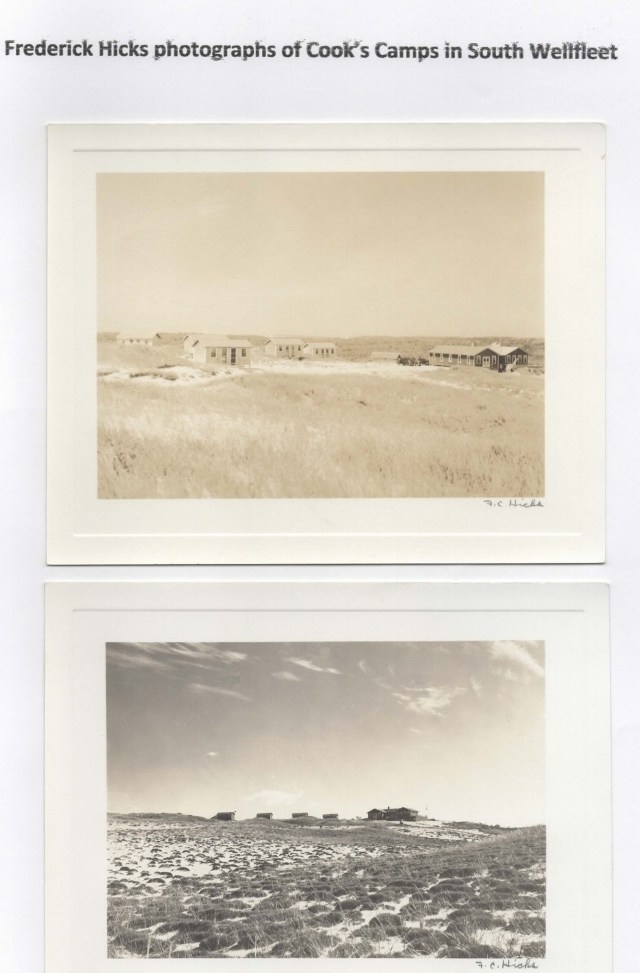
Cook’s Camps has been in Wellfleet since the 1930s. This unique group of cottages is situated right on the ocean, at the top of a 125 foot dune. It is owned by David and Laurie Sexton, through Laurie’s family, the Cooks, who go back to Edwin P. Cook.

Cook's Camps on the dune at South Wellfleet

Cook’s Camps on the dune at South Wellfleet

The Cook’s cottages are very close to the National Park’s Marconi site. Mr. Cook sold land to Mr. Guglielmo Marconi as he decided where to position the towers that transmitted the first trans-Atlantic radio message in 1902. You can read more about Marconi here.

Staying at Cook’s captures an experience that few vacationers can have today. The cottages are simple: sleeping and living space, small kitchen, bath. Showering is available in the Shower House. Families have been coming here for generations, and hold dear their “privilege” of renting a particular cottage at a particular time, say, the last two weeks of August, perhaps leaving it as legacy to their children. These folks have their own community on the dune. One of their regulars told me that it is this sense of community that makes her annual trip so special.

For some people, having their support systems on vacation may be necessary including electronics, tv/cable, dishwasher, and a Sub-zero refrigerator. But if a vacation is meant to be a kind of letting-go, then you can have such an experience at Cook’s. You can dial it back by decades and live beside the ocean where tides and extraordinary light frame your day.

Edwin P. Cook grew up in Scituate, Massachusetts, across Cape Cod Bay. He was born in 1843 in Cohasset, the son of Ichabod Cook, Jr. and Lucinda A. Cook. His father must have died while Edwin was young, since his mother is listed as a widow in the 1860 census. Edwin arrived in Wellfleet in the early 1860s. In 1864 he married Eliza Franklin Hopkins of Wellfleet, the daughter of a Wellfleet family with deep roots. Edwin and Eliza had three sons: Arthur, Herbert, and Ralph.

Edwin Cook soon developed a number of business interests in Wellfleet: lumber, fish, wrecking, and oil manufacturing, which collected the oil of the numerous blackfish that grounded there. That oil was a lubricant needed by watch manufacturers, giving it great value. Mr. Cook became a Town Selectman, and then the Chair of the Selectmen in 1894. Edwin P. Cook also dealt in real estate, a commodity that was becoming more important as the 19th century ended and Wellfleet began to develop as a summer home and tourist destination. He left behind many tracts of land for his family to sort out over the years.

One of several properties that Cook assembled in creating the land that became Cook’s Camps was an 1894 deed from Simeon Wiley, the Administrator of the estate of Betsey Wiley, a longtime South Wellfleet resident. Another was from Isaac LeCount of the family that gave us the name of LeCount Hollow Road, that takes us from Route 6 to the dunes today.

Herbert Cook and his wife Florence Chellis Cook came to own all the land that is now Cook’s Camps. They were Laurie Sexton’s grandparents.

Besides buying land, Cook also sold it. In 1900 Edwin sold a piece to Lorenzo Dow Baker who at that time was undertaking a number of projects to make Wellfleet a seaside town that would appeal to seasonal visitors. Baker built three cottages on the edge of the dune. News articles in the early 1900s refer to visitors staying in these cottages.

Frederick Dallinger began visiting in the early 1900s. He was a state legislator, then a Congressman, and finally a U.S. Senator by 1926. The area began to be called “Dallinger Heights” and “Dallinger Bluff” in news reports. There is no record of Dallinger owning property himself. Perhaps his “celebrity” status caused the name to be assigned. The name “stuck” until the late 1930s.

The three “Baker cottages” lasted until the hurricane of 1938, when they tumbled over the dune.

The Baker Cottages

The Baker Cottages

There are three additional owners of dune land who purchased from the Cooks. Addie M. Newhall of Montclair, New Jersey, purchased land from Edwin Cook in 1917, after she and her family had stayed in one of the Baker cottages. In 1929, Herbert Cook sold land to Harry S. Young of Cambridge, Mass. Also in 1929, Herbert sold land to Walter C. Guilder and his wife, Grace Davis Guilder. Guilder and Newman built cottages. There is no mention of a Young cottage in the deed transferring the land back to the Cooks.

Cook's Camps in the 1930s

Cook’s Camps in the 1930s

Adelaide May Newhall (1884-1960) earned her B.A. degree from Smith College, and studied art at Syracuse University along with several artists, including Charles Hawthorne, who was one of America’s most inspiring art teachers. Hawthorne established the Cape Cod School of Art in Provincetown and helped make the town a leading artists’ colony. Perhaps Addie Newhall studied with him there. She painted landscapes, in oil, and her painting “Lighthouse” sold as recently as 2005. As a young “independent” woman and teacher, she was 33 years old when she bought her dune land and built her cottage in 1917.

Addie Newhall

Addie Newhall

Walter C. Guilder (1877-1942) was a successful businessman, establishing Guilder Engineering Company, which manufactured motor trucks in Poughkeepsie, New York. Harry S. Young (b 1874) and his wife were born in New York, and lived in the Boston area where he was a salesman for Campbell Soup.

During the summers of 1929 and 1930, a Glider School was established where Cook’s Camps is today – I wrote a blog post about it which you can read here .


Edwin P. Cook died in 1925; his son, Herbert, died in 1934. Before Herbert died, Cook’s Camps was born. The Glider School had built an administration building where the main house is now, plus dormitories, and a hanger. There was a generator and water was pumped to a cistern. These leftovers became the Camp – including the shower house. Herbert and Florence’s daughter, Chellise Cook, now a young woman, helped out too.

Chellise Cook married Laurence Cardinal of Worcester, Massachusetts, in 1938 — a lucky match for Cook’s Camps. Larry was able to build-out the Camp, adding cottages. In 1944, Florence bought back the Guilder property, and those cottages became “Big Gilda” and “Little Gilda,” — so the “Guilder” name lives on in a simplified spelling.

Little Gilda Cottage

Little Gilda Cottage

In 1945, Addie Newhall sold her property back to Florence, but her cottage was moved to another spot on what became Ocean View Drive. We can hope the new owner who bought the cottage in 2011 has heard the remarkable history of his summer spot in the dunes.

Harry Young sold his property back to Florence Cook in 1944.

Addie Newhall purchased property nearby to Cook’s, off Ocean View Drive, in 1941. The cottage that was placed there is the same shape and size as the one next to her first dune cottage – in the photograph displayed here. She left it to her sister when she died in 1960. Perhaps it was Mr. Young’s. It is still in the family today, once again demonstrating the generational pull of South Wellfleet on many families.

Addie Newhall cottage in the middle and her second cottage on the right

Addie Newhall cottage in the middle and her second cottage on the right

Cook’s Camps made it through the years of having Camp Wellfleet right next door with its sometimes rambunctious young servicemen there. It transitioned to becoming private property within the National Park. Winter dune damage sometimes meant that a cottage had to be moved further back from the edge of the dune. Summers continued to bring visitors, and regular returning folks through the years.

Today, Cook’s Camps comprises fifteen cottages, along with the Cardinal’s home, built in the 1950s. Each cottage has a name, making it easy for families to identify with “their” cottage. Visitors can enjoy their private beach, accessible by a ladder trailing down the dunes. Like many cottage owners who rent, there are rules, spelled out on a hand-lettered sign in each cottage, gently urging behavior that is respectful of the other people staying there.

Season after season goes by, families come and go, kids grow up and bring their significant others, then another generation arrives. David and Laurie have a list of all visitors since 1940, and the family groups are apparent. Cook’s Camps has created a unique spot near the ocean in South Wellfleet.

Sources

U.S. Federal Census collection at www.ancestry.com

David Kew’s Cape Cod history site: www.capecodhistory.us

Barnstable Patriot (various) online archive: www.sturgislibrary.org

Barnstable County Deeds available at www.barnstablecountydeeds.org

Newspaper account online at www.genealogybank.com

Cape Codder available at www.snowlibrary.org.


Posted in Uncategorized | Leave a comment

South Wellfleet and the U.S. Coast Survey

Topographical Map, South Wellfleet showing Congregational Church triangulation Point

Topographical Map, South Wellfleet showing Congregational Church triangulation Point

With great thanks to Chet Lay, Wellfleet Surveyor, who has provided a continual supply of information, books, and maps, increasing my appreciation of how we chart the land and its ownership.

This article shares a few observations on South Wellfleet’s position in the U.S. Coastal and Geodetic Survey made in the 19th century.

In 1807 President Thomas Jefferson requested legislation “to cause a Survey to be taken of the coasts of the United States.” Jefferson was just receiving first reports from the Lewis and Clark Expedition of the recently-purchased Louisiana Territory. Mapping the nation was on his mind, and the Survey was meant to promote trade and commerce by providing knowledge of the sea surrounding the new maritime nation, mapping the coast, reefs, fishing banks, and other submerged land.

Jefferson personally chose the first Superintendent of the Survey, an immigrant from Switzerland named Ferdinand Hassler, who was a mathematician and a skilled measurer. Hassler devised a plan to measure the seacoast by laying out a network of enormous

Ferdinand Hassler

Ferdinand Hassler

consecutive triangles, the sides of which ranged from ten to sixty miles. While the name

“Coast Survey” seems to imply that only water-covered areas were of concern, Hassler first created a Geodetic Survey, using the ancient science of geodesy that determined the precise location of specific points on the earth’s surface.

The Coast Survey project was the beginning of what has become the oldest scientific agency of the United States government, today housed at the National Oceanic and Atmospheric Administration. Surveying continues today. Prior to the Coast Survey, there was a publication for mariners called the American Coast Pilot, published first in 1796 by Edmund M. Blunt. Blunt’s eventually made an alliance to use the data of the Coast Survey. Eventually, in 1867, Blunt’s rights were sold to the Coast Survey.

Surveying began in the 1830s, but it took until the 1840s for Congress to fully fund the project and then to get it organized successfully. While Hassler is credited for laying out the scientific measurement technique, the second Superintendent of the Survey, Alexander Bache, is credited with organizing the topographical and hydrographical survey areas, and actually publishing the results so that the survey could become a useful tool. Bache, a great grandson of Benjamin Franklin and the organizer of a magnetic observatory in Philadelphia, was a scientific scholar himself, and had paid attention to the pursuit of science underway in Europe, bringing this knowledge to the fast growing United States.

Major James Duncan Graham (1799-1865) was the U.S. Topographical Engineer who directed what must have been early surveys of Cape Cod in 1833-35. He was a West Point graduate, class of 1817, as were many of the surveyors of the 19th century. The Navy

The extremity of Cape Cod

The extremity of Cape Cod

supplied trained officers who conducted the soundings that marked the coast to the three-mile limit. One of my favorite early Cape Cod maps is “A Map of the Extremity of Cape Cod including the townships of Provincetown and Truro and a chart of their Seacoast and of Cape Cod Harbour.” Major Graham’s name is on the attribution of the map.

The triangulation points on the first Wellfleet topographical map are labeled 1847, so we have a time frame for the creation of the map.

I recently discovered in a triangulation listing that the 1847 points are attributed to a T.J. Cram. Cram was Thomas Jefferson Cram, a West Point graduate of 1826. I can imagine Captain Cram and his team working his way through Wellfleet with his Photo Plane Table, their measuring device. This is a description Chet Lay gave at a talk at the Wellfleet Library in November 2014:

A plane table is a board placed upon a tripod, with a surveying instrument with a protruding scale rule which rotates with the line of sight of the transit. A sheet of paper is clamped onto the board under the instrument at the start of the survey. Instead of recording angles and distances in a notebook, one uses the scale rule and simply puts a pencil “x” on the sheet of paper where the shot was taken. At the end of the day, you have the survey already done on the sheet and you returned to your tent to ink the lines and add the annotations – very fast and efficient.

Cram was from New Hampshire. The principal of the Hancock Academy wrote him a recommendation for West Point, indicating that he had “many tokens of uncommon genius.” As a Lieutenant, Cram taught mathematics at West Point in the 1830s.

I could not find anything further on Cram’s assignment that would have brought him to Wellfleet to lead the project as the Topographical Engineer. He is given attribution on other maps that include the Cape, including an 1857 Coast Chart Number 10 where he is listed as having authored the triangulations. Captain Cram had a distinguished career during the Civil War, and emerged a General. He died in Philadelphia in 1883.

On that 1857 map, the hydrography was under the command of Lt. Stellwagen and others of the U.S. Navy. Lt. Stellwagen mapped what was eventually named for him, the Stellwagen Bank, at the mouth of Massachusetts Bay, in 1854. Portions of the Bank were known long before, but the Lieutenant mapped the entire geological feature and its surrounding waters.

Here is a link to the 1857 map and an image.

1857 Coast Survey of Cape Cod

1857 Coast Survey of Cape Cod

It must have been exciting to have this important government project underway in Wellfleet, making the isolated town seem more connected to the country. Henry David Thoreau mentions the survey several times in Cape Cod, mentioning Major Graham in his chapter about Highland Light. Thoreau himself had just finished teaching himself surveying skills prior to his Cape walk in 1849. He noted “Lombard Head” on his version of a Cape Cod map that has a visual connection to the Coast Survey map of the Cape. (It was this designation that alerted me to other triangulation points in South Wellfleet.) When Thoreau visited the Wellfleet Oysterman, John Newcomb, the conversation includes a story of how the surveyors consulted Mr. Newcomb for the names of numerous fresh water ponds in North Wellfleet, and how he told them of one pond they had not detected.

The “Lombard Head” triangulation point is in the area of the early 20th century development laid out by Arthur Buffam, which he labeled “Wellfleet-By-The-Sea.” The development was on both sides of Ocean View Drive, near Cahoon Hollow, and today is within the Cape Cod National Seashore. Buffam bought the land from the Crowell family in 1915. The Crowells had purchased it from Mary Saunders, whose grandmother was a Lombard, and perhaps gave the Lombard designation to the land earler. Another tracing of the land, through deeds, and family through genealogical charts, led me to Lombards married to Covell family – a piece of this land was bordered by “Solomon Covell’s Way.” While I can’t make an exact match, there’s some evidence that Lombards owned land in this part of eastern South Wellfleet, most likely wood lots, since no one wanted to live near the ocean at that time.

Another family-named triangulation point was “Hamblin’s Mound” over in western Wellfleet, in the area of today’s “Newcomb Heights” just north of Old Chequesset Neck Road. Chet Lay told me that when the area was under development in the 1960s, one of the 1847 markers was uncovered. It is a clay, four-sided pyramid-shaped piece with “U.S.” on each side. A search is underway to find out where it exists today.

The other 1847 triangulation points in Wellfleet included the belfries of both the Wellfleet Congregational Church and the South Wellfleet Congregational Church. There was also a triangulation point near the (then) southern end of Indian Neck, on the north side of Blackfish Creek.

In 1887 there were two points added: “Rich” which must have been near land owned by the Nepthali Rich family, and “Gull Pond,” which was located on Gross Hill.

In 1909 additional points (or stations) included the Marconi Tower, Mayo Beach Light, and “Chequesset Tower” which was a 25-foot tower on a sand hill just north of Chequesset Inn, a wind-driven tower contraption for pumping water for the Inn, with the water storage tanks for the Inn located just to the south of the tower.

In South Wellfleet in 1909, the surveyors were also using the cupola of a home on “the north of Blackfish Creek on a hill at the edge of the timber line” — which I’m sure was the large house built on Indian Neck by the Crowell family. In addition, there was “an old tripod signal on Lieutenant’s Island, marked by an old stake.”

Sources

Prologue Magazine, Spring 20017, Vol. 39, No. 1 online: http://www.archives.gov/publications/prologue/2007/spring/coast-survey.html

Triangulation in Massachusetts, Volume 4, a publication by the U.S. Coast and Geodetic Survey, 1922

Shalowitz, Aaron L., Shore and Sea Boundaries, Volume 2, U.S. Government Publication 1964.

Thoreau, Henry David, Cape Cod, online at http://thoreau.eserver.org/capecd00.html

A copy of Chet Lay’s lecture given at the Wellfleet Library in November 2014

Breveted Major James Duncan Graham of the US Army’s Corps of Topographical Engineers issued A REPORT UPON THE MILITARY AND HYDROGRAPHICAL CHART OF THE EXTREMITY OF CAPE COD: INCLUDING THE TOWNSHIPS OF PROVINCETOWN AND TRURO, WITH THEIR SEACOAST AND SHIP HARBOR: PROJECTED FROM SURVEYS EXECUTED DURING PORTIONS OF THE YEARS 1833, 1834, AND 1835 (United States. Topographical Bureau; this included a map of Provincetown and Truro).


Posted in Uncategorized | 1 Comment

Developing Lieutenant’s Island

Continues the history of Lieutenant’s Island started in my previous post

In 1889, the upland areas of Lieutenant’s Island were purchased by Robert Howard and his partner, Edward Reed, and the modern era of the Island began. Robert Howard followed the same plan he’d put in place for the development of the Old Wharf. First, they purchased the western and eastern portions of the Island, along with the little piece of upland that was known as the “Small Island.”

Satellite Photo 2003

Satellite Photo 2003

Howard and Reed formed the Cape Cod Bay Land Company, hired Tully Crosby to lay out a map of 2800 square foot lots, named the roads, numbered lots and blocks, and began selling at $25 per lot. In 1889 and 1890, Howard made 54 sales, many of more than one lot. In the 1890s, an economic recession slowed down sales, but they kept at it until Mr. Howard’s death in 1916 at age 59.

At the same time the Cape Cod Bay Land Company was selling Lieutenant’s Island, they were also offering the Old Wharf, Cannon Hill, and Pleasant Point in separate plans, and they had mapped land closer to the ocean, east of the railroad tracks.

Robert Howard was the stepson of the successful inventor Luther C. Crowell, who by 1889 may have been able to finance his stepson’s investment. Mr. Crowell built a summer home on Indian Neck during this last decade of the 19th century, and settled there permanently in 1900. Mrs. Crowell was a Wellfleet Atwood. She had married Jeremiah Howard, and lived in Boston. He died of brain fever at age 35; in the 1860 census she is living with her children in a Boston boarding house. She married Crowell in 1863, and they went off to live in Brooklyn, New York, in a household that included Robert and two Howard daughters, along with two additional boys she had with Crowell.

When the unmarried Mr. Howard died in 1916, he left his property in Wellfleet to his sister’s son, Howard Mitchell, and to the two Crowell sons.

Wellfleet’s summer colonizing appealed to middle- and working-class people. Other parts of the Cape, more like New England villages and much closer to Boston, hosted large hotels and impressive summer homes. Mr. Crowell built a fairly substantial home on Indian Neck, but this was not a trend in South Wellfleet. The cottages on Lieutenant’s Island were modest structures. Until the 1950s, most of the building was on the western side where the views out over Cape Cod Bay — also referred to as Barnstable Bay — were quite spectacular.

On the 1848 map of Wellfleet, a cartway leading to Lieutenant’s Island began south of Fresh Brook, and headed out over the marsh. With the development of the Island, the road shifted to where it is today, directly to the eastern upland, with a bridge built over the creek that connects the Silver Spring Bay with Loagy Bay. These parts of South Wellfleet are labeled on the map sketched here.

Lieutenant's Island sketch map

Lieutenant’s Island sketch map

The Lieutenant’s Island Bridge is a South Wellfleet icon. For those with homes there today, crossing the bridge to the island becomes a magical moment when the cares of the world are laid aside, and life on an island begins again. On the practical side, those staying on the island need to plan their trips off-island at low tide and remain aware of high tides that can put the road under water.

Getting the bridge built was a first step. Mr. Howard and Mr. Reed negotiated with the Town to grant a five-year tax exemption to property owners “providing the owners build a bridge within the next year.” In 1894, the Massachusetts legislature gave the Cape Cod Bay Land Association (the Howard/Reed company) permission to build and maintain a bridge or dike in South Wellfleet “across the tide water.” Something indeed got built, most likely wooden. There was a report in the Barnstable Patriot in 1903 that a “new iron bridge was being built over the creek by the United Construction Company of Albany, New York” – and the construction job was employing Wellfleet men. In 1903 and 1905 Wellfleet appropriated funds at the Town Meeting for road and bridge repair.

In a 1980 report on historic homes in Wellfleet, the description of Lieutenant’s Island notes that an earlier bridge’s girders could be seen “under a hump-backed bridge of wooden trusses that replaced it.” This older bridge was characterized as “dangerous” since a driver could not see an approaching vehicle due to the angle. In 1972 a higher bridge was built, and today it’s still a narrow bridge.

Kevin F. photo of the bridge

Kevin F. photo of the bridge

On the 1910 map of Wellfleet that shows property owners by name, Lieutenant’s Island has six structures on the western side with the names Howard, Townsend, Healey, Breck and, on the north edge, Perkins. Far to the south is S. Atwood named. Interestingly, despite twenty years of property sales, only these structures exist. Of course, if even half of the 1890s buyers had built little cottages, the Island would not have remained as isolated as it did.

Comparing the deeds available through Barnstable County with Barnstable Patriot newspaper reports of families coming and going, I’ve been able to figure-out the earliest structures that were built on the island. The Wellfleet Assessors Database provides the age of each property on Map 40, which covers Lieutenant’s Island, and, if this is correct, some of those early cottages are still there today.

One of the earliest builders was John H. Kennedy of Lowell. In 1891 the Barnstable Patriot reported that he had shipped two carloads of lumber to the North Eastham station “for the purpose of building a cottage on Lieutenant’s Island.” Mr. Kennedy sold his lot and buildings to Adeline Breck of Dracut, Massachusetts in 1906. This is the first deed of the Breck family. The current Assessor’s Database names “an 1880 structure” as one of the family’s properties today; this may be the original cottage.

Charles Blake of Lowell bought his lot in 1890, and the newspaper reported when he came to South Wellfleet to enjoy a “gunning” excursion. In 1904 he sold his land and buildings to Walter Townsend, who is noted as a property owner on the 1910 map. In 1919, Townsend sold to M. Burton Baker, who was also developing property on Indian Neck. Baker sold to a Breck son-in-law in 1919. That property is still owned by the family today.

Robert Howard built his own cottage on the Island. His trips to Wellfleet to enjoy the Island’s sailing and fishing, and to visit his mother, are mentioned often in the newspaper.

Another family, the Healeys, bought land and built a cottage. Their son, Paul, was a doctor. Similarly, another early family, the Fields, had a doctor in the family. My initial reaction to these two doctors settling here was the reason South Wellfleet came to have a Doctor’s Hill, but now I know that name is applied to an area just before the Lieutenant’s Island bridge, and must have another origin-story.

Like Mr. Blake, the Healey son enjoyed the cottage for “gunning” trips, a popular pastime for men during this period. Shooting migratory birds eventually fell from favor, and it’s ironic that so much of Lieutenant’s Island today is part of the Audubon Society’s Wellfleet Bay Sanctuary.

Solomon Atwood (whom I assume was the S. Atwood on the 1910 map) hosted former President Grover Cleveland and a friend, according to a 1901 article in the Barnstable Patriot. The President came for fishing and gunning. In the 1938 booklet published by the South Wellfleet Neighborhood Association, Mr. Atwood’s son, Alton, is noted as having Mr. Cleveland’s fishing rod in his possession.

Gunning trips did not always go well. In 1915, a man named Lloyd Corbett joined Doctor Healey and another doctor on a trip to Healey’s camp. He was in a small boat by himself when he shot himself in the knee and unfortunately found by his doctor friends only after he had bled to death.

Another tragic event occurred in 1924 when two young cousins visiting the Brecks drowned while on a trip to the Island on a church camp outing.

Pilot whale strandings occur regularly on Lieutenant’s Island. I remember the one in 1957 when we all hiked to the island to see it. Others were reported in 1982 and 2002. Disposal of their bodies is a contentious issue, especially if the stranding occurs in summer when the beaches are meant to be welcoming swimmers.

In the 1930s Joseph H. Shuldice began buying the marshland surrounding Lieutenant’s Island. It’s clear from the deeds that a number of South Wellfleet residents had continued to hold onto their “meadow” lands in order to continue salt hay production as the upland areas converted to summer cottages. For Mr. Schuldice, the marshes were perfect for gunning expeditions. Today, a plaque on the Island recognizes his donation of 300 acres to Massachusetts Audubon Society and his lifelong interest in the conservation of wildlife.

The Cape Codder published this small note about Lieutenant’s Island in 1949:

When taking a ride over Doctor’s Hill in South Wellfleet you are surprised at the new name signs but the roads and hillsides look just the same. I had forgotten the white birch trees that grown on Lieutenant’s Island. Loagy Bay is filling in – it is noticeable. The old “yellow leg hole” was completely dry.

In the late 1950s, the Town of Wellfleet initiated a comprehensive “tax taking” process to tax the many owners of the small lots purchased years back. It’s unclear if the Town had tried to tax them regularly or had only been organized to collect property taxes. Lieutenant’s Island owners of those little lots made up a large part of this list. The land was taken back when there was a lack of response to the latest owner of record, and the land was resold, often in lots that were now made “not divisible.” Some of the sales were to property owners who were able to increase their lot size.

Lieutenant’s Island was in the news in the 1960s when the State Division of Waterway proposed that the bridge over the creek between Silver Spring Harbor and Loagy Bay be replaced with a solid-fill dike. The proposal was made just before regulation of property on or near salt marshes went into effect. Many of the Island property owners — and some others — protested vociferously that the dike would cut-off small-boat navigation and destroy the marsh environment. The Town agreed to delay a decision until the Army Corps of Engineers ruled. Fortunately the Corps ruled “no dike,” as it would cut-off a navigable waterway. The Town finally did straighten the roadway.

As with other property they owned in Wellfleet, by mid-century the Crowells had organized their holdings into a real estate company, creating subdivisions, and selling and building summer homes. In 1966 and 1967, in articles in the Cape Codder, Mr. Crowell’s proposed new house lots on Lieutenant’s Island were contested as too close to the marsh — similar to the arguments residents of the Old Wharf area made at the same time.

There were also heated arguments about who owned the land, a battle Massachusetts Audubon took on, claiming ownership to land the Schuldice family had left to the organization. The original plan Mr. Crowell made was withdrawn, but development eventually took place. This was the beginning, however, of some residents standing up for the protection of the island’s fragile nature: its water supply, waste removal practices, and eroding edges.

By the late 1960s, telephone service and electricity existed from utility poles serving several homes on the east island. A further private underground power network was created in 1973.  This activity created the Lieutenant’s Island Association, incorporated later in 1999 as the Lieutenant’s Island Services Improvement Company. The association today also cares for the network of private roads on the Island. The homeowners group works to remind owners of the Island’s fragility, and to engage in the best known practices regarding water use, wastewater, and commercial products, and to respect the endangered species that are trying to exist there also — the diamondback terrapin and the osprey.

By 1972 – according to the Wellfleet topological map created then — there were 35 houses on Lieutenant’s Island. Lisa Ricard Claro, a grandchild of the Breck family, wrote a memory piece about her visit to the Island in the 1970s.

Lieutenant’s Island was also in the news during the period of heightened development in the 1980s. A Cape Codder article in 1984 counts 60 houses, with a warning that these could double in number. More alarms were raised, especially from a Mrs. Stearns, that the water supply was threatened.

The sandbank edge of the western portion of Lieutenant’s Island has become another area of concern, since concrete seawalls create problems in a fragile landscape. The 2006 Wellfleet Harbor Management Report carefully covers this “coastal armoring” that the western side of the Island has now, with the phenomena carried out in separate permits to owners. When one owner armors, neighbors experience worse erosion, and so the process unfolds.

The Massachusetts Audubon Society now owns 1,100 acres in South Wellfleet, with a substantial portion the marshes surrounding Lieutenant’s Island, through gifts of the Schuldice and the Crowell Families. One of their recent projects is an oyster reef located just southwest of the Island. The Nature Conservancy, the Town of Wellfleet and NOAA are all supporters of this important research project, as reefs can buffer the shoreline and remove nitrogen from the water. Depending on the outcome here, Wellfleet may establish even more reefs as part of their harbor management.

Modest land protection on the Island also comes from the portions owned by the Town of Wellfleet, the Wellfleet Conservation Trust, and the South Wellfleet Conservation Trust.

It’s difficult to predict if human settlement on Lieutenant’s Island will overwhelm the

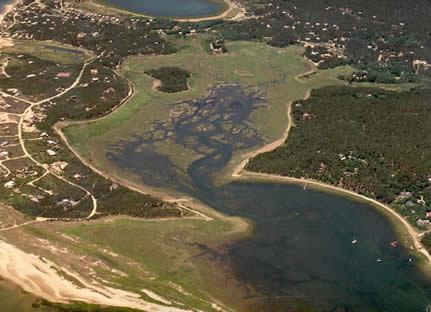
Aerial View Lieutenant's Island

Aerial View Lieutenant’s Island

various attempts to reinvigorate natural processes — the oysters, the ospreys’ nests, and the protection of the diamondback terrapins. Let us hope for the best.

Sources

Wellfleet Harbor Management Plan, Town of Wellfleet, Natural Resources Advisory Board, 2006

Wellfleet Historical Society’s listing sheets of properties of historical interest, produced in the late 1970s and early 1980s

U.S. Federal Census collection at www.ancestry.com

David Kew’s Cape Cod History site: www.capecodhistory.us

Barnstable Patriot (various) online archive: www.sturgislibrary.org

Barnstable County Deeds available at www.barnstablecountydeeds.org

Newspaper account online at www.genealogybank.com

Cape Codder available at www.snowlibrary.org.


Posted in Uncategorized | 1 Comment

Settling Lieutenant’s Island

Lieutenant’s Island became a seaside retreat in the 1890s, as the Cape began to develop as a tourist destination. Simeon Deyo, in his 1890 history of Cape Cod, refers to:

that sensible practice happily increasing among city people, of checking themselves each year in the rush and hurry of business, to take a vacation to the seaside, has already modified to a great extent the resources and prospects of Cape Cod.

Like other bayside areas of South Wellfleet — the Old Wharf, Pleasant Point, Indian Neck, Cannon Hill and others — Lieutenant’s Island came under the control of one developer, mapped as a “cottage colony” with small lots of land, and sold off to the ‘city people.’

Lieutenant’s Island was nevertheless a recognized part of South Wellfleet long before its tourism development. It was a distinct place as far back as the 1644 arrival of the Plymouth Pilgrims as settlers of Eastham. As discussed in my blog post, “Plantation Period”  the English settlers moving to the outer Cape from Plymouth purchased land that now comprises Orleans and Eastham. When they asked about the land north of Hatche’s Creek — today’s Wellfleet/Eastham town line — they were told no one owned it, and so included it in their purchase.

According to an oral tradition of the purchase tale, a native man named Lieutenant

Lieutenant's Island sketch map

Lieutenant’s Island sketch map

Anthony claimed to be the sachem of this land for the group called the Punonakanits of Billingsgate. A deed was negotiated in 1666 to legally add the Wellfleet purchase to the Eastham settlement:

We did then purchase all that land lying in Billingsgate from that which we purchased before of George the Sachem. To the end of our bounds norward upland and meddow of an Indian called Lefenant excepting reserved for himself to plant upon and sow wee lay claim to all lands within this ownership.

While the land that we today call Indian Neck was set aside for the use of the native people, Lieutenant’s Island was designated for common use in 1662, and in 1673 for the support of the ministry. However, Eastham did allocate “meddow grants” in the surrounding area to early settlers: William Walker had 3.5 acres at Silver Spring in 1659; Richard Higgins got 12 acres of upland and 44 acres of meadow “near Lieutenant’s Island” and his son Jonathan got 3 acres of meadow.

Despite the designation of “Lieutenant’s Island” in the earliest Eastham written records, on maps as late as 1893 the island is referred to as “Horse Island.” I have not found a reason why, but propose here that the popularity of raising horses in early Eastham may have caused the Island to become a place where the horses were pastured with the acres of salt hay for fodder. The early Eastham Town Records contain many entries recording the “earmarks” horse owners used. Numerous cattle earmarks were recorded in the town records also.

Lieutenant’s Island played an important role in the 1690s when the town, still a part of Plymouth Colony, needed funds to contribute to the cost of sending a delegation to London to seek a new charter. Both Lieutenant’s Island and Great Island were mortgaged to raise the funds, with the capital provided by Major John Freeman.

From the earliest dates of Eastham, meadowlands were allocated to the settlers to pasture their cattle and horses, and to harvest salt hay – a process described in my blog entry on harvesting Salt Hay.

With its woods providing a ready source of fuel, Lieutenant’s Island also became a place where shore whales were brought in for removal and “trying” (boiling) the blubber. By 1707 it was recognized that shore whaling needed regulation, since men from other towns were profiting from the practice. The Eastham Town Meeting voted that the harpoon man was to pay two shillings for each man in the boat not a resident of Eastham. Collecting this fee proved impossible.

In 1711 the common woodlands and meadows of Lieutenant’s Island began to be divided and allocated to private owners who had to be “allowed inhabitants” of the town. Joseph Collins, Israel Doane and Isaac Pepper got meadow and woodlot grants in the earliest distribution.

Durand Echeverria notes in his book on Billingsgate history that both English settlers and Indians protested this change to private ownership since they were accustomed to using the common lands for wood and for grazing their stock, and the Indians used the land for gathering berries and other wild resources. Indians were also shore whaling, having taught this to the settlers. These protests were ignored. In 1715, further divisions were made, including land in South Wellfleet. It is difficult to precisely place the allocated land, but we do know that Brown, Snow, Harding, Doane, Walker, and Atwood each got South Wellfleet land grants.

By the 1740s, the upland of Lieutenant’s Island was “wasted” through deforestation and over-grazing, just like many other areas of the Cape. In Enoch Pratt’s mid-nineteenth century book, he describes Lieutenant’s Island as a “sand bank two miles in circumference.”

Eighteenth century deeds for anywhere in Eastham are scarce, but I was fortunate to find three that mention Lieutenant’s Island. One source noted that a Joshua Newcomb (born 1712 Truro), a lieutenant in the British Navy, owned a part of the Island. Mr. Newcomb was killed aboard his ship by a falling spar, and his family sold his property. In the Walter Babbitt Collection of old Cape Cod deeds at Cape Cod Community College, we find Elisha Higgins selling land in 1718 “on the eastern part of Lieutenant’s Island” to Samuel Brown. Another deed, from 1726, indicates that George Ward sold a dwelling house on Lieutenant’s Island to Thomas Mulford. This is the only reference I have found to a dwelling house before 1890 — and the difficulty of access makes me wonder if this really existed.

Barnstable County deeds are not searchable by locations within a town, so I’ve worked backwards to assemble a list of Lieutenant’s Island owners through the nineteenth century. When Robert Howard bought much of the Island in 1889 for cottage colony development, he purchased two portions from David Higgins, a direct descendant of Eastham’s original settler Richard Higgins. Higgins also sold “Small Island” to Howard, but retained the right of way to “convey hay and also the privilege of laying the hay on the land”, thus showing that salt hay was still produced by South Wellfleet farmers. Howard’s partner Edward Reed purchased the other major portion of Lieutenant’s Island from Isaiah Horton’s children, and in this sale they reserved both the right of laying hay and weir (net) fishing.

These two purchases can be traced back further to previous owners of portions of Lieutenant’s Island: South Wellfleet’s Reuben Arey and Samuel Smith of Provincetown, who was Major Witherell’s son-in-law – I’ve written about Arey and Witherell in earlier posts.

One other mid-nineteenth century issue involved Lieutenant’s Island and represented an effort to control use of the land which is such a key issue today. In 1849, the Massachusetts legislature passed an Act to protect and regulate the “common usage” of the flats “lying in the southern part of the Town of Wellfleet between Blackfish Creek and the Town of Eastham.” This appears to be an extension of an 1801 Act regarding the pasturage of horses and ‘neat cattle’ on Great Island. (‘Neat cattle’ is a New England term used to describe domesticated cattle.) The legislators were trying to protect Wellfleet Harbor and its shellfish from “numerous cattle, sheep and horse kind” feeding on the beach and islands adjoining the western side of said harbor and, in 1849, extending that protection.

In early 1850, at the Wellfleet Town Meeting, three overseers were appointed to implement the new law. They posted notices that the tax for turning animals onto the flats would be 12 cents a head for neat cattle and 50 cents a head for horses. (I’m imagining posting this in the South Wellfleet General Store which Mr. Cole opened in 1844.) Starting June 15th that year, anyone using the flats had to have a written permit. The notice also announced a meeting at nearby Caleb Lombard’s house where the Wellfeet men were approved for permits, and six Eastham men were not, as the overseers ruled that these men had no claim to Wellfeet flats.

On June 17, 1850, the overseers went to the “flats and commons” to see if there were any unpermitted cattle or horses. They found Reuben Arey had three cows and John Taylor had one. Arey was still actively farming in South Wellfeet. Mr. Taylor, Mr. Arey’s stepfather, was nearing the end of his life. He was a beloved Revolutionary War veteran and was still living in the Boyington home in the 1850 census.

The overseers also put up notices in Eastham and Wellfleet “forbidding any person cutting any grass or hay on the flats common areas adjacent to Lieutenant’s Island.” The Town then “sold the grass on all the lots that anyone claimed any interest in, so the Town now has the right of possession.”

Petitions against the law ensued, and Reuben Arey and others successfully had the law repealed by the legislature in 1851.

Lieutenant’s Island continued to be a South Wellfleet backwater until forty years later when its contemporary development commenced.

Sources

Durand Echevierra, A History of Billingsgate, Wellfleet Historical Society, 1991

Jeremy Dupertus Bangs, editor, The Town Records of Eastham During the Time of Plymouth Colony 1620-     1692, (Publication of the Leiden American Pilgrim Museum, 2012)

Jeremy Dupertus Bangs, Indian Deeds Land Transactions in Plymouth County 1620-1691, Boston, 2002

U.S. Federal Census collection at www.ancestry.com

David Kew’s Cape Cod history site: www.capecodhistory.us

Barnstable Patriot (various) online archive: www.sturgislibrary.org

Barnstable County Deeds available at www.barnstablecountydeeds.org

Newspaper account online at www.genealogybank.com

Cape Codder available at www.snowlibrary.org

Cape Cod Community College – Nickerson Archives – Deeds and Papers.


Posted in Uncategorized | Leave a comment

Early Diseases and an Epidemic in South Wellfleet

Recently, a medical historian, while commenting on the Ebola epidemic, said “Ebola is jerking us back to the nineteenth century.” Human illnesses are certainly one of the great divides between modern life and that of the 18th and 19th centuries. As I’ve looked at families in South Wellfleet and their daily lives, Illness and death are constant themes.

One of the first recorded epidemics in New England decimated the Wapanoags of southeastern Massachusetts just before the Pilgrims arrived. At one time it was thought to be smallpox, but more recent writers now think that it was bubonic or pneumonic plague, and some think it may have been Leptospirosis, another bacterial infection. Coastal natives had increasing contact with European fishermen, traders and would-be settlers for years. From 1617 to 1619, a devastating epidemic killed nearly all the native population. The Pilgrims used their cleared land in Patuxet (the place they later named Plymouth) – thanking God for making the land ready and available.

Smallpox was a dreaded disease in the 17th and 18th centuries. In Boston there were seven major smallpox outbreaks between 1721 and 1791. The development of vaccination had begun, but many were afraid to engage. I found a Boston census of those who had been vaccinated, dated in the 1820s – a sign that the government was attempting to eradicate this scourge.

There were a number of smallpox outbreaks on the Cape. In 1649, a smallpox epidemic with a concurrent outbreak of whooping cough hit Scituate, Massachusetts, and Barnstable on Cape Cod, killing so many children that the church fathers declared a “Day of Humiliation” on November 15, 1649. There is no reference to the disease in the Eastham Town records of the 17th century. However, in the 18th century, when recorded history is more available, there were outbreaks in Chatham in 1765-66, in Sandwich and Yarmouth in 1778, in Wellfleet in 1793, and Falmouth and Yarmouth in 1797. I found one record for a family named Darling who lived on Griffin Island in western Wellfleet and lost four children. They then left the town and moved to Maine, perhaps too heartbroken to stay in Wellfleet.

Many old Cape towns have smallpox cemeteries, separate burying places for those who had died from the disease. They were denied internment in the established churchyard as it was thought that the corpse could affect others.

In Wellfleet, there is such a cemetery on Bound Brook Island where Lombard family members are buried. It is assumed they were banned from the South Truro cemetery. Wellfleet writer Robert Finch recently wrote about another theory concerning the Lombards when he noticed that their death dates were not consistent with a single outbreak of disease. After his wife died of smallpox in 1859, Mr. Lombard placed her grave where he could see it, across the Bound Brook marsh from his farm, and then eventually he and his sons were buried there too.

There is a smallpox cemetery dating to the 19th century in Provincetown where a “pox house” existed. In Chatham, victims of the 1765 epidemic had to be buried in their backyards, and although some were moved later, there are smallpox cemeteries now where these families had lived.

Wellfleet historian Durand Echeverria wrote about the Wellfleet smallpox epidemic of 1746-48. He found references to it in old legislative records, particularly one for Samuel Smith, who apparently took care of the Indians in Billingsgate who died, and then petitioned for reimbursement of his expenses.

In his writing preserved by the Massachusetts Historical Commission, Wellfleet’s 18th century Reverend Levi Whitman commented that “in 1772 a mortal fever carried off 40 citizens of Wellfleet.” I think that if it had been smallpox, he would have so named it. Of course there are lots of diseases that could cause a fever; this epidemic may have been cholera or typhoid.

Eventually, vaccination for smallpox was practiced on the Cape as elsewhere, and now as of 1977, smallpox has been eradicated world-wide. Nevertheless there is fear today that it could return as a weapon of bio-terrorism.

There’s one epidemic that I can definitely place in South Wellfleet. In 1816 there was a typhoid epidemic, also called spotted fever, affecting Truro, Wellfleet and Eastham. It worked its way through the population from late winter through the spring. Typhoid is a bacterial infection, and in earlier times was often transmitted by body lice. Medical historians theorize that the infected lice have more opportunity to bite in the colder winter and early spring months when clothing and bed linens were not removed so often. Fifty-two people lost their lives in Eastham, the town which seems to have been hit the hardest.

The disease also affected South Wellfleet. Death records early in the 19th century do not show the cause of death, nor do they provide a specific location within the town. However, I was able to connect a 1816 newspaper story about several deaths in Wellfleet to the 1816 records for the town, and then to the general location of the affected families.

A news report in the Boston Daily Advertiser said that the epidemic had hit “a Wellfleet small neighborhood at an alarming rate.” In the official Massachusetts records of deaths in Wellfleet for 1816 — a longer list than years just before and following – there are about 15 people that I can identify as strong possibilities for typhoid deaths. Their family names place them as South Wellfleet residents.

The January 1816 deaths recorded in Wellfleet are for three small children and infants, a common occurrence and with no reason to believe they were necessarily typhoid deaths. Then in February, there are two possible typhoid deaths, a Higgins and a Doane. March 1816 is the worst: Thomas Stubbs, age 16; Beriah Higgins, age 17; and Isaac Smith, age 17 – his father, John Smith, died in mid-June. Another Smith family lost a daughter, Sally Smith, age 18, and her brother, Hezekiah, age 20. Abigail Dill died in early March and her husband, John, in early April. They were an older couple; their son named his child born later that year “Abigail” for his mother. Seth Newcomb died; I believe he lived in Fresh Brook Village (part of South Wellfleet). John Gill died in late March. Captain Oliver Cromwell Lombard died in April of 1816, leaving a widow, Temperance Lombard, whose name appears in many South Wellfleet deeds.

In his book Truro Cape Cod, Land Marks and Sea Marks, Shebna Rich writes about the 1816 epidemic, quoting from one of the town ministers:

In the month of February, and the year 1816, an epidemic appeared in the town of Eastham in this county and proved very mortal. It was called by different names, as malignant fever, putrid fever, spotted fever, cold plague, etc. It extended from Brewster to Provincetown; in the latter place but lightly. It did not seem contagious; some that went freely among the ill continued well, while those that avoided the sick died. Its signs were pains, either in the head, breast, side, arms and legs, attended with chills. …Some lived four or five days and were in great distress. Those who lived over the seventh or ninth day generally recovered. It was melancholy times. The grave was opened daily to receive the dead. Two or three funerals in a day often took place.

Cholera was also recorded as a cause of death from time to time in Wellfleet death records, after mid-century when the records display the reason why people died, if it was known. This disease was often brought in on ships, and thus a concern in many ports. In 1832, the Wellfleet Board of Health ordered that a red flag be erected at Indian Neck and that “all vessels from a port where spasmodic cholera prevails, come at anchor due west from said flag and there lay until permission is given by a member of the Board of Health for them to proceed to shore.” There is no record I could find of how many years this procedure remained in place.

Another common disease in the 19th century was consumption, or tuberculosis, the more modern name. This disease is noted for many of the people listed in the Wellfleet death records. Sometimes it is called phthisis, the Greek name. In the 17th century it was given the name “White Plague.” I also noted the disease “scrofula,” an infection of the throat and lymph nodes around the neck, caused by tuberculosis. When the archaeological dig around Duck Creek in Wellfleet unearthed many historical artifacts in the mud, one of the medicine bottles found there was a concoction designed to heal scrofula: “Dr. Hough’s Anti-Scrofula” syrup. It was late in the 19th century when the cause of tuberculosis was discovered, and ways of treating it developed. A sanitarium for TB was established in Pocasset, near Bourne.

As I’ve researched life on the Cape, particularly family records from the 19th century, it’s

Childrens' gravestone, South Wellfleet Cemetery

Childrens’ gravestone, South Wellfleet Cemetery

common to find many childhood deaths, especially newborns and toddlers. As children started to grow, many were lost to childhood diseases that rarely occur today, since vaccines and antibiotics generally eradicated these diseases — at least in the developed countries. Over a number of years, South Wellfleet children no doubt died of diphtheria, scarlet fever, measles and whooping cough, but there was one particularly bad year, 1863.

I can place some of the children who died of diphtheria in 1863 in South Wellfleet. The

Scotto Fosters lost their son, Scotto Jr., 11 years old; Almira Newcomb died, also 11 years, along with her sister, Kate, 8 years. All of these children are buried in the South Wellfleet Cemetery. Benjamin Higgins (1.5 years old), Alice Kemp (one month) also died of diphtheria. South Wellfleet children George Bell (nine months) died of scarlatina and Collins S. Cole (2 years) of scarlet fever. Seth Pierce died of dysentery. Elmira Rich (2 years) died of whooping cough. Wellfleet was at the height of its 19th century population at this time, but the number of children who died seems particularly high that year.

Finally, while not a South Wellfleet family, the saddest case of an epidemic I found in

Little Scotto Foster's Grave

Little Scotto Foster’s Grave

Wellfleet was of the Captain Richard R. Freeman family, where “malignant scarlatina” killed five of his thirteen children in a single month’s time. One of the children who lived — also Richard R. Freeman — went on to a very successful life and became the owner of the shooting camp established in the 20th century in South Wellfleet.

Sources

The New York Times, October 19, 2014

Newspaper account online at www.genealogybank.com.

Barnstable County Deeds available at www.barnstablecountydeeds.org

David Kew’s Cape Cod History site: www.capecodhistory.us

Durand Echevierra, A History of Billingsgate, Wellfleet Historical Society, 1991

New England Historical and Genealogical Society, on-line publication of Mass. Vital Statistics

Encyclopedia of Plague and Pestilence, Third Edition (online)

Duck Creek Archaeological Dig paper: http://www.yale.edu/ynhti/curriculum/units/1998/3/98.03.03.x.html


Posted in Uncategorized | 2 Comments

When Thoreau Walked Through South Wellfleet

I recently opened Henry David Thoreau’s Cape Cod to check on a quote for another post, and started re-reading. To my surprise, I found that I was understanding this classic in a whole new way. Now that I’ve worked my way through a good deal of South Wellfleet history and many other historic pieces written about the outer Cape, I was “getting Henry” in a new way. I began thinking of his famous walk as traversing through our own South Wellfleet.

After spending the night at an Orleans hotel, Thoreau and his friend William Ellery Channing, a poet and the nephew and namesake of Boston’s great Unitarian preacher, walked north through Eastham. They were headed toward the ocean, to the site of the

Three Sisters Lighthouses U.S. Coast Guard photo

Three Sisters Lighthouses
U.S. Coast Guard photo

Three Sisters lighthouses — three small brick lighthouses erected in 1838 above Nauset Beach.

It was raining and blowing on this day, October 11, 1849. This was the first of Henry David Thoreau’s Cape visits, and he returned in 1850, 1854 and 1855. Thoreau wrote about the visits in his journal. He lectured and published first in a series of articles in Putnam’s Monthly Magazine in 1855. After he died of consumption in 1862 at the young age of 44, his sister Sophia and friend Channing published the book Cape Cod in 1865.

The 1849 “Thoreau walk” from Nauset to Provincetown provides the organization of the book, and includes observations that he collected on his subsequent trips. (Of course, the beach he walked on may be 400 feet further offshore today.)

Here are the two men starting their Back Shore walk at Nauset beach, umbrellas up to ward off the mist and rain, and, Thoreau says, reading Eastham’s history as they walk. The book is Enoch Pratt’s 1844 “Comprehensive History of Eastham, Wellfleet and Orleans.” This was the first published history of these outer Cape towns (earlier writing had been

The Back Shore in South Wellfleet

The Back Shore in South Wellfleet

about the Pilgrim’s explorations in 1620) and focused somewhat on the ecclesiastical history of Eastham. Thoreau adds a dash of humor to his description of the town, particularly about the ministers of Eastham depending on beached whales for their compensation. He mocks the Pilgrims from Eastham as they grabbed the Indian land that became Wellfleet, since they were told “not any” own it. (They had to settle up later.) Thoreau makes “Not Any” every Native American faced with the European snatching of their land. “Not Any” appears to have been the sole proprietor of all America before arrival of the Yankee. Thoreau jokes that Lieutenant Anthony, our South Wellfleet Native American for whom Lieutenant’s Island is named, “may be knocking at the door of the White House some day.”

Thoreau is also a bit jokey about the Millennial Grove in North Eastham, the site of many summer Methodist Camp meetings, before they moved further up Cape to be closer to the railroad. These remarks about religion, the sacred Pilgrim Fathers, his description of the Cape’s sandy, desert-like landscape, as well as a few pointed remarks about the appearance of Cape women, did not endear him to many Cape Codders. There were several disparaging pieces about how he simply did not understand the Cape and its way of life.

The book did not take on the sacred nature it holds today until much later in the 19th century. By the time that tourists came in great numbers at the start of the 20th century, the book was for sale at many summer tourist shops. Its depiction of many Cape characters, such as the Wellfleet Oysterman, may have helped create that early Cape brand as a land of many odd inhabitants.

We learn that Thoreau and Channing walk for a while and meet a “wrecker” on the beach, looking for the bolts of “tow cloth” that was part of the cargo of the wrecked Franklin, which had run aground in Wellfleet in March 1849. (Tow cloth was a coarse, heavy linen used to make work clothing.) The wrecker directs Thoreau and Channing to climb up from the beach at Snow’s Hollow, the first such hollow in South Wellfleet, nearest to the now-lost village of Fresh Brook. Thoreau uses an early piece of writing about the outer Cape “Description of the Eastern Coast of the County of Barnstable” (1802) which describes the “hollows” in the landscape along the Back Shore, places where a shipwrecked sailor could climb up the dune, and which way to turn to find the nearest house. These hollows are what was left of streams that had run down from the face of the retreating glacier that formed the Cape.

Before moving to the pages on the “Charity Huts,” Thoreau stops for a moment and writes about the land of South Wellfleet, called by the sailors “The Plains of Eastham”:

Here in Wellfleet, this pure sand plateau, known to sailors as the Table-lands of Eastham,… as seen from the ocean… stretched away northward from the southern boundary of the town, without a particle of vegetation, — as level almost as a table, — for two and a half or three miles, or as far as the eye could reach… We were traversing a desert, with the view of an autumnal landscape of extraordinary brilliancy, a sort of Promised Land, on the one hand, the ocean on the other.

By “mid-afternoon” Thoreau and Channing reach a “charity house” – one of the one-room huts that the Massachusetts Humane Society had erected on the top of the dune, a place where wrecked sailors could find shelter. Thoreau quotes from the 1802 publication named above in describing the charity huts, mentioning a specific hut in Truro. If his 1849 writing describes what he found on this first walk, in the order in which he found it, then the charity hut must be in Wellfleet, before he reaches the (now famous) Wellfleet Oysterman’s house, later identified as John Newcomb’s, near Gull Pond and Newcomb Hollow. Of course, it’s always possible that Thoreau worked this charity hut material into the narrative at this point, and may have visited another hut further up the coast. (At least one writer I found indicates that the hut Thoreau visited was in Truro.) In his memory piece on Wellfleet, Charles Cole describes a charity house put up by the Humane Society “about ½ mile north of the Hollow near Cook’s Camps.” I wonder if this is the hut that Thoreau visited.

The wreck of the Franklin is cited several times throughout the book. A few months ago, I wrote a blog piece about South Wellfleet’s Captain Isaiah Hatch and his son. The wreck also turned up a veritable treasure of seeds: when Thoreau visited the Wellfleet

John Newcomb's House (Library of Congress photo)

John Newcomb’s House (Library of Congress photo)

Oysterman, John Newcomb, he noticed his garden plantings of cabbage, broccoli, and parsley.

In re-reading Thoreau, I can see that he must have met Captain Hatch, although he does not name him. In the chapter “The Beach Again” he speaks about him:

Another [man], the same who picked up the Captain’s valise with the memorable letter in it, showed me, growing in his garden, many pear and plum trees which washed ashore from her, all nicely tied up and labelled, and he said that he might have got five hundred dollars worth; for a Mr. Bell was importing the nucleus of a nursery to be established near Boston. His turnip-seed came from the same source. Also valuable spars from the same vessel and from the Cactus lay in his yard. In short the inhabitants visit the beach to see what they have caught as regularly as a fisherman his weir or a lumberer his boom; the Cape is their boom.

Then in the next paragraph Thoreau writes one of my favorite passages:

But are we not all wreckers contriving that some treasure may be washed up on our beach, that we may secure it, and do we not infer the habits of these Nauset and Barnegat wreckers, from the common modes of getting a living?

About three years ago, as I was starting to research South Wellfleet history, I found a scrap of Thoreau’s map of Cape Cod, in a book published for the 300th anniversary of Eastham. I saved it, since this small map included part of South Wellfleet, with Thoreau’s note on the possibility of growing corn in the eastern side of North Eastham/South Wellfleet. Now that map is readily accessible online, having been made available at the Concord Free Public Library. With my added knowledge of South Wellfleet’s history, I was drawn to Thoreau’s notes on the map all understandable with the exception of one mysterious notation on the east coast of South Wellfleet: “Lombard’s Hd.” Here’s the Cape Cod Map.

Thanks to the Concord Free Public Library, I soon had a verification of these letters,

Henry David Thoreau

Henry David Thoreau

noting Lombard’s Head, but with no idea as to what it meant. Thanks to another Thoreau scholar, I learned that “Lombard Head” was on an 1848 map of Wellfleet produced by the Coast and Geodetic Survey, the national project begun under President Jefferson. Thoreau had set himself up as a self-taught surveyor, and was no doubt interested in this map, a part of the national effort to measure the coast. There were Lombards in Wellfleet, with one branch of the family in South Wellfleet. I’ll write about the Coastal Survey later.

If you wish to read Cape Cod again, here is a useful link.

Sources

1848 Coastal and Geodetic Survey Map of Wellfleet supplied by Chet Lay.

Henry David Thoreau, Cape Cod – I used an online version, cited above

New Englander and Yale Review Vol 24 Issue 92 (July 1865) “Notices of New Books.”

“Thoreau Walks the Cape” online at www.AmericanHeritage.com


Posted in Uncategorized | Leave a comment

The Millionaire Hermit of South Wellfleet

The Cape Codder in May of 1959 had a small note on the death of Albert Stone, Jr. who had a “summer camp” in the woods of South Wellfleet, near the ocean. The reporter noted that only three people from Wellfleet knew he was there: Earle Atwood, the tax collector; Lawrence Cardinal, who had the closest house (Cook’s Camps); and E.J. Davis, the proprietor of the General Store in South Wellfleet. Later, Major Yarbrough of Camp Wellfleet also became acquainted. Mr. Stone, it appears, traveled by bus to South Wellfleet and walked to his rustic camp. He was supplied by the General Store. “He never entered Wellfleet proper.”

In the late 19th Century, like many others, George Chapin had assembled South Wellfleet land and developed a plan for a cottage colony. Mr. Stone’s purchase in 1932 of Lot 24 of this plan appears to be his first purchase in South Wellfleet. In 1938 he bought the “… premises formerly owned by the Marconi Wireless Telegraph company” from Mr. Foster. Perhaps Mr. Stone occupied one of the buildings left by the company which had vacated the site at the outbreak of World War I, when the U.S. Navy took over the communications. The 1959 article noted that Mr. Stone owned 13 acres.

The Boston papers wrote about Mr. Stone extensively when he died in 1959, as a he left his 17 million dollar legacy to charity. (Today, that $17 million would be over $300 million by one wealth measure.) Mr. Stone lived quietly at 152 Bay State Road where his neighbors knew he had a housekeeper and (home) caretaker on site. The caretaker polished the brass on the front door every day. He took a walk most afternoons. He did not like headlines or ostentation, and was described as friendly, gracious, and warm. His charitable giving before his death had been anonymous.

I traced Albert Stone’s life through the federal censuses posted online; his parents married in 1871; his father was described as a “shoe manufacturer” from Alton, Illinois; and his mother was from Ipswich, Massachusetts. The family lived in Boston and had a summer home in Hull, as the census picked them up in both places. Albert Stone, Jr., born in 1878, had one sibling, a sister Mary, who was 6 years older.

By the turn of the 20th century, the Stone father and son were both occupied with “real estate.” In 1910, the family was living at the Bay State Road house, with both children — in their thirties — living there also. In the 1920 census, both parents were still alive, and both children still living at home. By the time of the 1930 census, the children were living there alone but with three servants also.

When Mr. Stone’s charitable bequest to the Permanent Charity Fund of Boston was announced in October 1959, the newspapers hunted for details about him, but only got a few comments from his banker who noted that his father had left him several million, and that the family had “textile interests.” The banker noted that he had been in failing health in recent years. Mr. Stone was 81 years old when he died. Presumably, his sister Mary died before him.

Services for Mr. Stone were at the Eastman Funeral Home, and he was buried at the Riverside Cemetery in Grafton, Mass. The family may have had a relationship with the Congregational Church there, as his mother’s family had memorial windows there. A cousin who lived in Wayland, Massachusetts, was the only reported living relative.

By the time Mr. Stone died, his property was within the bounds of Camp Wellfleet. Major Yarbrough reported that he often greeted Mr. Stone when he reached his camp. The Major kept an inventory of Mr. Stone’s camp furnishings: one bed with a bedroll, one skillet, one plate, and one drinking glass.

Sources

The Cape Codder on line at the Snow Library

U.S. Federal Census collection at www.ancestry.com

Newspaper account online at www.genealogybank.com.


Posted in Uncategorized | 1 Comment

Remembering Rookies

Hard to believe, but there was a time when pizza was not such a mainstay of the American diet. Introduced to the culture after World War II by returning American servicemen, it took a while for word to spread. By the late 1950s, chain stores were established: Pizza Hut, Little Caesar’s, and Domino’s, testament to the fact that this “fast food” was catching on across the country.

In 1959, two brothers named O’Rourke applied for their liquor license for an establishment they planned to call “Rookies” near the entrance to the then-Camp Wellfleet, now the entrance to the Cape Cod National Seashore’s headquarters and the road to Marconi Beach. At first they leased, and then in 1965 they purchased the land from the Lane family. The name “Rookies” was chosen because the entrance to Camp Wellfleet was nearby, and the Army recruits – real rookies — practiced artillery skills there. Indeed, while the Camp was still open, evenings at Rookies meant a load of Army guys would be enjoying their beer in there. In 1973, the O’Rourke family sold to the Nelsons, who continued operating the restaurant until it closed in 2012.

One of the Lane brothers owned a boat shop there, and The Cape Codder reported that the O’Rourke brothers leased the building from Lane, installed pizza ovens, and equipped a kitchen. Their “beer and wine license” occupied the attention of the Town Fathers, who advised them quite sternly that there were to be no drunks allowed, and that teenagers were not to be served.

As I followed the deeds for the Rookies land, one of them, back in the 19th century, mentioned the “old South Wellfleet school” that had been on this site. This was the school noted on the 1858 Walling Map just north of the Fresh Brook community in South Wellfleet. In the 1850s, the South Wellfleet population was at its height, so it makes sense that a school would be located there. Another deed refers to the road on the other side of today’s Route 6 as the “road to the old South Wharf” instead of today’s designation as “Lieutenant’s Island Road.” The Barker family, whose homestead was out near the South Wharf, remembered using that road whenever they planned a trip to Orleans, and the “Old Wharf” road when their trip took them to Wellfleet.

In a further digression from pizza, the Lane family purchased their land from the Doane family in the middle of the 19th century. The first Mr. William Lane, who married a Doane daughter, was a sail maker, a useful skill to have so close to South Wellfleet’s South Wharf. His son William was a Captain, taking the Nelly Rich south to Chesapeake Bay for oysters. Both these Lanes are buried in the South Wellfleet Cemetery.

Returning to the pizza story: For my family, Rookies was our introduction to pizza. Perhaps because we were in our summer mode, a pizza from Rookies was a special treat from time to time in an era when all meals were prepared in our kitchen, not ordered in. What is now of interest to me is how the Rookies’ pizza stayed exactly the same for those fifty years. That thin crispy crust and the taste of the tomato sauce were never the same as any other pizza.

This inherent quality to remain constant and unchanged is such an important part of Cape vacations in South Wellfleet. Our family cottage has the same quality. But for the more transient visitor, Rookies’ 1950s décor (“owned by an elderly couple”) and so-so fried seafood generated poor (and mocking) online reviews. Nevertheless, others raved about their pizza. The nearly-empty parking lot never signaled many patrons in the later years, or maybe the couple just needed to retire. When we arrived for our vacation in June of 2013, sadly it was gone.

In 1967, the land just south of Rookies was purchased by the Kears family to establish a “frozen custard stand.” That’s how we got our South Wellfleet “pizza and ice cream” location, for those times when you just can’t eat anymore seafood.

Rookies Restaurant

Rookies Restaurant

Sources

The Cape Codder, online through the Snow Library.

Barnstable County Deeds available at www.barnstablecountydeeds.org

David Kew’s Cape Cod History site: www.capecodhistory.us.


Posted in Uncategorized | 2 Comments

The Story of the Paulmino

Paulmino April 1959

Paulmino April 1959

The bottom of the sea is strewn with anchors, some deeper and some shallower, and alternately covered and uncovered by the sand, perchance with a small link of cable still attached, — to which where is the other end? Henry David Thoreau, Cape Cod

The remains of the trawler Paulmino were uncovered again this spring 2014, on the Back Shore near the Cook’s Camps beach, about one mile north of Marconi Beach. David and Laurie (Cardinal) Sexton told me about its re-emergence, and about their arrangement with the family of the ship’s Captain, Angelo Marino. Captain Marino lost his life that night in April 1959. His family visits the site, especially when the remains of the wreck are uncovered. Captain Marino’s wife, two sons and two daughters, have visited the site as a way of remembering their husband and father.

So many shipwrecks on the outer Cape are just names and numbers, but this one — even though it is over fifty years old — is still in a family’s memory. In 1959, the Marino family had just re-located from Boston’s North End, to Everett, where they purchased a home. The children were then 11 months, 7, 12 and 15 years old. Mrs. Marino had planned to meet her husband upon his return so the family could attend their older daughter’s First Communion together. Instead, on that tragic weekend, their lives changed forever.

Angelo Marino was a member of the Italian community of fishermen of the North End, many with roots in Sciacca, Italy. Today, the neighborhood still celebrates its Sicilian heritage with an annual Fisherman’s Feast of the Madonna Del Soccorso di Sciacca, now in its 104th year. As an up-and-coming young fisherman, Angelo Marino had recently bought the Paulmino, and in April 1959 was on his second voyage. Of the six other men on board, four were pulled from the surf and saved.

On April 4, 1959, the eighty-three foot Paulmino, loaded with fish from Georges Bank, and on its way back to Boston, ran aground in fog and heavy surf a half mile from shore at 1 am. The ship was able to send one distress signal before it lost its radio. Its radar was out of commission. At daybreak, the crew felt the ship breaking up and decided to swim to shore. Two later reported saying the Rosary as they struggled to reach the beach.

The Coast Guard was aware that the ship was in peril, and had dispatched beach patrols. One patrol stopped at the Cardinal’s home at Cook’s Camps, near LeCount Hollow. Laurie Cardinal was 12 years old, and remembers the 5 am event. She accompanied her father and mother down to the beach where they and two Coast Guardsmen managed to pull four men out of the surf, wrap them in blankets, and get them warmed up.

The four survivors were taken to the infirmary at Camp Wellfleet for a while, until they could be moved to a hospital in Boston. The bodies of the two drowned seamen, the cook and a crewman, were recovered. But Captain Marino’s body was missing. Fortunately, it was recovered two days later, on April 6th, after the Coast Guard had kept up a steady jeep patrol on watch.

The Cape Codder covered the event in 1959 when it happened, and again in 1995 when the wreck was uncovered. Laurie and David welcomed a Marino daughter on a searching visit a few years ago, and were able to share Laurie’s recollection of the event, and point out the actual place on the shore. Those of us who know the Sexton’s golden retriever, Stormy, have heard the story of how he sat with the young woman on the edge of the shore, somehow understanding that she was mourning her lost Dad.

Paulmino wreckage uncovered

Paulmino wreckage uncovered


Paulmino Wreck

Paulmino Wreck


Sources

Conversation with David and Laurie Sexton, June 2014

Conversation with Peter Marino, Captain Marino’s youngest child, June 2014

The Cape Codder, on line through the Snow Library

Newspaper account online at www.genealogybank.com.

Posted in Uncategorized | 1 Comment