The South Wharf at Blackfish Creek

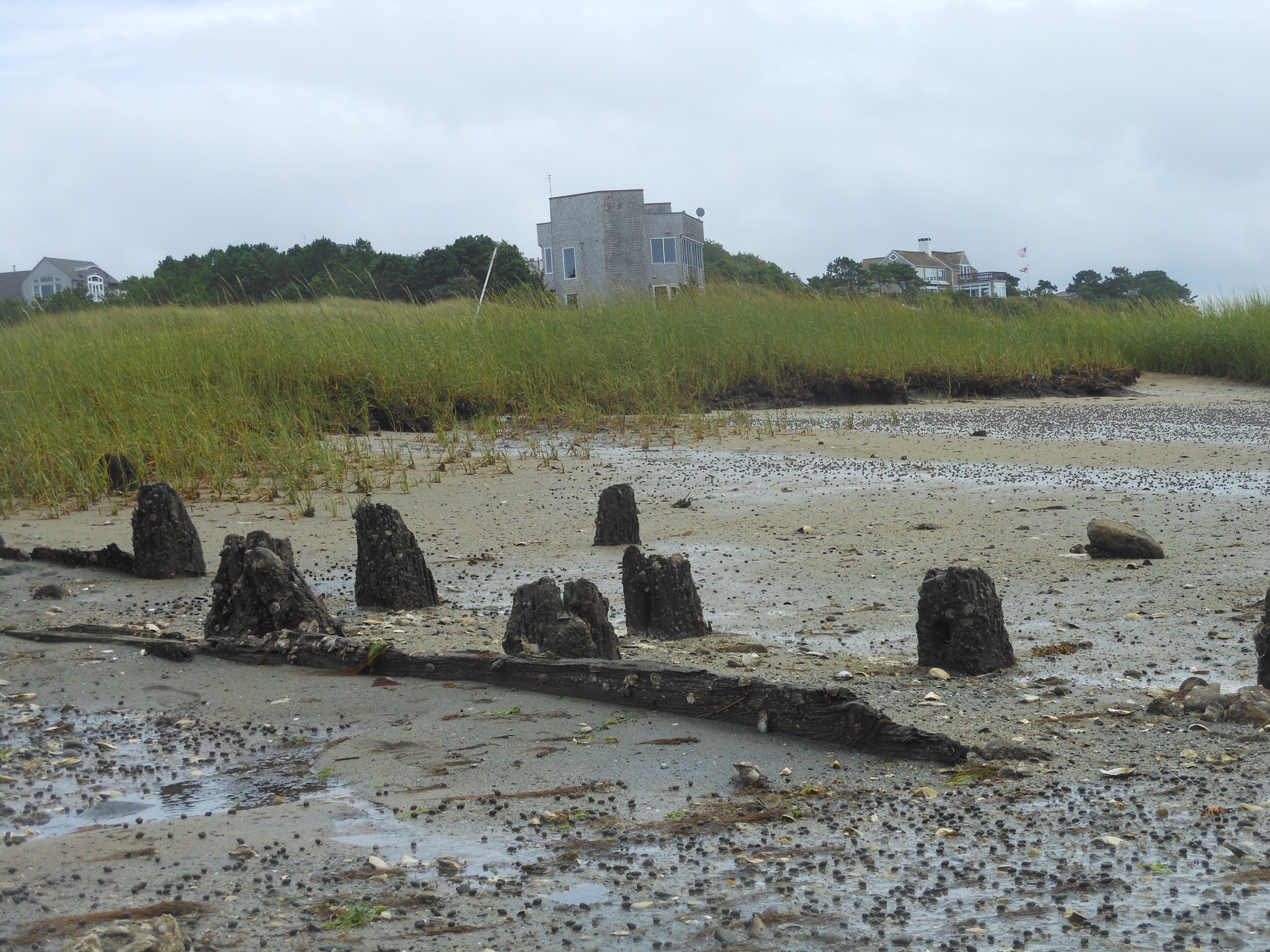
Fishing became the basis of the Wellfleet economy and grew steadily after the Revolution.  In 1831, Leonard Battelle and Robert Little, both of whom were in the shipping business in Boston, joined Richard Arey, South Wellfleet local, in building the South Wharf on Blackfish Creek.  They purchased  the land from Major John Witherell, a Revolutionary War veteran whose holdings seemed to spread out over the land from the old “Cannon Hill” (the south of the Creek hill, not the other north of the Creek) through to the edge of the Creek on the point we call “the Old Wharf” today.  Today, the pilings from the wharf are still visible.

In the early 1830s, Mr. Battelle  was in business with Mr. Little in Boston, merchants with a business that dealt in goods from the West Indies, according to the Boston City Directories for 1829 and 1830. Both men were married in the 1820s. Mr. Battelle died in 1840, another possible reason for the transfer of the South Wharf property to others.

From research on the life of Richard Arey, it looks like his involvement only lasted ten years, since he was listed as “insolvent” on a deed, and another source reported the wharf burning in 1840.  Deyo’s history lists the owners of the wharf and its store as:

1845: Collins S Cole took the store and Nathan Paine the wharf

A few years later: Elisha  Smith, George S. Newcomb and George Saunders took ownership of both wharf and store  (on the 1858 map, they are marked as the property owner of the wharf)

Still later, Newcomb sold to Alvin Paine; Saunders and Paine continued to 1866

1866: the Southern Wharf Company of forty shares was formed, and “stock taken up in the amount of $5,000”

1880: Alvin Paine became the owner.

There isn’t very much  documented evidence on the South Wharf. No photo or sketch of the South Wharf has been found (to date!). One source that provides some details on the operation is a document prepared by the Cole family that preserved the written memories of Charles Cole, who lived in South Wellfleet from 1854 to 1943. That document is available at the Wellfleet Public Library.  Earle Rich, another local writer, wrote a piece on Cole’s description, in 1973.  Cole wrote:

“Mackerel fishing at South Wellfleet began about 1826, and sometime between that year and 1834 Battelle and Little of Boston built a wharf on the south side of Blackfish Creek …The wharf was large enough to accommodate sheds for empty barrels, full barrels of mackerel and mackerel bait (porgies and clams), salt sometimes stored in bulk, and obtained from the Salt Works, there being several along the Creek, and a shed for packing the fish.”

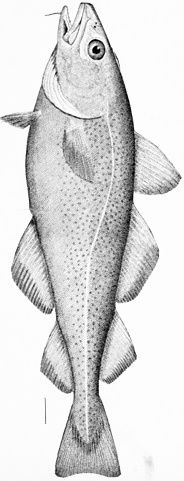
Mackerel

This account says that Collins Cole and Nathan Paine took over in 1834, and carried on the business in partnership until 1840 when Smith, Newcomb and Saunders took over. Cole’s memory of the wharf burning is dated during the Smith, Newcomb and Saunders ownership. His other dates agree with Deyo’s.

Cole lists the following vessels and their Captains “packing mackerel here” in those years.

Emerald  Captain Timothy Ward                              Alonzo  Captain A.T. Gross

Fairtrader  Captain  Solomon Smith                         Leader Captain Nathaniel Y.Paine, Jr.

William Henry   Captain John Chipman                   Diman  Captain Solomon WIley

Blossom    Captain Ebenezer Cole                             Aurora  Captain John Wiley

Hope     Captain Isaiah Hatch                                       Swan     Captain Jonathan Doane

Sister     Captain Seth Newcomb                               Sea         Captain David Childs

Cherub Captain Asa P. Arey                                       Catherine   Captain Henry Newcomb

Liberty   Captain Reuben Brown                               Fannie   Captain Stephen Hatch

Warbash   Captain Ezekiel Young                             Chariot   Captain David Wiley

                                               Mattamore   Captain Samuel Smith

These men — plus a few others — are the residents of South Wellfleet in the early and middle of the 19th Century. They are the property owners on the maps that show this detail. They are the owners of the pews in the Second Congregational Church. Their names are still with us on the gravestones at the South Wellfleet Cemetery.

In the 1850 Federal Census, there were 2372 counted in the town of Wellfleet. The first 422 names are in the South Wellfleet area, from the Eastham border to just past today’s LeCount Hollow Road. There were 79 households in that portion of the census count, with 125 men old enough to have an occupation; of these, 81 are listed as Mariners.

The Cole memories and the David Balch article about Wellfleet during the 1860’s are the best sources for understanding what fishing meant in the day-to-day life of Wellfleet men. Cole writes of an early fishing season for cod, haddock and halibut off Nantucket Shoals.  The mackerel season was about six months long, from early summer to late autumn. The most popular fishing areas were off the coasts of Maine and Canada. Fishing was done by land-lining, with each man owning and operating his own gear. After spotting a school of fish, the men would throw chum (chopped bait, usually porgies) around the ship and begin working their lines, five or six each. This would continue until there were about 200 barrels of fish caught. The mackerel were pickled in brine to preserve them. Later, back on the wharf, they were sorted into three sizes and packed for market.

also mackerel

Cole’s memory includes an incident concerning the schooner Ida R. Freeman, also reported in a New Hampshire newspaper in 1880. The schooner arrived back at port, and the crew all went to their homes, leaving the 90 barrels of mackerel on board. Three crew members who were “Swedes” stole the boat, heading for Europe. In addition to the fish, they took the dories, the seine boat, and the crew’s clothing. The newspaper noted that they had provisions enough for eight weeks. Cole remembers the thieves as Norwegians, and that the boat was actually found, but sold “over there” rather than brought back to Wellfleet.

After the fishing season was over, the boats would be run ashore at a high tide. South Wharf boats were placed just north of the wharf or across the Creek at “Point Pleasant.”  In the spring, after the ice had cleared, the crew — usually the same men each year — would work on the sails and painting the hull before re-launching for the fishing season.

While searching today for mention of the South Wharf in newspaper databases now online, one sad little story emerged from 1879, when Benjamin Snow, despondent about the death of his wife, was found on the flats “at the South Wellfleet Wharf” with a rope around his neck attached to a large stone.

In a later, blog, I’ll write more about the decline of the fishing and its impact on the South Wellfleet community. At some point, the South Wharf stopped its operation and the wharf would have disappeared, worn out, or perhaps crushed by the ice in a cold winter. The road to the Wharf became “Old Wharf Road.”

Earl Rich has a much later memory of the Old Wharf, one that went back to Prohibition (1919-1933). During those years, liquor would be brought to the coast on large vessels, and off-loaded to smaller ones, in burlap bags. The Old Wharf became a good spot to unload the bags, as there were few houses close by. Rich writes of the Pierce Arrows and Packard limousines that picked up the liquor there. This memory of the burlap bags is repeated in other local histories, Donald Sparrow’s of Eastham included.  My father recalled the lights that flashed from the “rum runners” that my parents could see from their cottage on Prospect Hill.

Sources

Earle G. Rich “The Old South Wharf, South Wellfleet”  The Cape Codder  October 7, 1971

“The Notes of Charles F. Cole” manuscript from the Wellfleet Public Library

Balch, David “The Anatomy of A Fishing Village, Wellfleet, Mass. 1860-1865” (1985 paper) available at the Wellfleet Public Library

Newspaper account on line at www.genealogybank.com

Deyo, Simon. History of Barnstable County, New York, 1898.   Wellfleet chapter on line at www.capecodhistory.net.

ckfish Creek

Posted in Uncategorized | Leave a comment

Whaling, Fishing, Salt Works, Wharves: The Big Picture

By focusing on the south side of Blackfish Creek, and the families that lived there, I’m narrowing history down to a very limited location.  But it’s important to also have “big picture history” to understand South Wellfleet’s economy, particularly fishing and shell fishing, which employed nearly all the male residents.

The National Park Service shares many of its documents online.  One in particular has helped me with the big picture of Outer Cape history. Dr.Patricia Rubertone prepared the second chapter of the NPS report, Chapters In the Archaeology of Cape Cod, III, The Historic Period and Historic Period Archaeology. This report provides an historic overview of the linkages between the Cape landscape, ecology, resources, and the people who came to depend upon those resources.  She contrasts the Outer Cape’s “pre-history” of native resource use with the European arrival, and a totally different understanding of the uses of land and marine resources.

The story of the 1640-1644 settlement at Nauset has been told often. The settlers “bought” the land from the natives, adding Billingsgate (now Wellfleet) in 1666 – initially, they had just taken it, as the native people were not sure who owned it. The native people’s understanding included the use of land and marine resources, not ownership. Already devastated by disease brought by the Europeans who had been fishing the coast for many years, their diminished numbers succumbed to the European worldview of ownership and consequent gathering of resources for trade and sale.  

Although fishing by Europeans on the northeast coast had been underway for many years prior to the Pilgrims’ arrival, those who settled in Massachusetts in 1620 were farmers, not fishermen. Land existed to be developed, initially in common ownership, but soon in assigned land holdings. Working the land was supported by religious belief that utilizing the land was God’s will — and the native people’s habit of clearing and planting mere portions of the landscape was another sign of their heathen inclinations.

The impulse to farm soon encountered the reality of the Cape soil with its glacial outwash, supporting only certain kinds of plants, and tending to dryness. The kettle holes that dotted the landscape (another feature of the last glaciers) provided a few wet areas, suitable for other kinds of plants that could grow in bogs. The salt marshes were cow-grazing land, or a place to harvest salt hay. The trees that existed back then were used for buildings, fuel, ship building, fences for the land, and the “try works” that involved burning whale and blackfish blubber to extract oil.

The Cape’s native populations depended upon the abundance of the marine resources, and, soon after they arrived, so did the Europeans. One early method of whaling, learned from the native people, was to herd the blackfish up on the beaches and slaughter them for their oil. This on-shore whaling did not last much past the mid-18th Century. The inclination of the blackfish to beach themselves was a regular feature of life in Wellfleet, and continues today.  The early settlement of the northern part of Eastham, on the western islands of Billingsgate, Great, Bound Brook and Griffin’s, all situating the earliest settlers near the bay for in-shore whaling and fishing — and for shellfish harvesting in the spectacular natural harbor.

The story of Billingsgate’s struggle to have its own Meeting House, an event that eventually led to the establishment of Wellfleet as a separate town, is well documented in Durand Echeverria’s book about the founding of Wellfleet. Rubertone views this struggle as evidence of the need to preserve the on-shore whales as a resource for their town, while Eastham, without a bayside harbor, and with more arable land, would find farming a more profitable venture.  Billingsgate became the market for the Eastham crop surplus. The oil they were “harvesting” in Billingsgate became a profitable cash product, used for illumination, candle-making, and oiling wools for combing. The oil was recognized as a valuable town resource in a town order of 1707 that sought to forbid outsiders from making “whaling voyages to Great Island or Lieutenants Island at Billingsgate.”  The 1970’s “dig” at the Wellfleet Tavern on Great Island uncovered artifacts that confirmed the whaling activity at that site.

Schooner at Sunset

As the in-shore whaling waned, deep-sea whaling became necessary, but this activity required much more capital to build and equip large, sturdy ships that could go the distance. Just prior to the Revolutionary War, Wellfleet had twenty such vessels, but they were dependent on wealthy owners for financing.

Fishing also moved from an activity that could be done close to land, to one that required trips out to sea of longer duration. In the 18th century, fishing was reorganized also. Elisha Doane of Eastham became one of the wealthiest men of colonial Massachusetts by investing in the ships that would fish off the Grand Banks, sail with their catch to the West Indies, where they traded their catch as food for the slave population for rum and molasses.

The New England coast was blockaded by the British during the Revolutionary War. In 1783, all American fish exports were prohibited from being shipped to the West Indies. These  changes meant that both whaling and fishing had to be reorganized. Wellfleet’s whaling ships never recovered from the War’s devastation. However, fishing was re-organized, and became a more equitable venture. The fishing took place off the Grand Banks, initially requiring somewhat smaller schooners that on trips of three to four weeks that allowed fishermen to be at home for part of the year. The vessels were owned in a share system, in part by their crews, and also by investors, some from Boston. The mariners furnished their own lines and gear, and shared in the proceeds of the catch. Food, such as salted meat and biscuits, and ship chandlery, was furnished by the owners, who deducted their cost from the gross proceeds before the shares were divided.

This system made it possible for many residents of Wellfleet to make a living from the sea. For many whose shares might be small, it may not have been more than subsistence, so that some farming became an additional necessity. Later, as fishing expanded, it became more profitable. David Balch, in his paper on the mackerel fishing in Wellfleet during the 1860’s, commented that the share of a “good” fishing trip, at perhaps $90 per crew member, allowed many young men to purchase a share in a vessel, at $50 or $60. He comments that buildable land was then selling for $10 to $15 an acre, and that it cost $500-$600 to build a house, so a few good fishing trips could result in modest property ownership for many.

In 1802, Wellfleet had 25 vessels: five whaling, four cod and mackerel fishing, four carrying oysters to the eastern coastal towns, and twelve fishing around the Cape. Levi Whitman, Wellfleet’s minister at that time, is perhaps more famous today for his written pieces about the town, preserved in the proceedings of the Massachusetts Historical Society and used by historians in many Cape Cod articles and books. In 1794 he wrote “There are few towns so well supplied with fish of all kinds as Wellfleet and no part of the world has better oysters.”

Richard Rich built Wellfleet’s first wharf on Griffin Island. In the 1800’s more wharves were built along Duck Creek as Wellfleet relocated its town center there.  Commercial Wharf was built in 1835, Enterprise Wharf prior to 1837, and South Wharf on Blackfish Creek in 1830. Fleets expanded during the antebellum period. Central Wharf was built later, in 1863, and finally Mercantile Wharf in 1870.

Schooner sails down

By 1860, according to a paper by David Balch on Wellfleet’s fishing economy, there were 70 schooners in Wellfleet. By that time, mackerel fishing had become the main focus, along with moving oysters from seed in the Chesapeake Bay, back to Wellfleet for planting and flavor development, and then finally shipping to New York, Boston and elsewhere. Whitman talks about the death of the oysters in 1773, and then the discovery that oyster seed brought from elsewhere and replanted could give the oysters their “Wellfleet flavor.”

The investment in the South Wharf on Blackfish Creek, and its store, by the two “Boston men”, Leonard Battelle and Robert Little, along with Richard Arey, was on land purchased from Major John Witherell.  Arey served as the local agent. I’ll write more about the operation of the South Wharf in my next piece.

Tied up

This maritime activity was supported by the salt works that also became a local investment through the 1850’s. Wellfleet had four salt works in 1802. In 1821, the Salt Manufacturing Company of Billingsgate was organized. By 1837, there were 39 salt works producing 17,500 bushels of salt annually. I’ve already mentioned in an earlier piece Richard Arey’s operation at Cannon Hill on Blackfish Creek. Mr. Townsend’s was at the foot of Paine Hollow, and Mr. Lewis’s “east of the Highway.” The cedar swamp in South Wellfleet provided a nearby source of the logs needed for the salt works. Salt works declined, however, as fish increasingly became a fresh food rather than a salted and preserved one. The fish were caught, iced, and shipped to urban markets where populations were growing fast.

Other subsidiary activities such as sail-making developed to supply the fishing boats. Of interest in South Wellfleet was “the store” whose owner would supply clothing, food, and make loans or extend credit to the mariners, not unlike the function that the owners provided in a mining or factory town. When I cover the story of the Barker family of South Wellfleet, the first to arrive in South Wellfleet was Isaiah, a cooper, who made the barrels needed at the South Wharf.

Eventually the fishing diminished, and South Wellfleet suffered the decline of an area whose economy has crashed.  But that is another story that I’ll cover in a future piece.

Sources

Nye, Everett History of Wellfleet from Early days to Present Time 1920 (online at Google Books)

National Park Service Chapters In The Archaeology of Cape Cod, III: The Historic Period and Historic Period Archaeology  Cultural Resources Management Study No. 13. Division of Cultural Resources, North Atlantic Regional Office, National Park Service, U.S. Department of the Interior, 1983

Quinn, William P. The Saltworks of Historic Cape Cod  Parnassus Imprints, Orleans, Mass. 1993

Balch, David “The Anatomy of A Fishing Village, Wellfleet, Mass. 1860-1865” (1985 paper)  available at the Wellfleet Public Library

Levi Whitman 1784 letter and 1802 note in the Collections of the Massachusetts Historical Society, Volume 8, online at   www.books.google.com.

Deyo, Simon. History of Barnstable County, New York, 1898.   Wellfleet chapter on line at www.capecodhistory.net.

Posted in Uncategorized | Leave a comment

Lydia Ward Arey and John Taylor

Lydia Ward was the daughter of George Ward and Barzilla Doane, two original Wellfleet families. She was born in 1760 and married Reuben Arey (1) in 1777 at age seventeen. Together they had eleven children. Reuben Arey died in 1801 when Lydia was 41.

Two years before he died, Reuben posted a newspaper notice that his wife had left his bed and board. We have no proof that she had done so – and perhaps Reuben Arey was angry about something, or just wrong. Maybe he was suffering from dementia. We do not have his Will, to see if there were actions taken there.  At any rate, this would have been a pretty exciting event for South Wellfleet!

Reuben’s action made me think about Lydia and her life.  In the 1800 Federal Census, there is only one Reuben Arey listed, with a large household. (In the earlier censuses, only the head of household is listed, with others counted by simply gender and age.) In the 1800 census, the Arey family appears to be living together, with the two adults and the younger children. John Taylor does not appear in the 1800 census as a “head of household.” Was he a romantic interest of Lydia’s before the death of her husband? There’s no obvious proximity.

Lydia remarried on August 6, 1808, to John Taylor. If she had been having an affair with John before Reuben died, it’s odd that she would have waited so long to remarry!  Now she is 38. I’m noting her age because the person who posted her and John on the website www.findagrave.org indicates that she had another child in 1824 but this sounds impossible as she would have been then 64 years old. I checked the Wellfleet birth records from 1800 to 1825 and do not find any record of a birth to John and Lydia.

In the 1810 Federal Census, in John Taylor’s home, there are children of varying ages – probably  Lydia’s younger children who were still at home. Her two youngest girls, Nancy and Rebecca, would have been in their early teens.

Another oddity is noted in the marriage records for Wellfleet. John Taylor declares an intention to marry Sally Witherell in July 1808, but then married Lydia in August. This may be an error, or another story of a relationship that did not work out.  Sally was the daughter of John Witherell and his first wife, Azubah Gross. (John  Witherell married again, to Lydia’s oldest daughter, Ruth, in 1822.) Sally later married John Connnick.)

John Taylor is of special interest because he was another of Wellfleet’s Revolutionary War soldiers, although he was not from Wellfleet. Until he married Lydia Arey in 1808, we do not know where he lived. There is no record of him in the 1790 and 1800 Federal censuses, but he may have been living in another home where he was not the head of household.

In her excellent 1975 paper “Wellfleet Soldiers and Sailors of the Revolution,“ Elizabeth Cole provides details of John Taylor’s military service. She cites his military enlistment as a private (no date) and that he may have deserted in June 1777 – not an uncommon occurance during the Revolution when soldiers simply returned home to work their land. In February 1778, he shows up on the record again, now as a corporal. He served until December 1779. I found evidence of his enlistment as a drummer in February, 1780. Cole indicated that he was in a “Light Company” assigned to West Point in July, 1780. His pension application indicates that he served until the end of the war. Cole was doing her research, pre-Internet, looking at National Archives records while I used “fold3,” a website with partial records from the National Archives.

Taylor’s service record states that he was a drummer in the regiment commanded by Michael Jackson of Massachusetts. The 8th Massachusetts Regiment was raised April 23, 1775, under Colonel Sargent at Cambridge. The Regiment saw action at the Battle of Bunker Hill, the New York Campaign, the Battles of Trenton and Princeton, and the Battle of Saratoga. In his pension application, Mr. Taylor swears that he enlisted in February 1780. He lost his certificate of discharge, so Colonel Michael Jackson’s son had to swear that Mr. Taylor’s name was described in his father’s regimental book.

There are notes that John Taylor was from New York. Cole does not state which unit he joined in his early enlistments.  The 8th Massachusetts Regiment may have been based near his home, as sources place it at West Point, an important strategic location for the Americans. Another source indicates that General Washington’s headquarters was in Newburgh, New York. in 1783, and there is a letter in Washington’s archive to Jackson that suggests that the Regiment be “put in a more respectable condition.”

By the time John Taylor joined the Regiment, the  battles of the Revolution in the north were over, and with most battles now fought in the South. Thus it is not clear that he saw major action during this time of service.

Taylor’s application for a pension in August 1820 states that he owns “two acres of meadow that is valued at $40. I owe eighty dollars (unreadable) one house. I have a wife named Lydia, aged 60. One child lives at home, a cripple aged 30 years whose name is Whitfield. (This would be Reuben and Lydia’s son.) My employment a day laborer and my general health such that I am unable to labor.”  The County Clerk’s office verified his property as worth $60.00.

While these details may seem cumbersome, there is one important fact about John Taylor that is of relevance today. John died a year or so after Lydia, in August 1851, at age 97 years. No doubt he was an honored South Wellfleet citizen. After his wife died, in February 1850, he was taken into the home of the Boyington family of South Wellfleet. He is noted living there in the April 1850 Federal Census. John Taylor’s grave at the South Wellfleet Cemetery has carved on his stone: “He was a Lifeguard to Washington during the Revolutionary War.”

Cole states in her paper, with regard to John Taylor, that various military units began to adopt fanciful titles and in April 1777 Congress passed a resolution that such titles were improper. Washington stated that they were not authorized by him and, in fact, were “forbidden in terms of severe reprehension.” Cole found no evidence that John Taylor served as “Washington’s Life Guard” nor did I. However, by 1850 there were few Revolutionary War veterans remaining, and one can imagine the high respect given to them —  the same type of admiration we give to World War II veterans today. South Wellfleet honored John Taylor with the inscription on his grave.

John Taylor’s grave South Wellfleet Cemetery

There’s one other significant note about Lydia Taylor.  Local historians Russell and Verna Moore have researched the Fresh Brook Village site in South Wellfleet, and lead tours for the National Park Service. They indicate that John Taylor’s wife, Lydia, owned a tavern in Fresh Brook Village. The National Park Service describes it as being located “along the King’s Highway, where travelers might stop for refreshment.”  Lydia Taylor appears to have become  known as “Aunt Lydia” at this point in her life. Deyo’s 1890 history describes it:

Aunt Lydia Taylor’s store or tavern, or both, is remembered by the elder people, although the house long ago succumbed to the march of improvement. Then the weekly horseback mail carrier plodded along the sandy road, and the people must gather as often at Aunt Lydia’s to enquire the news; and in early stage time the dusty traveler found an unstinted measure of relief under her roof. Reuben Arey had still another of these stores about 1820 at his house, where he kept the post office.

Note: there is another, perhaps more famous “Aunt Lydia’s Tavern” in Barnstable. This was the business of Lydia Sturgis, and was located across the road from today’s Sturgis Library.

Sources

Elizabeth L. Cole, “Wellfleet Soldiers and Sailors of The Revolutionary War” Wellfleet Bicentennial Committee, 1976 (paper held by the Wellfleet Public Library).

David Kew’s Cape Cod History site: www.capecodhistory.us.

U.S. Federal Census collection at www.ancestry.com.

Deyo, Simon. History of Barnstable County, New York, 1890.   Wellfleet chapter on line at www.capecodhistory.net.

Observer Reporter, Washington Pennsylvania, August 9, 1987 article on page F-6

National Archives Revolutionary War records online at www.fold3.com.

History of the Massachusetts 8th Regiment at www.wikipedia.com.

ylor

Posted in Uncategorized | 8 Comments

More on the South Wellfleet Areys

The second Reuben Arey, born in 1778 as the son of Reuben Arey (1) and Lydia Ward Arey, was also a distinguished  citizen of Wellfleet.  He was a successful businessman and is referenced as “Esquire” and “a Gentleman” in various records.  In 1799 he married Sara (Sally) Brown of Wellfleet whose father, David Brown, was a Congregational minister. They had eleven children. From recent conversations with the South Wellfleet homeowner, and records at the Wellfleet Historical Society, it appears that Reuben (1) built a second home in South Wellfleet for his son, next to his own.  Eventually, that home was owned by Isaac (Ikey) Paine who sold it to the family of the present owner.

Beginning in 1797, Reuben (2) served for five years as the town’s representative to the Massachusetts General Court.  He was a Wellfleet Selectman for eight years beginning in 1819.  In 1820 he was chosen as a delegate to the Constitutional Convention revising the Massachusetts Constitution.  He became Postmaster at South Wellfleet in 1829, operating the Post Office from his home.

As evidence of his role as a trusted member of the community, Reuben Arey (2) was appointed as a guardian to aging Revolutionary War veterans Elisha Ward and Lemuel Newcomb, and is named as such in their petitions for veteran support, prepared in the 1820s.

Reuben and Sally Brown Arey’s children are:

Reuben (3) (1801).

Ruth (1803) who lived to age 3 years.

Asa Packard (1805).

Benjamin Brown (1807) married Martha Chipman of Wellfleet.

Richard  (1809).

Elbridge Gerry (1811) became a Master Mariner, marrying Sophronia Lathrap of Sandwich, Mass., and relocated to New Bedford. He also had a son named Reuben.

Sally  (1813) married George Chapman.

Miranda  (1815) married Dr. Daniel Davis.

Oliver Cromwell (1817).

Ruth  (1820) married Parker Dodge.

Charles  (1822) was only fifteen when his father died, so his brother, Richard, was appointed his guardian.  His obituary noted that he was educated at the “Academy in Orleans and at Phillips Andover.” He attended Harvard and graduated from Kenyon College. He became a Congregational minister.

Reuben(2) died September 30, 1837. In 1839, his estate was appraised at $5,275.87, of which $2,456.87 was personal property. His Will mentioned real estate — salt works, and interest in Enterprise Wharf – plus pews in both the First and Second Congregational Churches. His Will lists the real estate, plot by plot, and in the description of each piece of land, gives us a list of other property owners in South Wellfleet — although not everyone listed may have had  a home there. Many property owners had a woodlot, or a piece of salt marsh to grow salt hay, or a salt works.  Interestingly, there were several owners of the Cedar Swamp, now in the National Park where we take nature walks.

The Reuben Arey home — one presumes the second house – was divided between Elbridge Gerry Arey and Oliver Arey – half to each, including the dwelling house, the barn, the corn house, the chaise house, the woodhouse and the garden. While both brothers inherited the house and grounds, it appears that Elbridge gave up his part, perhaps when he re-settled in New Bedford. In several places in the Will, an “Edmond’s Island” is mentioned — could this be Mill Hill Island or some other piece of land now called by another name?

The son, Asa Packard Arey, is of special interest to the Old Wharf Road/Prospect Hill area of South Wellfleet. His story is part of the Barker family tale, and is saved for that blog piece.

Another son’s life story,Richard Arey, led me to more research. Richard, grew up in South Wellfleet, and become an “important citizen” in the style of his father. Richard was President of the Wellfleet Marine Benevolent Society, established in 1836. He was the agent of the “Boston men” Leonard Battelle and Robert Little, who purchased Major John Witherell’s land to create the South Wharf on Blackfish Creek, around 1830.  Richard also had a salt works on Blackfish Creek. According to the 1938 South Wellfleet Neighborhood Association brochure, the salt works was at the foot of Cannon Hill, on the north side of Blackfish Creek. Despite this activity, Richard picked up and moved to Rapids City (now Rock Falls), Illinois.  I wondered why. By chance, I noticed a reference to Richard as an “insolvent” in a deed I found. Then I found a reference to the South Wharf burning in 1840, and in the early 1840’s the ownership changed.  Through an acquaintance – one source said a brother in law — he picked up his family, five children by this time, and moved to Rapids City in the western part of Illinois, arriving in May, 1844.

The family’s trip lasted 30 days —they traveled across New York on the Erie Canal, took a steamship through the Great Lakes to Chicago, and then by “team and wagon” to the Illinois prairie.  He purchased a large wooden home that had been a hotel (there was a business operating in the area)  and settled his family, planting trees on the property. The Illinois historian notes that “pioneer life” was difficult and strenuous, especially for his wife, Martha. She had three more children – and died after eight years living there.  The oldest four boys all went off to fight in the Civil War but only three returned. In the federal census in 1850 and 1860, Richard Arey is listed as a farmer.  But this leading citizen of SouthWellfleet became a leading citizen of Rapids City — later named Rock Falls — and was called “Deacon Arey.”  His daughter, Martha, told this story in 1929, after all the family members had died, and the local historical society preserved it. It’s a long way from South Wellfleet, but a sort of American story of the 19th Century when financial difficulties could be overcome by heading west and starting over.

Richard’s brother, Reuben Arey (3), married Jerusha Holbrook December 2, 1824.  They had nine children.  Many of them left Wellfleet when the fishing economy faded in the later years of the 19th century.  His son, Waterman Holbrook Arey, became a currier in Boston, and lived in Chelsea. His son, the 4thReuben, was a leather dealer, and lived in Cambridgeport. The youngest son, Edwin, was the bookkeeper for Reuben’s company.  Edwin’s son, Bertram Arey, lived with his wife Louise through the 1970s in South Wellfleet, on Arey Lane, off Old Wharf Road.

Reuben Arey (4) portrait at Wellfleet Historical Society

Reuben (4)’s obituary in the July 7, 1892 Boston Journal notes how he left home at 18 years, and came to Boston on a Wellfleet packet with few possessions. He found a position in the leather business, and by age 31 his name was part of the firm’s:  Arey, Maddock and Locke. In the Wellfleet Historical Society’s report on historical structures (to the Massachusetts Historical Commission) the oil portrait of ‘Reuben Arey’ hanging in the WHS headquarters is acknowledged to be this Reuben Arey (4), an item left by some of his descendants.  That document also notes that he worked with ‘glauber salts’ used in leather tanning from the family’s salt water evaporation facility, so his entry into that business isn’t too much of a surprise.  Reuben Arey (4) was one of the organizers of the South Wellfleet Cranberry Bog Association, and the Barnstable Patriot notes a meeting at his home in Cambridge in December, 1891. His wife Nellie was on the Board when the group met in 1895. The Association is noted on the 1910 Wellfleet map near the location of the former Fresh Brook Village.

Another brother of Reuben (3) was Oliver Cromwell Arey, born in 1817.  A biography of his life is available through the University of Wisconsin at Whitewater, where he established and served as the first President of the ‘Normal School’, as schools preparing teachers were known.  Like his brother Reuben (4), he grew up “farming and helping in the manufacture of salt by solar evaporation.” He spent some time at sea, but before he was 20, he bade farewell to Wellfleet. He studied at Phillips Academy, got a degree from Union College, and subsequently became a teacher, and then a principal at several institutions. He held posts in Buffalo, New York, and Cleveland, Ohio.  In his biography, the writer speaks of the deeply religious influences on Oliver Arey’s life, and of his pact with two other Wellfleet boys to refrain from ”…profane language, tobacco, alcohol and all other practices that make war on the highest form of manhood.” While the writer was undoubtedly putting Oliver Arey on a pedestal as the school’s first president, this comment shows us a bit of Wellfleetian thinking in the 19th Century. Albert Arey was Oliver’s son and was the Arey family member selling the oldest Arey home to Professor Hicks in 1936.


Sources

Chamberlin, Ralph Vary. “Richard Arey of Martha’s Vineyard and Some of His Descendants” New England Historical and Genealogical Register, Volumes 86 and 87. Issue Date 1932 (pages 391-406) and 1933 (pages 5-27)

South Wellfleet Neighborhood Association 1938 booklet, on line at www.capecodhistory.net

Reuben Arey (2) Will, 1839

Sterling –Rock Falls Historical Society website: www.svonline.net

Newspaper search on www.genealogybank.com  (subscription)

Arey search on www.familysearch.org

Freeman, Frederick. The History of Cape Cod: The Annals of The Thirteen Towns of Barnstable County, (two volumes), W.H. Piper & Co., Boston.  1869.   Wellfleet chapter on line at www.capecodhistory.net

Deyo, Simon. History of Barnstable County, New York, 1898.   Wellfleet chapter on line at www.capecodhistory.net

Barnstable Patriot (various) online  archive: www.sturgislibrary.org


Posted in Uncategorized | Leave a comment

The South Wellfleet Areys — The First Reuben Arey

The first Arey in the English colonies was Richard, a mariner born in 1606 in Truro, England.  His name appears in documents in Salisbury and Gloucester, Massachusetts, and he purchased land in New London, Connecticut.  Eventually he settled in Martha’s Vineyard where he owned a substantial part of Chappaquidick, at one point.  Married to Elizabeth Crouch, he had two sons: Richard (2) born in 1640 and John (1645).

Richard (2) married Sarah Marchant and spent his life in Edgartown.  His son Richard (3), born in 1682, moved his family to Cape Cod — initially to Truro, but later to the north part of Eastham which is now Wellfleet.  His brother, Samuel, also moved to Eastham, married Mary Mayo, and had nine children.  Richard (3)’s wife, Lydia Norton, is buried in Eastham’s Cove Burying Ground as “Lidia Airie” — she died giving birth to triplets in 1726 or 1727.

Richard (3)’s son Richard (4) was born in 1712 and is mentioned in Eastham/Wellfleet histories. He served on the Meeting House committee in 1756 when he also served as constable.  Richard (4) died in 1763 at age 51, and is buried in the old Duck Creek Cemetery near where the town’s meeting house once stood.

Richard (4)’s two sons, Timothy and Jesse, were both property owners in Wellfleet, perhaps owning property that had been given to them by their father.  Jesse Arey, called “Captain Arey,” married twice — not unusual in the 18th Century. The family tradition indicates that he was a privateersman in the Revolutionary War.  By the end of the 1790s he sold his land to Lemuel Newcomb and others, and moved to Hampden, Maine, where he died in 1836.  Timothy Arey owned some land in common with his brother, Jesse, and also in the late 1790s sold land to Simon Newcomb and to Cornelius Hamblin.  One piece of land was on Atkin’s Neck in the heart of Wellfleet.  In 1799 Timothy Arey sold his dwelling house, other buildings and land, and presumably moved also — but exactly where needs further research.

Meanwhile, Richard (4)’s brother, Samuel — born in 1718 also in Truro — married Ruth Snow in 1743. She was the daughter of Stephen Snow of Eastham. Stephen Snow’s ancestors were Eastham founders. The Snows lived in Fresh Brook Village, a settlement in the part of Eastham that became South Wellfleet that dates back to the 18th Century.

Samuel and Ruth’s third child was the first Reuben Arey, born March 17, 1750. He is the first Reuben Arey of Wellfleet. The 1790 Federal census for Wellfleet — the first U.S. Census – –  lists Reuben Arey, his cousins Jesse and Timothy, his uncles Sylvanus Arey, and Captain James Arey, who was a mariner.  Sylvanus’ daughter, Lydia, was married to Lemuel Newcomb.

In the 1798 tax record listing dwelling houses, other buildings, and lots exceeding two acres, Reuben is the only Arey listed in Wellfleet. Since the Reuben Arey (1) house in South Wellfleet dates to that period, it might be assumed that he had his base of operations in South Wellfleet. This house still stands, and is privately owned.

Deyo’s history of Wellfleet notes that the first Reuben Arey was a resident of Wellfleet when it was incorporated in 1763. Since he would have been only 13 at the time, we do not know if his father, Samuel, moved to Wellfleet from Truro or if he was in the home of his uncle, Richard.  There is no record of Reuben Arey (1) serving in the military during the Revolutionary War.

Reuben’s first wife, whom he married in 1773, was Elizabeth Smith. The Arey genealogy in the New England Historical and Genealogical Register indicates there was one child, Samuel born in 1774, and who died in 1797.  But Samuel Smith (3) of Wellfleet, left property in his will of January 5, 1779, to the children of his sister, Elizabeth: Samuel and Elizabeth Arey.

Reuben Arey married Lydia Ward in 1777 when she was 17 years old. Their children are:

Reuben (2) (1778).

Ruth (1780)who married (1) David Wiley and (2) Major John WItherell discussed in my earlier blog.

Bethia  (1781)who married Thomas Hatch.

Mehetable (1782) who married Joseph Jones.

Asa Packard (1785) and appears to have been named for a minister named Asa Packard who considered taking the position in Wellfleet in 1784 but then declined the offer. The Lewis Family of Wellfleet who had a baby boy in 1785 also named their son Asa Packard, indicating the high regard of the minister who was also a Revolutionary War hero.  This Asa Packard died in 1804.

Solomon Arey (1787) who stayed in Wellfleet for a while, but then moved to Boscawen, New Hampshire.

Phebe (1790) who married William Rixford.

Whitefield ( 1791) who died in 1827. He’s mentioned as being “a cripple” in the Revolutionary veteran pension application of John Taylo, who married Lydia Arey in 1808, after Reuben (1)’s death.

Jonathan (1793).

Rebecca  (1796) married Ephraim Stubbs (after her sister died) and lived to 1874.

Nancy born 1798 married Ephraim Stubbs but died in 1840.

Reuben Arey (1) died January 15, 1801. His grave is not listed at the Duck Creek cemetery. But Chet Lay provided me a note from Mrs. Magenau’s family land ownership history that certain Arey graves were “moved from their homestead” at one of the times when the County Road (now Route 6) was widened –in either 1904 or in 1948.The graves were moved to the South Wellfleet Cemetery, but I do not know if they were marked after the listing of graves at the cemetery was completed. Perhaps the first Reuben was buried there.

On April 30, 1799, Reuben Arey (1) placed a newspaper advertisement which shows us a stark bit of life in South Wellfleet:

“Whereas my wife Lydia has eloped from my Bed and Board and has deserted her family and duty, I do hereby forbid any and every person from trusting her on my account a single dollar, dime, cent or mill after the date hereof, May 3.”

Lydia Arey’s life did have another chapter, and that shall be the subject of an upcoming blog!

Sources

“1790 Federal Census” database. Ancestry.com http://www.ancestry.com: 2010

Chamberlin, Ralph Vary. “Richard Arey of Martha’s Vineyard and Some of His Descendants”

New England Historical and Genealogical Register

Volumes 86 and 87. Issue Date 1932 (pages 391-406) and 1933 (pages 5-27)

Massachusetts Mercury, May 17, 1799. Online archive: http://www.genealogicalbank.com 2011

Reuben Arey search on http://www.familysearch.org

Freeman, Frederick. The History of Cape Cod: The Annals of the Thirteen Towns of Barnstable County (Two Volumes), Van Piper & Co., Boston 1869.

Wellfleet chapter on line at www.capecodhistory.net

Deyo, Simon. History of Barnstable County, New York, 1898.   Wellfleet chapter on line at www.capecodhistory.net

Barnstable Patriot (various) online  archive: http://www.sturgislibrary.org

eys I

Posted in Uncategorized | Leave a comment

The First Cannon Hill

Firing a cannon on the Fourth of July is a long-time tradition – a celebration that predates the parades and fireworks of today.  This past winter, in reviewing the archive of the Cape Cod Genealogical Society’s monthly Bulletin, I came across an article that Mary Stubbs Magenau wrote as she was researching her grandfather’s land ownership.  She wrote about South Wellfleet’s Major John Witherell, a Revolutionary War veteran, on whose hill the cannon was fired, a tradition for some time until it was moved across Blackfish Creek.  I’d forgotten we had a Cannon Hill on the south side of Blackfish Creek until Erick Eastman casually mentioned it at dinner one evening last month.  That single remark helped me locate Major Witherell’s property, and that helped me to better understand Mrs. Magenau’s article.

Our Cannon Hill is to the left of Old Wharf Road as it turns into a sand road, and with its tree cover is less conspicuous as a hill than it appeared years ago.  Other than Mrs. Magenau’s remark about the cannon, there is no proof that this happened – in fact, she learned about it from her uncle. Nevertheless, we can imagine that Major Witherell would oversee such an activity as it celebrated his generation’s victory in the Revolutionary War.  The Major came from a family that had left England soon after the settlement at Plymouth, arriving in Duxbury in the 1600s. The first colonial Witherell became the pastor of the Second Church in Scituate. A few generations later, they were in Eastham where the Major was born in 1753.

As a young man, Major Witherell joined the Sea Coast Defense, the colonists’ solution to the lack of a navy. Shortly after the battles at Lexington and Concord, Barnstable County authorities took measures to secure all boats that could be of use to the enemy, hiding them when and wherever they could.  In June and July 1775, Wellfleet organized Captain Joseph Smith’s Seacoast Company of militia, and they were stationed there until the middle of 1776. After February 1776, they marched to Truro — which had called for more help — joining another company already located there. Witherell was a Sergeant when he first joined, according to his pension application. Another source indicates he was a First Lieutenant when he served the Seacoast Defense in 1780. I have not found any record proving that he became a Major, but from the records in Wellfleet recording the births of his children, he was listed as “Major Witherell.”

The Seacoast Defense was involved after the stranding of the British ship Somerset in November, 1778, off Truro, north of the Clay Pounds. This is the ship whose wreckage is still exposed from time to time, first recorded in 1885,and again in 1973. There were nearly 500 prisoners taken off the ship who had to be marched to Boston and fed along the way. The Wellfleet Historical Society possesses one of its cannonballs.

In September 1778, Witherell participated in a march to Falmouth along with many Wellfleet men, in response to the needs there, but their time of service was limited to just two days, when the enemy turned to Martha’s Vineyard to harass the coast.

Major Witherell married Azubah Gross in 1775. They lost four of their children at young ages, but three daughters survived into adulthood. Major Witherell’s brother, Whitfield, was an upstanding Wellfleet citizen also, and the Witherell family had a presence in South Wellfleet throughout the 19th Century.

According to Mrs. Magenau’s research, Major Witherell purchased his land, a homestead, and other buildings from Ezekiel Harding in 1789. Major Witherell married Ruth Arey Wiley in 1822, two years after his first wife died, and after Ruth’s first husband, David Wiley, had died. They were neighbors in South Wellfleet.  In his old age, Major Witherell lived with Ruth and his daughter Betsy, who was married to Simeon Smith. Another daughter, Polly, who had married Samuel Smith, lived nearby.

In September 1831, Major Witherell sold a portion of his coastal land to Leonard Battelle, Robert Little, and Richard Arey, the land that later became the South Wharf and its stores.  After Major Witherell died in 1838, his wife Ruth sold other pieces of his estate to settle his debts. She died in 1844.

The cannon that came to be located on the north side of Blackfish Creek — on the Cannon Hill that once belonged to Captain Isaiah Hatch — was described by one local historian as belonging to a British warship that wrecked on the backside during the War of 1812. We do not know if this was Major Witherell’s cannon.  The other “Cannon Hill” is the topic of many stories of the Wellfleet boys from the north part of town who stole the South Wellfleet cannon presumably for their Cannon Hill near Uncle Tim’s Bridge. The cannon was recovered later by the South Wellfleet boys. It was buried at one point early in the 20th Century. The living relative who knew the burial spot revealed it in time for the Bicentennial when it was officially presented to the Town and installed on the Town Hall lawn.

Sources

Mary Stubbs Magenau “A Vignette of Wellfleet History” Cape Cod Genealogical Society Bulletin VOL XIV no 2, page 37.

Elizabeth L. Cole, “Wellfleet Soldiers and Sailors of The Revolutionary War” Wellfleet Bicentennial Committee, 1976 (paper held by the Wellfleet Public Library).

David Kew’s Cape Cod History site: www.capecodhistory.us.

Barnstable County Deeds available at www.barnstablecountydeeds.org.

R.E. Rickmers, Wellfleet Remembered Volume 6, Blue Butterfly Publications, Wellfleet, Mass. 1986.

ill

Posted in Uncategorized | Tagged , , , , | 8 Comments

Prospect Hill and Why I’m Blogging

Prospect Hill, on the south side of Blackfish Creek, past the marsh on the road to the Old Wharf, became part of my family’s landscape in the early part of the 20th Century. In 1910, my great grandfather, John Edward Irvine,  had the foresight to buy four adjoining house lots and “put up a cottage” as they used to say. In 1915, he built a second cottage.  Since then, many other family members have been part of this lovely South Wellfleet spot.

I thought it might be a good idea to document what I’ve learned about our family’s arrival on Cape Cod, and when certain cottages and houses were added on Prospect Hill.  If I had stuck with that plan, it might have taken just thirty minutes. Instead, spurred on by a newfound interest in family history research — thanks to the increasingly detailed information available online — I began to look back on two South Wellfleet families that played an especially prominent role in Prospect Hill’s history: the Areys and the Barkers.

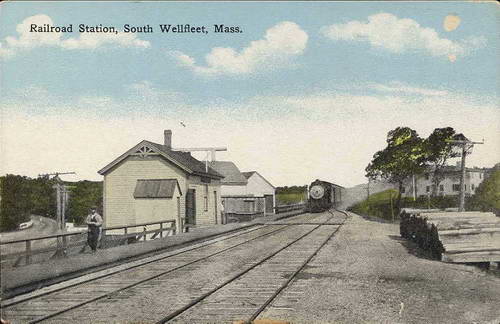
This initial local family research led me to dig further into Wellfleet’s history, the development of the village of South Wellfleet, and to the lives of other families that lived there in the 19th and early 20th centuries. I’ve spent some time looking back even further to the 17th and 18th centuries, broadening my understanding of Cape Cod’s history. Add in the churches, the graveyard, the railroad’s arrival, the stores and post office, the Wharf, and most notably, the Marconi Wireless, and the project has grown far beyond my initial plan.

Thanks to Chet Lay, local professional land surveyor, I’ve learned how to understand the deeds posted on the Barnstable County data base. There is a treasure trove at the Wellfleet Historical Society. Neighbors have been helpful too, particularly Bill and Alice Iacuessa, Ed Ayres, Eric Eastman, and others whom I hope to meet. So far, I’m focused on the land south of Blackfish Creek and south to Lieutenant’s Island Road, but I hope to expand my historical vista to Lieutenant’s Island, Pleasant Point, Drummer’s Cove, and Cannon Hill across Blackfish Creek.

Now I’m interested in sharing this information, since blogging has come along. This new media allows me to share without the discipline of writing a book with extensive footnotes, although I will try to cite my sources.  When a photo or other image is available, I’ll include it too, but not images that are copyrighted. I will also not give addresses of certain places so we can maintain the carefully crafted privacy of homeowners in the area.

Prospect Hill

The Barkers owned Prospect Hill beginning in 1866, when Isaiah and his son, George, purchased it from John Stubbs for $62.00.  (I will be writing about the Barker family in future posts.)

George Washington Barker (1844-1917) had the property surveyed by Tully Crosby Jr., and laid out lots in the 1890s. This appears to be the first time the area is named “Prospect Hill.” Like his fellow Wellfleetians, he saw the opportunity to develop his land for summer cottages. His 1893 brochure sells the area as very desirable, mentioning the development of South Wellfleet as a resort, and the “push and energy” of the Cape Cod Land Company, which “owns much of the seashore property here”. That company was busy selling Lieutenant’s Island.  He mentions the views of the Cape from shore to shore, from the broad Atlantic to the harbor on the bayside. There were few trees at this time, but Barker seemed to hope that the grassed-over soil of Prospect Hill would support the planting of trees. He notes that his house lots are larger than the Cape Cod Land Company’s, and offers them from $15 to $50 — for cash or monthly installments.  Finally, he gives the directions on the Old Colony Railroad or via the Steamer Longfellow to  Provincetown, and by train up to South Wellfleet where he will meet you at the station. He even tells the prospective buyer that the railroad fare will be $4.15 round trip.

George Barker was right there to take advantage of the changes in American society leading to the idea of resorts, vacations, summer homes, escaping the urban environment, and a new appreciation for the natural landscape.  The Cape — and particularly Wellfleet — transitioned from a place where harvesting the marine environment was the prime source of economic sustenance into a place where vacation visitors contributed to a major portion of the local economy. The transition took a number of decades, as fishing diminished and the resort culture grew to support local people. This transition is played out in the history of the South Wellfleet families, with the loss of population as children grew up and moved to the mainland and beyond.

My great grandfather, John Edward Irvine, was a cabinet maker and sash-and-blind maker. He was born in Mahone Bay, Nova Scotia, the first son in a large family. By the 1870s, he had most of his brothers and sisters in his household in Melrose, Massachusetts.  Married in the late 1870s, he and his wife lost three children early in their lives, and ended with just one, my grandmother Louise. When his wife died early in 1903, he spent some time in a mining town in South Dakota, but soon returned to the Boston area.

The Barnstable Patriot, in the 1890s and early 1900s, regularly ran a series of “notes” about who was coming and going in South Wellfleet.  In September, 1893, the paper notes J.E. Irvine renting the Robinson cottage on the Old Wharf. There is no record of when his interest in Wellfleet developed or why he made his first trip here. His wife was ill for a number of years before she died, and perhaps he was looking for “sea air” to help her. Perhaps it reminded him of Mahone Bay, a seaside town in Nova Scotia. He was living in Everett, Massachusetts, at the time, and the Robinson family was from Lowell. There is no record of how Irvine came to find the rental.

1915 Cottage nearly finished

The 1910 map of Wellfleet shows the property owners with four names in the vicinity of the “Old Wharf” as the area where the 19th Century South Wharf was located.  Grandfather Irvine is noted as the only property owner on “Prospect Hill.”

Sources:

Barnstable Patriot, available on line through the Sturgis Library site, www.sturgislibrary.org.

Barnstable County Mass. Index Map to the town of Wellfleet, available  at  www.ancestry.com U.S. Indexed County Land Ownership Maps, 1860-1918.  

Barnstable County Deeds available at www.barnstablecountydeeds.org.

George W. Barker’s “Seashore Lots” brochure, March, 1893; cover illustration posted here.

Posted in Uncategorized | Leave a comment