Shipwrecks on South Wellfleet’s Shore

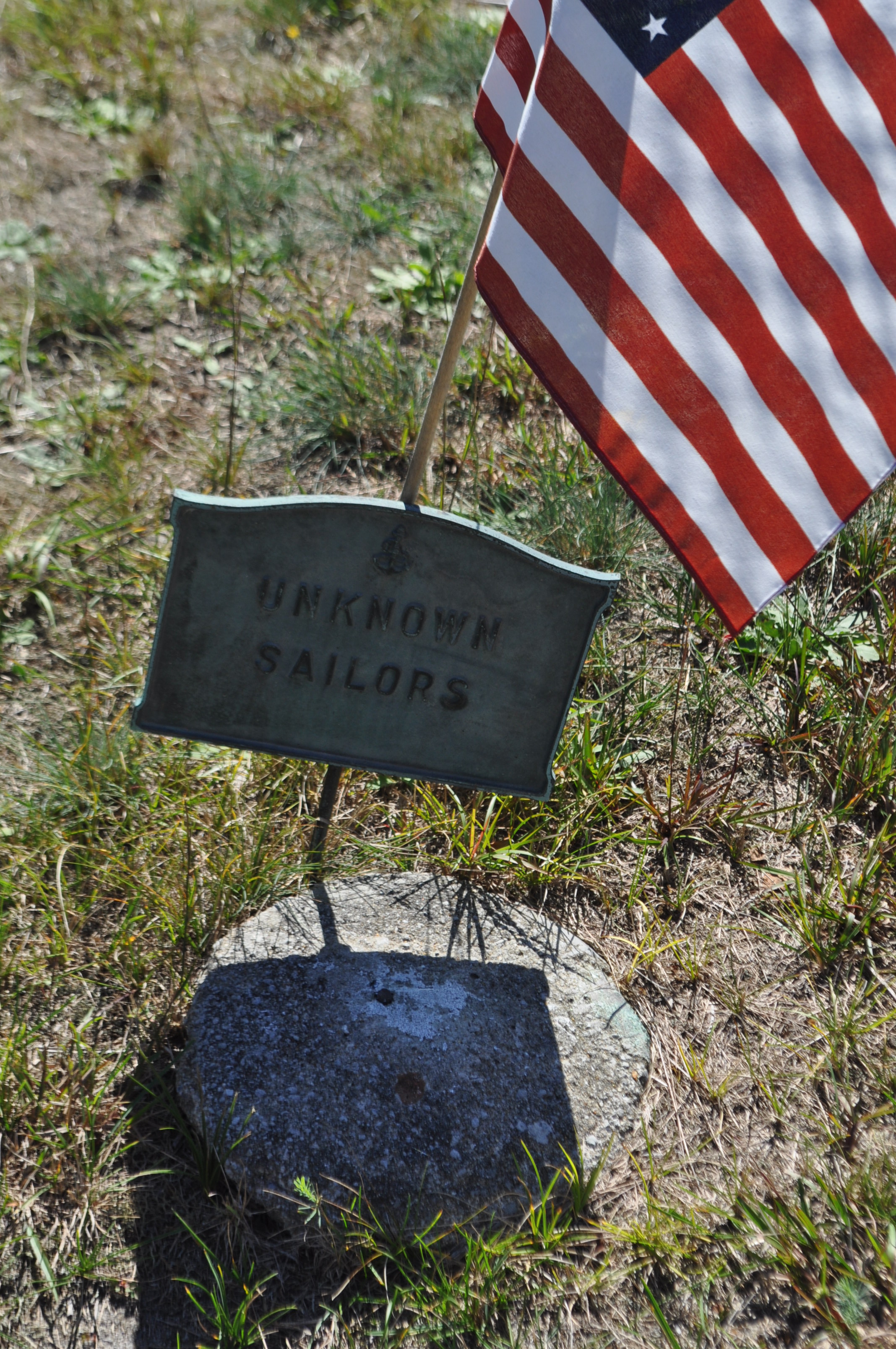
One of the most poignant graves in the South Wellfleet Cemetery is that of the unknown sailors buried there. To me, this marker stands for all the suffering sailors, found and lost, who did not make it past Cape Cod’s “graveyard of ships.”

Stories of the shipwrecks off the Cape Cod coast usually begin with three that are well documented:

  1. The 1626 wreck of the English Sparrowhawk under Captain Johnson on the shoals near Orleans, recorded in Governor Bradford’s diary. In 1863, the ship’s bones were discovered in a mud bank — and hauled into Boston for display on the Boston Common
    Sparrowhawk exhibited on Boston Common

    Sparrowhawk exhibited on Boston Common

    so all could see them.

2.   The British frigate Somerset on Peaked Hill Bars in November 1778. Now at war with the British, the Revolutionary soldiers took the survivors prisoners and marched them up the Cape to Barnstable, and then over to Boston. Colonel Doane of Wellfleet participated. This wreck is exposed from time to time, once in 1885 and another time in 1973.

3. In 1718, the pirate ship Widdah (also Wydah) under the command of Captain Bellamy, off South Wellfleet. The discovery of the wreck and subsequent identification of the ship was one of the premier stories of South Wellfleet in the 1980s.

There are other miscellaneous accounts of shipwrecks off the Cape Coast, but detailed

Clipper ship breaking up

Clipper ship breaking up

recordkeeping began with the Life Saving Service’s establishment in 1872. The location of the Life Saving Stations and their operation was detailed in my last blog post.

If a surfman patrolling the beach noticed a ship in distress, he was to fire a red Coston signal which he carried, signaling to the crew (and the Life Saving Station) that they have been seen and assistance summoned. Now the whole crew and the equipment was rolled out to the beach, with the aid of a horse — which might not be cooperative in the sand-blowing bad weather.

The Life Saving Service drilled constantly — two of the most important were the life boat drill and the breeches buoy drill. For the latter, most stations set up a “wreck pole” – to represent the mast of a ship  — and then would practice firing the Lyle gun to attach the

Lifesaving photo thanks to National Park Service

Lifesaving photo thanks to National Park Service

first line to the ship. That first line had instructions to the crew on how to attach other lines, and then the contraption called the “breeches buoy” would be sent over, with crew members able to fit into it, one by one, and thus be hauled to the shore. This contraption was only useful for wrecks located 600 yards or less offshore. The drills called for the surfmen to be able to set up in five minutes. Today, the National Park Service stages regular demonstrations at the Old Harbor Lifesaving Station in Provincetown.

Ninety-nine years ago, on February 17, 1914, the Castagna, a ship out of Sovona, Italy, went ashore in a storm, landing on South Wellfleet’s shore.  The account of the wreck is

Castagna washed ashor

Castagna washed ashore

especially well-documented.  Perhaps this was a reflection of the times, or because she was one of the last shipwrecks before the Cape Cod Canal opened later in 1914, or just because the writers wrote in a more vivid style.

The ship, whose name is now commemorated on a street name in South Wellfleet, was on a voyage from Uruguay to Weymouth, Massachusetts, south of Boston, carrying guano or fertilizer. She went ashore 3.5 miles south of Cahoon Hollow. Of her crew of thirteen, five perished during the rescue, and one later.

The surfmen from Cahoon Hollow and Nauset stations responded to the ship’s distress, beginning at 5:30 AM, when the patrol saw her and signaled with a Coston light. The ship attempted to move away from the shore, and then tried to put down the anchor — both typical moves in such a situation. The patrolling surfman went to the Halfway House in South Wellfleet and used the telephone to signal to Cahoon Hollow and Nauset.

Initially, the life-saving crew tried to use the breeches buoy, but the sailors on board the Castagna could not secure the line on board the ship. A number of them had climbed up onto the rigging to save themselves, and that’s where four perished. Their frozen bodies had to be cut down. The crew then brought the lifeboat through the heavy snow, and used it to save others, although one man died after they had brought him up onto the beach. Another sad aspect of this wreck was that the Italian sailors did not have suitable clothing for a winter voyage.

By the time the lifeboat rescue was underway, there were South Wellfleet residents

Castagna postcard

Castagna postcard

helping on the beach, although the reports do not indicate who was there. The survivors were taken to the Marconi Station, “a mile and a half away.” There, they were given “approved remedies for frostbite” and by the afternoon, they were all on the train bound for Boston, where they were hospitalized. Six lived, one more man died of infection, and one had to undergo an amputation.

When researching and writing about the Marconi operation in South Wellfleet, I found accounts of a cat named Castagna at the station, supposedly rescued from the ship – which is hard to imagine, given the ferociousness of the storm. But cats do have those nine lives.

Castagna at the Marconi Station -- photo thanks to the National Park Service

Castagna at the Marconi Station — photo thanks to the National Park Service

Not all the shipping incidents were on the Atlantic side of Wellfleet. In 1886, The New York Times reported that residents of Wellfleet noticed distress signals flying from Billingsgate Light. After rowing across the harbor, they found the captain and crew of the George K. Hatch, a schooner that had run aground in a storm, striking Billingsgate Island, and abandoned by the Captain and crew when they put off for the lighthouse. This ship, loaded with sugar, molasses and coco, did not become a wreck, and was expected to float again when the tide turned.

Combing the shore and picking up articles from ships’ cargo was a regular activity of nineteenth century Wellfleet men, and there are many stories of their finds. There is a long-standing mythic story of the treasure of the Wydah buried in a South Wellfleet garden plot. Enoch Pratt, in his 1844 history of the Eastham, Wellfleet and Orleans, notes:

Wrecks and parts of wrecks of vessels and other property were often cast ashore on the back side of the town, and picked up by the inhabitants, who gave oath to it before the town clerk; and the property was taken care of, as the law directed, for whom it might concern. The law required that this be done in all cases, yet it cannot be denied that it was frequently evaded, and the property found appropriated to private use, which has often been the case since.

In his memory piece about his Wellfleet childhood, Charles F. Cole says, “Father often went to the Backside and found something worthwhile saving.” Noting that his memories are of the time before the Life Saving Station, he writes, “It was no uncommon thing to hear the cry of ‘ship ashore at the Back Side.’”  He particularly remembers the wreck of the Aurora loaded with palm oil from Africa. Her casks of palm oil were scattered up and down the beach for one and a half miles. (He does not mention any loss of life.) He tells of ‘men in gangs’ saving the casks from the breakers. Some of the oil had burst from the casks and became hardened lumps on the beach. Cole and his brother got their neighbor, David Brown, to loan his cart, and they carried enough lumps home to their barn to fill eleven barrels. He felt proud because the insurance company paid him $30 for his find. The men in the gangs, he claims, made $100 each.

Today, shipwrecks still evoke great excitement. In late March 1984, when the Eldia went ashore on Nauset Beach, it became an instant attraction that we all just had to trudge along

Eldia aground Nauset Beach 1984

Eldia aground Nauset Beach 1984

the dune to see. In January 2008 a wreck of a 19th century schooner washed up on Newcomb Hollow Beach. These ship bones quickly became another must-see and must-photograph,  a way of connecting to Cape Cod’s past.

Sources

Dalton, J.W. and Frank Ackerman, Life Savers of Cape Cod, The Barta Press, Boston, 1902 (available on Google Books)

Barnstable Patriot (various) online  archive: www.sturgislibrary.org

U.S. Coastguard Station Cahoons Hollow, Massachusetts

www.uscg.mil/history/station/CAHOONSHOLLOW.pdf

“The Notes of Charles F. Cole” manuscript from the Wellfleet Public Library

The New York Times archive.


Posted in Uncategorized | 1 Comment

The Lifesaving Service on Wellfleet’s Atlantic Shore

The Atlantic shore along Cape Cod is known as the “graveyard of ships” — many accounts estimate that 3,000 or more shipwrecks occurred there.   The treacherous shoals along the Cape coast were well known by mariners and avoided when possible. Storms would ground ships pushed toward the shallow sandbars. The ships would soon break under the pressure of the raging water, with their contents and occupants thrown into the bone chilling surf. If a sailor did make it to shore, there were no houses providing refuge, as there was no ocean front property then. No wonder the ‘Back Shore’ of the Cape was viewed as a place of death and destruction.

Although Cahoon Hollow Lifesaving Station is not a South Wellfleet feature, the surfmen stationed at Cahoon Hollow who patrolled the beach covered South Wellfleet’s shore. To the north of Cahoon Hollow was the Pamet River station. To the south was Nauset Beach station in Eastham, one and ¾ miles south of Nauset Lights. The surfmen patrolled the beach, meeting their counterparts at a halfway station where they exchanged identification to prove they were on duty.  The distance between the Cahoon Hollow and Nauset stations was a bit longer than the usual five to six miles that the Life Saving Service had planned.  Descriptions of the Cahoon Hollow patrols indicate that the patrol down through South Wellfleet to meet the surfman walking north from Nauset was four miles.

(Note: in this article, I have chosen Cahoon Hollow as the designation; others call it Cahoons or Cahoon’s Hollow.)

Daniel Lombardo has a photograph of the South Wellfleet halfway house in his book Wellfleet, A Cape Cod Village.  Two of us who are familiar with Professor Hicks’ photographs of South Wellfleet find that the quality of this image suggests that it may be a Hicks photo. The Professor summered in South Wellfleet, having purchased the original Arey House off Route Six, near Old Wharf Road. But where was the building? The four miles required for the Cahoon Hollow patrol south along the beach would be around today’s Marconi Beach.

Long before there were surfmen walking the ocean beach, there were efforts to help shipwrecked sailors. The Humane Society of the Commonwealth of Massachusetts was organized in 1786 in Boston, an idea based on the Royal Humane Society organized in 1774. The Dutch had organized a similar effort in 1767, but the first documented Society, in the early 1700s, was the Chinese Chinkiang. The Massachusetts group organized to stow lifesaving equipment and shelters in certain coastal locations, and to reward individuals who rescued people.  In another effort, the Society offered prizes to anyone who might develop a technique for reviving persons near death by drowning or overcome by smoke or gas.

One of the key Cape Cod documents in the Collections of the Massachusetts Historical Society is the 1802 “Description of the Coast of the County of Barnstable from Cape Cod or Race Point to Cape Malebarre or Sandy Point of Chatham.” This document named the places where shipwrecked seamen could look for shelter. Numerous copies were printed – though I wonder if many seamen could read – and how many were able to pick themselves up from a wintery beach and seek shelter in the huts provided by the Trustees of the Massachusetts Humane Society.  After describing Newcomb’s Hollow, the document goes on to describe a valley called “Pearce’s Hollow” a half mile south, and then Cohoon’s (sic) Hollow a half mile south of Pearce’s, with a description that it is “east by north from the Wellfleet Meeting House, “ then located at the head of Duck Creek, where today Great Pond Road meets Route 6.

Of special interest to South Wellfleet historians is the description of the “eighth valley”, called Snow’s Hollow, which today would be LeCount Hollow, sometimes called Maguire Beach for a later property owner. In one of the early property descriptions of South Wellfleet, the sailor is directed to a house just north of where the road (the King’s Highway) traverses around the head of Blackfish Creek. The writer indicates that there are houses to the left, but these are more remote. The report goes on to describe a ninth valley at Fresh Brook Hollow, and then a tenth labeled “Plum Valley”, two and one half miles south of Fresh Brook.  Between Fresh Brook and Nauset there are houses “scattered all over the plain, open country, but none of them nearer than a mile to the shore.”

In 1807 the Humane Society huts were equipped with firewood and provisions. Presumably, there were volunteers who checked the sites and kept the supplies. Later, in some locations, lifeboats were stored.  One of the Humane Society‘s projects early in the 19th century was to develop a lifeboat, a 30 foot cork-lined vessel.

In his memory piece on Wellfleet, Charles F. Cole describes a “Charity House” put up by the Humane Society and containing wood and a few other things for use of those who were cast ashore. He places one “about ½ mile north of the Hollow near Cook’s Camps.”  That Hollow would be Lecount or Maguire’s Beach.

The 1876 Humane Society report notes that there was only one hut in Wellfleet. The same report notes that the Society had lifeboats at Newcomb Hollow and Cahoon Hollow, and also a place unfortunately named “Ni**er Hollow” — this is the only reference to such a name in Wellfleet I have seen. The latter had the Hut of Refuge and a surfboat, and was the responsibility of Justus Higgins in 1849 and Seth H. Baker in 1858. These men were paid $15 a year for their work.

Since the surfmen had to walk four miles to their Halfway House, I’m not sure this structure was re-adapted in the 1870’s, as the distance from Cahoon Hollow to this location would not be sufficient.

Congress appropriated funds in 1845 to assist the Humane Society. Nevertheless, another 25 years would pass before the Humane Huts were declared inadequate for the job. In 1871, after a number of fatal disasters along the coast, the U.S. government established the Life Saving Service. The stations were to be three to five miles apart. Cahoon Hollow station was one of the first to be built, in 1872, along with Nauset and the others along the outer Cape.

The U.S. Department of the Treasury arranged for the use of the land for Cahoon Hollow station with E.P. Cook, who was mentioned in a previous blog piece as the man selling land

Cahoon Hollow Station with nearby house

Cahoon Hollow Station with nearby house

to Marconi for his operation. It does not appear that the land was actually purchased, but that the government would “use and occupy” the site for $51.00. The fee appears to have been a one-time arrangement.

William Newcomb was the first keeper of the Cahoon Hollow Station. It appears that the Service applied the same title as the Light House Service. Eventually, the military organization of the Service changed the keeper’s title to Captain. In 1879, Daniel Cole became Captain of the Cahoon Hollow station, and remained in that position until 1905, when he retired.

Captain Cole was an honored citizen of Wellfleet. His family was one Welfleet’s originals. Born in 1844, Daniel had fished off the Grand Banks, and then went to seek his fortune on

Cahoon Hollow Station with crew

Cahoon Hollow Station with crew

the Great Lakes at age 19. When the Civil War broke out, he enlisted with the 12th Illinois Regiment, Company K, Second Brigade.  He fought in numerous engagements and was part of General Sherman’s “march to the sea.” He returned to Wellfleet, and joined the Life Saving Station as a surfman at the close of the fishing season in 1872. Cole’s military service, along with his knowledge as a mariner, must have made him the perfect choice as Captain.

The structures built for each station were each the same — two stories with a sitting room, mess room, kitchen, keeper’s office, and storage for the surfboat and beach apparatus. The equipment could easily be rolled out on a sloping platform. The men slept in dormitories on the second floor where there were also additional beds for rescued victims. All the

Cahoon Hollow Station with cupola

Cahoon Hollow Station with cupola

structures had a sixty-foot flagstaff where International Code signals were used to communicate with passing ships. The station was manned from August 1st to June 1st, but the keeper or Captain was on duty throughout the year.

When the Service began, keepers were paid $200 a year; by 1902, their annual pay had risen to $900.  Various writers mention the surfmen’s salary of $40 per month when the Service began, but these accounts may not be correct, as this would make the surfmen’s wages higher than their boss’.  By 1902, the surfmen were paid $65 a month.  Most stayed on the job for an average of two years.

The surfmen, numbered in terms of their seniority and accomplishment from One to Six or Seven, patrolled the beach every night and on foggy or “thick weather” days. There were six men at a station from August to November 1st , when a seventh was added.  On clear days, a watch was kept from a station lookout. The patrols could be exhausting on bad weather nights, when a surfman had to hold a wooden shingle in front of his face to keep sand out of his eyes, and walk into the wind. The night had four watches: from sunset to 8 PM; 8 to 12 AM; 12 to 4 AM; and 4 AM to sunrise. Two men went out on watch, and set out in opposite directions. If his counterpart from the neighboring station did not meet him at the halfway house,  then after a reasonable wait he had to keep walking until he met him, or even going as far as the next station to find out what happened to the other surfman. Initially, when a wreck occurred, someone had to go to the next station to round up additional rescuers, if needed. Later, a telephone signaling system provided communication between stations.

After making a number of rescues, surfmen began to develop a mythic status, as“warriors of the sea.” The surfmen’s motto was “You have to go, but you don’t have to come back.”

Life Saving Hero

Life Saving Hero

They had strong public support.  One of the historians of the Life Saving Service gives credit to the public relations skills of Sumner Kimball, the head of the Service.  Today we give such high status to firemen and other “first responders.”

Every station was run the same way, with certain duties prescribed for each day. On Monday, the station was put in order; Tuesdays were for lifeboat drills; Wednesdays for studying International code signals; Thursdays for the beach apparatus and breeches buoy drills; Fridays for resuscitation drills; Saturdays was wash day; and Sundays for religious observation and relaxation.

The Cahoon Hollow Station burned to the ground in February 1893. It was rebuilt in 1895, taking longer to construct because there were property ownership issues. The Barnstable County Deeds database refers to some transfer of property from E. P. Cook to Daniel Cole

Cahoon Hollow Station - Cole home?

Cahoon Hollow Station – Cole home?

at around that time, and later deeds refer to Cole’s property next to the three acres of Life Station land. (One of the photos shows a house near the station.) All the men lost personal possessions in the fire, and there’s an interesting document available on line that lists what each person lost and the reimbursement sought. Interestingly, Mrs. Cole lost a number of personal possessions in the fire as well — a Barnstable Patriot news article said she was living there.  Her reimbursement caused some consternation at the Service; one assumes this was outside the rules. During the time the station was being reconstructed, the crew operated out of the Coles’ barn.

Daniel Cole retired in 1905 – some accounts say he was forced to do so for health reasons. The Life Saving Service mandated an annual physical exam, and perhaps he did not pass.  In his 1902 account of the Cahoon Hollow station, Dalton counts their rescues at 16 vessels, 124 persons, with one life lost. I plan to write more about the actual shipwrecks in another post.

In 1915, the Life Saving Service was combined with the U.S. Revenue Cutter Service to form the U.S. Coast Guard. There were other changes in play that soon came along. The life saving techniques developed for wooden ships of the 1870’s – and those in trouble had to be fairly close to shore — were now needed for more motor-driven boats, and more recreational boaters — not commercial nor passenger vessels. There were also major improvements in weather prediction. Marconi’s wireless allowed ships to signal distress while at sea, and rescues were handled by other ships. But the most important change was the opening of the Cape Cod Canal in 1914 that gave ships an alternative route to Boston Harbor.

The Coast Guard continued beach patrols until after World War II — my mother told stories of going to the “Back Shore” to the beach during the war when the patrol would seize and take the film out of any camera. The Cahoon Hollow station was deaccessioned in 1950 when the Cook family sold the land  –part to the Town of Wellfleet.

An added note: in researching the Life Saving Service for this article, I found an article in the journal Historical Archaeology about the existence of a Halfway House in South Truro, the site where the surfmen of Cahoon Hollow and Pamet River stations would have

Truro Halfway House between Cahoon Hollow and Pamet Stations

Truro Halfway House between Cahoon Hollow and Pamet Stations

exchanged their identification and rested up for the walk back to the station. The 1972 article notes that little was left of the structure but someone did take a photo of it in 1963, displayed here. When the “dig” occurred, fragments of clay pipes manufactured in Glasgow, Scotland were found, along with patent medicine bottles, a wine bottle and a whiskey bottle. The author notes that these artifacts were turned over to the Wellfleet Historical Society. There was also evidence of a coal burning stove to keep the men warm as they rested halfway through their beach patrol.

Sources

Collections of the Massachusetts Historical Society, Volume 8, 1802 description of the Coast of the County of Barnstable from Cape Cod or Race Point to Cape Malebarre or Sandy Point of Chatham.

Dalton, J.W. and Frank Ackerman, Life Savers of Cape Cod, The Barta Press, Boston, 1902 (available on Google Books)

Massachusetts Humane Society website:  www.masslifesavingawards.com/history

U.S. Coastguard Station Cahoons Hollow, Massachusetts

www.uscg.mil/history/station/CAHOONSHOLLOW.pdf

Daniel Lombardo, Wellfleet: A Cape Cod Village,  Arcadia Publishing, 2000

Barnstable Patriot (various) online  archive: www.sturgislibrary.org

Barnstable County Deeds available at www.barnstablecountydeeds.org

“The Notes of Charles F. Cole” manuscript from the Wellfleet Public Library

“The Truro Halfway House, Cape Cod, Massachusetts,” by Edward J. Lenik. Historical Archaeology, Volume 6, 1972, pp. 77-86.

History of the Humane Society of The Commonwealth of Massachusetts, Boston, 1876 (on line at archive.com)

David Kew’s Cape Cod History site: www.capecodhistory.us.


Posted in Uncategorized | Leave a comment

Marconi Station Operations in South Wellfleet

Marconi Towers from path. Photo given to me by Ed Ayres. Possible F.C. Hicks photo

Marconi Towers from path. Photo given to me by Ed Ayres. Possible F.C. Hicks photo

Early in 1904, Mr. Paget and Mr. Taylor — Marconi engineers — came to South Wellfleet to prepare the Marconi station to become part of the company’s service of press and

private messages for subscribing ships at sea on the transatlantic route.  The South Wellfleet station operated for 15 years, under three sets of letters:  first, “CC” for Cape Cod; then “MCC” for Marconi Cape Cod; and finally “WCC” when all eastern U.S. stations took the “W” prefix.

I’d like to think that this period gave South Wellfleet an opportunity to be less of a “backwater” and more importance as a place where a very modern activity was taking place. Marconi Station put a bit of a polish on South Wellfleet.

Color photo postcard of the Marconi site pub by Everett Nye

Color photo postcard of the Marconi site pub by Everett Nye

Each day in Boston the news dispatches and private messages were sent by telegraph to South Wellfleet where the station now had its own telegraph operator.  By 10 PM, the wireless station had punched the messages into a paper tape, and the spark transmitter began a nightly operation. They repeated the program three times a night with 15 minute intervals between each transmission.

During these years, several Wellfleetians played significant roles in its operation.  In the 1910 Federal Census, I found several people who worked there, and still others are mentioned in various accounts of the Marconi operation.

Harold Higgins, age 24, worked as rigger at the Wireless Station. Eva Higgins, his 23-year-old wife, is listed in many accounts as the cook and housekeeper for the Marconi staff, but the census taker did not note that. Perhaps she did not work there until later.

Mrs. Higgins, Marconi Cook

Mrs. Higgins, Marconi Cook

Higgins’ father-in-law, Melgar Pierce, is listed in some accounts as a rigger, as is Lewis Paine, who is 62 years in the 1910 census. Herbert Nickerson, age 34, born in Massachusetts, is an engineer at the Marconi Station, and has been married to his wife, Ethel, age 27, for one year. At the Marconi Station itself, Oscar Christianson, born 1884 in North Dakota, is the manager.  Samuel Campbell, born 1882 in England to Irish parents, is a machinist. Richard Coffin, born 1885 and from New York, is an operator.  John Simpson, born in 1884 in Ireland, is an operator.  Adolph Brunner, a German born in 1885, was listed as a cook.

George Kemp, an Englishman who was mentioned in the previous article as Marconi’s chief assistant, met the Kemps of Wellfleet on his visits, but it’s not known if there was a direct relationship between the families.

Carl Taylor, the engineer mentioned above, settled in Wellfleet himself. In the 1920 census, he is living with his mother-in-law, Mary Tubman, and his wife, Mabel. Carl Taylor had come over to the Cape from England, and met Mabel at the station where she had

Marconi Station crew. Last man on right is Nickerson. Photo furnished by Walter Campbell

Marconi Station crew. Last man on right is Nickerson. Photo furnished by Walter Campbell

been a housekeeper helper. Mr. Taylor died in 1968, at age 93, having served as a Vice President of RCA Global Communications, retiring in 1941. He and his wife came back to Wellfleet during the summers. He kept up his local interest in the South Wellfleet station, as discussed below.

Samuel Campbell married Ethel Townsend of Wellfleet in 1914. His 1962 obituary listed him as a founding member in 1837 of the South Wellfleet Neighborhood Association. His son, Walter Campbell, was part of the 1963 dedication of the Marconi site in the Cape Cod National Seashore.

Everett Nye, the Wellfleet Postmaster, produced the postcard shown above. He must have been closely engaged with the Marconi event, as he also took the image on the card and had it made into a commemorative plate, sending it to England for manufacture and

Marconi Plate

Marconi Plate

importing it through Boston. The photo I was able to download is from a Christie’s auction.

Another important wireless station staff, Irving Vermilya, was the manager of the South Wellfleet station in 1914. As a boy, he was fortunate to meet Marconi and set his sights on a wireless career. When he was old enough, he became a wireless operator at sea, and then was chosen to manage the station. He wrote a piece later in life about those days, commenting on the need to have good food at the Station, and reminiscing about the days when World War I started, and the Navy moved in to protect the Station but forgot to put bullets in their guns.

Vermilya served at WCC Marconi Station during the War with the Station under the control of the U.S. Navy.  In 1912, after the Titanic disaster, when the U.S. Government began to require that all wireless operators take a test and be licensed, he went to the Brooklyn Navy Yard immediately and became the first license issued. Later, he established one of the first radio stations serving the Cape, in New Bedford, and is still remembered today as a talented ham operator who helped promote amateur radio efforts throughout his career.

Another memory of the South Wellfleet Station came from Marguerite Barker of the fourth generation of the Barker family which I’ve written about previously. In a letter to The Cape Codder , she recalled visiting her grandfather, George W. Barker, in South Wellfleet.

Mrs. Higgins with the butcher wagon

Mrs. Higgins with the butcher wagon

Mr. Barker’s farmhouse still stands, just south of the Old Wharf. She remembers the summer vacations she spent in South Wellfleet, and then recalls:

…riding over the sand roads with Grandpa to deliver butter, eggs and garden crops to the several men stationed at the Wireless plant. The trip was never completed without a run down and up the big dunes at the back shore. There were no bathers or picnic parties in those days. At night we’d watch the many-colored flashes from the tall towers, indicating more messages being sent somewhere. The four huge steel towers were a landmark and could be seen from many miles around. From the Boston boat, long before the Provincetown shoreline was visible, the passengers could plainly see the four towers rising majestically. To me, they marked Grandpa’s town, dear old South Wellfleet.

Other South Wellfleet residents are remembered in accounts of the Station. Degna Marconi writes that “Billy” Hatch (William Hatch) was a local watchman for the Station who amused himself by playing a triangle and singing while keeping watch. This must have occurred in the early period when Marconi was still visiting. Marconi noticed Billy’s musical interest, and invited him to the station on one occasion — and played the piano while Hatch sang for him.

Degna Marconi mentions Eliza Doane as the woman who “patched and sewed and mothered the men” at the South Wellfleet Station.  This would be the mother of Fred Doane written about in a recent post. The Higgins family who also helped lived closeby to her residence in the census documents, as was William Hatch.  More than one account mentions Fred Bell as having a butcher wagon that would bring meat to the South Wellfleet Station.

A startling accident occurred in 1907 when the operator, Arthur Dakin, was found dead, electrocuted, in the operations room at the South Wellfleet station. Reports of the death concluded that he had been “experimenting” on his own.

When World War I broke out, the U.S. Navy moved to protect the wireless stations, and when the U.S. entered the War in 1917, the government actually seized the stations. Until February 1918 the U.S. Navy operated the Station, and then closed it and moved its operations to Marion, Mass., and, later, to a new station in Chatham.  By the time this

Remains of Marconi in 1941. Photo J.C. Hicks

Remains of Marconi in 1941. Photo J.C. Hicks

decision was made, the erosion in South Wellfleet was apparent. The Navy disliked private operations, and, under its  pressure, in late 1919, Marconi sold its American radio assets to the newly formed General Electric Corporation’s Radio Corporation of America.  The operations at South Wellfleet were moved to Marion, Massachusetts.

The now abandoned South Wellfleet station fell into disrepair, and the loss of the dune

Tower base photo by Fred Parsons

Tower base photo by Fred Parsons

during storms caused the towers to start falling down. I’ve posted photographs from the 1920s and 1940s which show the slow destruction.  In the 1920s two Orleans contractors bought the plant from the government, salvaging the bricks and timber, trucked them to Orleans, and used them in cottage construction at Nauset Bluffs.

We also have today in South Wellfleet  the “Wireless Road” that travels through the woods to LeCount Hollow Road. When you visit the Cedar Swamp in South Wellfleet, you will walk on a piece of that original road. The swamp is mentioned in the deed of the property.

Sam Campbell at site; photo by Walter Campbell

Sam Campbell at site; photo by Walter Campbell

The U.S. Government kept the land and, after operating for some time as a Naval Station, the area became the U.S. Army’s Military Reservation Camp Wellfleet, a feature of South Wellfleet I’ll cover in a future blog.  Eventually the land was folded into the Cape Cod National Seashore.

In 1938, as the South Wellfleet Neighborhood Association was organizing, The New York Times wrote about plans the group was pursuing to establish a memorial at the Marconi site. They were considering asking the federal government to establish parkland for such a site. World War II intervened, and in the late 1940s, additional newspaper accounts reported on the plans to memorialize the Marconi site. Marconi did not live to witness the War, as he died in 1937. But he did begin spending more time in his home country during the late 1920’s, and divorced and remarried during that time. His second wife was a much younger Italian woman, and Benito Mussolini was the

Marconi Towers tumbling down the dune. Possibly Fred Parsons photo

Marconi Towers tumbling down the dune. Possibly Fred Parsons photo

best man at his wedding. This was an unfortunate ending to Marconi’s career, joining the Italian fascists. Maybe this aspect of Marconi’s life made the U.S. Government less interested in the memorial.

In 1950 the South Wellfleet Neighborhood Association established a granite marker commemorating his work, and placed it at the Wireless Road/LeCount Hollow Road corner. (Today, this granite marker is at the National Park Marconi site, on the left side of the sidewalk as you enter the Interpretive Shelter.) Carl Taylor made a speech that day in 1950 remembering his old boss, and Samuel Campbell was on the Committee.

The Marconi site is a well-marked place within the Cape Cod National Seashore today. When the shelter structure was built near the remains of the Marconi site, Carl Taylor

1963 Marconi site dedication

1963 Marconi site dedication

attended the dedication, as did Samuel Campbell’s son. In 1969, the National Seashore named the nearby beach “Marconi Beach.”  In 1974, a group of Italian businessmen, paid for a bust of Marconi to be added to the site. It was stolen in 1989, but recovered, and now is on display in the Headquarters Building near the site.

At some point, in the early 1960s, the daughter of the Higgins family mentioned above, Lyndell Higgins, served as the secretary to the Superintendent of the Cape Cod National Seashore.

This past year, as the 100th anniversary of the 1912 Titanic disaster was remembered, the Marconi site was given attention once again for the role wireless telegraphy played in helping bring the Carpathia to the sinking ocean liner to help save hundreds of passengers.

Sources

Marconi, Degna, My Father Marconi, on line at www.archive.org

Barnstable Patriot online archive: http://www.sturgislibrary.org

www.earlyradiohistory.us

Federal Censuses online at www.ancestry.com

The New York Times archive

Newspaper account on line at www.genealogybank.com

Cape Codder online at www.snowlibrary.org

Cape Cod National Seashore website

Photographs on the site: www.picassaweb.google.com/egcrowell6/wellfleetmarconipictures

Posted in Uncategorized | 6 Comments

Mr. Marconi Builds His Station in South Wellfleet

In May 1901 an article in the Barnstable Patriot reported that a wireless telegraph system was underway in South Wellfleet, describing it as a “plant” that would operate the Marconi system “…by which signals can be exchanged with passing ships.” Marconi and his engineer, R. N. Vyvyan, decided to build a structure that would duplicate the structure at Poldhu, an antenna system of 400 wires suspended in a vertical cone from a 200 foot circle of twenty 200-foot-high masts. Vyvyan stayed in South Wellfleet to oversee the construction.

Vyvyan claims in his later accounts of his work with Marconi that he had doubts about the design, but was ordered to build it. Most accounts of Marconi’s work tell that the local people warned that the masts would blow down in the next nor’easter. Vyvyan also reports that he had trouble with the locals people since too many came to watch the work at the construction area. He had to build a fence to keep them to hold them back.

While building the station at South Wellfleet was underway, Marconi continued testing from Poldhu, and a test between there and Ireland prompted him to find another North American landfall. He traveled again across the Atlantic, and was welcomed in St. John’s, Newfoundland — at that time an English colony, not a province of Canada. He assembled a receiver at Signal Hill in St. John’s, the site of the final 1762 battle culminating in the French surrender to the British.

On September 17, 1901, the ring of masts at Poldhu collapsed during a storm. A few weeks later, on November 25, the South Wellfleet masts went down, as the locals had predicted. Marconi was told that it would take three months to rebuild Poldhu, but he got it done in

South Wellfleet with masts

South Wellfleet with masts

just two months by devising a simple aerial that worked. Marconi was struggling at St. John’s as well, raising a kite there to hold the antenna aloft. Fortunately, this worked for a short time over a few days.

On December 12, 1901, Poldhu sent a signal to St. John’s in Newfoundland, a simple Morse code “S” of three clicks. This was done in daylight, before Marconi learned that longer distances could be covered better at night. There was no independent confirmation, and some press coverage raised doubts about his accomplishment.

Nevertheless, as press accounts of Marconi’s success spread throughout North America and Europe, the Anglo American Telegraph Company sent a stern warning to Marconi that they had a negotiated agreement with the government in Newfoundland providing them a monopoly on the telegraph business, going back to the time in the 1850s when the cable

SW original station PHOTO Charles F. Rollins

SW original station
PHOTO Charles F. Rollins

had been laid. Marconi knew of this monopoly, and had initially claimed he was experimenting with communications between ships at sea. At this point, the Canadian government stepped in and offered Marconi a place and funding to continue his North American work.

The Canadian Marconi site was in Glace Bay on Cape Breton Island in Nova Scotia. Like the site in South Wellfleet, Glace Bay was elevated providing an unobstructed view out over the ocean. In 1902, the Marconi team worked on both Glace Bay and South Wellfleet construction. On December 12, 1902, the first radio message to cross the Atlantic from west to east went out from Glace Bay.

Reconstruction in South Wellfleet began in 1902. The plan called for a staff living quarters, a boiler room to produce steam to generate electricity, a separate equipment room to concentrate power and produce a spark (South Wellfleet was a “spark transmitter”), and a

Horse team near Marconi station

Horse team near Marconi station

room for operators to send and receive messages. Newspaper accounts reported that fifteen cars of “Oregon pine” for construction were sent to South Wellfleet on the railroad — that must have been an exciting day in the village!

The most visible part of the South Wellfleet station was the latticed towers of red-painted wood. The towers were set at the corners of a square with 200-foot sides. Each 210 foot

Postcard of New South Wellfleet Station

Postcard of New South Wellfleet Station

tower was 24 feet square at the bottom and eight feet square at the top. Each was set into a four-foot-thick slab of concrete. Twelve steel cables secured each tower against the high winds on the dune. The aerial rigging was a conical arrangement of 200 wires converging in midair just above the transmitter house and feeding-in through a single wire.

When Marconi came to South Wellfleet to check on construction work, he stayed at the town’s only hotel, the Holbrook House.  His daughter’s account of his time in Wellfleet recalls that he disliked the food served there, and would import his own food and wine from Boston.  Another account of his visits to the Cape was in a newsletter about the Hopkins family history, where a boy who grew up in Truro remembered the visits from Marconi to his mother’s boarding house on weekends. Marconi would get a horse from the livery stable next to the Holbrook House, and travel to Truro because this woman knew how to prepare Italian-style food. And, despite her daughter’s membership in the Women’s Christian Temperance Union, she allowed Marconi to bring wine to the table for his own use.

Later, after living quarters were ready in South Wellfleet, Marconi stayed there and presumably had his desired food and wine waiting. In the photo shown here, the living

Interior of Marconi Bungalow. Photo furnished by Walter Campbell

Interior of Marconi Bungalow. Photo furnished by Walter Campbell

quarters had a piano which Marconi had brought in, as he enjoyed an evening of music.

Now we move on to January 1903 as Marconi and his team prepared to actually use the South Wellfleet station. The story of the days leading up to the transmission was captured in a 1915 article in The Wireless Age by Frank Stockbridge, a journalist who was assigned to follow Marconi that month. Stockbridge worked for the New York Morning Journal, a Hearst newspaper. William Randolph Hearst wanted to be the first to send the message to England, to the editor of the London Times. Stockbridge was assigned to make this happen. He left on a train from New York on a Wednesday, and by Friday he arrived at Sydney, Cape Breton, fifteen miles from Glace Bay, where Marconi was working.

Marconi invited him into the wireless room there, telling him to stay two-feet away from the apparatus — because sparks jump – and to put his fingers in his ears.  Stockbridge wrote, “ …the noise was like a machine gun firing, continuously“ and “High sparks jumped from the knobs of the immense Leyden jars that filled the center of the room.”

Marconi spoke about the day when all ships would be equipped with wireless and able to summon help immediately. Stockbridge asked Mr. Hearst’s question about sending the message, and Marconi did not say “no,” but indicated he might agree “…unless President Roosevelt wants to send a message to the King of England.”

Stockbridge filed a 5000-word interview, using the telegraph line from Sydney to the Morning Journal. Marconi loved the story. He invited Stockbridge to travel with him to the Cape – they went by train – and the other Boston reporters on the last leg of their journey thought that Stockbridge was Marconi’s secretary.

When they arrived in Wellfleet, the staff living quarters was occupied by Marconi’s engineers, and Stockbridge had to go to the hotel – presumably the Holbrook House.  Stockbridge indicates that there was only one telegraph operator in Wellfleet, and that man was also the station master, the freight agent, and general man for all work. Unfortunately, news dispatches were too much for him – he was used to ten-word messages. (The Degna Marconi book puts the telegraph in the hands of Mr. Swett in South Wellfleet, but all other accounts have the messages sent from the Wellfleet Railroad Station’s telegraph office.)

The only public telephone was in the Wellfleet post office, and Stockbridge convinced the Postmaster — who was Everett Nye at that time — to give him a key so he could make calls at night when other newsmen could not hear him. Talking to New York proved to be an impossible distance, but he could get through to Hearst’s Boston paper, and then they would send a telegram to New York for him.

After spending a week or so in Wellfleet, Marconi sent for Stockbridge on a windy evening and told him that the message was to be sent that night. Now it had been decided: the Roosevelt message would be sent first, and a second message would go from William Hearst to the London Times.  However, I could not find anything further about the second

old print of Marconi Bungalow taken from a height, no ID

old print of Marconi Bungalow taken from a height, no ID

message. Stockbridge returned to his spot by the public telephone, and Marconi called him — there must have been a phone at the Marconi station – and Stockbridge scooped the other reporters.  Since this was a memory piece, written many years later, some of the details may be unreliable.

Marconi’s daughter, Degna, also wrote about that night in her 1962 book My Father, Marconi.  The message was planned to go to Glace Bay in Canada, and directly to Poldhu.  On the night of January 18, between nine and eleven o’clock, it was sent:

His Majesty, Edward VII, London, England.  In taking advantage of the wonderful triumph of scientific research and ingenuity which has been achieved in perfecting a system of wireless telegraphy, I extend on behalf of the American people most cordial greetings and good wishes to you and all the people of the British Empire.

Theodore Roosevelt

To Marconi’s great joy, the message was received in England directly and a return message

Composite view from old poster made by H.R. Hicksdisplayed in QST Magazine

Composite view from old poster made by H.R. Hicks
displayed in QST Magazine

sent from the King:

To the President, the White House, Washington, America: I thank you most sincerely for the kind message which I have just received from you through Marconi’s transatlantic wireless telegraph. I sincerely reciprocate in the name of the people of the British Empire the cordial greetings and friendly sentiment expressed by you on behalf of the American nation, and I heartily wish you and your country every possible prosperity.

Edward R., Sandringham, January 19, 1903.

The reportage of the Marconi accomplishment also includes the story of Charlie Paine, who stayed at the South Wellfleet station through the evening, wrapped in a warm coat and with blankets on his horse, Diamond, until Marconi appeared in the doorway with the two

Charles Paine

Charles Paine

envelopes containing the messages to be telegraphed to Washington and New York.

To capture the Cape Cod spirit, the story also  tells of Marconi urging Charlie to make his horse fly like the wind to the Wellfleet Telegraph office, and how Charlie slowed down as soon as he was out of sight, illustrating the general Cape Codder skepticism about the Marconi venture. Charles Paine was over eighty when the South Wellfleet Neighborhood Association was formed in 1937 — and their promotion of him as a local character helped to fix his reputation.

Degna Marconi’s account also mentions the flood of messages to the Cape following the transmission. The King of Italy sent a half-page of congratulations, via the Provincetown telegraph office, and they transmitted it to the South Wellfleet Little Store where the “fatigued storekeeper and his pretty clerk had been standing by the wall telephone with a pencil in hand trying to take down the names of men of importance. It was stunning to contemplate.”

Sources

Frank Parker Stockbridge “An Adventure in Wireless in Popular Electricity and the World’s Advance, March 1915

June 2008 newsletter of the Pilgrim Hopkins Heritage Society

Marconi, Degna, My Father Marconi, on line at www.archive.org

Barnstable Patriot online archive: http://www.sturgislibrary.org

www.earlyradiohistory.us

Newspaper archive at www.genealogybank.com

The Cape Codder archive online at www.snowlibrary.org.

Posted in Uncategorized | 1 Comment

Mr. Marconi Comes to South Wellfleet

January is a good month to write about Marconi and the years his company operated in South Wellfleet. On January 19, 2013, we’ll be celebrating the 110th anniversary of his historic accomplishment. Marconi’s choice of South Wellfleet as his American site to carry out his venture was the village’s most important moment in history, and has put it on the world map forever. As I’ve pulled together this post on Marconi, I found that I needed to understand what he was trying to accomplish, as well as look for evidence of his impact on South Wellfleet.

When Guglielmo Marconi arrived in South Wellfleet in 1901 he was already quite famous. The Wellfleetians who helped him and his project, even if they did not fully understand what they were participating in, must have realized it was to be an important moment.

Marconi was born in Bologna, Italy, on April 25, 1874, to Giuseppe Marconi, a successful businessman, and his wife, Annie Jameson, of the Irish distilling family.  There are many books, journal articles, newspaper accounts and websites  that provide details on the whole of Marconi’s life and work. Marconi was tutored at home as a child and learned English. He was brought up as an Anglican, which demonstrates his mother’s influence on his life.  He showed an early interest in electricity and knew about Benjamin Franklin.

As a teenager, he attended the Technical Institute in Leghorn, where he learned the Morse Code and became interested in electronics. Recognizing his interest and abilities — after his stern father became convinced that his experiments were worth supporting — his parents hired a well-known Italian physicist, August Righi, of the University of Bologna, to tutor him. By the time he was 16, Marconi was sending wireless messages in Morse Code, using home-made electronic devices and tin plates hung in his parents’ vegetable garden.

Marconi had read about the possibility of signaling by electromagnetic waves first discovered by German Professor Hertz in 1888. Many inventors had thought that these waves could be a way to signal, but it was Marconi who worked-out the practicalities and disproved certain assumptions, like the fact that the transmission did not have to go in a straight line with nothing else in the way. Marconi worked out the issues of long-distance transmission, and by 1895 he successfully transmitted the Morse Code “S” to his brother on the other side of a hill, more than a mile away. This experiment gave him significant attention, and his work became well-known.

Unable to convince the Italian authorities to support him, Marconi moved to England and began to work with the British Post Office, where experiments with wireless had been underway, but thus far not successful.

Soon the government was supporting Marconi’s work. He gained the attention of Queen Victoria when he reported the outcome of a yachting regatta simply transmitting the immediate results of the race. Another story told of his reporting to the Queen the accounting of the Prince of Wales’ injured knee by transmitting between the royal yacht — which may have been at the Regatta — and the Queen. The Prince became King Edward VII soon after, and perhaps this event helped the King’s interest in becoming the first to receive President Roosevelt’s message a few years later.

The years in England were the important ones for Marconi’s work, and on March 27, 1899, he successfully transmitted across the English Channel. By that autumn, the New York Herald invited him to the United States to report on another yachting event, the America’s Cup. The investment paid off, getting the results of the race first. Next the United States

The young Marconi

The young Marconi

Navy called on him to transmit between two of their ships, and that was accomplished at a distance of 36 miles.

Marconi formed his American Marconi Company. In March 1900 he obtained a patent for his invention that allowed a wireless transmitter to be tuned to a particular station, just as a radio is tuned. That year, he set up his high-powered transmitting station at Poldhu, on the Cornwall Coast in England, and soon was transmitting up to 150 miles — and even further by increasing the station’s power. Then he began looking for a place on the American coast to set-up similar equipment.

In March 1901 Marconi and his engineer, R. N. Vyvyan, and perhaps his assistant, George Kemp, went to Cape Cod, which they had identified as the most suitable place on the North American coast to receive a wireless signal from Poldhu in Corwall. Several accounts tell of Marconi meeting Edwin P. Cook of Wellfleet at the Boston boat in Provincetown, and describe Cook as a “wrecker” to lend credence to Cook’s ability to know the coastline well. However, I think Cook was more than that; he was a businessman who saw Marconi’s plan as an opportunity both for himself and the town.

E. P. (Edwin Payson) Cook had lived in Wellfleet all of his adult life, after growing up in Scituate, Massachusetts. The 1860 Federal Census records show that his father was not in the home there, and his mother was listed as the head of the family. The father had been a mariner, and he may have died at a young age.

As the oldest son, Cook may have felt a particular need to succeed and support his family. He married Eliza Hopkins in Wellfleet in 1864, at age 20, and in that record and those of the birth of their sons, he is listed as a “caulker,” a likely occupation in a town that lived on the work of its ships and schooners. Nevertheless, Cook undertook a number of other businesses: lumber, fish, wrecker and oil manufacturer, collecting the oil of the blackfish that regularly grounded there.

By the 1890s he was a Selectman of the town. He also had multiple real estate holdings. He and Eliza had three sons: Arthur, Herbert, and Ralph.  We do not know how Cook came to be the man who met Marconi in Provincetown, but it makes sense that this Wellfleet businessman would be the one to guide Marconi.

There had been some thought given to Barnstable as a place to locate the Marconi station, because materials could easily reach there from Boston. However, upon inspection, it was found to be too close to the mainland, and the arm of the Cape extending father out into the ocean looked more suitable. Florence Cook is quoted in an article that her father-in-law “…drove Marconi from Provincetown to Chatham” looking for a likely spot.

They made an effort to locate near Highland Light, but were rebuffed. Accounts of the search indicate that the Highland Light staff were not welcoming, and they thought Marconi a “foreigner” and a “charlatan.” The Lighthouse had been the site for many years of the ship-spotters who made visual contact with a ship headed to Boston, and telegraphed its arrival. A wireless transmission would take that task away from them.

Eventually, Cook took Marconi to South Wellfleet to some land he owned, and a deal was made to sell him the 8 acres on the dune for $250. When I looked for the deed for the transaction, I found it to be between Herbert and Florence Cook, Ed Cook’s son and daughter-in-law, who were the owners at that point. Marconi was represented by a John Bottomly, who my research discovered was the Vice President and General Manager of the Marconi Wireless Telegraph Company of America. In a separate transaction, the land tranferred to the Marconi Company.

Sources

Marconi, Degna, My Father Marconi, on line at www.archive.org

Barnstable Patriot online archive: http://www.sturgislibrary.org

www.earlyradiohistory.us

Massachusetts Vital Records on line at www.americanancestors.org

David Kew’s Cape Cod History site: www.capecodhistory.us

Barnstable County Deeds available at www.barnstablecountydeeds.org.

Posted in Uncategorized | 2 Comments

Two South Wellfleet Families: The Doanes and the Fosters

Last summer, in an effort to learn more about the families that lived in South Wellfleet, I was welcomed for a visit to the historic home of Ed Ayres and his son, and the home of Valerie and Bill Scheel. They live near Route 6 in homes that were built more than 150 years ago. As I researched the families that occupied these homes in the 19th Century, I found multiple connections that linked them to each other and to the life of the community.

Ed Ayres home with bay window added

Ed Ayres home with bay window added

Earlier, I’d already had the pleasure of visiting the first Arey home, located nearby, and then the second Arey home, also nearby and now Henry Cortes’ house. I’ve already covered the history of the Arey family, and the Barkers, whose homestead was originally an Arey residence. I’ve also written about Collins S. Cole, the owner of one of the earliest stores in South Wellfleet, and the store’s successor owner, Alvin Paine.

The Scheel’s home is the oldest one of the two I visited. Their records show ownership that may have started with Thomas Paine, recognized as the first Paine to settle in Wellfleet. He is not in the 1790 Federal Census, but may have come here in the next few years, because in 1800 there are three Thomas Paines in Wellfleet: the original, a “Junior,” and a “Third.” The next owner of the Scheel home may have been Ephraim Stubbs, who married two daughters of Reuben Arey (though not at the same time!). There is a record of a sale to Timothy Doane. More research will be needed to precisely determine the house’s early ownership. Eventually Reuben Arey came to own the house, as his brother Benjamin sold it to him when he moved to New York state.  The sale in 1844 was by Reuben Arey to Jonathan Doane and Scotto Foster.

Jonathan Doane, Jesse Doane and Elizabeth Doane Foster were siblings, children of Jonathan Doane and Rebecca Wiley. Rebecca was the daughter of Levi Wiley and Rebecca Stubbs, both South Wellfleet families. The Wellfleet and Eastham Doanes can all be traced back to the original Deacon John Doane, who was one of the founders of Eastham.

In the 1840 Federal Census, which only lists heads of households, Jonathan Doane and Scotto Foster are listed next to each other. In the 1850 Federal Census, Jonathan Doane and his family, and Scotto Foster and his family appear to be two households in the same home (#62). Rebecca Wiley Doane, age 70, is living with them.  In addition, there is a Jesse Doane and his family in a nearby location (#45).  So, while we don’t know the Doane/Foster living arrangement in 1840, the purchase of the house in 1844 appears to keep them together for a few more years. Both Jonathan Doane and Scotto Foster were mariners.

Scotto Foster was the son of Seth and Tabitha Foster of Brewster, Mass. The original Foster was a 1600s immigrant to Weymouth, Massachusetts.  An early ancestor was Chillingsworth Foster, whose name may be reflected in the Brewster restaurant of the same name. Scotto Foster’s mother was a Crosby, another old Brewster family.

Presumably, Scotto Foster did well as a mariner, because he purchased other South Wellfleet property in the 1840s. In 1843, he purchased land and a portion of a dwelling house from Edward Freeman, property that Freeman had purchased from John Witherell although deed descriptions make it difficult to precisely locate this property. Foster also appears to have purchased property that Richard Arey sold- off as his affairs were settled and he relocated to western Illinois.

Scotto Foster and his wife, Elizabeth, had their first child, Seth, in 1837. He lived a long life, to 1909, and married Eunice Knowles Hatch, a South Wellfleet family I’ll cover in a future blog. The second Foster child, Eliza Freeman Foster, born in 1839, eventually married Alvin Paine, who was a grandson of Thomas Paine, and the successful mariner who purchased the second Arey house in the 1870’s.

The Fosters had two daughters next.  Rebecca born in 1841 must have died, because they followed a pattern of naming another child for the dead one, and indeed had a second Rebecca in 1845. She died also. Next born was Collins Cole Foster in 1847, who appears to be named to honor Collins S. Cole, the successful South Wellfleet merchant. Cole held a mortgage on the Foster home in the 1840’s. The sixth Foster child was Harriet, born in

The Foster home in the early 20th century

The Foster home in the early 20th century

Foster home rear view

Foster home rear view

1850. Finally, Scotto Foster Jr. was born in 1852, but he died in 1863 of diphtheria, along with several other Wellfleet children who succumbed to that disease the same year.  Several Foster graves can be found in the South Wellfleet cemetery, and the Fosters had a pew in the South Wellfleet Congregational Church.

Charles F. Cole mentions Captain Scotto Foster in his memory piece about Wellfleet, noting that his schooner, the “H. Atwood,” was the first Wellfleet schooner to pursue seine fishing.  Later, he remembers, the “H. Atwood” was under the command of Captain Collins S. Foster, and was wrecked near Boston Harbor, although all the crew members were saved. An 1883 Barnstable Patriot column mentions that Captain Seth Foster would be taking charge of the schooner “Nellie Rich” and would engage in blue fishing in the coming season. Later, in 1888, this same ship was under the command of Captain Collins C. Foster, sailing for Maryland and “engaged in the oyster business for J.A. Stubbs.”  In 1884, the Barnstable Patriot noted that Captain Scotto of the schooner “Mary E. Whorf” had arrived home from Virginia where he had been to pick up oysters.  Shellfishermen planted these Southern oysters on the Wellfleet flats to give them the distinctive flavor of the town.

The 1970’s Massachusetts Historical Commission reports on historic Wellfleet houses date the Foster home to 1849. The report also calls it a “luxurious adaptation of modified Greek Revival.” The Doane/Foster house is of the earlier old Cape style.

Foster house from Route 6

Foster house from Route 6

There is a second Foster house still in existence. Typical of 19th Century families, it appears that this was built for one of the Foster sons. This home is not on the 1858 Walling Map.  In the 1880 Federal Census, Scotto and Elizabeth are living in the same household as Collins Foster and his wife Sabra Newcomb Wiley. Next door is Seth Foster and his wife Eunice. This second house still stands, but I have not yet visited it — but have hopes.

Ed Ayres shared this photo, which he identified as Captain Scotto Foster and his wife.  It might be Collins Cole Foster and his wife instead. The two Foster sons were residents of Cambridge

Captain and Mrs. Scotto Foster

Captain and Mrs. Scotto Foster

and East Boston by the late 19th Century. Captain Scotto Foster died in 1895, Seth Foster in 1909, and Captain Collins Cole Foster in 1917. By the time of Collins Cole Foster’s death, the family houses were sold to Ed Ayres’ grandmother.

Meanwhile, the Doanes continued to live in their home after the Fosters moved. The mother, Rebecca Doane, died in 1867, having lived for almost ninety years, quite an accomplishment in that time. Their daughter Martha married a Paine, and eventually left the Cape like many of their generation. Their second daughter, Eusebia, married a Higgins and then Alvin Goodspeed, another close-by family that I’ll cover in a future blog. Their son, Willard Doane, came to own the house eventually.

Willard Doane and his wife Eliza Chipman had two children, Edna (1876) and Fred (1874). One neighbor remembers that Mrs. Doane supplied the local neighbors with yeast — before the days of packaged yeast — and also sold eggs. Fred Doane married Mabel Paine, his next-door neighbor. Mabel was Alvin Paine and Eliza Foster’s daughter, so the Fosters and the Doanes reunited once more in the old house.  Mabel Paine Doane was Isaac Paine’s sister; Isaac was known to South Wellfleetians as “Ikey,” the owner of the General Store.  Fred and Mabel are listed in Federal censuses as working in the store.

Valerie Scheel and Ed Ayres both told the story of Mabel Doane’s great interest in watching Route 6 traffic from her window. (Fred died in 1945, and she died in 1956). Of course traffic would have been sporadic at that time, but may have been quite exciting during the summer months.

When Route 6 was widened in the late forties, the Doane house had to be moved, and it was relocated to the east side of the road, on the corner of Cemetery Road. The house was turned so that the front window faced the road to assist in Mabel’s need to watch the road.  The move was somewhat destructive of the structure, but it still has the presence of a home that has sheltered many lives.

Sources

Barnstable Patriot (various) online  archive: www.sturgislibrary.org

Barnstable County Deeds available at www.barnstablecountydeeds.org

“The Notes of Charles F. Cole” manuscript from the Wellfleet Public Library

David Kew’s Cape Cod History site: www.capecodhistory.us

U.S. Federal Census collection at www.ancestry.com

Massachusetts Historical Commission, forms listing Wellfleet’s historic structures, No 78, 80,

and 81 available at the Wellfleet Historical Society.

Posted in Uncategorized | 4 Comments

South Wellfleet Schools and Libraries

Pond Hill School built in 1857

South Wellfleet Pond Hill School built in 1857

Massachusetts prides itself on its premier role in education, pointing to the 1642 Massachusetts Bay Colony law requiring that children be taught to read and write. In 1647 a law set out the size of a settlement that would be required to maintain a school: “It being one cheife piect of yt ould deluder Satan to keep men from knowledge of ye Scriptures …it is therefore ordered, every township in this jurisdiction, aft ye Lord hath increased ye number of 50 households ..”  The Colony had already established Boston Latin School (1635) and Harvard College (1636) along with their support, another indication of the importance of education for the Puritans.

Eastham in the 1600s was an offshoot of Plymouth Colony, not of Massachusetts Bay. Some writers indicate that the Pilgrims/Separatists were less interested in education. However, when the two colonies merged in 1691, laws governing the provision of education were applied throughout the settlements. To their credit, Eastham records indicate that in 1665 Jonathan Sparrow was appointed to be the schoolmaster. In these early days, the schoolmaster spent some time in a number of houses so that the boys could attend a “school.”  Girls were not thought worthy of such effort.

After the Colony’s merger in 1709, Eastham received a formal complaint from the General Court, urging them to find a schoolmaster. Eastham divided the town into two districts, and a recent Harvard graduate, Peter Barnes, was engaged as a teacher. Since the town encompassed the area from Orleans to Truro, this must have been a difficult job.  A few years later, another teacher was employed who had to teach — but also help the Reverend Mr. Treat, Eastham’s fire-and-brimstone preacher. However, the effort to employ a teacher proved difficult, perhaps because the colony was not producing enough Harvard graduates. Eastham was fined in 1719 for not providing a school.

In the 1720s, Eastham refused the petition of Billingsgate to become a separate town but did allow a minister to serve the northern portion of the town. In 1749, Eastham divided the town into three parts, with the northern division — the part that became Wellfleet in 1763 — consisting of 103 families. For each division, there was a committee appointed to settle and supervise a school. Was there a school in South Wellfleet? Impossible to discern, as land records that would show settlements are not available. We do know that some of Wellfleet’s early settlement was on Bound Brook Island and the Chequesset Neck areas, the latter being the site of the first meeting house. (In 1798 a group of men built Wellfleet’s first schoolhouse, with 32 shares. Everett Nye indicates in his Wellfleet history that it was north of Herring brook about 15 rods south of the Truro Line.)

The first census of Massachusetts was taken in 1765, two years after Wellfleet separated from Eastham. Wellfleet’s population was 917. One of the town’s first acts was to raise money for the support of the ministry and the schools. The homes where the school was to operate were named: five weeks each at James Atwood’s, Joseph Atkins’, Joseph Pierce’s, Zoheth Smith’s, and then at Widow Doane’s for the remainder of the six months.  Without records, however, we don’t know if any of these homes were in the South Wellfleet area.

In 1768 Wellfleet appointed John Greenough (Harvard 1763) to keep a grammar school for one year to teach reading, writing, and cyphering, but also Latin and Greek, the languages a boy needed to gain admission to Harvard. In this act, there were 48 families in the south division, but the area is not defined. In 1770 the records show 58 pounds allocated for the common school.

Greenough became a citizen of Wellfleet, but caused some trouble in 1774 when he purchased a damaged chest of tea, after the town had adopted a resolution not to use or purchase any imported item on which the Crown had imposed “unlawful duties.” Another teacher, Dr. Nutting, was appointed to run the school, but Greenough seems to have been forgiven, as he represented the town at the 1779 County Convention in Barnstable. He died in 1781.

In 1790, Wellfleet named eight school districts, the eighth being “all the remainder to Blackfish Creek.” Then we see an expansion of districts, with a sixth in South Wellfleet as that part of town grew in population. There were ten schools in Wellfleet by 1844 and twelve by 1857.

Mr. Nye, in his history of Wellfleet. quotes from a manuscript written by Eben Freeman, who was born in Wellfleet in 1790. He states:

In those days there was always someone who went to sea in summer and stayed home in winter. The neighbors would select someone to teach their boys, hire some kitchen in an old house, fit it up with rough seats and tables. School begins next Monday, it would be announced. The master calls the names to see if all who applied are there. All in, he directs them to their seats. Those with slates and writing books sit at the tables and benches, and readers only sit on low benches. School begins. The schoolmaster brings Pike’s Arithmetic, the Bible, and Westminster Catechisms. The scholars bring the same if they have them. Some bring a book called the Psalter. …A scholar who could read a chapter in St. John’s gospel without spelling the words was thought a good reader; and if he could cipher as far as the rule of three he was then considered finished, left school and went to sea for a living.

At the Wellfleet Historical Society, I found a South Wellfleet School document (possibly from the 1840s) that recorded the school support charges for each family calculated by the number of days their children attended the local school. The Areys, Doanes, Hatches, Wileys, Goodspeeds and others brought in nearly $32, which when added to the $64 the town covered, made expenses of $96 for the school in South Wellfleet. But where was the school?

The 1858 Walling map of Wellfleet shows a school in South Wellfleet south of Fresh Brook, as well as the one that became the Pond Hill School. The South Wellfleet Neighborhood Association’s 1938 brochure indicates that there were two schools south of Blackfish Creek. Mr. Coles’ memory piece that I’ve quoted in previous posts confirms this fact. He names four South Wellfleet Schools: Trout Brook or Silver Spring and Monkey Neck south of Blackfish Creek. The two schools north of Blackfish Creek were the Pond Hill, and the one in Spring Valley or Dogtown. These documents are the only ones I have found that use the term “Monkey Neck” to refer to part of South Wellfleet south of Old Wharf Road, perhaps near where Lieutenant Island Road is today. Somewhere, I recall reading that there was a school near where Rookie’s Pizza stands today — perhaps that was the Monkey Neck School.

The remainder of the 19th Century was spent by the town of Wellfleet in arranging and re-arranging school property and funding to meet first population growth and then decline. In 1855, the Town voted to own all the school property, showing us that the early schools were built by the families they served. In the 1860s a major effort was made to enforce truancy laws.

In 1866, the town established its first high school, and moved it to Main Street in 1889.  Before the high school was established, the Orleans Academy, started in 1827, was the only alternative for those seeking education beyond that provided by the neighboring towns’ schools; the Academy may have also provided enough education so that a student could qualify as a teacher for a town school.

The Pond Hill School was closed in 1880, another sign of the South Wellfleet population diminishing. The Wellfleet Town Meeting voted in 1880 to move “South Wellfleet Schoolhouse Number 1” to a location near Solomon Bell’s house.  The Barnstable Patriot covered that story, noting that the South Wellfleet “number 1” school was moved to be near the Second Congregational Church. In 1884, a note on the start of the school year indicated that a Miss Smith of Dover, New Hampshire would be the teacher.

Charles Coles’ memories of growing up in South Wellfleet include several pages on his schooling, perhaps more important because he became a teacher himself, and he could reflect on what was important in his education. He remembers the “three R’s” as well as learning U.S. history and grammar. He claims that the “A B C method of teaching” was such that it took several years for the average child to learn to read. Writing consisted mostly of copying exercises in copy books. Penmanship may have been learned, but spelling was oral, with no practice in writing words or sentences.

Pond Hill School before construction

Pond Hill School before construction

Mr. Cole attended District School #3 in 1860, in the red Pond Hill School he says was built (in 1857) to take the place of the one-story little  red schoolhouse which had become too small to accommodate all the children of the district. All the children were in the lower room in the summer, taught by one teacher. In the winter when the boys older than ten years were not away fishing with their fathers, the upper level was opened for their education, as well as that of the older girls. This is where the term “fisherman’s school” comes from.  The older children were taught by a male, usually a young man who was studying to be a teacher himself. Mr. Cole took that role himself somewhat later. Since his grandfather, Collins S. Cole, had left a considerable estate, Mr. Cole was allowed to attend the high school in North Wellfleet, as he did not have to embark upon a fishing career. Eventually he attended Bridgewater Normal School and held many teaching positions.

Today, the Pond Hill School is undergoing restoration so that it can continue serving the South Wellfleet community as the headquarters for the Neighborhood Association. Please consider making a gift to this venerable South Wellfleet institution: www.swnasu.org.

Wellfleet Libraries

South Wellfleet has a library also, one of the ways in which adults continue to educate themselves. As I began to explore the history of the Wellfleet Library, I found a State report on statistics from the state’s 1875 census. Here there were four libraries in Wellfleet: the Worker’s Library, the Smith Circulating Library, and the Sunday School libraries of the First Congregational and the Methodist Episcopal Churches. The Barnstable Patriot reported in 1882 that there were twelve “entertainments” in Wellfleet that year to support and enlarge the “Wellfleet Worker’s Society Library.”  There were additions to the Worker’s Library in 1883 and 1884. However, I have not (yet) been able to find the source of this library.

The Worker’s Library was absorbed into the Town Library which that had been established in 1894 under the Massachusetts State Library Act of 1890. A report about the library noted that it was in the Town Hall in 1895 with 587 volumes, with a circulation of 1,847.

The Wellfleet Library sent me a 1941 paper written by Mary S. Freeman about the history of the Library. In that document, she notes that during the Reconstruction period after the Civil War, a few men each contributed a dollar to begin to obtain free reading matter to be collected into a Library. Perhaps this was the beginning of the Worker’s Library. However, Ms. Freeman indicates that the Worker’s Library was started in 1893. More research is clearly needed to untangle the history of these various Wellfleet Libraries.

In 1914, the South Wellfleet Library was established on the second floor of the Pond Hill School under the direction of Mary E. Paine. The building, at that time, was the South Wellfleet Social Union and had been purchased from the Town for $100. The Wellfleet Library made the South Wellfleet Library an official branch in 1923. By 1939, it had 3,000 volumes. Today it is no longer a branch but is under the auspices of The South Wellfleet Neighborhood Association and Social Union.

After the restoration work is done and the books and records unpacked, I may be able to write more about the SWNASU archives. I have happy memories of stopping by the Library on summer afternoons and choosing volumes in the Bobbsey Twins or the Nancy Drew series as I worked my way through these  books for young readers.

Sources

Pratt, Enoch A Comprehensive History, Ecclesiastical and Civil, Eastham, Wellfleet and Orleans, From 1644 to 1844, Yarmouth, W.S. Fisher and Co., 1844  (available on Google Books)

Barnstable Patriot (various) online  archive: www.sturgislibrary.org

“The Notes of Charles F. Cole” manuscript from the Wellfleet Public Library

“Town Meeting Highlights” list supplied by Dawn Rickman, Wellfleet Town Clerk in 2007

South Wellfleet Neighborhood Association booklet on line at David Kew’s site: www.capecodhistory.us

“History of the Wellfleet Public Library,” a paper by Mary S. Freeman, July 1941

Nye, Everett History of Wellfleet from Early days to Present Time 1920 (online at Google Books)

South Wellfleet Neighborhood Association: www.swnasu.org.

Posted in Libraries, Schools, South Wellfleet | Leave a comment

The Diminishing Fish and People

The years before the Civil War brought a good degree of prosperity to South Wellfleet. The South Wharf and its fishing operation brought many families to this part of town, and soon it had two churches, a store, and its own post office, as I’ve already written. The growth of South Wellfleet resulted from the increased size of the mackerel fishing fleet, with Wellfleet claiming more than 100 vessels between 1845 and 1865.

South Wellfleet Old Wharf pilings
Photo by Bill Iacuessa

The good fishing reached its maximum during the antebellum years, but after that the fishing diminished over a 20 year period. By the 1880s, life was quite different.

Cod Fish

Diminished fishing was a Cape-wide problem. In his 2010 book, Clearing the Coastline: The Nineteenth Century Ecological and Cultural Transformation of Cape Cod, Matthew McKenzie wrote about the changes in Cape Cod from an 18th Century backwater to a 20th Century resort destination.  McKenzie explains the differences in both “Banks fishing” and the “in-shore fishing” that Cape fishermen pursued.

Banks fishing, off the Grand Banks on trips lasting two to three weeks diminished as the stocks of cod, halibut, and other commercial fish declined. To pursue the fish in deeper water the schooners had to become larger and faster, and became too big to enter the Cape’s smaller and shallower harbors. While a fleet remained in Provincetown, other schooners consolidated and shifted to ports on the mainland in Boston and Gloucester.  These places had better auction houses, ice and refrigeration facilities, and a concentration of buyers and business contacts.

The in-shore fishermen experienced changes as well. Fishing had long been a source of needed protein for local populations, as the Cape’s agriculture was limited due to the poor soils, and made worse by certain actions early in Cape history. The early spring spawning of the alewives had always provided relief to winter-hungry people. But, in the early 19th Century, towns began to sell the rights to take these fish, and soon they were primarily harvested as a bait source for Banks fishermen.

Weir fishing became more popular in the 19thCentury. This technique involved building a “holding pen” for the fish, close to shore, with the nets buoyed with wooden floats on the upper edges, and weighted with leads at the bottom. The fish were caught in this trap, and the owner had to ride out onto the flats at low tide and pitch his catch into a cart. Besides saving labor, these devices did not require the capital investment of a ship and equipment. Men who worked the weirs were paid an hourly wage, not a share as they were on the schooners. There were fourteen weirs on the shore between Brewster and Lieutenant Island in South Wellfleet, according to McKenzie. Another report, from 1879, indicated that

Fish Weir

Wellfleet had five weirs, four of them off “Horse Island,” the early name of Lieutenant Island.

A review of New England’s fishing industries in 1879, noted that Wellfleet had thirty schooners with an average crew of fourteen men — this number of schooners was greatly reduced from levels earlier in the century. The 1879 report also notes that, with one exception, they all used purse seines. The report notes that from May to November these fishermen followed the mackerel from Cape Hatteras early in the season to Mount Desert, Maine later in the year. From November to May, these same vessels carried oysters from Virginia to the Boston market.

According to Deyo’s history, purse seines used by the mackerel fishermen were the cause of the fish diminishing. Deyo charted the barrels of fish taken by Wellfleet schooners, showing the numbers increasing from 3,912 barrels in 1840 to a high of 36,784 barrels in 1884. He shows the dramatic fall-off in 1886-1889 (he was published in 1890) when annual counts became an average of 9,000 barrels, ending in a new low in 1889 of just 1,690 barrels.

Another form of in-shore fishing — mackerel gill net fishing  —  took place in the spring and the fall. The gill netters caught as many fish as possible from a school, sometimes “driving” the fish into their nets.

Gill Net Fishing

Wellfleet’s decline in population did not happen overnight, as might have occurred if a large factory had closed. The following population figures showed the change in the town:


Year Wellfleet Population
1790 1,117
1800 1,207
1810 1,402
1820 1,475
1830 2,046
1840 2,377
1850 2,411
1860 2,322
1870 2,135
1880 1,875
1890 1,201

These numbers are from Charles Swift’s history of Cape Cod, written in 1897.  I looked at the Federal Census images after this period and noted that the population was 989 in 1900; 826 in 1920, and 840 in 1940. (In 1900 the total population is written on the last page of the Census document; for the latter two, I multiplied the number of people counted times the number of pages.)

When I apply this population decline to South Wellfleet, it is difficult to construct an exact chart as South Wellfleet is not particularly well-defined.  Sometimes the census taker labeled certain pages “South Wellfleet Village,” and on other censuses I had to guess the South Wellfleet pages by the names of the families living there.

My estimate is that in 1860 there were approximately 500 people living in South Wellfleet. By 1900 there were only 125. The census takers also distinguished between dwelling places (houses) and families – sometimes, especially when the population was at its height, there was more than one family in a dwelling.

What really struck me was the comparison of the 1850 Federal Census with 96 households in South Wellfleet (defined by me as from the Eastham Town Line to Paine Hollow) to the 1940 Federal Census when there are just 40 households in the same general area.

Sources

Charles F. Swift, Cape Cod: The Right Arm of Massachusetts,  Yarmouth: Register Publishing Company, 1897

Matthew McKenzie, Clearing the Coastline: The Nineteenth Century Ecological and Cultural Transformation of Cape Cod, Hanover and London: University Press of New England 2010

Deyo, Simon. History of Barnstable County, New York, 1898.   Wellfleet chapter on line at www.capecodhistory.net

“Federal Census Collection” database. Ancestry.com http://www.ancestry.com

David Kew’s Cape Cod History site: www.capecodhistory.us.

Posted in Uncategorized | Leave a comment

South Wellfleet Glider School

In late July 1928, Peter Hesselbach, premier flier of the Darmstadt Academic in Rossiten, Germany, was catapulted up from Corn Hill in Truro in a glider craft just like the one that had recently set a world record for time aloft. Hesselbach stayed up for four hours and five minutes, hanging over Cape Cod Bay, going back and forth over a 19-mile area. When the flight mileage was calculated, it was 120 miles. His flight was far less than the 14-hour-plus world record, but was record-setting for the United States. Before Hesselbach’s flight, Orville Wright held the U.S. record for the nine minutes, 45 seconds he achieved in 1911, in his box-like invention first tested and flown at Kitty Hawk, North Carolina. The Corn Hill flight was reported on the front page of the Boston Herald.

Hesselbach and two German colleagues had arrived in the U.S. in May. They first tested gliding possibilities over the Palisades on the Hudson River in the spring. Far ahead of any American efforts, the Germans had established two centers of motorless flying.  After World War I, they were limited in aircraft building and turned to the motorless alternative, achieving world records. In the 1920s, interest in soaring increased throughout the U.S. Someone placed a notice in the Barnstable Patriot in 1923, seeking soaring places on the Cape, describing the needed attributes of hills and dunes with onshore uplifting winds.

Hesselbach and  his German associates from Darmstadt were in the U.S. at the invitation of J.C. Penney, Jr., son of the retail giant. Penney wanted to promote the sport of “soaring” in the U.S. and had chosen Corn Hill as a site for a school to teach the sport. Penney had formed The American Motorless Aviation Club to organize his aviation interests.

Penney was 24 years old,and a graduate of Princeton, and one of his associates was W. J. Scripps. Penney was fined for drunkenness and driving under the influence a month later on the Cape. At the end on 1928, he was divorced from a woman he had married while a student – the marriage had lasted only two days in 1924. All of this information must have met with disapproval by the native Cape Codders, as Penney and his wealthy “playboy” friends pursued their interests. One report told of “wealthy summer visitors” motoring to Corm Hill to watch the gliding activities.

I have not found the back story as to how the planning for the school changed from Corn Hill to South Wellfleet, bay side to ocean side, but it did. Herbert Cook, son of E. P. Cook of Wellfleet, rented the site to “a syndicate from Boston” and it was either then or later that the site in South Wellfleet gained the name Dallinger Heights. There is no record of how the name came to be applied to these treeless dunes. Frederick Dallinger was a U.S. Senator from 1926 to 1932, resigning his elected position when President Hoover appointed him a Federal judge. Perhaps this Massachusetts legislator knew the Boston men who funded the Glider School. Today, former Dallinger Heights is the place where the unparalleled Cook’s Camps is located. Herbert Cook’s father, E.P.Cook, is the man who sold the site just to the south to Mr. Marconi when he sought the best place to establish his wireless operation.

Taking off from the dune. David Sexton photo collection

In late July 1929, Boston newspapers reported that the first glider school would be in South Wellfleet. A mess hall, kitchen and store were already built, and hangars were under construction. The students – some 100 were planned – would live  in tents.  The school planned to attract boys who were interested in flying, with motorless flying considered a safe way to learn about operating an airplane. Indeed, the news reported, even a few pilots operating out of the airports in East Boston and Hyannis planned to attend, to hone their flying skills.

The simple gliders were catapulted up and off the sand dune by pulling back an elastic rope hooked onto the glider’s nose. It takes a few crew members to handle the operation, pulling back on the rope and holding the tail in place. Once the signal is given and the glider catapults, the rope unhooks from the nose, and then it’s up to the pilot to operate the glider’s pedals and stick. The pilot’s goal was to stay up, and land the glider at the top of the dune. However, some came to land on the beach. Since the top of the dune is over 100 feet up from the beach where the gliders came to rest, the school used horses to pull the machines back up to the

Horses pull glider back up the dune. David Sexton photo collection.

top of the dune. This method is exactly the same as the method used at the German school – including the horses – reported in an extensive article in The New York Times in March,

1929. The Times was reporting on the accomplishment of Philip Allen of Providence, Rhode Island, a Naval Reserve officer and a Yale graduate, pursuing further engineering studies at M.I.T., the first American to gain the gliding school’s “three gulls” enamel pin.

Pilot sitting up front. David Sexton photo collection.

Like their German counterpart, the school at South Wellfleet also had three enamel buttons to note student accomplishment: One Gull, for those who stayed aloft for five seconds; Two Gulls for those who stayed aloft long enough to do a right and a left bank; and Three Gulls for those who stayed up for five minutes and could perform various maneuvers.

The newspapers kept up regular reports during the summer of 1929. When five gliders arrived in Boston on a ship from Germany, they reported it. When a 15-year-old-boy, Jimmy Stewart, son of a millionaire aviation enthusiast,Cecil Stewart, had a gliding accident at the School, they reported on it.

Over the sand dune. David Sexton photo collection

When hundreds of people drove out to Dallinger Heights to watch the gliders, it was a reportable event.  Mr. E. J. Davis had just opened his new General Store in South Wellfleet, at the corner of LeCount Hollow Road where the visitors to Dallinger Heights would be traveling. He must have enjoyed a successful summer business.

The School opened the following year with plans to train 250 students in ten-day courses. After that, the news reports stopped and so, as it turned out, did the school. The Great Depression had begun. One report alleged that there was local concern that Germans were staying in South Wellfleet but, if there was, this does not appear to be the reason for the school’s demise. Cook’s Camps used some of the school’s materials to build their facility, and this has lasted much longer than the school. David Sexton shared some of the photos he has collected, and I’ve posted them here.

In July 1934, a year after Hitler’s rise to power, the German soaring schools and their

Glider School class. David Sexton collection.

sailplanes were reorganized as part of the Nazi movement, with the “red hooked cross” of Hitler painted on their tails. The New York Times writer asserts that Hitler had the beginnings of an air force in these schools, and that another war would be fought partly in the air. He also wrote of the bond that grows between gliderists, and how that spirit had been harnessed as part of the Nazi movement.

Sources

Barnstable Patriot  online  archive: http://www.sturgislibrary.org

Newspaper account on line at www.genealogybank.com

The New York Times  Archive

David Sexton .


Posted in Uncategorized | 2 Comments

Murder In South Wellfleet

On the night of May 2, 1859, between 12 and 1 AM, Eben S. Ward was murdered by his son-in-law, Samuel S. Rich.  The Wards lived between the South Wellfleet church/cemetery and the area noted on early maps as “Fresh Brook Village.” The news account reports Mrs. and Mrs. Ward were awakened just after 12 when two bricks were thrown through their bedroom window. They got up, lighted a lamp, and went to a back room. Mr. Ward was too frightened to go outside. A half-hour later, two more bricks were thrown into the kitchen where they were sitting.  Mr. Ward was walking to the front room when they saw the muzzle of a gun pointing at them through a window, and then the shots were fired. The women of the house were too frightened to give an alarm until daylight came.” The report goes on, “The murderer has been caught and confessed to his crime. He attempted to shoot himself after committing the murder, but the cap on the gun did not explode.

This story in the Boston Daily Advertiser on May 3, 1859, described some details of the event, but left a lot out. It also reported the wrong name of the murderer as: “Samuel Fish.” A  Springfield Republican story provided more information as to motive: “Mr. Fish” was known in the town of Wellfleet for being subject to fits of insanity. He had married Miss Ward about a year earlier, but she left him and went to her father’s and the newspaper surmised: “ …it is supposed he killed Mr. Ward while he was laboring under the infatuation that he was the cause of the separation.”

By May 10, 1859, the Barnstable Patriot filled out the story of Samuel Rich, correctly named in this article. The Patriot refers to a “gentleman from Wellfleet” who talked to their reporter, about Rich’s well-known fits of insanity. He would tie himself to a tree in the woods and bellow like a bull. He sometimes thought he was a horse, and would kick and bite the horses around him. He rarely or never troubled people, and was permitted to pursue his insane fancies until he became tired. He is between 20 and 30 years old and a common laborer. Several times he found girls who were willing to marry him, but the town authorities always interfered. However, about a year before the murder, he succeeded in marrying Miss Ward “privately” but then kept steady at work, and no one was inclined to bring a separation. Then, he became savagely wild, breaking all his house furniture, even the stove. His wife was frightened and went home to her father. Rich left Wellfleet for a while and went to Boston, and then Chelsea, where he worked industriously for some time. It is unknown when he returned to Wellfleet, but his rage at the loss of his wife soon caused the actions of May 2. This story tells a lot about the problem of the insane in the mid-19th Century. Samuel Rich was not violent enough to be locked up, but nevertheless a burden on the town’s support system.  Those who could not work had to be supported with Town funds. Thus, the Town authorities made an effort not to allow a marriage and additional family to support.

The Ward family is part of the 1600s Eastham family. Eben (Ebenezer) Ward, son of Elisha Ward and Thankful Smith, and his wife, Phebe, daughter of Seth and Olive Brigs, were born in1799 and 1804. Their children were Ebenezer (1825), William (1827), Louisa (1829) and Thankful Kennedy (1833).

There is a record dated May 13, 1857, for the marriage of the Ward’s daughter, Thankful K. Ward, to Samuel S. Rich, son of Elisha and Mary Rich. All other bridegrooms on the page have an occupation; Samuel Rich does not. They were married by a clergyman, L.H. Patrick, whose name is difficult to read due to the handwriting. The clergyman is listed as marrying others on the page, so the ceremony did not reflect a couple who ran away to another place to get married. Samuel was 26 years old; Thankful was 24.

There is a birth record for a Sarah L. Rich, born in Wellfleet February 25, 1859, to Samuel and Thankful Rich. The father’s occupation is not listed.

The next record available to us is the 1860 Federal Census, taken on June 22. This version of the census does not list family relationships, only who is living in a particular household. Phebe Ward, age 58, is the head of the family. Ebenezer Ward, age 35 is next, presumably a son. He is a farmer. Next is “Mary Rich” age 28; other than the name Mary, this would appear to be Thankful. Even more mysterious is the three-year-old child in the home, listed as “Hariot Doyle.” This person surely is Sarah Rich, the child of Samuel and Thankful. Were the changed names an effort to hide the relationship to Samuel?

In the1860 Federal Census, David Wiley, Joseph Boyington, Elisha Smith and William Ward (Phebe’s son), were South Wellfleet neighbors. Eben Ward is buried in the South Wellfleet cemetery, which seems to imply that they were members of the South Wellfleet Congregational Church.

In September 1859, there are news reports of the indictment of Samuel Rich for the murder of his father-in-law. Another man was indicted for the murder of his wife in Mashpee. Trial dates were not set, but both men were assigned “counsel”, with George Marston and J.M. Day assigned to Rich. Grand Jurors and Petit Jurors were listed for each Cape town for this session of the “new Superior Court” of Barnstable County.

Other contemporary news stories about homicides indicate that convicted murderers were hanged for their crimes. One news report gave details of such a hanging, reporting quite a crowd gathering at the scaffold outside the jail  to witness the event and “discuss capital punishment.” The ceremony of last words, readings from Scripture, and the mechanics of the hanging are all described in minute detail, including the fact that the rope was cut a bit too long.

Samuel Rich’s trial was reported in the Boston papers in early December, when the defendant’s attorney “Judge Marston” entered an insanity plea. Rich’s father testified to “mental peculiarities from childhood” and the report noted that there were 25 additional witnesses. Two doctors — Stedman and Choate — said the prisoner was not insane but acting under delusion.

I could not find a news report as to the results of the jury’s deliberations, but fortunately, thanks to David Kew’s research, found a 1860 Federal census record for “Sam’l Rich”. Mr. Rich is listed as a prisoner in the Charlestown State Prison, with the census- taker noting the reasons why each person was incarcerated. Samuel Rich’s is “murder in the 2nd degree,” which explains why he was not hanged. Like today, prisoners are put to work making things. Strangely, for an insane person, Samuel Rich is making whips.  But Samuel was not to live much longer. The Massachusetts death records show his death from consumption on July 31, 1863.

Thankful (Ward) may have divorced her husband. She married a second time on June 17, 1863 – just before he died, another indication that they divorced – to Leartus Lincoln, age 54, a South Wellfleet neighbor. Both bride and groom were marrying for the second time. She is listed as “Thankful Ward.” A minister named Mr. White married them.

In the 1870 Federal census, Leartus and Thankful are in South Wellfleet with a daughter named Lilla, age 6, a daughter named Hellen, age 2, and a daughter named Sarah, age 11. Sarah appears to be the right age to be Sarah Rich, Thankful’s first daughter. Sadly, far over in the right column, she is noted as “idiotic.”  Soon after the census, in October 1870, Leartus died of heart disease. In 1871, there is a death record for Sarah L. (Sally) Rich, who died of apoplexy at age 15.

Phebe Ward died in 1881 at age 79. A Barnstable Patriot column about South Wellfleet notes that Eben had arrived in town to “open his house again,”  suggesting that he left at some point, perhaps pursuing work off Cape as so many others were doing at this time. Eben Ward died in 1898 at age 75.

Phebe and Eben’s son, William Ward, was mentioned in an earlier posting I wrote about the South Wellfleet Post Office where he is noted as the 1871 postmaster. The 1880 Federal Census notes that he is the “Depot Master” of the South Wellfleet Railroad.

Sources

Massachusetts Vital Records on line at www.americanancestors.org

Barnstable Patriot online archive: http://www.sturgislibrary.org

Newspaper account on line at www.genealogybank.com

U.S. Federal Census collection at www.ancestry.com

David Kew’s Cape Cod History site: www.capecodhistory.us.

Posted in Uncategorized | Leave a comment