Added Notes on South Wellfleet

One of the useful things about blogging is the ability to add more information when I find it. Here are further notes on five topics:

South Wellfleet Schools

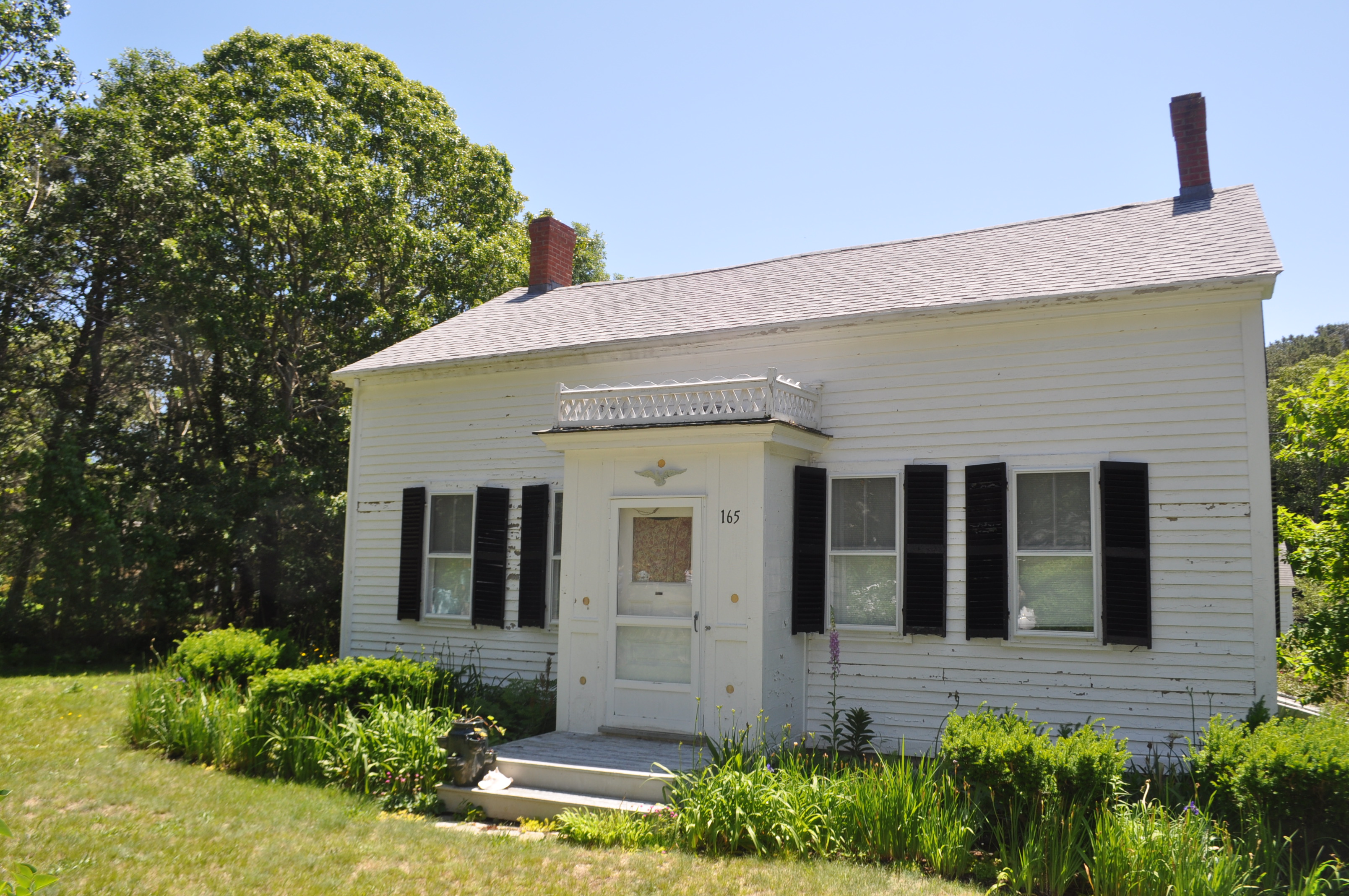
Valerie Scheel was kind enough to send me a copy of notes called “Reminisces” by Lyndell Higgins Baldwin Coumans – age 96. This is Lynnie Higgins, daughter of Harold and Eva Higgins. I mentioned Eva in my post about Marconi’s operations in South Wellfleet — when she was the cook and housekeeper at the Marconi Station. Lynnie and her family lived in the Parsonage in South Wellfleet, the home that once housed the minister of the South Wellfleet Second Congregational Church.  The house still stands on Cemetery Road.

Lynnie lived in the Parsonage from 1912 when she was six years old, until she was twelve. In her memory notes, Lynnie remembers going to a four-room school house. Since the Pond Hill School closed in 1880, this must have been the elementary school that was in town on Main Street, where Main Street, Holbrook Avenue and Briar Lane merge. She tells of getting there on a vehicle they called “the barge.” This was a bus-shaped vehicle, a “box with windows” drawn by a horse. There were benches down each side, and in winter there was hay in the aisle to keep your feet warm. She remembers how the big boys used to kick the smaller kids, and she “still has scars from those big boots.”

Her uncle drove the barge, so in the morning she and her brother knew they could be a few minutes late because he would never leave them behind. Also, since the barge was at the school in the afternoons by 3 PM sharp, they could not be kept after school. At their hour-long lunch period, they joined their uncle – who apparently parked for the day, waiting for the afternoon return trip.

South Wellfleet Cemetery and the unknown sailors

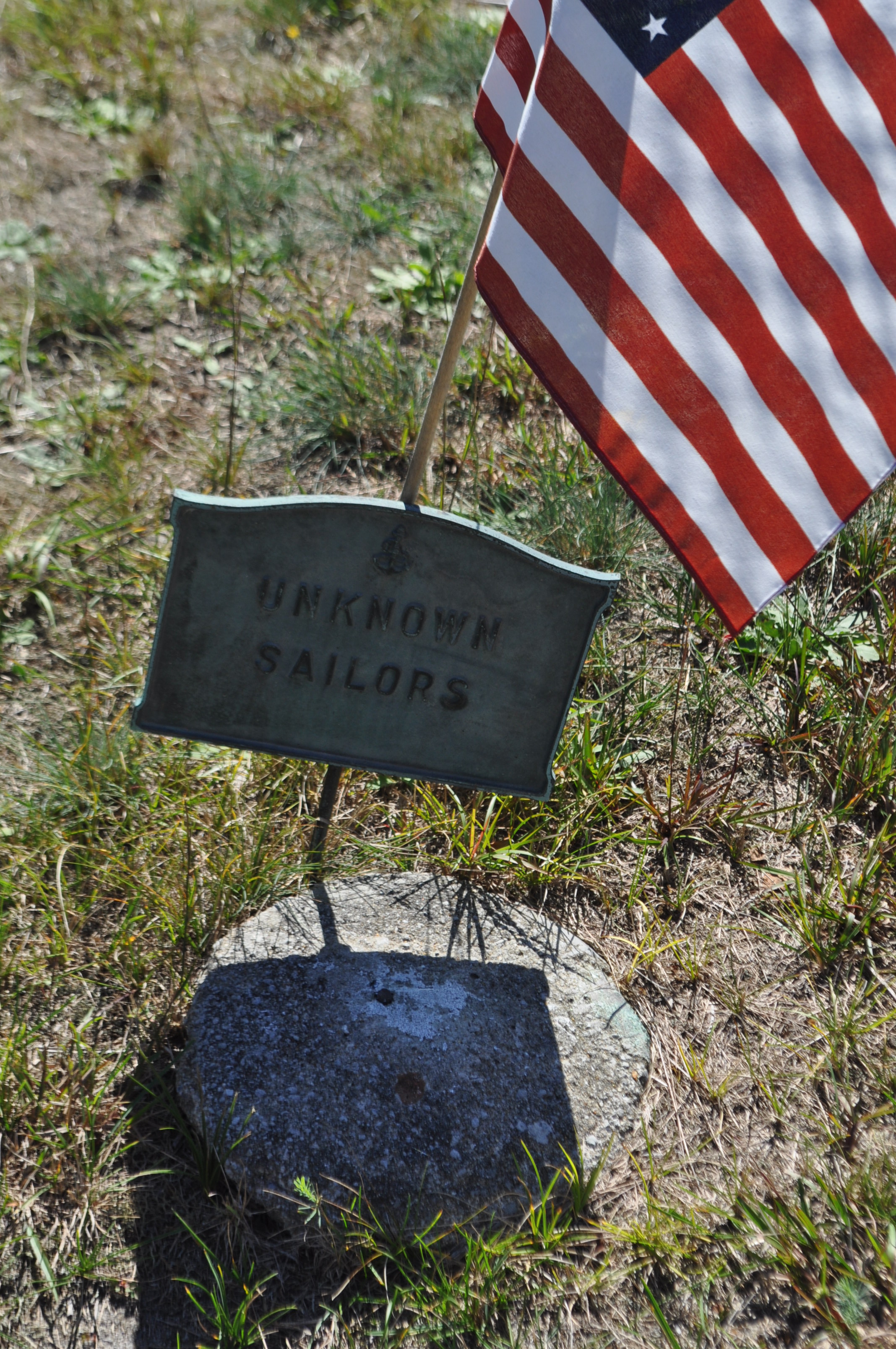
When writing about shipwrecks, I mentioned the unknown sailors in their South Wellfleet

South Wellfleet Cemetery Unknown Sailors marker

South Wellfleet Cemetery
Unknown Sailors marker

Cemetery grave. I read an article from a 1948 Cape Codder about Pauline Crowell, who spent considerable time and energy caring for the cemetery. She had taken up the chore after her husband, Luther F. Crowell, died in 1941.

Mrs. Crowell told the reporter about the three unknown sailors who had been buried long before she was involved. She said “they washed up on the beach.” But she did know that Herbert Nickerson, the Orleans funeral director, had come to the cemetery and used a rod to determine their burial place. Then Mrs. Crowell had the site fenced, and made the sign we find there today: “Unknown Sailors.”

Mrs. Crowell raised the money she needed for the cemetery care through whist parties. She also mentioned in this article that she had attended the South Wellfleet elementary school was was located near the Cemetery.

Camp Wellfleet’s Guns Fix a Problem

This note touches upon posts I wrote last summer about Camp Wellfleet, about electricity coming to Wellfleet, and about Prospect Hill.  I found a clipping slipped into a folder at the Wellfleet Historical Society. The title of the Cape Cod Standard Times newspaper report was “Guns Revive Broken-down Cape Ice Box.” The date is July 1943. Mr. and Mrs. George Barker’s electric refrigerator in their year-round home on Prospect Hill stopped working, and due to the scarcity of repairmen on the “lower Cape” they’d had to revert to the use of an “old-style ice box.” However, when a new company equipped with big guns moved into Camp Wellfleet the first salvo jolted the Barkers’ electric refrigerator into working condition again.

Marconi Marker at Cape Cod National Seashore

When I was in Wellfleet in June, I went to the Marconi site to check on the marker

Marconi Marker at the site in South Wellfleet

Marconi Marker at the site in South Wellfleet

pictured here. This is the marker that used to be on LeCount Hollow Road. It’s still near the interpretive site, as I’d written in the winter, but of course the Marconi Towers model in the shelter structure had to be removed — just after I was there, in July – because of the severe erosion of the 2013 winter. Bill Burke, the Park Historian, reports that the edge of dune is now where the rear position of the Marconi towers was in 1903.

Nicknames for Roads

When I wrote about the Old Wharf area late last summer, I mentioned a local man with a Ford truck and a forty-foot boat who was probably a rum runner — although people are still very careful about that appellation. Recently, I read a 1964 Cape Codder article describing the back roads in South Wellfleet into Eastham as an alternative to Route 6 driving. The writer called these “the old rum runners road” or “whiskey road” – local names for the back roads used by rum runners evading Federal pursuit during Prohibition.


Posted in Uncategorized | 2 Comments

Prospect Hill Development 1890s to 1960s

There was no “Prospect Hill” until George Washington Barker had the land surveyed and cottage lots drawn in 1892. He entitled his plan, shown here, “Plan of Prospect Hill.” Mr. Barker and his father, Isaiah Barker, purchased the land in 1866, just after the Civil War, from John Stubbs, paying $62.00.

John Stubbs, son of John Stubbs and Bethiah Ward, was the grandson of Richard Stubbs and Eunice Knowles, she of the prominent Eastham family. This was the branch of the Stubbs family that remained in South Wellfleet. In an earlier blog post, I described the branching off of the Stubbs family, with one branch departing for Maine, and then returning to South Wellfleet generations later. That part of the family includes Joseph A. Stubbs, with his successful shellfish company that operated on Blackfish Creek.

The Richard Stubbs family produced sons John (mentioned above), Simeon, Ephraim, Richard, and Elkanah. As I study deeds for the South Wellfleet area, their names are frequently noted. Ephraim married two Arey daughters, first Nancy, and then Rebecca, after Nancy died. He may have secured some land through those marriages. Ephraim purchased half of Mill Hill along with David Wiley. He served as Lydia Arey Taylor’s attorney when her land holdings were dissolved. (She was married to the first Reuben Arey, and, secondly, to John Taylor, Revolutionary War soldier – I’ve also covered them in a previous blog post.)

Richard Stubbs grew up in South Wellfleet to become “Deacon Stubbs,” playing a leading role in the Temperance Movement of the nineteenth century. Richard married Phoebe Arey Wiley, daughter of David Wiley and Ruth Arey, who also lived in the area, south of the Barker/Arey farm.  It was Richard’s house and land that Joseph A. Stubbs purchased, and then moved to the head of Blackfish Creek and established it with surrounding outbuildings — becoming known as “Stubbs Landing.”

The deed from John Stubbs to the father and son Barkers did not mention any buildings.

Like Robert Howard, who was actively engaged in buying land in Wellfleet and laying out cottage lots, George W. Barker also hired the Brewster surveyor and attorney, Tully

Prospect Hill Development, Tully Map

Prospect Hill Development, Tully Map

Crosby, to survey and lay out a plan for Prospect Hill. Isaiah Barker died in 1885, and his

wife, Betsy Higgins Arey Barker, in 1887. The Barker land, much of it surrounding their farmhouse, as well as the Prospect Hill property, was held jointly by their children, Isaiah Jr., George Washington, and Lewis Cheever Barker. Isaiah Jr. had become a mariner, owning a schooner for a while. He eventually settled in Norfolk, Virginia, where he became engaged in the shellfish trade. Lewis Cheever Barker had a rather sad life, losing a young wife, who left him with a small child, and leaving the Cape to remarry. He moved around, and, on one deed, is listed as living in Australia. I wrote about the family in several blog posts last year.

George Washington Barker married Clara Bell in 1864, and became a mariner — until the diminished fishing caused him to leave the Cape and settle in New Hampshire. From census records and deeds, one can see George becoming the family’s land manager, using this opportunity to sell the family’s South Wellfleet holdings as interest in Cape Cod as a tourist destination began to take hold. George and Clara’s children were Scotto, George Jr., Clara, Ralph, Walter, Edward, and Beulah. There are numerous mentions of these family members visiting their grandparents at the Barker farm and, later, their parents, who eventually returned to South Wellfleet. However, it is George Washington Barker, Jr. who came to take over from his father as the family’s property manager. George Washington Barker died in 1917, and Clara Bell Barker died in 1933.

George Washington Barker developed a Prospect Hill Prospectus in 1893 describing

Prospect Hill Prospectus

Prospect Hill Prospectus

theland, the locale, and the transportation. He particularly mentions the hill — as grass covered – and lending itself to the growth of trees. Even later photographs do not show much grass nor many trees. Barker describes the ten-minute walk to Church and the School, and the close proximity of the General Store and Depot. He mentions plans for a hotel to be built by “Nashua parties.” Indeed, there were property purchasers from Nashua – they bought land on Old Wharf Point as well – but no commercial property was ever developed. Perhaps the economic recession of 1893 — quite a severe one — ended those plans.

John Edward Irvine, a cabinet maker and my great grandfather, purchased his first lot in the Prospect Hill development in 1892. We do not have a diary or even family tale as to how he came to find Wellfleet and purchase a lot of land there. We do know that he and his family rented the Robinson cottage out on Old Wharf Point in 1893 – and we can only imagine that he must have walked over to Prospect Hill to plan his own cottage. Eventually

Prospect Cottage

Prospect Cottage

he purchased three more lots and built two cottages, one in 1910 and one in 1915. Both are still standing.

A recent Barker family interview revealed that George W. Barker, Jr. invented a device related to the sewing machine and was thus able to retire from full-time employment. Perhaps this free time gave him the chance to focus on the family’s property. Not many sales of lots in the Prospect Hill Development occurred in the 1920s. In the 1930s two important land transfers took place. Mr. and Mrs. Sexton purchased land on the “bluff” overlooking Blackfish Creek and built a large house. My family sold their second cottage in 1920 to a couple named Mackernan. Mrs. Mackernan was Mr.

Sexton House

Sexton House

Sexton’s sister, so our long-time family friendship started here.

George Barker’s first marriage ended at some point in the 1920s — either Mrs. Barker died, or they divorced. The Mackernans rented their cottage to a Mrs. Nobles and her sister, Harriet Werts. Miss Werts was an older woman who had remained single and pursued a career as a legal secretary at a law firm in New York. Her father served as Governor and Supreme Court Justice of New Jersey. Our family tales include the supposition that she had money, and built the Barker home.  Those same family tales note Mr. Irvine’s interest in Miss Werts also.

In 1932, the Barker family created a spacious lot and transferred its ownership to George and Harriet Barker; they were both still single in 1930 (Federal census), so their marriage must have occurred around the time of the land transfer and house building. The house is a Sears catalogue home, and the assembly instructions on the beams are still visible. Besides the house, they built a small cottage on the property.

George W. Barker Jr. died in 1947, and in his will left around twenty five acres on Prospect Hill — all the land that had not been sold in the past fifty years — to his widow, Harriet W. Barker. The family had transferred ownership to him while retaining the land and buildings that made up the “Barker homestead.” Mrs. Barker, who the adults called ‘Skippy,’ died in 1952 after a long illness resulting from a stroke. I remember her from my childhood as the pretty white-haired woman with two dogs living in the “the big house.” She was cared for by a local woman, Sarah Francis, from a large Azorian family living in Truro. We called her a nurse, but I think she was more of a caretaker, as she was for another Wellfleet woman listed in the 1930 federal census.

When Mrs. Barker died, she left all of her property to Sarah Francis, setting off a court battle with Mrs. Barker’s nephew, Elon Nobles. Eventually, he gained control over the land, and Sarah Francis kept the home and the cottage. At this point, another phase in the development of Prospect Hill began.

On the top of the hill, my mother and her sister purchased more property, built a second cottage, and divided their interest. We kept the old cottage, and, later, bought back the second one that John Edward Irvine had built. Two of my father’s brothers bought lots from Elon Nobles and put up cottages; another brother had built a small cottage in the late 1940s.

In 1957, Elon Nobles sold several lots to Charles Zehnder, an architect who established himself in Wellfleet, and became one of the key figures in what is now called the “modernist house” movement. Mr. Zehnder built such a house for himself first, tucked away at the edge of the Prospect Hill landscape, near Old Wharf Road. Later, Mr. Zehnder owned one of the original houses out on Old Wharf Point. Mr. Zehnder owned enough land in the original Prospect Hill development to create his own “Zehnder Plan” in 1964, and developed a number of home sites. Mr. Zehnder unfortunately was killed in an automobile accident in Wellfleet in 1985.

Another purchaser of a significant amount of land in the late 1950s was Frank Beckerer, who also bought property out on Old Wharf Point. One of his sales within the Prospect Hill development was to Lincoln Almond who served as the Governor of Rhode Island in the 1980s.

The original Prospect Hill homes passed along to other families. The Barker house was owned for a number of years by Charles Philbrick, the poet, who created a number of poems that were set in Wellfleet, including “At The Wellfleet Historical Society, During A Moderate Tempest.”

The Sexton house changed ownership only a couple of times. The family had acquired extra land in the late 1930s, bought the old South Wellfleet depot and moved it over to

South Wellfleet Railroad Depot moved to Sexton property and made into a garage

South Wellfleet Railroad Depot moved to Sexton property and made into a garage

become a garage. Today it is a home. The next generation of the Sexton family purchased more land and still own another home on Prospect Hill.

This 1946 photograph of the Prospect Hill families enjoying the beach at high tide on Blackfish Creek represents the ambiance of the Hill — several families, meeting during the summer season and enjoying afternoons together at the shore.

Prospect Hill Families at high tide on Blackfish Creek 1946

Prospect Hill Families at high tide on Blackfish Creek 1946

Sources

U.S. Federal Census collection at www.ancestry.com

David Kew’s Cape Cod History site: www.capecodhistory.us

Barnstable Patriot (various) online archive: www.sturgislibrary.org

Barnstable County Deeds available at www.barnstablecountydeeds.org

Barker Family interview.


Posted in Uncategorized | 2 Comments

The Old Wharf 1910 to the 1960s

My family had tales of Prohibition-era rum-running in Wellfleet; my mother and aunt spoke of “watching the lights over at the Old Wharf from the attic window” during the 1920s and 1930s. Another person recently interviewed laughingly spoke of the “pirate” living at the Old Wharf who not only brought in the liquor, but also had a strong Ford truck to drive it off-Cape. “He’d be gone all night.” Yet another account, this one a bit more sinister, was the memory of someone living south of Loagy Bay remembering hearing gunshots on a dark night coming from the Old Wharf area.

So it was with these accounts in mind that I pursued my research on how the Old Wharf Point developed into today’s South Wellfleet neighborhood.  (For this posting, I am referring to the same lots 1-19, Block A, of the Old Wharf Plan as I did in the previous post. These were the lots that lined the bluff on Old Wharf Point.)

No single fact I have discovered points to the Old Wharf life in the Prohibition era, but, taken together, and considered in light of the “tales” of others, something unusual was surely going on! Now, of course, it’s an amusing South Wellfleet story, part of the other Wellfleet tales of the time. And not just Wellfleet tales, since Donald Sparrow writes about the same issues in his work on Eastham.

In the early 1950s the Cape Codder published a series of stories about rum-running on the Outer Cape, collecting reminiscences of Cape Codders barely twenty years after Prohibition ended. The writer used a pseudonym, and no name or place is named directly, but the stories put these Cape folks directly into the picture. The writer says,

The leaders of the smuggling craft came from outside the Cape – but they had many Cape Cod recruits and many a tidy sum was netted by the local men who were familiar with the remote inlets, the best roads for getaway and were sensible enough to be guarded in their talk. The local men were relied upon to handle the drops – whiskey carefully packed into burlap sacks – and load them in fast cars or trucks. The truckers were especially valued. A number were “all set” when the Prohibition era came to an end.

Much of the illegal liquor landed in North America on the French island of St. Pierre et Miquelon off Newfoundland, and was “delivered” on fairly large ships  positioned on “Rum Row” three miles off the U.S. coast, and supplied the smaller boats venturing out there while trying to avoid the U.S. Coast Guard. Daniel Okrent’s book, Last Call, The Rise and Fall of Prohibition, describes this history in great detail.

My Old Wharf research was greatly helped by A.F. Joy’s book on spending his summers with Aunt Leah and Uncle Mel in the Old Wharf cottages. That’s where I learned that Uncle Mel had owned a liquor distribution business until Prohibition, when the revenue agents destroyed his stock, and he had to load what was left of his supply into the two Cadillacs he owned. He was no supporter of Prohibition, and he was angry at the U.S. Government for their actions. Uncle Mel also had a forty-foot boat and a Ford truck.

Most of Mr. Joy’s book concerns Aunt Leah, who seemed to have one venture after another to make money after the business was destroyed, from collecting Cape pinecones to sell to florists in Boston, and to making lots of Beach Plum jelly to sell to vacationing visitors. She had a jelly stand out on Route 6 for a while, but eventually moved her jars to a little shed beside the house and ran her shop right out on the Old Wharf Point. One of the Goss family members told me in an interview last year that he remembers “Miss Leah and her jelly.”

Mr. Joy also writes about how Uncle Mel and Mr. Barney — “another early settler on the Old Wharf” –worked to build a dike and road that made a useful access point to the homes on the bluff. The Barker family remembers their grandfather working on this project too. They did a good job and we still use that road today.

Mr. Joy’s information provided a basis for my further research on the Old Wharf property owners after 1910.

First, in 1912, Mr. Oberg, who owned the furthermost house (Lots 17-19) sold his cottage to Mr. Earl Barney and his wife Bertha.  When I checked the 1910 Federal census for the Barney family of Boston, I found that he was a salesman in a wholesale liquor business. Further, in his World War I draft registration, he lists “E.M. Rogers” as his employer.

E.M. Rogers is Mr. Joy’s “uncle,” and I characterize him that way because in all the property transfers, Mr. Rogers is “unmarried,” as is Leah Joy — Aunt Leah. She really was his actual aunt, but they appear to never have married.  He was originally from Orleans, and as late as 1947 when he is named as one of the executors of his sister’s will, the documents notes he is “unmarried.” In the censuses I looked at for 1910 and 1920, he is listed living in a boarding house, sometimes with a woman named Rogers. There, he is recorded as “married” by the census taker. It’s important to note, however, that one unrelated person may have provided the information on the boarding house tenants.

In 1918 Elisha Rogers purchased Lots 4 and 5 from the Davis family, and then transferred the purchase to the ownership of Leah Joy. She was a 30-year-old single woman in the 1910 census, living in her parents’ home, and working as a ”cashier in a distributing company.”  The Joys were a good-sized family: six children, older brothers and younger sisters. Mr. Joy’s memories are of many family members coming to the Cape to enjoy vacation time together. He mentions a second cottage – and, indeed, in 1920, Leah purchased the Robinson property, the house next to the Davises. Now she owned two cottages.

In 1919 Leah bought Lot 2 from Frederick Mountain. She also bought the land Mrs. Mountain had purchased on Prospect Hill, and then sold it back to George Barker in 1936. In 1923, Leah Joy sold the Robinson property on Lot 1 to Frank McCallum of Brookline, and, in 1927, she purchased a home in Auburndale, Massachusetts, possibly the family home she had grown up in. Leah Joy bought additional land on the Old Wharf in the “B” section in 1927, 1933, and 1958, and, in 1957, Lot 6 on the bluff.

In the 1930 Federal Census, Leah is still living with her parents in Newton, and, for the first time, E.M. Rogers is the household as well, listed as having an occupation in an automobile garage (but unemployed), which matches Mr. Joy’s recollection in his book. Leah is listed in 1930 as a “gift shop clerk” which matches Mr. Joy’s memory of her shop in Auburndale — the same shop that she apparently moved to South Wellfleet in the summers.

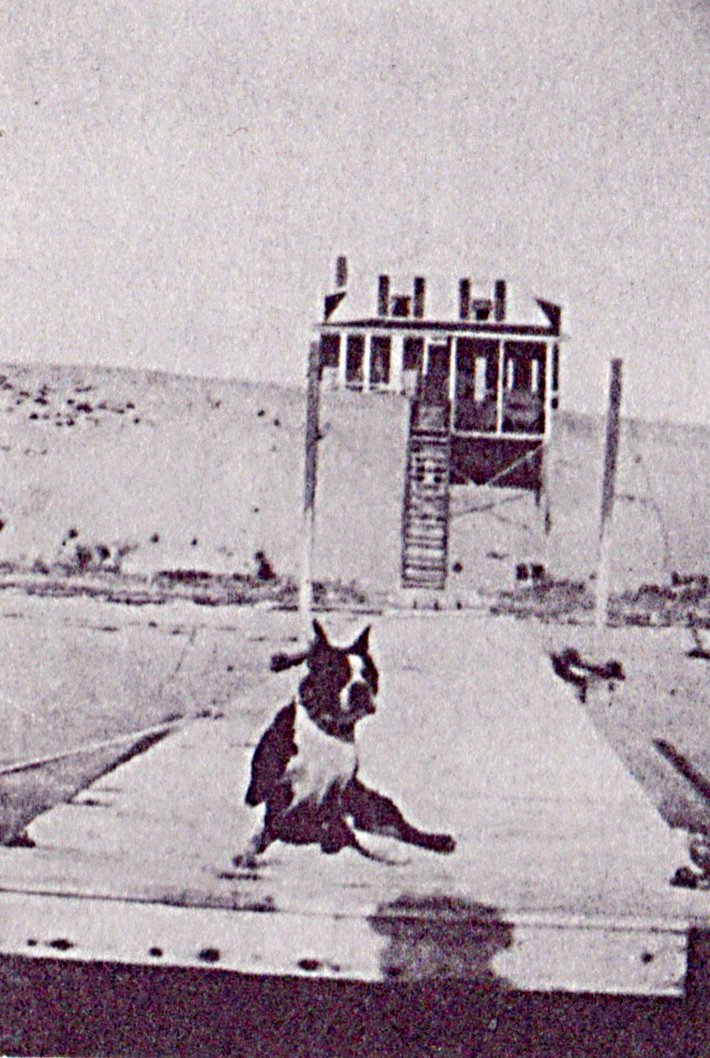
In the 1940s and 1950s life on Old Wharf Point remained pretty much the same, except one assumes that the rum-running nighttime activity of the 1920s and 1930s had ceased. This photograph shows the treeless landscape, and also the long dock protruding out into Loagy Bay – with thanks to Mr. Joy for printing this in his book. I have not found another Old Wharf photo – although I’m sure there must be some in family albums.

Old Wharf Point house with dock from A.F. Joy's  book listed below

Old Wharf Point house with dock from A.F. Joy’s
book listed below

By the 1960s the pace of property sales and development picked up. The Stubbs house was sold to Charles Zehnder, the modernist architect. Now, Luther A. Crowell, the grandson of the inventor, started assembling his land holdings and making plans to develop them. One of his purchases was the remaining land still held in the Old Wharf area by the Cook family.

On the Old Wharf, as well as on Lieutenant Island, Crowell’s plans kicked up a conservation firestorm, as he initially proposed to fill in marshland to create a road to the very end of the Point, and proposed a similar road on Lieutenant’s Island. By this time, new development had to be approved by the Wellfleet Planning Board, and in cases when wetlands are involved, the Conservation Commission. Crowell did not get his approvals in the initial round, but eventually he got it, with a subdivision plan reflecting the lot sizes of this later time, which replaced the Howard Plan of 1890.  One of the first houses of this era was the modern structure out on Old Wharf Point, near the still-visible pilings of the South Wharf. The southernmost house, near the road that ends at today’s public landing, is a cottage along with other buildings that were described to me as the former “garage” for the first house up on the bluff. Perhaps it was also created out of the Robinson cottage on Lot 1.

Mr. Crowell, in his efforts to get his subdivision approved in 1967, found a 1927 map that showed a road along the “north shore” of the Old Wharf land. This must have been the roadway used by the 19th Century fishermen to get their supply carts and horses out to the Wharf buildings, and their barrels of fish to the South Wellfleet Railroad Station.

Sources

A.F. Joy, Return to Cape Cod , Saturscent Publications, South Wellfleet, 1985, available in Cape libraries

U.S. Federal Census collection at www.ancestry.com

David Kew’s Cape Cod History site: www.capecodhistory.us

Barnstable Patriot (various) online  archive: www.sturgislibrary.org

Barnstable County Deeds available at www.barnstablecountydeeds.org

Barker Family interview.


Posted in Uncategorized | Leave a comment

Developing Old Wharf Point 1890-1910

Robert Howard and his partner in the Cape Cod Bay Land Company, Edward Reed, began developing new cottage neighborhoods in Wellfleet in the late 1880s. The mackerel fishing had fallen to new lows, many Wellfleetians were moving elsewhere and had property to sell, and there was a new interest in the Cape as a vacation destination, a new concept in American life.

Robert Howard was the step-son of Luther C. Crowell, the inventor, who married Mrs. Jeremiah Howard, born Margaret Atwood, from Wellfleet. After their three children were born, Mrs. Howard — widowed and running a boarding house in Cambride — somehow met Mr. Crowell, and they married in 1863. The Crowells lived in Brooklyn, New York, for a few years when Mr. Crowell was employed by Hoe & Company. The company was using his patented inventions for folding paper items and figuring out mass production — including the square bottom paper bag, the item Crowell is remembered for. In 1888, the Crowells came to Wellfleet as summer visitors, buying and moving the Eleazer Cole house. The Crowells had two sons, Luther F. and Edgar.

In an earlier blog post on the fishing industry in South Wellfleet, I wrote about the ownership of the South Wharf, starting in 1831 when Major John Witherell sold land to Richard Arey and the Battelle & Little firm of Boston. That property exchanged hands a number of times in the years that followed, and ended up in the hands of the Southern Wharf Company. In her book Eva and Henry, Irene Paine notes the final years of the company in 1888, with Blackfish Creek silting up and the mackerels’ diminishment. Indeed, in 1889, the Southern Wharf Company sold their property to Edwin P. Cook, known for his land purchases all around the town.

Mr. Cook rather quickly turned his purchase around, selling 20 acres of “Old Wharf land” to Robert Howard, who hired Tully Crosby, Jr., a Brewster attorney and surveyor, to lay out a plan of cottage lots. In various deeds, the waterfront-facing area of the land is named as “Brier’s Cliff”, and this name has been retained on one of the old roads. The whole area is, of course, an island, much like Lieutenant’s Island.  I’ve only found one reference to a name for this spot: Edmund’s Island. This is in the will of Reuben Arey, who died in 1837 and left pieces of his land holdings to children and grandchildren, including “the heirs of Asa Packard Arey.” Those children’s mother, Betsey, married Isaiah Barker, who settled into the farmhouse near Old Wharf, making barrels for the fishing operation there. A contemporary member of the Barker family recalls the family calling his land Edmund’s Island.

Mr. Cook did not sell the wetland on the southwestern edge of the “island” to Howard – in 1885, this land was being converted to a “cranberry swamp” which Cook sold to a Lewis Stone. They made a deal: Cook would grow and harvest the cranberries, and keep half the harvest. This bog is clearly shown on the Old Wharf Plan, and the dike edging the bog may have been the access point to the island, since the dike/road we use today was built much later. The Barker family also had a small bog on their property, as did the Alvin Paines, who were living in an Arey house on the County Road by this time.

The development of summer homes along Brier’s Cliff — today’s Old Wharf Point — is best understood from the layout of the cottage lots in the 1890 Plan. In a conversation this summer with an older Wellfleet resident, she recalled her father calling these “handkerchief lots” – small pieces of land for the city folks, laughable to the Wellfleet citizens whose land holdings were much larger, and divided into upland, salt meadows and woodlots.

Along the top of the cliff, from south to north, the lots are designated as “Block A,” and numbered from one to nineteen. Today, the properties there have Bay View Avenue addresses, the road that runs behind the homes.

The Old Wharf Property Plan 1890

The Old Wharf Property Plan 1890

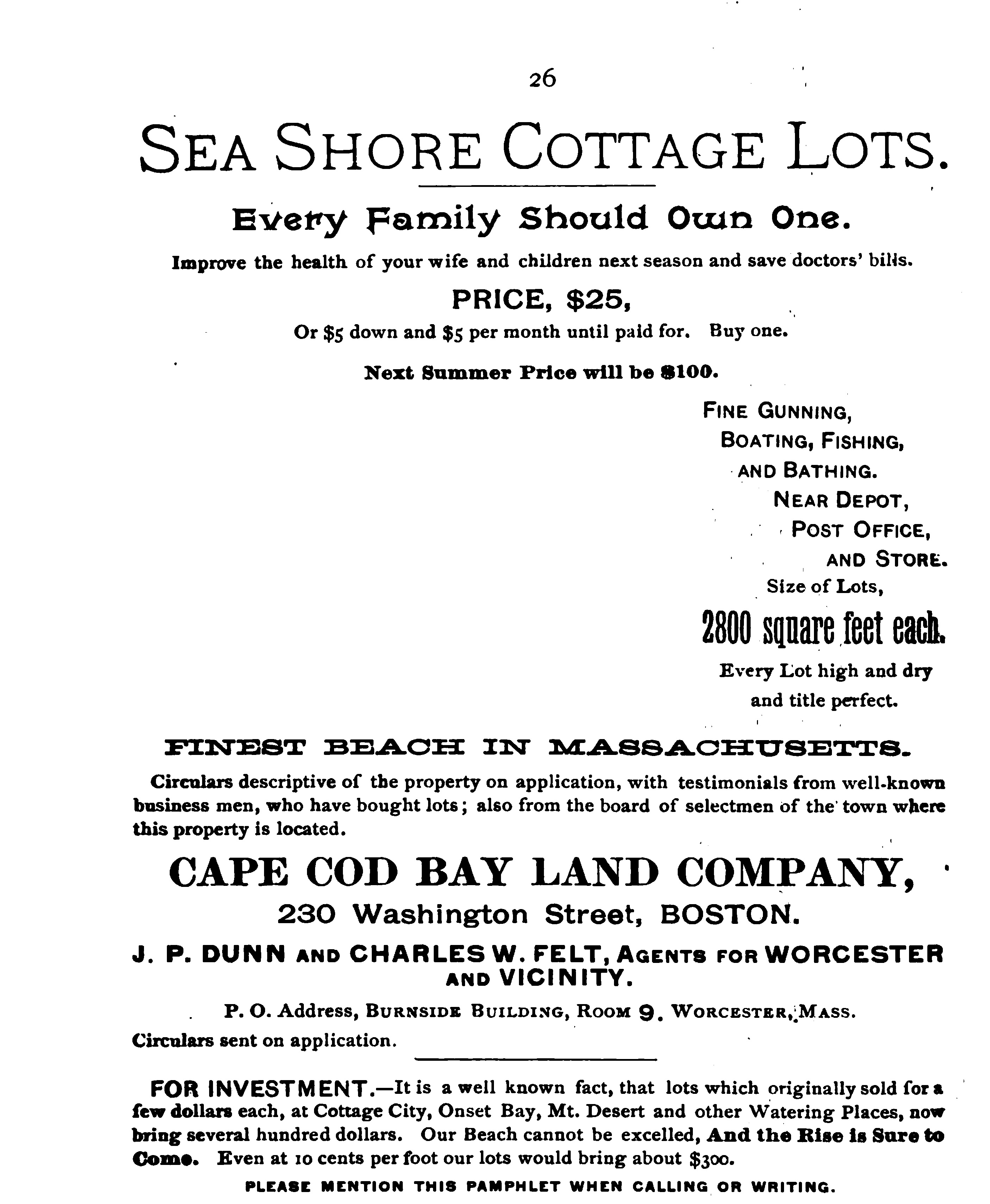
While I have found one advertisement for the Cape Cod Bay Land Company, I do not know where the company advertised its land. However, as the lots were purchased and written in deeds, my research on the families who made the land purchases showed their connections.

In 1890, Mr. Howard sold Lot 1 on the bluff to Elizabeth and Joseph Robinson of Lowell, Massachusetts. The Robinsons were immigrants from England with four children; Mr. Robinson’s occupation is listed in the census as “overseer.” The Robinsons built a cottage; my great grandfather rented it in 1893, according to a Barnstable Patriot note, the first evidence I’ve found of my family’s interest in South Wellfleet. The Robinsons kept their cottage until 1920, when they sold it.

Also in 1890, Mr. Howard sold Lots 2 and 3 to a Frederick Mountain of Lowell. Mr. Mountain, who also bought lots in the nearby Prospect Hill development a couple of years later, was also an immigrant, from Canada. There is no evidence that he ever built a cottage, and eventually he sold his land.

Cape Cod Bay Land Company advertisement

Cape Cod Bay Land Company advertisement

Another 1890 sale went to Caroline Sugden of Lowell for Lots 10, 11, 12, and 13 in Block A, and additional land in Block B. The Sugdens were also English immigrants; Mr. Sugden’s occupation as a manufacturer of something related to a press, may have had a relationship to Luther Crowell’s work. (The census taker’s handwriting is not clear, so my interpretation is a guess.)  The Sugden daughter, Amy, married John W. Stubbs in 1899, and became the parents of Mary and Caroline Stubbs, who were active Wellfleet citizens throughout their lives.  Their grandfather Joseph A. Stubbs’ oyster business was at the height of its success on Blackfish Creek at this time — see my earlier blog post about the Stubbs family. The Sugdens built a house on Old Wharf Point.

In 1891, Mr. Howard sold Lots 4 and 5 to a Mary Wiley; by 1907 this land was the property of William and Annie Davis of Lowell. The Wileys built a cottage, since such a building was mentioned in the 1907 deed to the Davis family.

Meanwhile, Mr. Howard and Mr. Reed, partners in the Cape Cod Bay Land Company, were buying up property around South Wellfleet and creating similar plans.  This is how Lieutenant’s Island was developed; no one lived there until Mr. Howard came along, and I hope to discover more about its history in the future.  Interestingly, there was a plan filed to build the bridge to the Island in 1893, from the Old Wharf Point, near Mr. Robinson’s property, out over the waters of Loagy Bay.

Mr. Howard and Mr. Reed also developed plans for cottages at Paine’s landing, Cannon Hill, and a rectangular piece of land with one straight street between the Old Colony Railroad tracks and the ocean, just south of the Wireless Road.

Mr. Howard never married, and lived in Boston in boarding houses in the census records I found. Mr. Reed also lived in Boston, and I found no evidence of his wealth; in the 1880 Federal census he is working in a shoe factory and living in his father-in-law’s home, and in 1900 he has his own home and his occupation is “capitalist.”

Through mentions of him in the Barnstable Patriot, we know that Mr. Howard built a cottage on Lieutenant’s Island, purchased a sailboat, and visited his mother often. Mr. Crowell died in 1903, leaving Margaret Crowell as his widow. She died in 1911. Hannah Howard Mitchell, Margaret’s daughter, died in 1914. Mr. Howard died at age 59 in 1916, leaving his property in Wellfleet to his sister’s son, Howard Mitchell, and to the Crowell sons.

Continuing back along Old Wharf Point, in 1893 James Barnard of Nashua, New Hampshire, purchased Lots 14 and 15, and in 1893 increased his holdings by purchasing Lots 17, 18 and 19.  Howard had sold these lots in 1891 to Joseph C. Batchelder, who re-sold in 1892 to William Walker. Walker next sold to Mr.Barnard in 1895, and then Barnard sold to Lizzie Heald Buswell. All of these owners were from Nashua, New Hampshire.  Lizzie Buswell sold the property back to Mr. Howard in 1904.

In 1907, Mr. Howard sold Lots 17, 18 and 19 to Andrew Gustaf Oberg and his wife. Mr. Oberg was a Swedish immigrant, living in Boston. Someone had built a cottage there earlier, because a building is mentioned in the 1907 deed. Soon after his purchase, Andrew Oberg transferred the property to his son Percy Oberg, and in 1909 he was released from the mortgage Robert Howard had granted them.

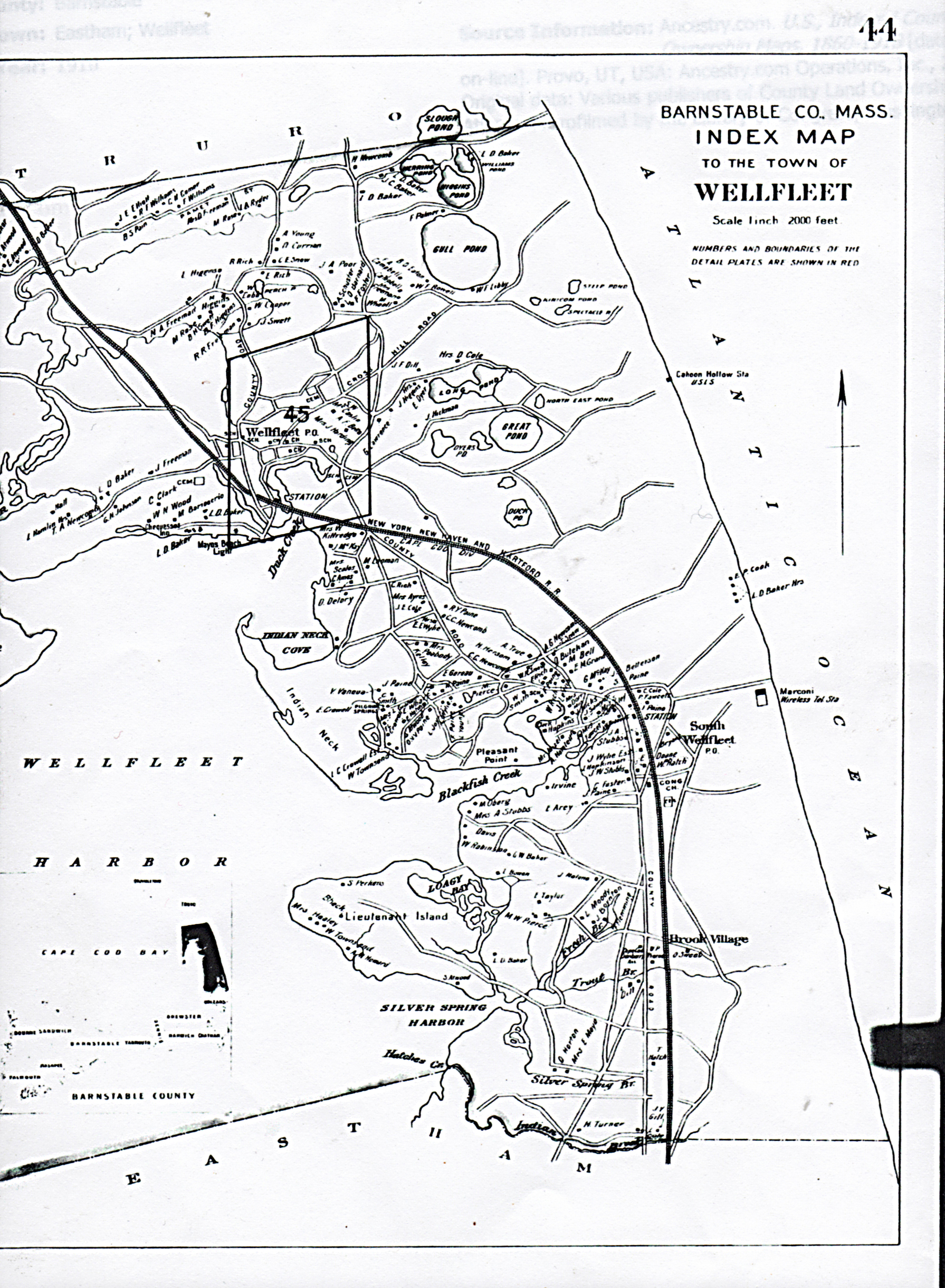
In 1910, a map with property owners shows four houses on Old Wharf Point: Robinson, Davis, Stubbs, and Oberg. There are no homes indicated on the remainder of the Old Wharf land. We can imagine families coming to South Wellfleet on the train, buying their supplies and getting their mail at Mr. Paine’s General Store and the South Wellfleet Post Office, and walking to the ocean, and to the Marconi Towers.

1910 Map of Wellfleet with property owners

1910 Map of Wellfleet with property owners

Local people, including the Barkers, had gardens and produced vegetables they sold to the summer people. Mr. Bell had a meat wagon he rolled around town, and others sold fish from wagons. The flats were open for people to dig clams, oysters and quahogs. Irene Paine writes about older sea captains taking visiting families out for a sail if they did not have a boat of their own.

This neighborhood of South Wellfleet had become a vacationer’s paradise.

Sources

U.S. Federal Census collection at www.ancestry.com

David Kew’s Cape Cod History site: www.capecodhistory.us

Barnstable Patriot (various) online  archive: www.sturgislibrary.org

Barnstable County Deeds available at www.barnstablecountydeeds.org

Barker Family interview.


Posted in Uncategorized | 1 Comment

The South Wellfleet Fire Tower

The Fire Tower in South Wellfleet on Route Six near Pilgrim Spring Road was erected in 1927. Cape Cod had been regularly threatened with damaging woodland fires, some reaching many hundreds of acres. A report in the Barnstable Patriot in May 1875 described a fire of more than 100 acres burning in the vicinity of the South Wellfleet Railroad station for more than a day “in spite of the efforts of the citizens to extinguish the flames.”

Such fires became of greater concern when the early twentieth century brought new summer residents and vacationers. Some blame the Cape’s sandy soil with plants that quickly dried out without rain but fires also were clearly a result of the sparks from railroad engines. There are numerous newspaper reports of the pressures Cape residents put on the New York New Haven and Hartford Railroad to acquire more land on either side of their tracks, and to keep it clear of brush.

Wherever the fire came from, all citizens — even children — were put to work putting out the flames. On a taped “memory piece” Mary Stubbs Magenau speaks of her experience beating out flames in South Wellfleet when she was a child.

In a July 1915 article “Forest Fires on The Cape” in Cape Cod Magazine, R.H. Cahoon reports that in 1915 Massachusetts set up a man to watch for fires in Harwich, in the cupola of the Exchange Theatre. He was paid $60 per month to work every day (except rainy days). Another observatory was set up in 1910 in Barnstable on Shoot Flying Hill. Cahoon describes the job:

In the observatory, besides being equipped with a telephone, the watchman has a chart, arranged with a shifting rod, by which the observer is able to locate fires within his district, the station is equipped with books, maps and lists of fire wardens residing in the various districts. The observatory is connected by telephone with the office of the local fire warden, who is called when any smoke is sighted. The chief fire warden learns the exact location of the fire, then hastens there, calls aid and commands the work of extinguishing the blaze.

This observatory quickly became a favorite place for visitors to climb and look out over the Cape, much as we go to the top of skyscrapers today. One report notes that the Marconi Towers in Wellfleet were clearly visible against the sky.

The new Fire Tower in South Wellfleet

The new Fire Tower in South Wellfleet

Reports began to appear in the Hyannis Patriot in the spring of 1927 that Wellfleet’s tower would soon be erected. In April of that year there was a serious multi-day 2,500 acre fire in Truro. There were reports that a fire tower to protect the lower Cape could not be built until 1928. However, the state workmen got busy and soon had “a cement foundation and posts for a twenty foot square steel tower to be erected after the Fourth of July, and to be done in August, which is located about fifty feet in the State Highway line in the South Wellfleet section of Wellfleet, at the crest of a hill between Spring Valley Road and so-called Hinckley’s corner, on the west side of the road.”

There were also plans to plant trees and to grade the Fire Tower site so that it would be attractive. An article later in July reports that the State fire tower was going up rapidly, with the workmen tenting at the rear, in the woods, and that Richard Baker of South Wellfleet was expected to be the watchman there. Richard Baker was the son of M. Burton Baker bought up much of the Crowell family land on Indian Neck, and ran the Indian Neck Inn (more on this topic later).

In early 1928, the paper reported the discussion, at the Wellfleet Town Meeting in February, about the Town’s expected donation to the cost of erecting the Fire Tower. The Tower’s cost was $2,000, mostly covered by the Commonwealth. Wellfleet contributed $150, and the towns of Orleans, Eastham and Truro each contributed $100. The extra $50 requested of Wellfleet must have spurred the discussion. But people understood that Wellfleet would benefit more, and have the quickest results of a fire being spotted. Richard Baker contributed to the discussion by reporting that during the months the fire tower was open in 1927, two thousand visitors had registered their visit by signing the book kept at the top. The reporter continues, “One can see what advertisement of our wonderful panoramic scenery is received from the height of the town and what it does for those away in telling of the Cape’s beauties and charm.” Richard’s father, Burton Baker, had attended a meeting at the State House in January when the contributions were proposed and — the reporter noted — the other towns were coming in line.

In April 1928, the flag began flying again at the Fire Tower, and Richard Baker was the “observer” once again. In 1929, William Wyler must have taken the position, as he is listed in the 1930 census as “fire observer” for the State. In 1929, a news report notes that Miss Dorothy Baker was substituting for Mr. Wyler who was home with a swollen ankle.
In 1927, the Howes family built “Brownie’s Cabins” – first calling it a Motor Court – near the Tower, as pictured in this old postcard. They are still there today, but having become a condominium association about ten years ago.

One other news report gives us a report of the Fire Tower visitors, this one in 1942 when 4,282 visitors from 41 states and 12 foreign nations climbed the fire observation tower.
In 1960, a new sixty-eight foot tower replaced the old iron tower. In 2001, a new cab was installed. an excellent site today for cell tower additions.
My research about the Wellfleet Fire Tower was greatly helped by the website: http://www.firelookout.or/towers/ma/wellfleet.htm
Sources
http://www.firelookout.org/lookouts/ma/welfleet.htm
http://easternlookouts.weebly.com/massachusetts.html
News reports from Hyannis Patriot online at http://www.sturgislibrary.org.

Posted in Uncategorized | 1 Comment

Telephones and Electricity

My earliest childhood days in South Wellfleet were without electricity or telephone service, so I’ve been curious about when these modern devices reached Wellfleet, and how they were assimilated into the lives of the town’s citizens.

Kerosene lamp

Kerosene lamp

There were just two houses on Prospect Hill that were not summer cottages: George and Harriet Barker’s home, built in the 1920s, and the Sexton’s home, built in the early 1930s. Both had electricity and telephones. One family emergency in the 1950s made us thankful for a phone, to summon an ambulance to the hill.

Telephones
In Wellfleet as elsewhere, the telephone came along first. The Barnstable Patriot reports regularly on the development of telephone service in the 1880s and 1890s. In the 1880s, the “government line” serving the Life Saving Stations was initiated, and there are reports of how the Life Saving Service communicated between stations to handle ships floundering offshore. The men in the Nauset station would notice such a ship, and now could call Cahoon Hollow to be ready to assist. When a severe thunderstorm it the outer Cape in March 1891, the phone system at Highland Light was destroyed.

Like any new “contraption,” the telephone took time to become accepted and recognized as a useful tool. The Barnstable Patriot carried ads for non-Bell telephones that anyone could set up between two points. Early on, the instrument was recognized as a way for a businessman or a doctor to communicate between his home and his office. One news report told of a Barnstable citizen listening to music from a church in New Bedford, and the reporter marveling at this wonderful telephone instrument.

The Barnstable Patriot reported in 1882 that the Signal Service Bureau wanted to use the telephone to notify towns on the Cape of frost warnings, so that the cranberry bog owners could take action to protect them. Wellfleet was one of the towns agreeing to be forewarned.

In 1900, a Barnstable Patriot report notes telephone poles being carried along the County Road from Wellfleet to Provincetown, foreseeing that soon telephone communication will be completed all along the Cape.

In an earlier post about the night Marconi sent his first wireless message in January 1903, I wrote about the news reporters using the telegraph at the Railroad office in Wellfleet. One enterprising journalist made sure he got a key to the post office in Wellfleet so he could use the only public telephone in town. He reported taking a call from the Marconi Station, so they too must have had a telephone there.

A Barnstable Patriot article in 1900 reported on some of the locations in Wellfleet that had recently installed telephones: Dr. F.S. Cannedy, the F.A.Wiley & Co. store, the residence of Dr. E.F. Perry, Captain L.D. Baker, and Mr. M.D. Holbrook.

Early telephone, candlestick model

Early telephone, candlestick model

In 1912 the Barnstable Patriot reported that New England Telephone and Telegraph had installed 93 phones in Wellfleet. A similar story in 1918 reported 130 telephones. At that time, telephone subscribers (as they were called) needed an operator to connect them. The 1912 report noted that there were 13 “exchanges” on the Cape, each employing 2 to 13 operators.

Thanks to David Kew’s detailed site, I found a reference to the Wellfleet Exchange, in the home of Agnes Rich. Unfortunately, the story that elicited this information concerned Mrs. Rich’s murder by her husband in 1913. I think that the home was on Holbrook Avenue. In 1910, the Federal Census lists Agnes and her husband, and Agnes’ parents, James and Mary Rich, living next door to each other (but possibly in the same house) and both couples as grocers.

Agnes’ brother, Solon Rich, and his wife, Emily, were listed as the Telephone Exchange Manager and an operator. A young woman named Caroline Wert who lived in their home was also a telephone operator. By 1915, Solon Rich had moved to Orleans, but continued his employment with the telephone company.

In 1916, according to a Barnstable Patriot article, the New England Telephone & Telegraph Company’s “central office” in Wellfleet was moved to the home of Miss Lila Higgins.
In the 1920 Federal census, I found two young women with occupations as telephone operators, but I did not find any reference to the telephone exchange.

Radios with Batteries
A 1926 Barnstable Patriot article noted that Frank Dill of South Wellfleet had a new radio installed in his home. The reporter notes that many South Wellfleet citizens were visiting Mr. Dill to “hear the messages”: M. Burton Baker, Earl Atwood, Alton Atwood, W.A. Short, L.B. Paine, Clarence Hicks, Fred W. Bell, Dave Buitekan, Isaac R. Paine, Isaac (Ikey) Paine, Fred Doane and E.J. Davis. I found a 1925 ad for a console “radio telephone” loaded with heavy-duty batteries – priced at $139, pretty high for 1925.

Electricity
Electricity came to Wellfleet much later. At the February 1927 Town Meeting, Wellfleet turned over its old almshouse property to the Cape and Vineyard Company to build a substation there.

The Barnstable Patriot reported in 1925 that the Cape and Vineyard Company petitioned the Public Utilities agency to extend its service to Wellfleet and Eastham. That article also noted that Provincetown had its own power plant.

News reports of how electrification proceeded are scarce; we don’t know how fast it proceeded through town. By the time of the 1930 Federal Census, there are two electricians listed in Wellfleet: Mr. Murray and Mr. Gates.

Mary Freeman noted in her regular Wellfleet column in the Barnstable Patriot of July 17, 1930, that “Electricity has at last reached its pencil of light to Nauhaught Bluffs and the Checquesset Girls Summer School even to the top of its flagpole.”

Another 1930 article mentioned the installation of electrical lighting to light the town clock in the tower of the First Congregational Church, and thanked the donors who had contributed to its cost.

Electricity’s arrival in the town also brought on nostalgia. An article in the Springfield Republican in 1927 was headlined “Progress Robs Wellfleet of Its Cape Cod Quaintness,” and goes on to say “Little Gasoline Lamps that lighted its winding streets give way to electricity – modern life goes on under the shadow of Old Whaling Captains who look down from the walls of the homes and their days of fame.” The writer, J.C. Johnson, also notes that modernization is a necessity, as Wellfleet hoped to become a “popular summer place for the rich.” In 1929 newspaper ads, the Cape and Vineyard Company offers Cold Control Frigidaires and Hotpoint Electric Ranges for sale.

Mr. M. Burton Baker, serving as selectman during that time, is quoted in the Barnstable Patriot in 1928 about the possibility of lights coming to South Wellfleet, reporting that the Cape and Vineyard Company were looking for 65 houses to wire. Baker is concerned that the South Wellfleet wiring is a problem due to most homes there serving as summer residences, and they would not be able to produce 65 new customers.

Before electricity came to Wellfleet in the conventional way in 1927, two New Bedford engineers proposed a scheme at a special town meeting in 1921. They sought to use Drummer Pond for an experiment that involved using salt water to generate electricity. The reporter at the Barnstable Patriot noted that “similar experiments had been without success in Saugus and Marblehead.” However, the men had found two ponds, and wanted to make a third. Making electricity using salt water is a long-time DIY science project, with illustrations now on YouTube.

In 2011, a news report from Stanford University stated that Stanford researchers had developed a rechargeable battery that uses freshwater and seawater to create electricity. The report notes that the researchers were aided by nanotechnology, and that the battery employs the difference in salinity between fresh and salt water to generate a current. The report imagines power stations built wherever a river runs into the ocean. Now it looks like the men who had wanted to harness Drummer Pond were just ahead of their time!

Sources

David Kew’s Cape Cod History site: www.capecodhistory.us
Barnstable Patriot (various) online archive: www.sturgislibrary.org
Federal census documents at: www.ancestry.com
Newspaper accounts online at: www.genealogybank.com.

Posted in Uncategorized | 1 Comment

Pumping Water

When I was very young, our Prospect Hill cottage did not have electricity. Mr. Rose, the iceman, brought blocks of ice for the ice box. We had a kerosene stove. We used an outhouse. When darkness fell, the oil lamp was lit, and we kids were required to sit quietly and play a board game at the table, or read a book, until it was time to go to bed.

We pumped our water as my mother and her family had done from the time the cottage was built in 1910. The pump was on the porch, and there was a big galvanized tub underneath it, ready for washing a child. There were two enamel pails next to the kitchen

Cottage Porch with Pump

Cottage Porch with Pump

sink; it was my older brother’s chore to keep them filled. An enamel dipper was always there for a delicious drink of cold water. (We ran around the hill all summer, making up our own games no one worried about where we were. A whistle was blown to round us up at lunchtime.)

Recently, I was perusing a 1971 Earle Rich article in a Cape Codder newspaper, now digitized by the Snow Library in Orleans. He was writing about the town pumps around Wellfleet the one at the corner of Commercial and Bank Streets that was well-photographed in its time. He mentioned one at the intersection of Main Street, Holbrook Avenue and Briar Lane, near what once was the Wellfleet Elementary School on that corner. Mr. Rich attended that school and remembered how handy the pump was for a thirsty student. That pump is today on the former Biddle property on Bound Brook Island.

He further reported on the pump at the South Wellfleet General Store pictured in a photo

South Wellfleet General Store Pump and Cistern from Danial Lombardo book

South Wellfleet General Store Pump and Cistern
from Danial Lombardo book

I placed on my blog post on the General Store. The Town Meeting had voted to “remove and discontinue” the pump in 1932. According to Rich, this one was moved to the American Legion Hall, now the Left Bank Gallery, on Commercial Street. Sometimes I take photos of the flowers in front of the Gallery and here it is from an early 1990’s shot.

Cistern from South Wellfleet in front of Left Bank Gallery c 1990

Cistern from South Wellfleet in front of Left Bank Gallery c 1990

Mr. Rich wrote about something I’d been wondering about as I look at old photos of South Wellfleet, particularly the one pictured here of Stubbs landing, near where the County Road crosses Blackfish Creek. This shows a windmill in use, with a big cistern for holding the water. Now I know this structure was pumping water. Mr. Rich says that this was pretty popular around the turn of the century. It must have made the housewives happy on wash day.

South Wellfleet Causeway and J.A. Stubbs home with windmill pump

South Wellfleet Causeway and J.A. Stubbs home with windmill pump

Soon, another pumping mechanism was introduced, a small, kerosene pump which, he says, was very difficult to start up in the morning. Finally, after electricity came to Wellfleet in 1927, pumping became an electrical job and turning on the faucet a simple task.

Sources

Cape Codder Volume 26, Issue 41

Daniel Lombardo Wellfleet Then and Now, Arcadia Publishing, 2007

Posted in Uncategorized | Leave a comment

South Wellfleet’s Camp Wellfleet

Military operations were nothing new in South Wellfleet. In April 1917 the U.S. Navy took possession of the Marconi Station in South Wellfleet, creating the U.S. Navy Radio Station until 1926, when the Navy de-accessioned the operation. The Navy purchased the Marconi land in 1918.  The U.S. government owned the land where the Cahoon Hollow Life Saving Station was located, although the operation there employed local men.

When I first began researching the Army’s Camp Wellfleet operation, I assumed that the United States still owned the Marconi Station land. I was wrong it was sold to a J. Sidney Forster in 1931. The U.S. government had no land in South Wellfleet.

The United States launched a limited war-preparedness campaign in 1939; in the 1930s the U.S. Army completed a review process that concluded that war-readiness could not effectively begin on the day hostilities are declared. But President Roosevelt, running for his third term in 1940, was well aware of the pacifists on the one hand who did not want war, and, on the other, those who thought that the cost of a military buildup would subvert his recent social legislation. However, when Japan, Italy and Germany pursued imperial expansion in 1939-1940, the need to prepare grew more apparent. After Germany invaded Poland in 1939, launching a general European war, there was increased momentum in America to prepare for war.

Late in 1940, when the National Guard was “federalized,” this act included the various units of the Massachusetts National Guard, which had trained at the “Massachusetts Military Reservation” in Falmouth. This site was now under the command of the U. S. Army and was designated “Camp Edwards.”

A significant amount was spent by the War Department in making the Camp Edwards site ready, providing work for hundreds of carpenters and other building craftsmen and laborers. Contractors constructed barracks for 50,000 men, along with numerous other buildings, including two hospitals. Two auxiliary sites were established: one in Sandwich, and one in South Wellfleet.

Another sign of war readiness was to assign soldiers of the 241st Massachusetts Coast Artillery to guard Boston Harbor. The 211th Coast Artillery was the first unit to report in at Camp Edwards, where they stayed for a few days, and then were shipped to Texas’ Camp Hulle, near Galveston.

A significant sign of preparation for an attack by an “enemy force” was a combat exercise on the Cape in 1941. The enemy had landed at South Wellfleet, and proceeded westward. Forces were to clash somewhere between Orleans and Brewster on a Tuesday and Wednesday in late July. This exercise involved combat teams of the 51st Infantry Brigade. Bags of flour were used as “bombs” that would aid in their vehicles’ advance, driving the enemy from the Cape.

In her history of Wellfleet, Judy Stetson reports that the U.S. Army rented the land they needed near the old Marconi site. Nevertheless, now the Army needed a lot more land to establish an anti-aircraft range. In March 1943 there are newspaper reports of the formal opening of Camp Wellfleet. Prior to that date, there may have been some military activities, but I have not found any news reports likely not allowed, since the country was now at war.

On July 26, 1943, there is a “petition for condemnation” on the Barnstable County Deeds database indicating that 1800 acres of land in Wellfleet was taken for public use,” extendable during the existing national emergency.” The landowners, some known and some presumed, are listed in the document, viewable online.

There are sketchy accounts I’ve found so far on how Camp Wellfleet operated. The news account in the Boston Herald reporting on the March 1943 opening indicated that this was the largest facility of its type in the United States. Hopefully, this building project provided work for local men, just as the work in building Camp Edwards had further up Cape.  Camp Wellfleet had “facilities for firing, bivouac and tactical maneuvers, for four miles along the coast, and extending inland for a mile.”  The site “offered gunners a perfect two miles firing line and terrain and heavily wooded sections to give troops an opportunity to test field maneuvers.”

In researching this article, I found bits and pieces that described Camp Wellfleet operations. Noel Beyle wrote a description of the “Winch House.” a concrete bunker located somewhere between the Marconi site and Marconi Beach. In The Cape Cod Voice, Beyle reported interviewing a man who had served as a range control officer at Camp Wellfleet in the nineteen fifties, and the article provided this good description:

The bunker protected the operator and machinery which hauled targets mounted on sleds pulled by cables from a position near the Eastham-Wellfleet town line along the dune parallel to the beach… From these positions, well behind the water’s edge, the guns also attacked targets mounted on rafts moored in the ocean… In addition to ground and floating water targets Camp Wellfleet anti-aircraft that would take off from a tiny airstrip on the top of the bluffs.

The eye-witness reports in this article, however, were from the nineteen fifties, when the drones were used for target practice — I don’t know if this technique was in place during the war years.

Target plane from the www.hotharky.tripod.com

Target plane from the http://www.hotharky.tripod.com

Once the Camp was built, it could accommodate 1,000 men – so the buildings and barracks were extensive.

Recently, I spoke with one of the members of the Barker family who still summers here in South Wellfleet. He and his family lived at the Barker farmhouse during World War II while his father was on active duty. One day, Army representatives knocked on their door and requested that the family leave for a few days. They did, finding another place to stay temporarily in Wellfleet. When they returned, the Army had left behind evidence of their maneuvers a piece of a gun on a nearby hill, a foxhole, and a discarded shovel and an axe, Army green. The Army also used this family’s woodlot, east of Route 6, behind what is now Maurice’s Campground.

In February 1945 Camp Wellfleet was turned over to the U.S. Navy as an adjunct of the Hyannis Naval Auxiliary Air Facility. The accounts of the Navy usage indicate a portion of the Camp was designated a bomb target site.

Along with other Wellfleetians, I remember the noise of the guns firing a background noise to my childhood Cape summers. Also, reveille playing in the morning and taps in the evening over the loudspeakers, clearly heard where we were located on Blackfish Creek if the wind was just right.

After World War II, Camp Wellfleet reverted back to the Army but within a few years, as the Korean War heated up, the training facility was needed again. Now the training was directed to National Guard units that came to the Cape in the summers. This continued through the fifties, until the weaponry changed and the guns of Wellfleet became obsolete.

The U.S. Army and Camp Wellfleet had a defining moment with Cape Codders in August and September of 1951. In an unfortunate flat-footed moment, the Army announced that it was expanding the firing range to 300 square miles, from Race Point to Chatham. The plan was announced with notices tacked up in the post offices no public hearings, and any objections to be filed in triplicate in Boston. The newspapers went wild, with the residents and fishermen sounding off about the plan.

Soon a petition was circulated and printed in the papers, stating in part:

We are unalterably opposed to further taking or restricting of any territorial waters or territorial land by the Armed Services. We are residents of the narrowest part of our beloved Cape Cod and feel that such activity by the Armed Services will amount to confiscation of our property, our interests and our livelihood.

One of the residents of South Wellfleet said, “It’ll ruin this part of the Cape.”

The Army backed off a bit, and agreed to a hearing which was held at Wellfleet’s American Legion Hall on September 20, 1951. The confrontation of the military by angry local fisherman and residents drew national media attention. Besides The New York Times and the Boston papers, the event was covered in a long piece by E.J. Kahn (a Wellfleet summer resident) in The New Yorker (October 13, 1951) in an article  titled ”The Battle of Wellfleet.”  A long meeting was held that day, and the Army officers who attended had to listen to a lot of what the Cape Codder reporter called “unvarnished” language.

Nevertheless, the Army won. In December 1951, the Cape Codder announced that the Army would go ahead with their plan to put Camp Wellfleet on a permanent basis. The report said the Army left unclear if its range would be expanded. However, the military did make some concessions to the fishermen, who worked with them after the September meeting. Only specific portions of the range under use would be closed to the fishermen; weekly mariners’ schedules were to be posted in advance; in case of emergencies, vessels would be allowed to proceed; and sunken targets were to be cleaned-up so as not to interfere with navigation. Newspaper accounts of South Wellfleet after this time announced plans to fire the Camp Wellfleet guns. During the fifties, the Camp hosted the public

Visitors' Day, Camp Wellfleet. Photo thanks to the Sexton family

Visitors’ Day, Camp Wellfleet. Photo thanks to the Sexton family

regularly, and kids growing up in the area remember visiting the site and admiring the big guns.

Camp Wellfleet caused other pressures upon the local communities. Convoys of Army trucks slowed traffic, especially before the widening of Route 6 in 1948-49. Groups of rambunctious young men sometimes got out of hand. There were regular newspaper accounts of Army trucks blowing through red lights in Orleans before the Mid-Cape was built.

The website www.campwellfleet.com has information about the site, remembrances of young men who served in the National Guard there, and a memory piece by Jeffrey Haste of South Wellfleet of visiting the Camp with his father. There’s also a photo of one of the drone planes.

As the fifties ended and the legislation establishing the Cape Cod National Seashore was signed by President Kennedy in August 1961, Camp Wellfleet reached its final days of usefulness. Nike missiles replaced the 90mm anti-aircraft guns.

Camp Wellfleet was closed and a small crew left to manage the site until the National Park Service arrived. Many buildings were removed and, early on, the dunes were planted with beach grass to stabilize them. I remember that the grass plantings looked like rows of corn when first planted.

From about 1964 to 1969, the former barracks at Camp Wellfleet served as a Job Corps Training Center, but was closed down when its effectiveness in job training was questioned.

Before the Army left, they plowed the dune to four feet deep to remove any unexploded shells that might have been stuck in the sand.  A decontamination crew walked the site, probing for explosives. However, this first pass at decontamination was followed up with further study in the late 1990s. In 2002 and 2004 contractors moved through the site again, looking for ordnance. A specially equipped helicopter flew over the site to detect buried metal.

In his 1963 book “The Great Beach,” John Hay described the abandoned Camp Wellfleet and its eight towers overlooking the Atlantic Ocean.  He notes the Marconi Towers, now fallen into the sea.  Hay likens the military and its power to that of the sea, rolling on, and leaving human beings vulnerable. “I thought of how many worlds, how many inventions, how much devising we had run through, at a faster rate even than the sea cut down the cliffs. The maniacal weight of one war had gone, but the knowledge and power it had let loose had sent us on, committing us to human ends in the most and at the same time isolated sense, universally vulnerable.”

Sources

John Hay, The Great Beach, paperback version 1972, Ballantine Books.

The Cape Codder digital files available online at www.snowlibrary.org

Barnstable County Deeds available at www.barnstablecountydeeds.org

The New York Times archive

Newspaper account online at www.genealogybank.com

www.campwellfleet.com.

Posted in Uncategorized | 5 Comments

Counting the Birds in South Wellfleet

Late in 1929 and early in 1930, a surgeon from Westchester County, New York, Dr. Oliver L. Austin, purchased a number of acres in South Wellfleet, just north of the Eastham border that is marked by Hatches Creek.  The Macpherson family owned the land.  Earlier owners included the Lincoln family, the Atwoods, the Witherells and others. The 1858 Walling Map shows all these families as mid-nineteenth century South Wellfleet residents.

Dr. Austin’s intention was to establish a bird banding station – an idea from his son, Oliver L. Austin, Jr., a recent Harvard graduate in ornithology. While Oliver Jr. was the professional ornithologist, Dr. Austin Sr. appears to have been thoroughly involved in the operation of the facility, known as the Austin Ornithology Research Center. A 1930 newspaper account indicates that the Austins had been coming to Provincetown from their home in Tuckahoe, New York, for fifteen years before they established their Center.  Throughout its life — until it was sold to the Massachusetts Audubon Society in 1959 — the Center was supported with private funds, presumably Dr. Austin’s.

It’s not clear from my research on the Austins whether the father or the son became interested first in studying birds. Oliver Austin Jr. grew up in Tuckahoe, N.Y., and graduated from Wesleyan University in Connecticut. His studies at Harvard University appear to have set his career as an ornithologist. In 1927, he and his father together organized a cruise to Labrador to study arctic birds. They took a schooner out of Provincetown, captained by Richard Parmenter, who had some experience already as a Labrador explorer. A Boston newspaper account described the Austins’ interest in the natural history of the Arctic regions and their intent on banding “nestlings.” The ship had “a supply of 10,000 non-rusting metal tags.” Unfortunately, the schooner blew ashore at Hurricane Harbor, Baffin Island, and the Austins had to return overland to New Brunswick. Another account indicates that the Austins went to Labrador twice, in 1927 and 1928; this formed the basis for young Austin’s doctoral dissertation, which was later published as “The Birds of Newfoundland Labrador.”

The systematic study of birds began early in the 19th Century throughout many countries. We have our John James Audubon and his masterly paintings from that time.  Late in the century the studies became more scientific, and banding became a way to measure migration, longevity, mortality, territoriality, feeding behavior and other aspects of bird life. The 1918 Migratory Bird Treaty between the United States and Canada provided new impetus to gather data that would protect migratory birds.

After Harvard, young Austin worked for the Bureau of Biological Survey in Minnesota, and later surveyed terns on the East Coast. Nevertheless, as the Depression deepened, government biologists were laid off, and Oliver and his wife returned to New York — and then to Cape Cod where they settled in Wellfleet as year-round citizens. Austin conducted research at the Center, and taught young ornithologists who studied there. An article published in the Auk, the journal of the American Ornithological Union, where Austin served as editor from 1968 to 1977, describes his career.

A 1932 article in the journal Bird Banding described the Austin Research Station as 600 acres – that it was bisected by the King’s Highway, and that the Center had “guardianship control” over the land all the way to the Atlantic coast. Much of this land became part of the National Seashore much later. (Other articles describe the Ornithology Center/Station at 300 or 400 acres.)

By the 1930s, South Wellfleet was in its nadir as a place where people lived, as I’ve mentioned in earlier posts about South Wellfleet’s population contraction following its fishing heyday. By 1930 there were very few houses extant until the County Road reached the area around the former Congregational Church and its graveyard.

The 1932 article in Bird Banding describes “a commodious dwelling” serving as a quarters for as large a staff as possible – during the season of early May to late October – when “young college men of more or less ornithological enthusiasm” worked on the tasks of

Austin home and research center. Image from April 1932 issue of 'Bird Banding"

Austin home and research center. Image from April 1932
issue of ‘Bird Banding”

banding many species of birds. Careful field notes were entered into daily records, and many hours of motion-picture film were made. In the first two years of operation 13,600 birds were banded, from 112 species. More than half the banding was of terns, the bird studied by Oliver Austin Jr. In addition to locations at the Center, tern colonies on Billingsgate Island were studied.

The 1932 article alludes to more serious scientific work commencing in the fall of 1931, possibly when young Oliver moved there permanently. He jokingly told a writer that during this time he had an “orchid business”” and played bridge for money to support himself.  Other articles mention his floral business.

Austin Landscape, early 1930's. Image from April 1932 issue  of "Bird Banding."

Austin Landscape, early 1930’s. Image from April 1932 issue
of “Bird Banding.”

Newspaper accounts during the 1930s mention Dr. Austin’s bailing out one of Wellfleet’s young men who was caught setting a fire in town.

At some point, Dr. Austin moderated the Wellfleet Town Meeting, and was one of the organizers of the Board of Trade. In 1935, Dr. Austin was the citizen who stood up at the Town Meeting and moved to strike a proposed resolution that the town would require “head to knees” bathing attire. Some of the town’s residents were offended by the practice of strolling through town in bathing suits — even the covered-up version of the mid-1930s.

When World War II began, Dr. Austin joined the U.S. Navy, serving in the South Pacific.  At the end of the war, he served in South Korea for nearly a year, still in the Navy, where he completed his research on a book about the birds of Korea.  As a Lt. Commander, he joined General MacArthur’s staff in Japan and was named as the Chief of the Wildlife Branch of the military government.

Dr. Austin’s family – his wife and two young sons – joined him in Japan; I found a note posted online from his granddaughter, commenting on her father’s tales of living as a child in Occupied Japan. The family returned to the Cape in 1950. A new publication, The Cape Codder, reported on Dr. Austin’s slide lectures to the local Rotary and other groups during that time. Dr. Austin received a Guggenheim Fellowship and produced another important book on the birds of Japan. After only three years, the Austin family moved south as Dr. Austin pursued his profession. He did not live on the Cape again.

The work on behalf of the birds in South Wellfleet continued. In 1946, the Austin Ornithological Station was under the direction of Jim Adamson, Superintendent, and Gertrude Benner, ornithologist. The senior Dr. Austin died in 1957 at age 86; in 1959 the land and buildings of the Ornithological Station were sold to the Massachusetts Audubon Society, supported by private gifts from the Mellon family. The Wellfleet Bay Wildlife Sanctuary today, covering more than 1,000 acres, is a South Wellfleet jewel.

In my research, I came across several references to a sweet tale of music composition. Jerome Kern was a friend of the senior Dr. Austin, and came to visit the South Wellfleet Center more than once. The piano he composed on was mentioned in the 1959 transfer to Massachusetts Audubon. One of Kern’s most famous songs “I’ve Told Every Little Star” (lyrics by Oscar Hammerstein) is supposed to have its opening notes from the song sparrows he heard in South Wellfleet.

Sources

Austin, Oliver L., M.D., “The Austin Ornithological Research Station,” Bird Banding, Volume 3, No. 2, April, 1932, Page 51 – 62.

Clench, Mary H. and J. William Hardy, “In Memoriam: Oliver L. Austin Jr.”  The Auk,  Number 106, page 706 – 723, October 1989.

The Cape Codder digital files available online at www.snowlibrary.org

Posted in Uncategorized | 4 Comments

South Wellfleet Shellfishing and the Stubbs Family

Wellfleet’s rich lode of shellfish is a theme constant with its fishing industry. David Wright has covered the history of shellfishing in Wellfleet in his book The Famous Beds of Wellfleet, A Shellfishing History (Wellfleet Historical Society, 2008).

Shellfish became a food source when the Pilgrims landed. Soon, the shellfish were on their way to Boston to feed growing numbers of Massachusetts Bay residents. One of the early oyster beds was in the bay near Silver Spring, part of the Audubon Sanctuary today. Pratt’s history comments on the 1775 ecological disaster when all the oysters died, and imagines that this had happened because it came at a time when a large number of blackfish had come ashore, and perhaps their decayed carcasses caused the death of the oysters.

The 1912 Report of The Mollusk Fisheries (Massachusetts Commission on Fisheries and Game) quotes Wellfleet’s E.P. Cook with another guess as to the diminished oysters. He thought that the early inhabitants did not understand the value of the natural shell beds for catching the spat.  “They took every shell away, burning the shells into fertilizer for their farms and plaster for their houses.” Cook notes that “there once was a stand of woods near the original oyster rock, but this was cut down, and the sand gradually washed over the beds, killing the young oysters.”

The destruction of the beds, however, brought about a “new” industry: bringing southern oysters up to Wellfleet to bed them for the spring and summer, taking them to market the following fall. Mr. Cook credits Captain William Dill with bringing the first cargo from Virginia.  This method grew up until the beginning of the Civil War, when it diminished. For a few years, the oysters were shipped north without the stopover in Wellfleet.

According to the same report cited above, in the mid-1870s E.P. Cook began to plant seed oysters, picking as his first spot the flats next to Silver Spring, the site of the original “natural rock.” He achieved remarkable oyster growth there and soon had others interested. Soon there was wheeling and dealing in Wellfleet for the lease of the flats for oyster cultivation.

Joseph A. Stubbs was one of the wholesale dealers who participated. There were about 200 acres of flats in South Wellfleet.  One report indicated that the area on the south side of Blackfish Creek was quite productive. Eastham grants were farmed by the Wellfleet shell fishermen and the companies operating out of the town. Besides Stubbs, there were R.R. Higgins and D. Atwood & Co.

Joseph Andrew Stubbs’ business was extensive, covering much more than Wellfleet alone. He dealt in many kinds of shellfish, and had beds in Crisfield, Maryland; Warren, Rhode Island; and Pocasset, Massachusetts, as well as in Wellfleet. In her book on Wellfleet, R.E. Rickmers has a copy of the “wreck report” of the schooner Mary J. Stubbs which sank in a heavy gale off Chincoteague, Virginia on April 6, 1889, with all four hands lost. The schooner was bringing oysters from Maryland to Rhode Island. (Note: this is the ship that was lost in the story told by Irene Paine in her fictional account of her family, “Henry and Eva: A Cape Cod Marriage.”

At some point, he left Wellfleet and settled in Cambridge to be near his Boston business. He and his family are listed in the 1880 Federal census there.

Stubbs returned to Wellfleet with his family each summer, and his comings and goings are well-covered in the Barnstable Patriot town news. My favorite was a note that he had sent a cow to South Wellfleet to be ready for his family’s summer visit. In the time of fishing diminishment, late in the 19th century, Stubbs and his operation provided a number of jobs for local men. He accumulated several properties in South Wellfleet, as described below.

After he died in 1903, Joseph A. Stubbs’ business was continued by his son, John Wiley Stubbs. Unfortunately, John died at the young age of 45. His brother, Frederick, a doctor, died quite young also. The company was sold to Bernard Collins of Eastham, a cousin. About 1940, Mr. Collins sold the business to General Foods.

The Stubbs family impact on South Wellfleet went far beyond the harvesting of shellfish. Their story begins in the early days of Eastham, when Wellfleet was its northern precinct.  Luke Stubbs, born in Hull, Massachusetts, arrived in Eastham where he married Mary Newcomb, whose mother was the daughter of one of the Eastham founders. While we don’t know what year Stubbs arrived in Eastham, we know that he died there in 1756. Thanks to David Kew’s research on Wellfleet families, we know that he worked as a “house wright”, and that he lived in the part of Eastham that became Wellfleet — but we do not know exactly where.

Luke Stubbs’ sons made different choices as to where they would live. His son John stayed in Wellfleet/Eastham, while his son Samuel relocated to Maine, at a time when it was still a part of Massachusetts. Those sons both had families, and a couple of generations passed.  John’s children, Richard (1767) and John (1794) and his grandchildren, Ephraim (1787) and Richard (1806), were South Wellfleet property owners around the Old Wharf Road area.  John Stubbs owned the Prospect Hill land that was sold to Isaiah and George Barker in 1866. Ephraim Stubbs married two Arey daughters (not at the same time), first Nancy in 1819 and then her sister Rebecca in the 1840s.

One of the Maine Stubbs family retuned to Wellfleet – Andrew Lincoln Stubbs, a carpenter, was born in Hampden, Maine, but died in Wellfleet. He may have lived near Long Pond since a biography of his son, Joseph Andrew Stubbs, indicates he was born near the Pond in 1838.

The South Wellfleet Stubbs family were leading citizens. Richard Stubbs, great grandson of Luke, became Deacon Stubbs, a leader in the Cape’s temperance movement, heading the Wellfleet Temperance Society in the 1850s and 1860s. In 1882, Richard sold his South Wellfleet home to Joseph A. Stubbs when his oyster business began to thrive.  Richard Stubbs’ wife was Phoebe Arey Wiley, daughter of Ruth Arey and David Wiley, and his daughter, Eunice, married a Wellfleet Witherell. The marriages between these South Wellfleet families are not untypical of other Cape towns, where many families are intertwined.

Joseph A. Stubbs moved the Richard Stubbs house from “somewhere on Old Wharf Road” to the location where the south side of Blackfish Creek meets the County Road, just before the “causeway” or bridge that crosses the Creek. After moving the home, he added a number of additions to the relocated house and to the property, so that it became an important South Wellfleet landmark in its time, even deserving a postcard.

Stubbs Landing, South Wellfleet, postcard

Stubbs Landing, South Wellfleet, postcard

Joseph A. Stubbs’s wife was Mary Smith Wiley, daughter of John Wiley and Mary Ann Smith Ward.  The Wards were a long-time South Wellfleet family. Thus the Wileys and Stubbs were linked in their generation even as the Areys and Stubbs were linked in an earlier generation. But the family links are even more extensive. Earlier, Elkanah Ward had married Mary Stubbs, a grand-daughter to Luke Stubbs. Mary Stubbs Ward’s daughter, Nancy Ward, first married a Wiley, and then a Harding. She was “Nancy Harding” in the 1880 census, a widow, living in the home of her daughter, Matilda Wiley. Her son, Otis Wiley, was an associate of Joseph A. Stubbs, and Stubbs bought Nancy Harding’s home.

Two women on the Causeway, South Wellfleet, with Stubbs home in the background --image at Wellfleet Historical Society

Two women on the Causeway, South Wellfleet, with Stubbs home in the background –image at Wellfleet Historical Society

The Joseph A. Stubbs home that once belonged to Deacon Richard Stubbs burned one night in 1934 during a windstorm that also destroyed a house “across the road.” Luckily, Ethel Stubbs, the widow of Joseph’s son, Dr. Frank Stubbs, was able to escape the fire.  This was no doubt the beginning of the end of the “Stubbs’ Landing” on Blackfish Creek — I remember a couple of old stumps there when I was a child, taking  a rowboat with my older brother through the marsh to the road, and anchoring the boat while we went across the road to the general store.

Joseph A. Stubbs is responsible for another South Wellfleet house, the one that still stands today — the last one on the right of Route 6 just before the wetland of Blackfish Creek appears, and the road curves over the Creek while the old road leads off to the right to the general store. It is a large white house, a Greek Revival. According to the survey of South Wellfleet buildings reported to the Massachusetts Historical Commission in 1980 (copies available at the Wellfleet Historical Society), this house was sold by Uriah Dyer’s son to Joseph A. Stubbs in September 1890 and moved to South Wellfleet shortly thereafter. As a side note, after the construction of the Marconi Station, this house was rented to the engineers at the station.

Another Stubbs historic South Wellfleet house still exists today, just past Cemetery Road. This house once belonged to Solomon Rich, and the cottage attached to it was the Nancy Harding property mentioned above. This home is also covered in the reports to the Massachusetts Historical Commission.

The Stubbs family owned many other properties in South Wellfleet which have been disbursed to many other owners.

A further note: The Massachusetts Audubon Society’s Wellfleet Bay Wildlife  Sanctuary is building an “oyster reef” in the bay off Lieutenant Island in South Wellfleet. This project began in 2008 and will be helpful in keeping the Bay waters clean, as well as providing a home for oysters.  http://www.massaudubon.org/PDF/sanctuaries/wellfleet/oyster_reef_faq.pdf

Sources

D. B. Wright The Famous Beds of Wellfleet, A Shellfishing History, Wellfleet Historical Society, 2008

A Report of the Quahog and Oyster Fisheries of Massachusetts,  Massachusetts Commission of Fisheries and Game, Boston, 1912

R.E. Rickmers, Wellfleet Remembered Volume 2, Blue Butterfly Publications, Wellfleet, Mass.

David Kew’s Cape Cod History site: www.capecodhistory.us

Barnstable Patriot (various) online  archive: www.sturgislibrary.org

Barnstable County Deeds available at www.barnstablecountydeeds.org.


Posted in Uncategorized | 9 Comments