Trying the Whales in South Wellfleet

The Cape’s whaling heritage is more visible this summer (2014) with visits to various Cape harbors by the refurbished 1841 whaling ship Charles F. Morgan, the last square-rigged wooden whaling ship — a restoration project of the Mystic Seaport Museum. The Cape’s and Nantucket’s whaling heritage is well-documented by historians. Wellfleet was a well-endowed whaling town before the Revolution.

However, before there were whaling ships operating in the North Atlantic, and then round the globe, there was a long period when the English settlers learned how to capture and harvest these animals. South Wellfleet was one of the places where the earliest whaling – called “shore whaling” — took place.

John Braginton-Smith and Duncan Oliver present their extensive research on the Cape’s shore whaling efforts in their book, Cape Cod Shore Whaling. There is a long-time and extensive literature about whaling that emerged as an early key industry in New England, but little had been written about what went before, and how the first European settlers learned to hunt these creatures.

Like early agriculture, shore whaling skills were learned from native inhabitants. Indeed, as the Pilgrims left the Mayflower to explore the Cape, one of the first reported sights was the Indians cutting up a grampus — a blackfish or pilot whale. That image is incorporated

Wellfleet Town Seal

Wellfleet Town Seal

into the Wellfleet Town Seal. For the native people, the whales were a food source. For the English, they became an important commodity, as the oil and baleen were harvested.

Great Island and Lieutenant’s Island became the places in Wellfleet where the whales were brought ashore for “trying” – the process of stripping and boiling the blubber. Durand Echeverria’s book on early Wellfleet, A History of Billingsgate, places these activities on these two islands.

Lieutenant’s Island in South Wellfleet, then a part of the town of Eastham, was set aside in 1662 as common land. Later, in 1673, it was designated to support the town’s minister. In the 1690s, when the town had to raise 86 pounds to support Plymouth Colony’s effort to get their charter re-established and fund travel to London, Lieutenant’s Island and Great Island were mortgaged to raise the funds. Eventually, both islands were released from public ownership and lots were sold to individuals, although some rights were reserved for people who owned whale houses so they could travel across private land. Today, we are left with the designation of “Try Island” by Massachusetts Audubon as the last remaining vestige of shore whaling activity in South Wellfleet.

Shore whaling was not a new human activity: the Basques had been catching whales since the 10th century. Nevertheless, it was new to the English farmers who settled Plymouth and Massachusetts Bay colonies. In 1635, Governor John Winthrop noted “Some of our people went to Cape Cod, and made some oil of a whale that was cast on shore.” (“Cape Cod” at that time was the name given to today’s Provincetown.)

Initially, the harvested whales were “drift whales,” those that had died of natural causes, and floated in on the tides. Later, as their value became established, men began actually pursuing the whales spotted from lookouts.

It took Plymouth Colony a bit longer than Massachusetts Bay Colony to get started in shore whaling, and to build the boats needed to harpoon and bring the whales to shore. Besides overcoming their agricultural backgrounds, the colony was poorer, with not much

19th century whaleboat

19th century whaleboat

capital to invest in boat-building. The boats had to accommodate six men: a harpooner, four oarsmen, and a steersman. The whaling season in winter, from November to March, thus establishing the Cape’s tradition of weaving together maritime work with farming work to make a sufficient living.

Cape Cod Bay had several thousand whales in the mid-seventeenth century. The colonists were on the lookout for right whales – the term “right” indicated the right kind, as these floated after they were killed and had baleen rather than teeth, which could be used for stays, buttons, stiffeners, and other clothing purposes.

Of course the whale oil was the most important product of the whale, as it had become necessary for lighting in ever-more populated places. The Colony shifted its oil requirement (often spelled “oyle”) from “a barrel” (31 gallons) to “a hogshead” (63 gallons) in 1662. Much of the whale oil went to England, with the Cape Codders shipping their barrels to Boston to the merchants who handled the trade.

The shore whaling book mentioned above provides the details of what the settlers had to do to “try” a whale. Their cutting tools and large, 50-gallon try pots were stored in “whale houses” until used. They had to cut large amounts of wood to build a fire, another way the landscape was denuded.

Now a drift whale might land on any beach, so they were cut up right there, and the blubber moved in carts to the “try yard.” Or, one can imagine, a whale harpooned and hauled to shore, would be brought into where the try yard was located. The first part of the operation was to cut off the lips, mostly blubber, remove the bone from the head, and then cut off the head. Next the visible blubber was removed, and a windlass attached so that at the next high tide, the carcass could be rolled over and more blubber exposed and removed. One report says it took two or three days to fully strip the whale. A source notes that four tons of blubber would yield three tons of oil. The smell of cooking blubber was extremely obnoxious, all the more reason to put the try yards on land that was not used for other purposes.

Since whale oil had to be put in barrels, having a local cooper, or barrel-maker, was necessary. In early Eastham documents, sometimes a man’s occupation would be noted. For example, Thomas Paine’s father, one of the earliest Eastham settlers, was a cooper.

In November and December 1660, there were laws passed in Eastham about the drift whales. Their first rule ordered anyone who found a whale within the township to notify the governor and his nearest neighbor, and all were to converge at the governor’s house to organize the harvesting. The person first finding the whale was to get a double share of the proceeds, but if he was not a townsman, his share would be only a single one. Within a month, this process was found to be cumbersome, and a new order was put out, that any four men of the town could cut up a whale; if the whale was found between Great Namscakett (today’s Orleans/Brewster border) and Blackfish Creek (in South Wellfleet), the four men were to have two pounds (cash) per whale. Whales found north of Blackfish Creek to Pamet (today’s Truro) would receive three pounds per whale. Groups of four men were developed and assigned to the first, and then the second, etc. whales to arrive onshore.

Later, in December 1662, the town meeting decided that whale distribution should be divided: the first whale to the north part of town, the second whale to the southern half. Each whale, however, had to supply a barrel of oil for powder and a hogshead for the public ministry, delivered to the deacon. These rules changed from time to time. As the industry of hunting and harpooning whales developed, new rules were established as to how a whale would be marked for ownership, and how the men in the whaleboats were to be compensated.

The Eastham town records record an incident in South Wellfleet in November 1684 when John Snow, Josiah Cooke and Stephen Hopkins had cut up a whale “beyond the head of Blackfish Creek” without notifying the town. They had to surrender the blubber to the town, although they were compensated for their labor. Another group of men, in the same meeting, received the same arrangement for a whale they had cut up at Rock Harbor. Captain Jabez Snow was one of the men appointed to settle the Blackfish Creek case. Both he and John Snow left wills that showed, in their inventories, that they were part-owners of whaleboats.

Wellfleet is known today for Smith’s tavern, located on the northeastern side of Great Island. After the archaeological dig there in summer of 1970, it was dated from its ceramics and other material as operating from the 1690s to the 1740s. Amongst 24,000 objects removed from the site, archaeologists found a large whale vertebra that was used as a chopping block. They also determined that the second floor was used as sleeping space, making the tavern a gathering place for the work of catching and harvesting whales. In his Wellfleet book, Durand Echeverria does not agree with the tavern’s dating, as he could not find property records that showed Samuel Smith’s ownership. However, James Deetz, one of the archaeologists who worked on this for the National Park Service, explains the dating of ceramics and pipe-stems in a way that certainly does not appear open to dispute.

As whale stocks declined, shore whaling began to diminish as early as 1720 which various newspaper reports reported. Cape Codders began to harvest the blackfish that came on shore regularly, a subject I’ll cover in a future post. However, in the years before the Revolution, Wellfleet developed its Atlantic-based whale fleet to a size of nearly thirty ships, and one of its citizens, Elisha Doane, became the richest man in Massachusetts. Nevertheless this maritime industry was lost in the long seven years of the Revolution when the Cape was blockaded — and never recovered.

An Added Note

I noticed recently that, as I was reviewing old newsletters of the Wellfleet Conservation Trust, that there is some Trust property around “Whale Bone Point” on the north side of Blackfish Creek. There is a walking trail near the Point.

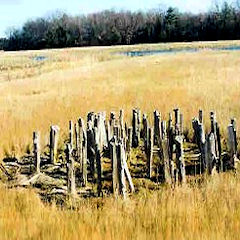
Whale Bone Point received its name from its prominence as a spot for landing blackfish and small whales when the inshore fishing industry was in its heyday. According to the WCT newsletter, “reputedly, the bones of these marine mammals could be found stacked on the site after blubber and oil was rendered from the carcasses.”

Sources

Durand Echevierra, A History of Billingsgate, Wellfleet Historical Society, 1991.

Jeremy Dupertus Bangs, editor, The Town Records of Eastham During the Time of Plymouth Colony 1620-     1692, (Publication of the Leiden American Pilgrim Museum, 2012)

James Deetz, Patricia Scott Deetz, The Times of Their Live: Love, Life and Death in Plymouth Colony, New York: Anchor Books 2000.

H. Roger King, Cape Cod and Plymouth Colony in the 17th Century, Landham, MD: University Press of America, 1994.

Braginton-Smith, John and Duncan Oliver, Cape Cod Shore Whaling, Charleston, S.C.: The History Press, 2008

Bolster, W. Jeffrey, “Putting the Ocean in Atlantic History: Marine Communities and Marine Ecology in the Northwest Atlantic, 1500-1800,” The American Historical Review, Volume 113, Number 1 (February 2008) pp 19-47.


Posted in Uncategorized | Leave a comment

Blackfish Creek’s Fulling Mill

The Massachusetts Historical Society began publishing papers in their collection in the late 1700s. One of the earliest writers about Wellfleet, quoted often, is the town’s minister, Levi Whitman. In 1794 he wrote a letter called “An Account of the Creeks and Islands of Wellfleet.” He began at the Eastham border with Silver Spring Creek, then moving on:

Advancing further north is Blackfish Creek, the head of which was formerly a fresh pond. A way was cut from it to the main creek, for the purpose of erecting a fulling-mill, which in time went to decay, and the time has worn a passage for vessels of sixty or seventy tons.

This held two surprising facts: first, that Drummer Cove (what we now call the head of Blackfish Creek) was once a fresh water pond, and second, that South Wellfleet had a fulling mill. I had to check out what a fulling mill is, or was, as these pre-industrial mills have disappeared.

Fulling mills processed hand-woven woolen cloth. We know that the early settlers of Eastham, including Billingsgate which became Wellfleet, kept sheep, so it’s no surprise that they needed to process the cloth they wove. Woven wool is not very compact and the wool contains excess grease and oils. Fulling is a process involving beating the cloth in a wooden tub filled with water and soap to remove the oils. The beating “felts” the fibers to form a denser, more compact cloth. In a fulling mill, a waterwheel powered a pair of wooden mallets that beat the cloths in a tub for an extensive time.

After this processing, the cloth would be attached to a “tentering” frame, a long framework of horizontal bars covered with L-shaped nails called tenterhooks. The cloth would eventually dry, and then would be stroked with teasels to raise its nap, and finally sheared smooth.

From this second process we get the expression “on tenterhooks” or held in suspense. Does anyone say this anymore?

New England used its many streams and brooks to build grist mills, saw mills and fulling mills. Eastham and Wellfleet had windmills for grinding corn, but I was unaware of a fulling mill until I read Levi Whitman’s letter. There was also a tide mill in South Wellfleet, in the small channel in Loagy Bay near Mill Hill now a conservation area.

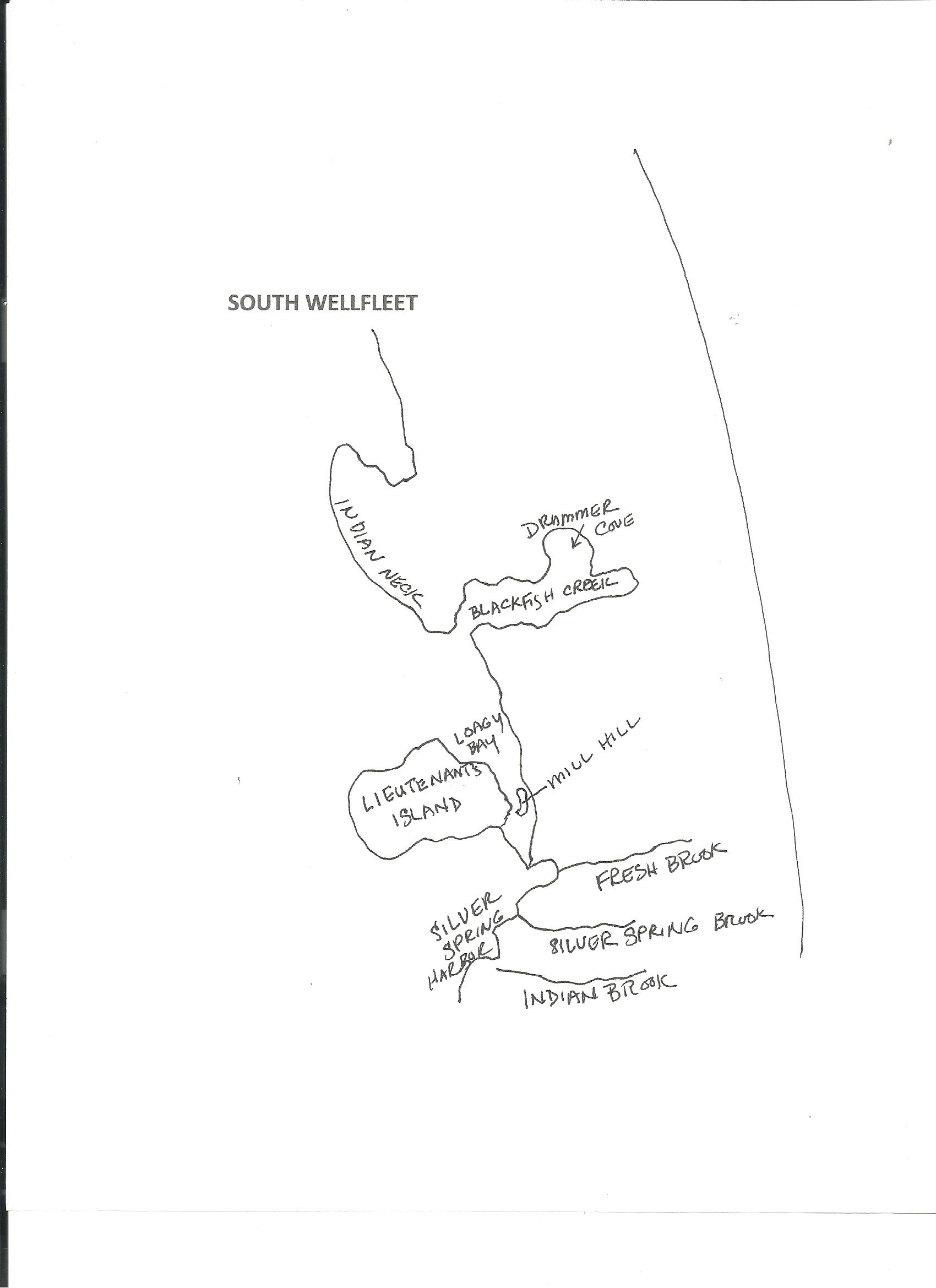
South Wellfleet

South Wellfleet

When I first read Levi Whitman’s essay, I had thought he was referring to “Drummer Cove” at the head of Blackfish Creek. I know that in the nineteenth century the fishing schooners were brought in there for winter storage, and his reference to “a passage for vessels of sixty or seventy tons” confirmed my assumption. Several people commented to me as I was working on this research that the tidal movement into Drummer Cove would not have been strong enough to power a mill. Could the minister have been referring to the part of Blackfish Creek now cutoff and to the east of today’s highway?

However, another source for believing Whitman was referring to today’s Drummer Pond is the 1775 map of Wellfleet which Chet Lay provided recently. On this map, a “mill pond” is clearly marked, with a very small water passage between Blackfish Creek and the pond.

1795 Map of Wellfleet from Mass. State Archives

1795 Map of Wellfleet from Mass. State Archives

(This map also marks the “water mill” near Loagy Bay, separating Lieutenant’s Island from the mainland South Wellfleet.)

The Brewster Grist Mill at Stony Brook once had a fulling mill; one account says that it was across the road, another says that the grist mill there today was built on the foundation of the fulling mill. Marstons Mills, further up the Cape, claims to have had the last fulling mill in operation, it closed in 1830.

Sources

Collections of the Massachusetts Historical Society Volume IV 1795, available at Google Books.

1795 Map of Wellfleet by Waterman and Hamblin (State Archives of Massachusetts)

Posted in Uncategorized | 1 Comment

Making Hay in South Wellfleet

Free food! The first Billingsgate settlers joined the other English farmers who found the salt marshes up and down the North Atlantic coast as a certain source of fodder for their livestock. Harvesting salt hay was not new – it had been practiced in Europe and in the British Isles for a long time. As discussed in my previous post, many of the earliest land grants in South Wellfleet were “meadow grants” for the salt marshes around Blackfish Creek, Lieutenant Island and Loagy Bay, and other marshy areas around the bay.

Blackfish Creek marsh

Blackfish Creek marsh

There were no cattle on the Mayflower brought by the English farmers who settled Plymouth in 1620. The first to arrive were three heifers and a bull on the ship Charity in 1624. Plymouth Colony records show a very careful division of cattle, and also groupings of colonists there who were to share the services of the bull. Eastham’s early records show bull (often spelled “boole”) groups also.

When the Plymouth settlers came to Nauset (later Eastham) in 1646, the earliest town records note the individual earmarks given to cattle and horses. Initially, the settlers’ homes were around the Town Cove, and all the open fields were shared. As time went on, fields became individually owned and fenced, and meadow grants were allotted to individuals. The earliest records of land division in South Wellfleet are for these meadow grants, as discussed in my previous blog post.

Salt hay is the marsh grass, spartina patens, the low, delicate grass that makes beautiful cowlicks on the marsh. The other common marsh grass is spartina alterniflora, the upright cordgrass that creates the thatch left on the beaches today. It was used to thatch roofs, and perhaps as insulation around houses in the winter time.

The salt hay was cut by hand, raked into long rows called windrows and then into larger bundles called haycocks. The settlers probably used cedar from the South Wellfleet cedar swamp that we can stroll through today to build what they called staddles. These were platforms on the marsh that the hay was stacked on, built high enough to avoid the tide flooding the structure and floating the hay away.

Salt Hay tools

Salt Hay tools

All of this information is assumed, since I have not found records that confirm that the South Wellfleet men were handling their hay in this manner. Nevertheless, it is the method other colonists used, as historians have well documented. We do know that the Cedar Swamp near the current Marconi site supplied the right kind of wood for the salt works of the early 19th century, wood that could stand-up to salt water without deteriorating.

Once stacked, the hay might have been weighted down. It was cut in summer when the

Marsh Hay stacked on a staddle

Marsh Hay stacked on a staddle

neap tides created the least amount of water coming into the marshes. Cutting hay took more than one person, so the settlers helped each other. It was hard work, not helped by sinking to one’s knees in the mud from time to time, or being bitten by mosquitos and green head flies. Later in the year, after the marshes were frozen, the farmers returned to their staddles to collect the hay and store it in their barn for the winter.

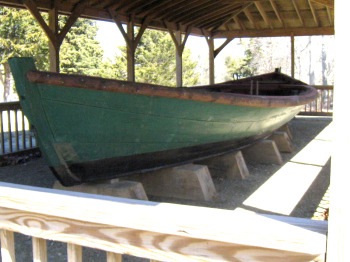
Another method for harvesting was to pile the hay in a flat-bottom boat known as a “hay scow” and float it back to dry land and into one’s barn. The

Salt Hay boat on display at CCNS Visitor Center

Salt Hay boat on display at CCNS Visitor Center

National Park has a “hay barge” from the 1850s on display at the Salt Pond Visitor Center.

Haying has often been depicted by artists — and even more humble salt-hay making written about by James Russell Lowell (1819-1891) in his poem “Charles River Marshes”:

In Summer ‘tis a blithesome sight to see,

As, step by step, with measured swing, they pass,

The wide-ranked mowers wading to the knee,

Their sharp scythes panting through the thick-set grass.

Later, after some experimentation, the farmers discovered how to grow some of the grasses they had in England, and the cattle had this more nutritious source. However, the English grasses never replaced salt hay completely. Salt hay remained a local commodity well into the 19th century. I’ve read deeds for land around Lieutenant’s Island that transfer meadow land to a new owner, but keep the rights to access other portions, so haying could be done. In the 19th century, some harvesting may have been done with a tool called a drag, raked by a horse wearing special shoes to prevent it from sinking.

an empty staddle

an empty staddle

Milk from the cows fed salt hay was salty. One writer about this harvesting process told of a young man returning to his farm after being away, asking his father to feed the cows a good mix of salt hay before he returned so he could enjoy a taste of home he’d missed.

Sources

James Deetz, Patricia Scott Deetz, The Times of Their Live: Love, Life and Death in Plymouth Colony, New York: Anchor Books 2000.

Jeremy Dupertus Bangs, editor, The Town Records of Eastham During the Time of Plymouth Colony 1620-     1692, (Publication of the Leiden American Pilgrim Museum,2012)


Teal, John and Mildred Life and Death of the Salt Marsh, New York: Audubon/Ballentine Books, 1969

http://benmuse.typepad.com/ben_muse/2006/05/harvesting_salt.html


Posted in Uncategorized | 1 Comment

When South Wellfleet was Hither Billingsgate

Land Distribution in South Wellfleet

Since I began researching the history of South Wellfleet, I’ve looked for evidence of the earliest European settlers — and evidence of native people populating the area, yet another topic. This article discusses the records I’ve found of land distribution known to be in South Wellfleet.

In Durand Echeverria’s book on the settlement and political development of the town of Wellfleet, A History of Billingsgate, he refers to land deeds that named the area just to the north of Indian Brook “hither Billingsgate.” Indian Brook, now called Hatch’s Creek, remains the dividing line between Eastham and Wellfleet. “Hither Billingsgate” is another earlier name for South Wellfleet.

The three Barnstable County historians Pratt (1844), Freeman (1858), and Deyo (1890) touch lightly on early settlers but do not provide many details. A more certain early record is the 1734 notation in “The Records of Wellfleet, Formerly the North Precinct of Eastham, Massachusetts” published in The Mayflower Descendant. It names the men who wanted to remain with the church in Eastham, and pay their taxes there rather than to the new “precinct” of Billingsgate. Presumably, they lived with their families in SouthPam Tice South Wellfleet Map with Title 001 Wellfleet, and the meeting house on Chequesset Neck (in today’s Wellfleet) was too distant.

There are two other records that we can draw certainty from — both are land distribution lists. The first is the published records of land distributed by the Town of Eastham, although there is no record of home building. Another is a record of the 1711-1715 distribution of Eastham land that had been held in common. Taken together, these records, as well as many family histories, are my sources for who was living in today’s South Wellfleet. Another source, one that I have not fully explored, is the record left by individual’s wills, where land is left to family members and others by the deceased.

The Town Records of Eastham, newly published by Jeremy Dupertuise Bangs, lists the earliest land grants by the ruling town of Eastham, in places that named South Wellfleet sites:

  • 1654, a meadow at Blackfish Creek to Richard Bishop, next to the meadow of William Twining
  • 1658, half acre of meadowland at Blackfish Creek transferred to Mr. Smalley by Daniel Cole, next to that of Richard Sparrow.

Then, in 1659, there are numerous land grants in Billingsgate, many on the islands west of the harbor where historians have determined that the settlement of Wellfleet began. In South Wellfleet, these 1659 land grants included 3¾ acres of meadow to Jonathan Sparrow and the same amount to William Walker, at Silver Spring Meadow, on both sides of Silver Spring Creek. There’s an important distinction made in these land distributions: “meadow” refers to the marshland where salt hay could be harvested for the animals that were key to the farms of the early settlers; I plan to post about salt hay making in a separate article. Many of the distributions around Blackfish Creek were such meadow grants.

In 1662, Lt. Joseph Rogers received two acres on “the netherside” of Little Blackfish, as Blackfish Creek was sometimes called, between land belonging to Job Cole and John Doane. Rogers was an important town figure, named the head of the Eastham militia soon after the town began, at a time when Plymouth Colony took action to be ready for potential disruption from the Dutch in New Amsterdam. Fort Hill in Eastham was so named because it was the site of the fort that Plymouth Colony had ordered the town to build at that time. In 1665, Joseph Rogers Jr. was given four acres “at Loge,” today’s Loagy Bay, adjacent to land belonging to Samuel Freeman. There’s no record I’ve found to tell us why Loagy Bay is so named; I wonder if it might reflect the word “logy,” an old Dutch term meaning slow-moving and sluggish, perhaps referring to the movement of the tides.

In 1664 and 1665 there was another round of land distribution. Jonathan Higgins, son of Richard Higgins, received three acres of meadowland at Silver Spring, adjacent to the land of Mark Snow, son of Nicholas Snow. When Richard Higgins and Nicholas Snow became Eastham Proprietors, they were older and it wasn’t long before their sons needed land as they married and started their own families.

In 1665, Nicholas Snow was given five acres at the mouth of Blackfish Creek and, later that same year, two acres of meadow “in the second meadow coming out of Blackfish Creek.” The second piece was land transferred from Mr. Doane, extending to land belonging to Job Cole. In 1678 Nicholas Snow was given an acre and a half “with the sedge within land belonging to William Walker against the Silver Spring Creek.”

In his will of 1676, Nicholas left to his son, Jabez Snow, “one-half of a meadow at Silver Springs on the northside of William Walker, and the cliff of upland adjacent to the meadow and all the sedge ground about it (next) to Ephraim Doane’s.” Jabez Snow was the grandfather of the Sylvanus Snow mentioned later in this piece. Nicholas Snow’s son, Joseph Snow, who died in 1722/23, left to his son, Benjamin, “1/4 meadow on the south side of Lieutenant Island” and to his sons, Stephen and James, meadow and upland at Silver Spring.

The Snow family figures prominently in the early days of South Wellfleet. Previous to the establishment of Wellfleet as a town, there were years of negotiations as Billingsgate — the north part of Eastham — began its separation. In 1723, when the Billingsgate residents were given permission to have their own minister, the area so-designated was as far south as Blackfish Creek, leaving those further south in South Wellfleet able to still attend church at the Eastham meeting house.

In 1734, when Billingsgate was set aside formally as “the North Precinct” it was Sylvanus Snow and “five others” who were released from paying their tax to the precinct, presumably because they were living closer to the Eastham church. The others were Eldad and Ebenezer Atwood, Joseph and Jesse Brown, and Samuel Snow (Sylvanus’ brother). These records are the first we have of actual South Wellfleet settlers who did not want to travel all the way to the new meeting house at Chequesset Neck. Sylvanus Snow’s mother, Elizabeth, is buried in the cemetery now called “Bridge Road Cemetery” in Eastham, where the second Eastham Meetinghouse stood, further proof that the Snows of South Wellfleet attended church in nearby Eastham.

When the limits of Wellfleet were described in 1763, Wellfleet was “joined from the Bay to the Back Side Sea” but “leaving aside the estate of Sylvanus Snow as excepted in the incorporation.” In the 1802 description of Wellfleet’s ocean side by the Humane Society, telling seamen where they could find shelter after they scaled the dunes, there was a hollow described as Snow’s Hollow, two miles south of Cahoon’s, noting that the County Road rounding the head of Blackfish Creek was a half-mile west. However, on the 1858 map, Snow’s Hollow is prominently designated further south, close to the Eastham border, just east of Fresh Brook. Today that hollow is not named, since there is no beach access for 21st-century swimmers. The more northerly hollow, north of the National Park’s Marconi Beach, is now LeCount’s Hollow, named for the family that settled nearby at a later time.

Returning to the seventeenth century, in 1664, Governor Bradford got twelve acres of upland and 44 acres of meadow near Lieutenant’s Island “now lawfully possessed by Richard Higgins.” Governor Bradford never settled on the Cape; perhaps the land was for payment of a debt. That same year, Jonathan Sparrow, son of Richard Sparrow, an original Proprietor, gave Richard Higgins an acre and a half of meadow at Indian Brook, between land belonging to Nathaniel Mayo and Daniel Cole. He also sold three and ¾ acres of meadow on both sides of Silver Spring Brook, nearby to land belonging to William Walker. Also in the mid-1660s, Edward Bangs, Josiah Cook, Robert Wixam, and John Jenkins each received two-acre meadows on the Blackfish River, another name for Blackfish Creek in early deeds.

Richard Higgins, a tailor and one of the Eastham Proprietors, left the Cape in 1669, to purchase and settle on land in Piscataway, New Jersey. His son Benjamin, already grown and married, stayed in Wellfleet, and was grandfather to the Thomas Higgins who built the first part of the “Atwood Higgins House” on Bound Brook.

When Edward Bangs wrote his will in 1676, he left four acres of meadow at Blackfish Creek to a third son, Joshua, along with other extensive land holdings. When Lt. Joshua Bangs died in 1706, his own son Edward had already died, so he left his meadow near Blackfish Creek to John Knowles. Previously, when I was researching Old Wharf Point, I noticed that the Knowles family still owned a piece of land near there in the 19th century.

In 1666/67 Daniel Cole received four acres on the southerly side of Indian Brook, “beginning at the cartway that goes over the bridge.”

In 1669, Captain Samuel Freeman got four acres of meadowland at Loge (also known as Loagy Bay), near the north arm of Silver Spring Creek. We know that Captain Freeman had a family tie to Governor Bradford’s wife.

In 1672, William Brown (recorded as Browne) of Sandwich received 16 acres and “associated meadow” at Little Billlingsgate and Silver Spring in a sale from a Daniel Seward. Mr. Browne was the great grandfather of Joseph and Jesse Brown, who were also released from North Precinct taxes along with Sylvanus Snow, presumably because they also lived in South Wellfleet, so this deed notes their family’s beginnings in South Wellfleet.

James Brown, Jesse and Joseph’s father, was another who left South Wellfleet. He moved to Gorham (then part of Massachusetts, now in Maine) in about 1750, as did some of the Harding family members who had become South Wellfleet settlers. Land grants were made in Gorham in 1733 to reward the men who had successfully fought the Narragansetts in King Philip’s War of 1675. By the time the grants were made, the land was given to children and grandchildren of the soldiers. Other members of the Brown family stayed in South Wellfleet. George Brown married a daughter of the Freeman family, mentioned above, and lived to 1767; he is buried in Duck Creek Cemetery.

Another family named in the agreement of 1734 concerning the payment of North Precinct taxes was Ebenezer and Eldad Atwood. Since so many of these early Eastham families have been researched, it’s pretty easy to check on who the early settlers were. Stephen Atwood was an early arrival in Eastham, producing the large family characteristic of that era. His son, Eldad, married a Snow daughter. They had numerous children, including Eldad, born in 1695, and Ebenezer, born in 1696. Other Atwood children settled in Wellfleet’s western islands. The Eldad and Ebenezer named in the 1734 town meeting notes appear to be the two who were living in what was South Wellfleet. Children born later in the 1700s married daughters of families I can place in South Wellfleet also — Witherell, Cole, and Doane. One of my early blog postings was about the Barker family; their son married Lizzie Atwood, whose family line can be traced back to these South Wellfleet Atwoods.

The second source for land distribution records, mentioned above, is the Division of 1711-1715. This record has been published separately, and I found a copy at the New York Public Library. It’s a list of names, numbered from 1 to 143, of “Lot” and “Woodlot” distributions. There was no key to the list, although I found a note in yet another source that it was numbered from south to north, but with no indication which numbers were in Wellfleet. Fortunately, Durand Echeverria dug a bit deeper than I have been able to do, and noted several of the Wellfleet grants made at this time, including some in South Wellfleet, allowing me to assign numbers to sites. Again, this list refers only to land, not homesteads:

  • Brown family members: lots 111, 115, 117, 119, 120, 121, 123.
  • Harding family: 112 and 113. In her research, Polly Stubbs, noted that John Witherell bought his land from the Hardings when they moved to Gorham, one of the families receiving land grants there. Durand Echeverria noted that this Harding land was on Blackfish Creek. (I wrote about Major John Witherell several blog posts ago.)
  • Isaac Doane lot 118 which Echeverria notes was on Indian Brook.
  • Isaac Pepper received lots 104 and 107; I have a record of a 19th century Arey land naming a portion “the Pepper marsh” perhaps referencing this 18th century land.
  • William Walker received ½ of lot 104, sharing this with Isaac Pepper; a John Walker got lot 116.
  • Isaac Higgins got Lot 114.
  • The Collins men – Jonathan, Joseph Sr., Joseph Jr. and John — received lots 101, 102, 103, and 110.
  • Daniel Atwood received lot 108.
  • Joshua Cooke received 109.
  • Stephen Snow received Lot 106.

This ends my research that identifies the earliest South Wellfleet families.

Sources

Durand Echevierra, A History of Billingsgate, Wellfleet Historical Society, 1991.

Kneedler-Schad, Lynn, Katharine Lacy, Larry Lowenthal, Cultural Landscape Report for Fort Hill, Cape Cod National Seashore, 1995

Jeremy Dupertus Bangs, editor, The Town Records of Eastham During the Time of Plymouth Colony 1620-     1692, (Publication of the Leiden American Pilgrim Museum, 2012)

Trayser, Donald G. “Eastham Massachusetts 1651-1951” Eastham Tercentenary Committee, 1951

New England Historical and Genealogical Society, on-line publication of The Mayflower Descendant.

Smith, Edward Leodore, compiled in 1913, Ancient Eastham, Massachusetts, two lists of those proprietors there in seventeen hundred and fifteen: from the originals in Town Book Lands and Ways, 1711-1747.

David Kew’s Cape Cod History site: www.capecodhistory.us.


Posted in Uncategorized | Leave a comment

South Wellfleet During the Plantation Period

We require great imagination to take us from the 21st century back to the 17th in South Wellfleet. Historians call the time frame of 1620-1692 the “Plantation Period”. This followed the “Contact Period,” pre-1620, when there were European explorers and fishermen making contact with the Cape’s native people. The word “plantation” means the time of settlement; Plymouth Colony’s reenacted village site is called “Plimoth Plantation.”

There’s no evidence of anyone establishing their “plantation” in South Wellfleet during this time, but land distributions were made by the Town of Eastham (also encompassing the area that is now Wellfleet) established by Plymouth Colony. Looking at these records made me curious about the legal basis on which lies the whole Plymouth Colony venture. Much of our history considers the “Pilgrims” (a term not used until the late 18th century) and their search for religious freedom. They were also referred to as “Separatists” to note their wish to separate from the religious practices in England. I wanted to look more closely at the business negotiations that brought them to North America, and the context for their venture. I sought to understand their changing role as Englishmen far distant from home. While greatly diverting from my South Wellfleet subject here, I am sharing understanding of the context in which the Plymouth colonists, and their Eastham counterparts, operated in the 1600s.

Fortunately, the Pilgrim Hall Museum in Plymouth has an explanatory piece on just this subject. An online essay “The Plymouth Colony Patent” outlines this legal arrangement in detail.

In 16th century England, there was new knowledge of the world’s geography, newly developing capitalism and its structures, and a wealthy landed gentry. Adventuresome aristocrats and rich merchants began to put together “companies,” pooling income, securing a patent from the Crown (thus gaining import duties and taxes), and funding a “project.” By 1615, there were two Virginia Companies with royal charters that split the monopoly on colonizing British North America.

The Virginia Company of London covered the Carolinas to northern New Jersey, and the Virginia Company of Plymouth (England) covered northern New Jersey to Maine, and was reorganized as the Council of New England around 1620. The Pilgrims obtained their patent — called the Peirce Patent — from the Virginia Company of London to settle within the jurisdiction of Jamestown. Creating these special patents was a mechanism to help the financially floundering Jamestown colony.

As we know, the Pilgrims landed on Cape Cod, putting them outside the jurisdiction of the Virginia Company of London patent, but instead under the aegis of the territory of the Council of New England. The Mayflower Compact, which they drafted and signed while in Provincetown harbor, was an attempt to structure a government to govern the conduct of the settlers. However, it had no force in law as recognized by any outside authority. The Compact did emphasize their commitment to mutual support and cooperation, but individual freedom — as we know it today — was not a consideration.

In 1621, the Plymouth settlers got a second patent, giving them permission to attempt a settlement. This patent was to last seven years, and that the settlement — not individuals — would receive 100 acres for every person who moved there, who stayed for three of the seven years, or who died in the attempt. The seven years proved successful, more or less – the Separatists in Plymouth began sending fish, clapboards, and beaver pelts back to England in December 1621.

When 1628 arrived and it was time for a new patent, a “deal” was struck by William Bradford whereby he and eleven of his fellow settlers agreed to take on the remaining debt of £1800 in exchange for the sole right to trade for six years. They became known as “the Undertakers.” The patent settled far more than 100 acres for every person, and even included territory in Maine where fur trading took place. In 1635, the Council for New England went out of business, and for 25 years Plymouth drifted along without any direct authority by England.

Dramatic changes were underway in England during this time. James I, who had been king when the Separatists left for North America, was succeeded by his son, Charles I, who was beheaded during the Civil War and the government came under the leadership of the Puritan Oliver Cromwell. Charles II was restored to the throne in 1660 and ruled until 1685, when James II took the throne.

Now England began to pay more attention to its colonies, and made an effort to assert royal control. Proposals to appoint a royal governor were not met with enthusiasm, but neither was Plymouth’s request for a new royal charter granted. The Colony’s government drifted for a decade until, in 1675, King Philip’s War broke out in southeastern Plymouth Colony. This costly and bloody war lasted until 1678. The English government criticized Plymouth for allowing it to happen.

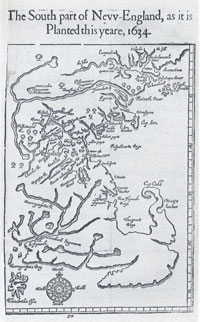
In the 1680s the Crown became aware that Massachusetts Bay Colony, a far wealthier settlement to the north of Plymouth, had been refusing to enforce the Acts of Trade and Navigation, England’s means of collecting taxes on the colonies. In 1684, Mass Bay’s charter was revoked, and all the colonies – Massachusetts, Maine, Plymouth, Connecticut, Rhode Island, and New Hampshire, plus New York and New Jersey two years later — were consolidated into the “Dominion of New England.” A royal governor, Sir Edmund Andros, was sent to colonial New England to enforce all English laws, including religious toleration. (The Puritans in Massachusetts Bay had become rather extreme.) The new government tried to impose new taxes and limit the town meeting self-government that had grown up around New England. The colonists disliked Governor Andros, and there was growing civil disobedience.1634 map2-01

The “Glorious Revolution of 1689” overthrew James II, and William and Mary came to the throne. In Boston, Governor Andros was overthrown too, and Massachusetts Bay Colony reasserted its colony status with self-government. At the same time — perhaps as a way to show their loyalty to the new monarchs — the colonies launched a poorly-planned expedition against Canada, where the French and their Native (Indian) allies had initiated hostile action against the English. Several Plymouth men were killed.

Plymouth Colony attempted to obtain a royal charter again during this period, but was overcome by the strength of the Massachusetts Bay Colony. There was even a chance during this time that Plymouth might be included in the New York colony. Finally, by 1691, a new charter was granted that annexed Plymouth to Massachusetts Bay; property rights and some aspects of representative government were kept, but a crown-appointed royal governor was put in place in Boston. The new charter arrived in 1692, putting an end to the Plymouth Colony.

This is the background of the time that Eastham — then comprising all of today’s towns of Eastham, Wellfleet and Orleans — was established and people came to settle in the area, the home of the indigenous Nausets, one of bands of southeastern New England Wampanoags.

The settlement of Nauset — later named Eastham — took place beginning in 1644, when a committee of seven Plymouth men first explored the area as a potential settlement. The area called Nauset was already known to the Plymouth settlers. During their December 1620 explorations while the Mayflower was anchored in Provincetown harbor, they had, over several days of exploration, found fresh water in Truro, stolen corn, disrupted a burial site, saw a grampus (blackfish) being slaughtered on the beach, and had their “First Encounter” in Eastham. The Plymouth settlers eventually paid for the stolen corn, and later purchased more during their first year during the time when they experienced starvation in Plymouth. The Nausets also helped the Plymouth colonists in April 1621, when the Billington boy wandered off too far and was taken into safekeeping, but later returned.Plymouth_Colony_map

The seven men who came to be known as the “Proprietors of Eastham” were all leading citizens of Plymouth, office holders, and landowners. It had become apparent as a second generation was developing that Plymouth’s land was not especially productive. In fact, the Colony considered moving all of its settlers to Nauset, but later decided that the land could not support them all. The men who became the Eastham Proprietors included Governor Thomas Prence, who had been elected Plymouth Colony Governor in 1634 and again in 1638, during years when Governor Bradford was not in office. The other Proprietors were Josiah Cooke, John Doane, Richard Higgins (sometimes referred to as Higginson), Edward Bangs, John Smalley, and Nicholas Snow.

By 1645, John Jenkins, Samuel Hicks and Joseph Rogers had been added to the list of “freemen” and, soon after, Daniel and Job Cole, Robert Wixam, and John Freeman. By 1658 other men were on the list of freemen: Stephen Atwood (often referred to as “Wood”), Henry Atkins, William Walker, William Merrick, Thomas Paine, Ralph Smith, Joseph Harding, George Crisp, Richard Sparrow, William Twining and John Young. Some of these men may have gained their status by marrying the daughters of the Proprietors.

Plymouth had granted land previously for the establishment of other towns on the Cape: Sandwich, Yarmouth and Barnstable. However, these settlements were the result of religious disputes within the Massachusetts Bay Colony. Plymouth Colony had proven itself to be more relaxed in religious tolerance than were the Puritans of Massachusetts Bay.

The settlement at Nauset was the first on the Cape that sent Plymouth Separatists to the Cape directly. The seven men proceeded to purchase from two sachems. They purchased from Mattaquason, the sachem of the Manamoyick, a tract of land called Pochet, with a beach and small island upon it, and also all the land called Namskaket. They bought from George, the sachem of the Nausets, land as far as Indian Brook (today’s Hatch’s Creek, the line separating Eastham and Wellfleet).

There is an oral tradition regarding the remaining land north to the stream the English called Bound Brook (northern Wellfleet). George told them no one owned it, so the English purchasers claimed it as theirs. Later, a Native man named Lieutenant Anthony claimed to be the sachem of this land, for a group called the Punonakanits of Billingsgate. A deed was negotiated much later. This transaction reserved a small neck called Tuttomnest for the use of the native people. It became known as James’ Neck, and later Indian Neck. Confirming the arrangement in the sale, this land was set aside by the Eastham town meeting for the exclusive use of the native people in 1716. The island in South Wellfleet that was named for Lieutenant Anthony — “Lieutenant’s Island” — was not set aside for native use; rather, it was designated for common use in 1662, and in 1673 for the support of the ministry.

The Eastham Proprietors were acting for the Plymouth Colony, since no one had the right to buy native land individually. Thus, on March 3, 1645, the Plymouth Colony Court, whose records are carefully transcribed (and now on the internet!) issued to the Proprietors the following grant:

The court doth grant unto the church of New Plymouth, or those that go to dwell at Nossett, all the tract of land lying betweene the sea and sea, from the Purchasors bounds at Naumskeckett, to the Hering Brooke at Billingsgate, with the said Hering Brooke and all the meddowes on both sides of the said brooke, with the great basse pound there, and all the meddowes and islands lying within the said tract.

The Purchasers’ bounds at Namskaket refers to land south of Yarmouth that the original purchasers (the Undertakers) received in 1640 to reward them for their efforts in settling the colony. That land later became Harwich. The Nauset purchase began east of there, at today’s Namskaket Creek, which marks the line between Orleans and Brewster. By 1640, the remainder of the Plymouth Colony was in the hands of the Colony’s freemen. William Bradford, the often-elected Governor, had explored the Nauset area with the seven purchasers, but never settled there, though he did receive land and meadow grants there, including one at Blackfish Creek.

In 1646 the town of Nauset was established, and in 1651 it had an unexplained name change to Eastham. Once a town was established it then became the governing body including selectmen, a constable, men to maintain the highway, and representatives to the colony court, that served as both the legislative and judicial body.

Before ending this part of the Plantation era story, a word here about place names. It appears that Billingsgate was already a known name for the Wellfleet area by the mid-1600s. Sometimes it would be referred to as “Little Billingsgate,” but this did not appear to be a mere section of the area, but the whole. Some deeds called a section “Hither Billingsgate” to refer to the closest part — that being today’s South Wellfleet. Blackfish Creek, Blackfish River and Great Blackfish River were referred to in locating meadow grants, as was Boat Creek in Eastham.Pam Tice South Wellfleet Map with Title 001

Lieutenant’s Island was so named in the 1662 meeting when it was decided to keep it for public use. It may have had this name long before. Loagy Bay was referred to as “Loge Bay,” but I have found no explanation as to why this name was so given. Silver Spring and Indian Brook in South Wellfleet were early named reference points. Both arms of Duck Creek are referenced.

In what is now Orleans, Pochet or Pochey, was often referenced, along with Town Cove. Not all deeds had these reference points that can be understood today. Most deeds were very difficult to understand, as they named rocks, trees and other natural features, along with abutting owners. Sometimes a land description contains a useful clue to the researcher, such as naming a “Mill Pond” signifying that a mill had been built there.

There is no recorded information as to the first land distribution in Eastham, but we know from later records and from recorded wills that the Proprietors settled around Town Cove, building their first meeting house and homes there. The Cove Cemetery is today’s remnant of that settlement. They shared the common lands for grazing their cattle, used wood as needed, and fished and took shellfish wherever they wished. Soon that would change.

Sources

Baker, Peggy M. “The Plymouth Colony Patent, Setting the Stage,” downloadable at http://www.pilgrimhallmuseum.org.

Durand Echevierra, A History of Billingsgate, Wellfleet Historical Society, 1991.

James Deetz, Patricia Scott Deetz, The Times of Their Live: Love, Life and Death in Plymouth Colony , New York: Anchor Books 2000.

Jeremy Dupertus Bangs, editor, The Town Records of Eastham During the Time of Plymouth Colony 1620-1692, (Publication of the Leiden American Pilgrim Museum, 2012)

Plymouth Colony Records (Boston: William White 1855-1861) edited by Nathaniel Shurtleff and David Pulsifer (available on line)

H. Roger King, Cape Cod and Plymouth Colony in the 17th Century, Landham, MD: University Press of America, 1994.


Posted in Uncategorized | 1 Comment

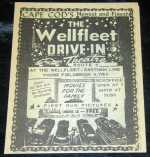
South Wellfleet’s Drive-In Theater

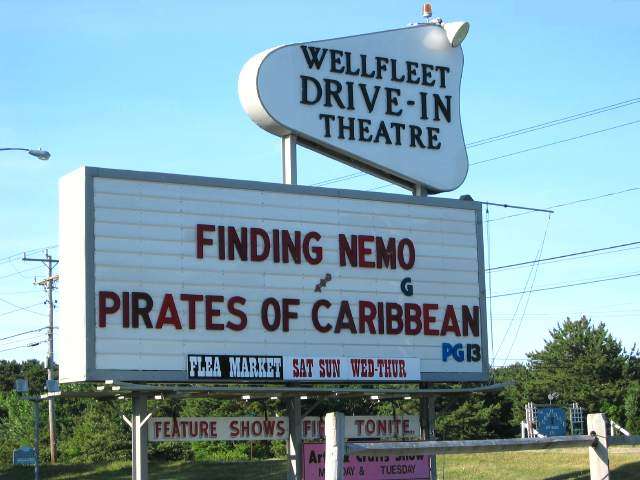
In 1957, two Wellfleet citizens, Charles Zehnder and John M. Jentz, purchased about 26 acres of land in South Wellfleet just across the Eastham border, and formed the Spring Brook Center, a company that operated the Wellfleet Drive-In theater. There’s no public record of why they planned this venture – but it was a popular time for this type of entertainment. In 1958 there were more than 4000 drive-ins in the U.S.; today, one account estimates that there are only 357 still operating. The movie theaters in Orleans and Provincetown were popular spots as well, but the Wellfleet Drive-In was an entirely different movie experience.

Drive In photo from Surfside Cottages

Drive In photo from Surfside Cottages


The Wellfleet Drive-In opened on July 3, 1957. A 2008 Cape Cod Times article stated:

“I remember my father telling the story of opening night,” said Ben Zehnder, Charlie’s son. “The asphalt wasn’t quite dry, so the cars all sank in with their tires.” Jentz, a graduate of Harvard and the Massachusetts Institute of Technology with a degree in engineering, had designed the pavement to rise in such a way that every car had a good view, but in all the excitement hadn’t quite managed to get the drying time right.

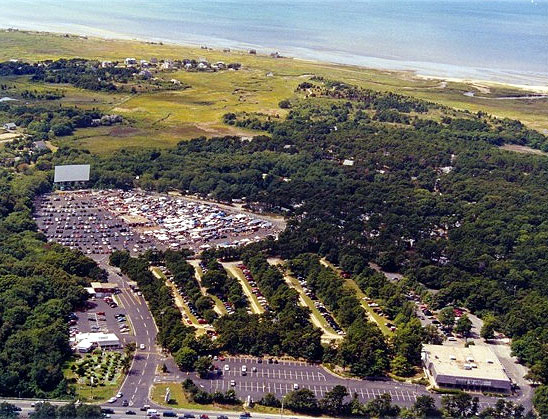
Zehnder and Jentz purchased their equipment from RCA: 650 speakers and speaker baskets plus other equipment. The Drive-in has stayed pretty much the same, one screen and about a 700-car capacity. Now the sound can also be accessed on FM stereo.

Old Advertisement

Old Advertisement

My Dad was always up for trying something new. He loaded up the family car and drove us there the first summer, when we watched Debby Reynolds in Tammy and the Bachelor. Later, the Wellfleet Drive-In was a date place, and, for a short while, I added to my summer earnings by working at the snack bar on Wednesday nights. That must have been during the era when  Eleanor Hazen managed the site – including the miniature golf and snack bar that was added in 1961. I’m not sure how long Famous Tang’s, the Chinese restaurant, lasted, but it was there in 1988 when Alice Hoffman, the novelist, wrote her encomium to the Wellfleet Drive-in in The New York Times. I’m sure that others in South Wellfleet have the same memories.

Today, the site is miraculously still in operation with the support of the Wellfleet Cinemas added in the 1980s, and the ever-popular Flea Market helping make this business last. Now the drive-ins that managed to last into the 21st Century are threatened with having to make an expensive change to digital projectors. Recently, Honda got into the process of trying to save these nostalgia spots by awarding $80,000 grants to nine family-owned drive-ins around the country so they could upgrade.

When you’re at the drive-in, you’re sitting on the land of the Lincoln family who had deep roots in the town of Eastham, and eventually settled in the section that became Wellfleet in 1763. Like many old Cape families, Joshua Lincoln farmed his family land from the mid-19th Century to its end, when the heirs had moved away and were probably glad to sell their nearly one hundred acres. Everett Osterbanks arrived in Wellfleet in the mid-1920s and bought the land, then sold off portions. In 1950 he sold a piece to Maurice and Anna Gauthier, whose family still owns the Maurice’s Campground complex in South Wellfleet. The acreage that became the drive-in had another owner, a Mr. Dettman, and then afterwards it became the Zehnder/Jentz property when they formed their Spring Brook Center business.

Wellfleet aerial view from Drive-In's website

Wellfleet aerial view from Drive-In’s website

A recent Boston Globe article (March 15, 2014) by Sarah Shemkus concerning the Mendon (Mass.) Twin Drive-In purchase notes that this one and two others are the last remaining drive-ins in Massachusetts. In addition to South Wellfleet, the other is the Leicester Triple Drive-In outside of Worcester.

Sources

The New York Times, September 4, 1988

Boston Globe, March 15, 2014

www.drive-ins.com

Barnstable County Deeds available at www.barnstablecountydeeds.org

Newspaper account online at www.genealogybank.com.


Posted in Uncategorized | 3 Comments

The Other South Wellfleet Hatchs

Exploring the family connections of the two Isaiah Hatchs caused me to sort-out other Hatchs who lived in South Wellfleet.  A clipping in the South Wellfleet folder at the Wellfleet Historical Society reported the unfortunate demise of Lewis Hatch, who lived near the South Wellfleet Cemetery just past and a bit to the north of the house on Cemetery Road that served as the Parsonage to the South Wellfleet Congregational Church. I wondered who he was, and where he fit into the Hatch family. I also wondered if Clifford Hatch, the owner of Hatch’s Fish store in downtown Wellfleet, was a member of this family. A little genealogical research tied it all together.

Bethia Arey, daughter of the first Reuben Arey of South Wellfleet, married Thomas Hatch, whose family line stretched back to the Scituate Hatchs, as like the Isaiah Hatchs did.  Bethia and Thomas had eleven children. When Thomas and Bethia died, they were buried in Duck Creek Cemetery. Their ninth child, William Horton Hatch, was born in 1820. He married Hannah Snow, stayed in Wellfleet, and had numerous children.

One of William’s daughters, Eunice, married Seth Foster, son of Scotto Foster and Elizabeth Doane, a family I’ve written about.  Another Hatch son was William Junior, who never married, and lived in Wellfleet with his parents. Another son, Solomon Hatch, moved to Provincetown, and was the grandfather of Clifford Hatch. Yet another son, Lewis, married and moved to Boston.

By the time of the 1920 Federal census, Eunice and William –brother and widowed sister — are living in South Wellfleet and both are in their seventies. In the next few years, both of them died. By the 1930 Federal census, their brother Lewis (also spelled Louis in some accounts) was living there alone. In the 1930 Federal census, he is a widower.

The 1939 clipping I found at the Historical Society told of the sad death of “Louis” Hatch when his house and barn was burned and destroyed. This was just one of many fires in South Wellfleet that destroyed old homes. Mr. Hatch was 85 years old, and drove a horse and wagon that supplied vegetables to his neighbors.  There’s a wonderful photo of Mr. Hatch in Daniel Lombardo’s book “Wellfleet Then and Now.”

The fire at Mr. Hatch’s was on December 27, 1939. The temperature was down to fifteen degrees, with the wind blowing at twenty miles per hour. A Mr. Murphy was driving by on his way to Orleans at around 7 pm when he noticed the flames, and quickly went back to Mr. Davis’ South Wellfleet store to summon the Wellfleet Fire Department. Mr. Murphy returned to the fire, broke windows, and opened the barn door; only three piglets survived. Later, Mr. Hatch’s charred body was removed, not identifiable by the county coroner, but presumed to be the elderly man.

The news report says that the firemen laid hose to “Duck Creek” – they meant Blackfish Creek – but did not have sufficient hose to put out the fire. They summoned the Truro Fire Department through the radio system; Lawrence Gardiner had a radio in his car. The size of the fire attracted numerous onlookers. Smaller brush fires were ignited, but the proximity of the cedar swamp helped to contain their spread.

The fire was declared accidental. According to the news report, Mr. Hatch lived in only one room of the 150 year old house. There may have been a defective chimney, or it was supposed that Mr. Hatch may have tripped while holding a kerosene lamp.

Sources

Family History records at www.familysearch.org

U.S. Federal Census collection at www.ancestry.com

David Kew’s Cape Cod History site: www.capecodhistory.us

Barnstable Patriot (various) online archive: www.sturgislibrary.org

Newspaper account online at www.genealogybank.com.

Posted in Uncategorized | 1 Comment

The Isaiah Hatchs of South Wellfleet

The father plays a key role in solving the wreck of the ‘Franklin’; the son becomes ‘The Little Man of South Wellfleet’

In 1823, Isaiah Holbrook Hatch purchased half of the Lombard family’s holdings north of Blackfish Creek — today, thanks to Charles Cole’s memoir of his childhood in South Wellfleet, we know that the area was today’s Cannon Hill. Born in 1798, Isaiah H. Hatch was the son of George Hatch of Truro; in 1820 Isaiah married Elizabeth Smith Young of Wellfleet. Peel back a few generations — as with other Wellfleet families — and you can find Mr. Hatch’s ancestor, Thomas Hatch, an early arrival in New England, settling in Scituate, in the 1600s.

Isaiah H. Hatch pursued the usual career of a Wellfleet man of that era. Charles Cole notes that he owned the ship Aurora anchored at the South Wharf, and his brother Stephen Hatch owned the Fanny.  Captain Isaiah Hatch also owned pew number 43 in the South Wellfleet Congregational Church.

By the time of the 1850 Federal census, Mr. Hatch’s occupation is “farmer”, although he was referred to as ‘Captain’ throughout his life. Mr. Cole notes that Mr. Hatch grew alternating crops of corn and rye, the latter used to make brown bread and hasty pudding, New England staples.  In the 1850 Federal agricultural census, Mr. Hatch owns 50 acres, but only four acres are under cultivation.

Mr. and Mrs. Hatch’s first child was Rebecca, born in 1821; she died at age 7 in 1828. Their second child, Elisa Arey Hatch, was born in 1823 and married in 1844 to Nathan Y. Paine, another of South Wellfleet’s distinguished citizens. Mr. Paine became one of the South Wharf owners in the 1840s, after Richard Arey moved away. A third daughter, Minerva, was born in 1828; she later married Joshua Paine. Their fourth child, a son, was named Isaiah Adams Hatch. Born a dwarf, he lived at home throughout his life, and achieved some fame later in life, as I’ll write about later. The Hatchs had another child in 1834, Harriet, but there is no record of her in the 1850 census, so presumably she died in childhood.

Mr. Hatch’s moment of fame came in 1849 when the Franklin ran aground in Wellfleet. Donald Trayser, a Cape Cod historian, puts the wreck near Newcomb’s Hollow.  The Franklin was en route from Deal, England, to Boston, with passengers and cargo — wool and linseed oil, nutmegs, books, dry goods, and what the news called “a choice selection of nursery stock” that a Boston man had ordered to establish his horticultural business.

The news reports and later testimony of the crew described the situation on March 3, 1849, as one in which the wind increased to gale force, and drove the ship onto the bars early on that morning. The Captain, Charles Smith, packed a valise (some reports said he had gold coins and jewelry), summoned the passengers into a lifeboat, and left the crew to deal with the wreck. While leaving, a young woman was told to jump onto the lifeboat; when she did, the surf lurched the boat, and she fell into the sea. A few minutes later, the lifeboat capsized, and all the people in it were drowned.

Much later in the day, a group of Wellfleet citizens were able to launch a boat and rescue those remaining on board, although before the rescue others were washed off the deck and drowned. By the time of the rescue, the ship was in two pieces, with the sailors and passengers clinging to one of them. The Wellfleet men in the rescue boat were Mulford Rich, Joseph Swett, Benjamin S. Rice, Nehemiah C. Newcomb, Joseph Harding, Thomas Newcomb, and James A. James. Later, nine of the fifteen Franklin passengers who drowned were found: six in Truro, two in Provincetown, and one in Wellfleet.  A new report on March 12 described the sighting of a body in the surf off Provincetown, a body that was “successfully grappled for and proved to be a woman, about 25 years old, dark complexion, black hair, black dress, with two rings on her left hand. Said to be one of the two lady passengers from the Franklin, she was taken up to town and buried.”

The story has it that the nursery stock from the Franklin was rescued by the Wellfleet citizens who turned out for the wreck; thereafter many fruit trees brought years of fresh fruit to the town. Nevertheless, the most important item salvaged from the ship was a valise – the Captain’s, marked C. Smith — taken by Isaiah Hatch.

Mr. Hatch carried the valise home and extracted and dried the letters he found in it; after reading them, he invited Ebenezer Davis, the underwriters’ agent, to visit his home so that he could share what he’d found.

The letters, signed by the two owners — Mr. John W. Crafts, a tallow chandler of South Boston, and Mr. James W. Wilson, a Boston businessman — implied that the Captain should destroy the ship so that they would benefit from the insurance payment and settle their financial problems. When the content of the rescued letters became known, the “Commissioner’s Court” in Boston summoned Mr. Crafts to appear. As later testimony showed, Mr. Wilson hid out for a few days, and finally turned himself in.

By April, both men had been indicted, and Mr. Crafts went to trial in Federal court in Boston, charged with “barratry,” which in maritime law is misconduct that results in damaging a ship, including scuttling it. In the case of the Franklin, the crime was to defraud the insurers. The penalty for the two men in this case, if convicted, would have been a $10,000 fine and ten years in prison.

This case is the only known one of barratry regarding the wrecks on the Cape Cod coast. Mr. Hatch’s crucial role played an important part in the drama reported by the press. One article in a New Bedford paper gave credit to “a wise and superintending Providence” who put Mr. Hatch on the beach with his hook, and sent him home to dry and read the letters in the Captain’s valise, and to bring “these purposes of fraud and villainy to light.”

The trial of Mr. Crafts stretched out through April and May. The Hatch family — Isaiah, his wife Eliza, and daughter Minerva — all appeared in court in Boston to tell their story of drying out the letters. Mr. Wilson, testifying for the prosecution, gave many days of testimony regarding the complicated ownership of the ship, trying to deny his actual role, although admitting his role in making the arrangements to destroy her. One writer called his testimony a “mass of chaos.” Mr. Crafts’ defense team worked hard to portray Mr. Crafts as a somewhat naïve businessman, and Mr. Wilson “an irresponsible adventurer having no permanent location.”  Another reporter said that Mr. Wilson’s “aim seems to be to amuse the Court with characteristic Irish repartee.”

Early in June Mr. Crafts was found not guilty.  I could not find any later legal action against Mr. Wilson, so perhaps he was granted immunity. Mr. Crafts’ attorneys made a strong case that Mr. Wilson was indeed a villainous man who had tricked Crafts; when the jury gave their verdict, the many spectators in the courtroom burst into applause.

All of the Franklin proceedings were reported in detail in numerous newspapers in Boston and the surrounding area. In October 1849, Henry David Thoreau took his first walk on the outer beach of the Cape with his friend Ellery Channing. Upon meeting a man who was still looking for salvage from the Franklin, he commented on the unfortunate events earlier in the year. He also discusses the Franklin wreck when writing about his visit with the Wellfleet Oysterman.

Captain Hatch’s life seemed to settle back to normal after his ’fifteen minutes of fame.’ He is mentioned in the Charles Cole memory piece as loaning his wagon to the South Wellfleet boys who stole back the cannon fired on the Fourth of July, and buried it for many years on Cannon Hill. He was listed as one of Wellfleet’s “Commissioners of Wrecks” in 1867. His pear tree was mentioned in a Barnstable Patriot article in 1871. The tree was claimed to be 130 years old; perhaps the remarkable age of the tree was given to head off any connection to the Franklin wreck. In another Patriot story, Mrs. Hatch broke her leg in 1874, an occurrence garnering mention in the local news column of the paper.  Mrs. Hatch died in 1877 at 79 years of age.

Starting in 1862, Captain Hatch’s son, Isaiah Adams Hatch, began to get some attention. In September that year The Barnstable Patriot reported that “Col. Isaiah Hatch” proposed to raise a company for active service in the U.S. Army wherein every applicant must be only four feet high or shorter. The report goes on to mention that “the Colonel is well known in the lower Cape towns as an active, intelligent man. His business has been that of a “Travelling Merchant”, supplying the Provincetown Market with the productions of his father’s farm, and always ready to convey passengers by day or night to any town in the county. Col. Hatch is 30 years of age, four feet high and weighs 80 pounds. Little folks from Cape towns are urged to fill up this Company immediately.” If anything happened as a result of this recruitment, I have not found any such report. Nor have I found any mention of how Isaiah Adams Hatch came to be designated “Colonel.”  A later piece refers to him as a General. Perhaps he was held in the same regard as General Tom Thumb, a popular little man of Middleboro, Massachusetts, who lived at the same time.

In 1873, a Patriot Letter to the Editor notes “our friend Isaiah Hatch of South Wellfleet” is most agreeable to his customers – especially the ladies – with his dependable and safe conveyance to and from the railroad station.

Isaiah’s life took another public turn in the late 1880s, as Olivia C. Harriman penned a long Victorian elegy about him called “The Little Man”. Olivia and her family lived in Wellfleet where she was born; she wrote the poem when she was eleven or twelve. The verses note the sadness of The Little Man, as his five sisters have all died, followed a few years later by his mother. I only found records for four sisters, two of whom died young and the older ones, Elisa and Minerva, died of typhoid fever within days of each other in August 1865.

The poem could be purchased as a “broadside” for five cents. Mr. Hatch himself kept them available during his travels. Brown University has a copy in its archive.

Either the poem or his “traveling merchant” work seems to have given Hatch, the Little Man of South Wellfleet, a reputation, as there are a number of Barnstable Patriot articles

Isaiah Adams Hatch, the Little Man of South Wellfleet

Isaiah Adams Hatch, the Little Man of South Wellfleet

noting his stopping by to visit people in one town or another. In 1878, a six-week trip he made to Boston and Cambridge was reported on in detail, noting the many sights he took in, and the friends he visited. Another ‘little man,’ E. Parker Lombard, became a companion on visits, and the two were noted as well-known on the Cape.

In 1879, perhaps looking ahead as to how he would handle his property, Isaiah H. Hatch sold it to George and Susan Rogers of Orleans. Susan Rogers grew up in Orleans. The next year, as shown in the Federal census, the two families are living together in the same dwelling. Isaiah H. Hatch may not have known how long he would live – he died in 1893 at age 94, a remarkably long life in the 19th century. Perhaps he made the arrangement with the Rogers family so that they would watch out for his son after his death. However, Isaiah Adams Hatch died shortly after his father, in 1894, at age 63.

The Rogers family continued to live in the Hatch home; Mr. Rogers died in 1897. Perhaps then, Mrs. Rogers took advantage of the developing Wellfleet tourism and established her home as a guest house named the “Willows.” The Barnstable Patriot noted her visitors in their “South Wellfleet” column. Mrs. Rogers also took advantage of the real estate development Mr. Howard began in the 1890s, selling much of “Cannon Hill” to him. Mr. Howard’s Cape Cod Bay Land Company had a plan developed for Cannon Hill by 1897, just as there were plans for the Old Wharf, Lieutenant’s Island, and elsewhere. Mrs. Rogers died in 1905; her obituary noted that her funeral was in Captain Hatch’s home.

Soon after her death, her son sold the property to Ida Hicks of Cambridge. Five years later, Clarence Hicks and his wife, Asenath Pierce of Wellfleet, occupied the house and had two daughters, Ida and Myra, who grew up there. Since Clarence named one of his daughters Ida, there seems to be a relationship between the Ida Hicks who bought the house and land in 1906.

Many years later, it was Myra Hicks who gave up the secret of the buried South Wellfleet cannon on the Hatch/Hicks property.  It must have been important enough that the story of its capture by the South Wellfleet boys was passed along from the Hatch to the Rogers to the Hicks family.

Sources

“The Notes of Charles F. Cole” manuscript from the Wellfleet Public Library

Family History records at www.familysearch.org

Provincetown Advocate available on line at http://advocate.provincetown-ma.gov

U.S. Federal Census collection at www.ancestry.com

David Kew’s Cape Cod History site: www.capecodhistory.us

Barnstable Patriot (various) online archive: www.sturgislibrary.org

Barnstable County Deeds available at www.barnstablecountydeeds.org

Newspaper account online at www.genealogybank.com.

Posted in Uncategorized | 3 Comments

Big Chief Dance Hall in Dogtown

Just a bit north of South Wellfleet, past the Fire Tower, is a section of Wellfleet known as Dogtown — no definitive reason why — perhaps the reason is long since forgotten. I don’t think anyone uses the term today.  In his Wellfleet history, Deyo notes that the older residents call this part of the town “Dogtown.”  In an 1885 gazeteer, Dogtown is listed as a specific area of Wellfleet, on the same list as Fresh Brook Village, South Wellfleet and “Painsville” (Paine Hollow).

Dogtown, typically a term that refers to a town overrun by dogs, or as a section of town where the residents did not amount to much. Other writers say the term refers to the folk art of divination based on canine behavior where a dog can foretell death.  Perhaps the art of cynomancy was practiced in Wellfleet’s Dogtown; or perhaps it was the same as the Dogtown at Cape Ann, where the sailors’ widows kept dogs for protection.

Dr. Stone, the town’s doctor and poet, included “Dogtown” as he wrote his poem about the railroad’s arrival in Wellfleet: “the little dogs in Dogtown will wag their little tails; they’ll think something’s coming a riding on the rails.”

Now that I’ve told you all I could find on Dogtown, today the area has a road, Big Chief Hill, near the former Oliver’s tennis courts.

Ruth Rickmers had a page on the Big Chief Dance Hall in her 1983 book. The deed to the land where it stood was transferred from E. P. Cook to Albert and George Avery in 1924. According to the 1910 census, Mr. George Avery was a musician in an orchestra which seems to be the reason he pursued building a dance hall in Wellfleet.  In the 1920 census he is a house painter, in Wellfleet, a widower with two daughters, living with his father, Albert, a cobbler. The Averys appear to have only owned the dance hall for a short time; in 1925 they sold it to Lester G. Horton.

Horton was from the Horton family of North Eastham, and settled in Wellfleet to run a grocery business on Commercial Street. ‘Horton and Gill’s Grocery’ was in the building that was the Olde Helpee Selfee Laundry, then the Lobster Hutt, and now Mac’s Shack.

In the “My Pamet” column in a 1983 Cape Codder Helen Purcell, Wellfleet’s historian, supplies the writer with a faded photo of the Big Chief Dance Hall (sometimes called The Pavillion) inclusing a description — an imaginary one  –of a building the size of a hanger with a polished hardwood floor and warmly lit, with an elevated stage. But no, the writer goes on, it wasn’t like that at all. The real Big Chief was “meagre in proportions” with a few tangled beachplum bushes nearby. The rough walls, the garish lights, and a rickety platform for the band are recalled, while the dance floor and the spectators’ gallery are separated by merely a rough two by four railing, somewhat dangerous when over-active dancers got into a spirited rendition of Tiger Rag.

After the summer visitors left, and the circuit bands no longer moved around the Cape’s dance halls, the Big Chief served as the location for Wellfleet High School basketball games, sometimes followed by a dance. The pot-bellied stoves were hardly able to dispel the freezing cold air.  Later, in the springtime, the Junior Class would decorate the hall and hold their prom, raising money for their senior trip to Washington, DC, a Wellfleet tradition. Sometimes a graduation, held at the Congregational Church, would be followed by a reception at the Big Chief Dance Hall.

Rickers reports in her notes on the Hall that on April 13, 1933, the Big Chief Dance Pavillion burned down as a result of suspected arson. Mr. Horton sold the property in 1934 to the Connellys, and they sold it in 1947 to Charles Frazier Jr., while much later the property it belonged to the McGinns, who had an excavating company there in the early 1980s.

Big Chief Dance Hall as the site of a Klan speech

Another Barnstable Patriot article from 1927 mentioned the Big Chief Dance Hall as the site of a speech by a man named Guy Willis Holmes with a reference to his association with the Ku Klux Klan. Further research showed him to be a defrocked Methodist minister who had been kicked out of his church in New Bedford because of his strong support of the Klan and an effort to organize the women of the church into an auxiliary of the Klan organization. Later, he was brought to trial on charges that he had had an illicit affair with a young waitress, meeting her in a Boston hotel where they signed in under assumed names, one of the criminal charges. His trial ended in a hung jury, and he was free to come to Wellfleet where he apparently continued his work on behalf of the Klan.

The Klan enjoyed their hey-day in the 1920s, some say started by the film Birth of A Nation in 1915. Mr. Holmes had spoken the year before at the Wellfleet Congregational Church at a “public KKK meeting” according to the Barnstable Patriot reporter. My research shows that the Cape had three KKK chapters in Chatham, in Hyannis and in Provincetown wherein they burned a cross in front of the Catholic Church.


Sources

Deyo, Simon. History of Barnstable County, New York, 1898.   Wellfleet chapter on line at www.capecodhistory.net


Barnstable Patriot (various) online  archive: www.sturgislibrary.org

The Cape Codder digital files available online at www.snowlibrary.org

Barnstable County Deeds available at http://www.barnstablecountydeeds.org

The New York Times archive

R.E. Rickmers, Wellfleet Remembered Volume 2, Blue Butterfly Publications, Wellfleet, Mass.

“Federal Census Collection” database. Ancestry.com http://www.ancestry.com.

Posted in Uncategorized | 3 Comments

The Wiley Homestead in South Wellfleet

South of the Barker/Arey homestead in South Wellfleet, the David Wileys established their home.  Some current Barker family members have knowledge of this area, and there are a number of deeds that describe the land that the Wiley family assembled during the nineteenth century.

The original David Wiley who settled there was born in 1777. Unfortunately, the genealogical records for Wellfleet do not note his parents – at least, those I have found so far. Someone else was looking for this same information when he or she posted an inquiry in the Cape Cod Genealogical Society’s publication in the 1970s. I wonder if they found out.

There were Wileys in Wellfleet from its earliest days. In 1724, Moses Wiley was one of a group of Wellfleet citizens who objected to the local minister when Wellfleet was having its ecclesiastical difficulties. Another Moses Wiley served on the Wellfleet Committee of Correspondence in 1777.

On January 19, 1797, David Wiley married Ruth Arey, daughter of the “first” Reuben Arey. Ruth was born in 1780. There is no known record that determines if her father gave the young Wiley couple the land they settled on – as her father had for his son, Reuben, and as the second Reuben did for his son Asa Packard Arey, which became the Barker homestead. I’ve already written about Ruth Arey– her second husband was Major John Witherell who lived just to the north. Ruth and David Wiley’s children were:

  • Samuel Arey Wiley (1798)
  • Temperance Lewis Wiley (1799) who married Lemuel Newcomb
  • Lydia Wiley (1800) who married Ezra Goodspeed and settled on what became “Old Wharf Road”
  • David Wiley (1804) whose life is discussed below
  • Ruth Wiley (1807) who married Elisha Ward Smith whose mother was a Stubbs
  • Phebe Wiley (1809) who married Richard Stubbs and lived in South Wellfleet.

There is a document in the Barnstable County deeds database detailing a legal suit David Wiley’s neighbor, Whitfield Witherell, brought against him in 1811. Whitfield Witherell was John Witherell’s brother. Mr. Wiley owed Mr. Witherell $70.32. A committee was appointed to determine the value of Mr. Wiley’s property, and then the debt was satisfied. Wellfleet residents Benjamin Brown, Moses Wiley and Isaac Smith served on the committee. Reuben Arey signed a separate part of the document to indicate he has no claim on this property – which led me to believe he once did have an interest, and may have transferred it when the Wileys married.

David Wiley (Senior) died sometime before 1822, just as his son David was reaching maturity. We do not have a specific date for his death, but we do have a record of Ruth Arey Wiley‘s marriage to Major John WItherell in 1822. David Wiley, Jr. married Thankful Ward Young in 1826, and lived a long life in South Wellfleet as one of its leading citizens.

The younger David Wiley was one of the founders of the Second Congregational Church, and was still living when the church celebrated its fiftieth anniversary in 1883. In 1861, he served on a Wellfleet Committee that surveyed for the coming of the Cape Cod Railroad. In 1870 he served on another committee that determined how Wellfleet would implement a new state regulation on truancy.

David Wiley and Thankful Young had eight children:

  • Henrietta (1829) — married Jesse Higgins Wiley
  • Harriet (1831) – married and settled in Vermont
  • Lorietta (1833) – married Dean Bangs Nickerson
  • Warren Franklin — whom I write about further
  • Levi (1838) – died in New Orleans in 1863
  • Daniel (1841) – married Abigail Higgins
  • Russell Davis (1843) – lived until 1920
  • Phebe (1845) – never married; lived until 1936.

David Wiley lived his entire life in South Wellfleet at the family homestead, just south of the Barker’s. I found him listed in the 1860 Federal Agricultural census with details about his farm’s production, a topic I will write about separately. He expanded his land holdings in the 1830s when he purchased land from John Witherell and from Ruth Witherell, David’s mother, as she settled Major John Witherell’s estate. The Barker family called a small point of land pushing out into Loagy Bay “Wiley Point.”

In 1862, David Wiley and Ephraim Stubbs purchased from Robert Y. Paine one half of Mill-Hill – the small island in Loagy Bay which had a water mill at one point. Remnants of the cartway bridge, made of stone, are still there. This was located adjacent to Mr. Wiley’s farm.

Thankful Wiley died in 1867. In 1868, when he was 64, David Wiley remarried to Mary Foster Newcomb.

In 1879, David Wiley was one of four Wellfleet men who were supposed to decide where the South Wellfleet school would be located in the south district. The group could not agree; one account mentions that Wiley could not decide to close the local school and upset his neighbors. As a result, the Pond Hill School was closed for some time. Eventually, a second committee decided to move the schoolhouse to the north side of Blackfish Creek. Of course, all of this disruption was the result of the mackerel fishing diminishing, and of South Wellfleet’s population moving away.

One of David Wiley’s sons, Daniel, was a veteran of the Civil War and well-known as a tug boat commander. He participated in the effort to raise the Battleship Maine. His obituary mentions his “towering physique” and that he went off to sea at age 17, as his father had before him.

Warren Wiley was also a sea captain, commanding steamers that brought tropical fruit to Boston. One Barnstable Patriot article mentions “the new steamer Lorenzo D. Baker” and Captain Wiley who brought the then largest cargo of tropical fruit to Boston: 88 boxes of oranges and 14,000 bunches of bananas.

Warren Wiley married Elizabeth (Lizzie) Paine on January 1, 1861. She was the daughter of Isaac Paine and Catherine Rider, and a sister to Alvin Paine, who became the proprietor of the South Wellfleet General Store, handing it down to his son, Isaac Paine (see my blog posting of August 2012).

Warren and Lizzie’s daughter, Lillian (Lily) Grey Wiley, later married Charles F. Cole, whose memory piece has been so useful to me in working on South Wellfleet history. In that document, I learned about the movement of the Wiley house to the other side of Blackfish Creek. Much to my delight, when I joined a walking tour of Paine Hollow Houses in June 2013, there was the Wiley house! I’m posting a photo here — see below.

There are two references to the Wiley homestead area as “Monkey Neck” in South Wellfleet. One is in the Cole memory piece; Charles Cole refers to the South Wellfleet school location as Monkey Neck. On the walking tour, the guide referred to the area from which the Wiley house was moved as Monkey Neck. As late as 1939, when the South Wellfleet Neighborhood Association prepared their descriptive booklet of South Wellfleet, the area was designated as Monkey Neck on their map.

The family notes that the house was moved in 1866 when Lily was three years old. We don’t know how it was moved across the Creek — on the mudflats? Or would they have used the road? Today’s Barker family members have identified the site, since there are one or two cellar holes, and lilacs growing nearby, a sure sign of an old house.

It’s interesting that the Barkers note that there may be two cellar-holes.  David Wiley died in 1887. In 1888, Warren F. Wiley, who was the executor of his father’s estate, ran an advertisement in the Barnstable Patriot for “the estate of Captain David Wiley, comprising Garden, Meadow, Pasturage, Cranberry Land, House, Barn, Carriage house, etc.”  With one house moved, there must have been another one remaining that David Wiley and his second wife lived in.

The Wiley house that was moved across Blackfish Creek

The Wiley house that was moved across Blackfish Creek

While the Wiley home may be confusing, the Wiley land disposition is much clearer. In 1890, David Wiley’s youngest children, Russell D. Wiley and Phebe Wiley, sold all of his land holdings – the farm, the one half of Mill Hill, a piece of the cedar swamp, and more – to George Baker who was accumulating Wellfleet property during this time. Shortly thereafter, in 1891, Mr. Baker sold the land now called “the estate of David Wiley” – about eleven acres – to Miles Merrill, who had a cottage lots plan drawn up, adding this” Old Wharf area” to the other two cottage-lots plans on the Old Wharf Point and Prospect Hill.

Sources

U.S. Federal Census collection at www.ancestry.com

David Kew’s Cape Cod History site: www.capecodhistory.us

Barnstable Patriot (various) online  archive: www.sturgislibrary.org

Barnstable County Deeds available at www.barnstablecountydeeds.org

Barker Family interview.


Posted in Uncategorized | Leave a comment