The First Cannon Hill

Firing a cannon on the Fourth of July is a long-time tradition – a celebration that predates the parades and fireworks of today.  This past winter, in reviewing the archive of the Cape Cod Genealogical Society’s monthly Bulletin, I came across an article that Mary Stubbs Magenau wrote as she was researching her grandfather’s land ownership.  She wrote about South Wellfleet’s Major John Witherell, a Revolutionary War veteran, on whose hill the cannon was fired, a tradition for some time until it was moved across Blackfish Creek.  I’d forgotten we had a Cannon Hill on the south side of Blackfish Creek until Erick Eastman casually mentioned it at dinner one evening last month.  That single remark helped me locate Major Witherell’s property, and that helped me to better understand Mrs. Magenau’s article.

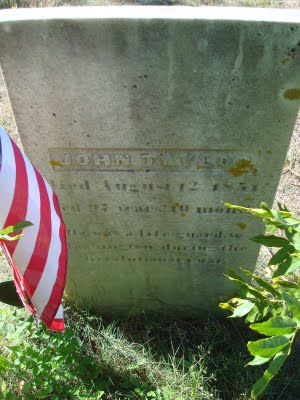
Our Cannon Hill is to the left of Old Wharf Road as it turns into a sand road, and with its tree cover is less conspicuous as a hill than it appeared years ago.  Other than Mrs. Magenau’s remark about the cannon, there is no proof that this happened – in fact, she learned about it from her uncle. Nevertheless, we can imagine that Major Witherell would oversee such an activity as it celebrated his generation’s victory in the Revolutionary War.  The Major came from a family that had left England soon after the settlement at Plymouth, arriving in Duxbury in the 1600s. The first colonial Witherell became the pastor of the Second Church in Scituate. A few generations later, they were in Eastham where the Major was born in 1753.

As a young man, Major Witherell joined the Sea Coast Defense, the colonists’ solution to the lack of a navy. Shortly after the battles at Lexington and Concord, Barnstable County authorities took measures to secure all boats that could be of use to the enemy, hiding them when and wherever they could.  In June and July 1775, Wellfleet organized Captain Joseph Smith’s Seacoast Company of militia, and they were stationed there until the middle of 1776. After February 1776, they marched to Truro — which had called for more help — joining another company already located there. Witherell was a Sergeant when he first joined, according to his pension application. Another source indicates he was a First Lieutenant when he served the Seacoast Defense in 1780. I have not found any record proving that he became a Major, but from the records in Wellfleet recording the births of his children, he was listed as “Major Witherell.”

The Seacoast Defense was involved after the stranding of the British ship Somerset in November, 1778, off Truro, north of the Clay Pounds. This is the ship whose wreckage is still exposed from time to time, first recorded in 1885,and again in 1973. There were nearly 500 prisoners taken off the ship who had to be marched to Boston and fed along the way. The Wellfleet Historical Society possesses one of its cannonballs.

In September 1778, Witherell participated in a march to Falmouth along with many Wellfleet men, in response to the needs there, but their time of service was limited to just two days, when the enemy turned to Martha’s Vineyard to harass the coast.

Major Witherell married Azubah Gross in 1775. They lost four of their children at young ages, but three daughters survived into adulthood. Major Witherell’s brother, Whitfield, was an upstanding Wellfleet citizen also, and the Witherell family had a presence in South Wellfleet throughout the 19th Century.

According to Mrs. Magenau’s research, Major Witherell purchased his land, a homestead, and other buildings from Ezekiel Harding in 1789. Major Witherell married Ruth Arey Wiley in 1822, two years after his first wife died, and after Ruth’s first husband, David Wiley, had died. They were neighbors in South Wellfleet.  In his old age, Major Witherell lived with Ruth and his daughter Betsy, who was married to Simeon Smith. Another daughter, Polly, who had married Samuel Smith, lived nearby.

In September 1831, Major Witherell sold a portion of his coastal land to Leonard Battelle, Robert Little, and Richard Arey, the land that later became the South Wharf and its stores.  After Major Witherell died in 1838, his wife Ruth sold other pieces of his estate to settle his debts. She died in 1844.

The cannon that came to be located on the north side of Blackfish Creek — on the Cannon Hill that once belonged to Captain Isaiah Hatch — was described by one local historian as belonging to a British warship that wrecked on the backside during the War of 1812. We do not know if this was Major Witherell’s cannon.  The other “Cannon Hill” is the topic of many stories of the Wellfleet boys from the north part of town who stole the South Wellfleet cannon presumably for their Cannon Hill near Uncle Tim’s Bridge. The cannon was recovered later by the South Wellfleet boys. It was buried at one point early in the 20th Century. The living relative who knew the burial spot revealed it in time for the Bicentennial when it was officially presented to the Town and installed on the Town Hall lawn.

Sources

Mary Stubbs Magenau “A Vignette of Wellfleet History” Cape Cod Genealogical Society Bulletin VOL XIV no 2, page 37.

Elizabeth L. Cole, “Wellfleet Soldiers and Sailors of The Revolutionary War” Wellfleet Bicentennial Committee, 1976 (paper held by the Wellfleet Public Library).

David Kew’s Cape Cod History site: www.capecodhistory.us.

Barnstable County Deeds available at www.barnstablecountydeeds.org.

R.E. Rickmers, Wellfleet Remembered Volume 6, Blue Butterfly Publications, Wellfleet, Mass. 1986.

ill

Posted in Uncategorized | Tagged , , , , | 8 Comments

Prospect Hill and Why I’m Blogging

Prospect Hill, on the south side of Blackfish Creek, past the marsh on the road to the Old Wharf, became part of my family’s landscape in the early part of the 20th Century. In 1910, my great grandfather, John Edward Irvine,  had the foresight to buy four adjoining house lots and “put up a cottage” as they used to say. In 1915, he built a second cottage.  Since then, many other family members have been part of this lovely South Wellfleet spot.

I thought it might be a good idea to document what I’ve learned about our family’s arrival on Cape Cod, and when certain cottages and houses were added on Prospect Hill.  If I had stuck with that plan, it might have taken just thirty minutes. Instead, spurred on by a newfound interest in family history research — thanks to the increasingly detailed information available online — I began to look back on two South Wellfleet families that played an especially prominent role in Prospect Hill’s history: the Areys and the Barkers.

This initial local family research led me to dig further into Wellfleet’s history, the development of the village of South Wellfleet, and to the lives of other families that lived there in the 19th and early 20th centuries. I’ve spent some time looking back even further to the 17th and 18th centuries, broadening my understanding of Cape Cod’s history. Add in the churches, the graveyard, the railroad’s arrival, the stores and post office, the Wharf, and most notably, the Marconi Wireless, and the project has grown far beyond my initial plan.

Thanks to Chet Lay, local professional land surveyor, I’ve learned how to understand the deeds posted on the Barnstable County data base. There is a treasure trove at the Wellfleet Historical Society. Neighbors have been helpful too, particularly Bill and Alice Iacuessa, Ed Ayres, Eric Eastman, and others whom I hope to meet. So far, I’m focused on the land south of Blackfish Creek and south to Lieutenant’s Island Road, but I hope to expand my historical vista to Lieutenant’s Island, Pleasant Point, Drummer’s Cove, and Cannon Hill across Blackfish Creek.

Now I’m interested in sharing this information, since blogging has come along. This new media allows me to share without the discipline of writing a book with extensive footnotes, although I will try to cite my sources.  When a photo or other image is available, I’ll include it too, but not images that are copyrighted. I will also not give addresses of certain places so we can maintain the carefully crafted privacy of homeowners in the area.

Prospect Hill

The Barkers owned Prospect Hill beginning in 1866, when Isaiah and his son, George, purchased it from John Stubbs for $62.00.  (I will be writing about the Barker family in future posts.)

George Washington Barker (1844-1917) had the property surveyed by Tully Crosby Jr., and laid out lots in the 1890s. This appears to be the first time the area is named “Prospect Hill.” Like his fellow Wellfleetians, he saw the opportunity to develop his land for summer cottages. His 1893 brochure sells the area as very desirable, mentioning the development of South Wellfleet as a resort, and the “push and energy” of the Cape Cod Land Company, which “owns much of the seashore property here”. That company was busy selling Lieutenant’s Island.  He mentions the views of the Cape from shore to shore, from the broad Atlantic to the harbor on the bayside. There were few trees at this time, but Barker seemed to hope that the grassed-over soil of Prospect Hill would support the planting of trees. He notes that his house lots are larger than the Cape Cod Land Company’s, and offers them from $15 to $50 — for cash or monthly installments.  Finally, he gives the directions on the Old Colony Railroad or via the Steamer Longfellow to  Provincetown, and by train up to South Wellfleet where he will meet you at the station. He even tells the prospective buyer that the railroad fare will be $4.15 round trip.

George Barker was right there to take advantage of the changes in American society leading to the idea of resorts, vacations, summer homes, escaping the urban environment, and a new appreciation for the natural landscape.  The Cape — and particularly Wellfleet — transitioned from a place where harvesting the marine environment was the prime source of economic sustenance into a place where vacation visitors contributed to a major portion of the local economy. The transition took a number of decades, as fishing diminished and the resort culture grew to support local people. This transition is played out in the history of the South Wellfleet families, with the loss of population as children grew up and moved to the mainland and beyond.

My great grandfather, John Edward Irvine, was a cabinet maker and sash-and-blind maker. He was born in Mahone Bay, Nova Scotia, the first son in a large family. By the 1870s, he had most of his brothers and sisters in his household in Melrose, Massachusetts.  Married in the late 1870s, he and his wife lost three children early in their lives, and ended with just one, my grandmother Louise. When his wife died early in 1903, he spent some time in a mining town in South Dakota, but soon returned to the Boston area.

The Barnstable Patriot, in the 1890s and early 1900s, regularly ran a series of “notes” about who was coming and going in South Wellfleet.  In September, 1893, the paper notes J.E. Irvine renting the Robinson cottage on the Old Wharf. There is no record of when his interest in Wellfleet developed or why he made his first trip here. His wife was ill for a number of years before she died, and perhaps he was looking for “sea air” to help her. Perhaps it reminded him of Mahone Bay, a seaside town in Nova Scotia. He was living in Everett, Massachusetts, at the time, and the Robinson family was from Lowell. There is no record of how Irvine came to find the rental.

1915 Cottage nearly finished

The 1910 map of Wellfleet shows the property owners with four names in the vicinity of the “Old Wharf” as the area where the 19th Century South Wharf was located.  Grandfather Irvine is noted as the only property owner on “Prospect Hill.”

Sources:

Barnstable Patriot, available on line through the Sturgis Library site, www.sturgislibrary.org.

Barnstable County Mass. Index Map to the town of Wellfleet, available  at  www.ancestry.com U.S. Indexed County Land Ownership Maps, 1860-1918.  

Barnstable County Deeds available at www.barnstablecountydeeds.org.
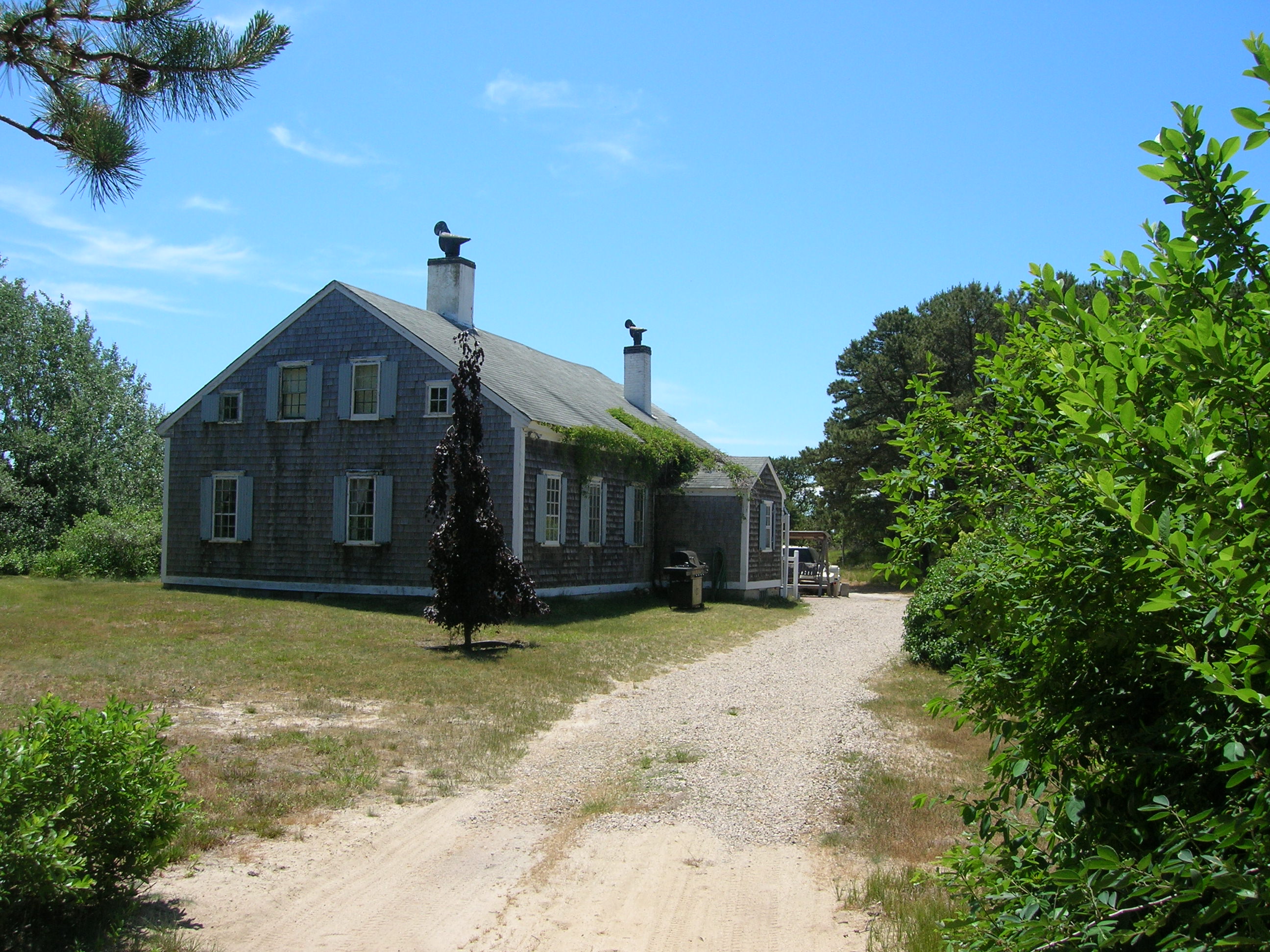
George W. Barker’s “Seashore Lots” brochure, March, 1893; cover illustration posted here.

Posted in Uncategorized | Leave a comment