If you are upset by killing animals please don’t read this.

This image may be the most widely distributed photograph of South Wellfleet. It was taken by Provincetown photographer George Henry Nickerson (1829-1902) in November 1884 when a large school of blackfish was herded ashore in South Wellfleet.
Today we may experience a “blackfish stranding” when these pilot whales land on one of our beaches and breathe their last. But in 1884, the value of the oil in both the blubber and the “melon” in the blackfish’s head made these creatures profitable. Thus, when a school was glimpsed in Cape Cod Bay, all the local men jumped in their boats and tried to capture them. Cape Codders have many tales of such incidents happening, even on a Sunday morning while a church service was underway.
In a 1992 article in The Cape Codder, Eastham historian Noel Beyle wrote about the photograph and Mr. Nickerson. Mr. Nickerson was a Civil War veteran with photography studios in Chatham, Orleans, and Provincetown in the mid-19th century. Beyle spoke with Gordon D. Spence of Wellfleet about the location of the photograph, on the beach near Old Wharf Point on Loagy Bay.
Spence commented that the beach here was often called “Barkers.” The Barker family lived nearby and there were no houses at the top of the dune as there are today. Isaiah Barker was a cooper (barrel maker) which fits in with the job of moving mackerel catches from the wharf to the South Wellfleet railroad station. As mentioned below, Mr. Barker took part in the blackfish catch that day. He died in 1885 at 77 years old but must have been out and about on the day of such an exciting event so close to his home.
The Boston Globe wrote about the 1884 event on Tuesday, November 18, 1884. The adventure started in Provincetown on Saturday afternoon, November 15, at about 3 pm when the cry went out about the blackfish in the bay. A large group of men tried to drive them closer to shore to kill them but they came too close to the fish weirs, and it began to get dark, so they returned to shore with only a few captured.
The next day, Sunday, in the early morning, more men in boats found the school again and it was driven across the bay to Dennis and Brewster “but efforts to drive them to shoal water were of no avail.” They killed as many as they could with “case knives” and succeeded in capturing about sixty. The story goes on to report that the remaining blackfish “found deep water” and were chased across the bay assisted by several mackerel fishermen who joined in the pursuit.
The Globe did not mention whether the men stayed in the bay all night. It states that early the next morning (Monday) the fish were driven into Wellfleet Harbor with 150 driven ashore at Indian Neck and immediately killed by the boatmen assisted by many inhabitants on the shore. Now the remaining blackfish in the bay were unable to escape the harbor. The men succeeded in driving 1300 of the “sea monsters” ashore at Blackfish Creek.
The writer goes on, “Thus ended at dark last night the most exciting chase ever witnessed in these waters. The fish were attracted by the large quantities of squid and herring on which they feed. They are very valuable for the fine oil they make for watches and other delicate machinery.” This report valued the catch at $25,000 which would be divided among 500 participants of Provincetown, Truro, and Wellfleet who took part in the capture.
The article ends with a comment that a large number were purchased by Cook and Company of Provincetown and would be tried out at Cape Cod Oil Works at Long Point.
The Boston Globe’s description of the event was covered in many newspapers across the county in the two weeks following the event. A few newspapers added gory details to the description of the event. A paper in Indianapolis described how “vessels and boats of all kinds with men and boys of every trade and practice” went out on the bay on Monday. “Men of experience used harpoons and lances to make the kill and others used scythes, knives, daggers, picks, and axes.” A Maine newspaper stated, “Everyone big enough to handle a weapon was killing a blackfish.”
The writers added how the shore was lined with carriages and carts as men, women, and children came out to witness the event. All business was suspended. “Free use was made of the railroad which brought many from miles away to witness the excitement.” That report estimated the number of blackfish to be 1200 to 1500 to be divided into 500 shares, the value probably between $10-15,000. The fish are to be sold at an auction tomorrow.”
Later newspaper reports give a few details as to how the individuals involved in the event would benefit. On November 29, 1884 The Barnstable Patriot reported that the blackfish taken on the Cape recently were sold at auction to the following:
William Nickerson of Eastham, 24
Henry Cook of Provincetown: 512 and 24 porpoises
Harvey Cook of Provincetown: 200
S.S. Swift: 300
Isaiah Barker: 72 porpoises
American Oil of Wellfleet: 447
The article ended by noting there were 1498 blackfish (my addition comes to 1483) and 96 porpoises and that 400 to 500 claims had been filed.
(A quick check on how porpoises were used and it appears to be the oil in the blubber since eating them was not as popular as it once had been.)
The next article about the financial rewards from the event was found in The Yarmouth Register of December 6, 1884 reporting on a meeting of The Blackfish Company held in Union Hall with Captain Warren Newcomb moderating. Mr. Newcomb was a grocer in Wellfleet. The total amount to be realized from the sale was $15,353.75. “Everyone over 15 years should draw a full share; keelboats and dories a share, and those under 12 years a quarter share. A committee was named to settle the shares. The Treasurer’s Book had an accounting taken of “the time each man was employed.” No record was found of the company in Wellfleet as to whether it was an ongoing concern to handle the distribution of blackfish funds or established just for this event.

A later article on December 20, 1884, in The Yarmouth Register noted that at a meeting of The Blackfish Company” on December 10 decided to pay a dividend of $24 a share payable at Mr. William Tubman’s place of business. The 1880 federal census lists Mr. Tubman as a blacksmith. The same paper reported in a separate piece on that date that American Oil of Wellfleet has sold and shipped 1000 barrels of blackfish oil in the past week. “The works are being run day and night as there is a large quantity of blubber still on hand.” On December 30, 1884 in their Wellfleet column, The Barnstable Patriot reported that the American Oil Company finished trying their oil on Saturday having gotten about 400 barrels.”
On January 13, 1885, George H. Nickerson announced in The Barnstable Patriot that he had six excellent views of the recent school of blackfish captured at Wellfleet and would send an image to any address on receipt of $1.50.
This stereopticon view may be one of those views:
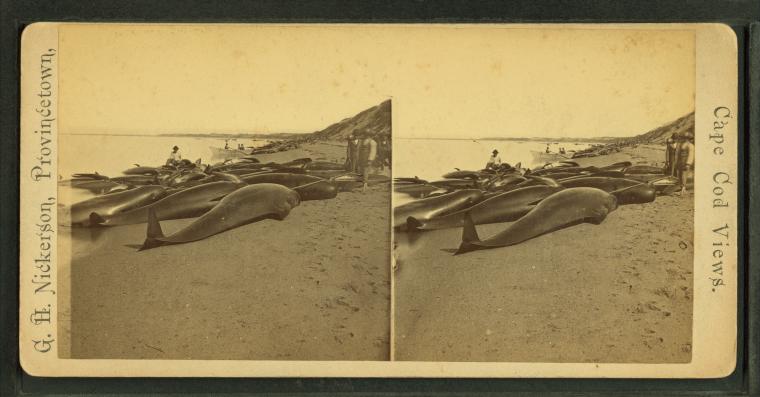
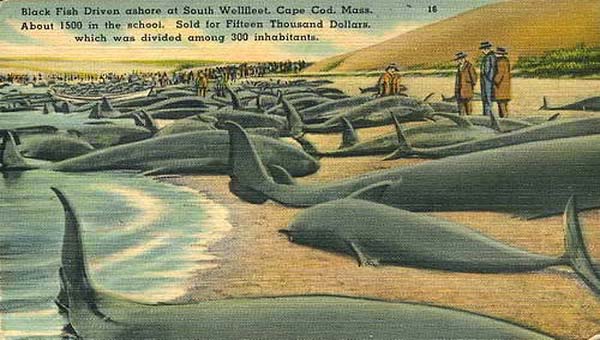
Noel Beyle wrote in his 1992 article that Irving L. Rosenthal went into business with Mr. Nickerson and continued the studio after Nickerson died in 1902. Nickerson’s “Cape Cod Views” were highly collectible. The tourism industry on the Cape developed as the century turned. Postcards became very popular. The 1883 photograph was sold, first as a black and white image, and later a colorized image.
Mentioning the value of the blackfish catch on the postcard gave the event an added element of excitement, sharing with visitors the high value of the dead animals who landed on the beach. The $15,000 of 1884 would be worth nearly a half-million dollars today.

While not taken on that day, this image of a blackfish event at a later date gives another view of the slaughter that happened on our beaches.

Sources
photos from Massachusetts Digital Commonwealth
The Barnstable Patriot at the Sturgis Library (the database not available for a few months while it transitions to a new platform)

 South Wellfleet, Massachusetts
Old Wharf Point?Sent from my iPhone
Was your question about WHERE Old Wharf Point is located? It’s on the southern edge of the entrance to Blackfish Creek, where the wharf was
in the mid-19th Century, now referred to as “the Old Wharf.” Reachable on Old Wharf Road off Route 6.
I believe you mean photographer George Hathaway Nickerson 1835 – 1890. I can find no evidence for the existence of a George Henry Nickerson. Noel Beyle seems to have made him up out of whole cloth.
The NYPL has a collection of his photos including the blackfish.
https://digitalcollections.nypl.org/search/index?filters=%5Bname%3DNickerson%2C+G.+H.+%28George+Hathaway%29%2C+1835-1890%5D%5Brights%3DpublicDomain%5D#/?scroll=34
PS. Love your blog. I am ridiculously happy looking everyone up on Ancestry dot com and finding they’re my 6th cousin 4 X removed. We’re barely related at all; why does it give me such a thrill?