The Railroad Comes to South Wellfleet

The arrival of the railroad on Cape Cod in the middle of the Nineteenth Century brought a new level of change. Now the Cape towns were connected to each other and to the rest of Massachusetts. Fishermen and those harvesting shellfish were able to bring their products to market more efficiently.

The Cape Cod branch railroad reached Sandwich from Middleboro in 1848, and by 1854 was extended to Yarmouthport and Hyannis.  The tracks went onto the Cape over the Monument River on the “Buzzards Bay Bridge.” It wasn’t until many years later that the Cape Cod Canal’s iconic railroad bridge handled the train service to the Cape. The Civil War delayed progress for a while, but by 1865 the Cape Cod Central Railroad was formed, and built their line to Orleans. Soon the Cape Cod Railroad absorbed the company, and the line was extended to Wellfleet on December 28, 1870. Shortly thereafter, the line merged into the Old Colony Railroad.

The telegraph was essential to train operations, providing the means by which messages could be transmitted ahead of the arrival of the trains. The telegraph sent timetable changes, cancelling, rescheduling, or adding train service, and making sure trains moved to sidetracks, where available, so other trains could pass by. Thus, the extension of the railroad to South Wellfleet also brought a telegraph line to the depot. And, as mentioned previously, the mail came in and went out on the trains, so the Post Office was receiving mail more often. One writer compared the increase over the early days of horseback when just one bag would be sufficient to the multiple bags of mail coming in and going out as the service became more frequent and dependable.

A Barnstable Patriot article describes the exciting day in Wellfleet when the first passenger cars arrived in the town: “Since the settlement of the place, no event has occurred so important to its bearing upon the material and social interests of its people.” Citizens gathered at the South Wellfleet station “…near the late Collins S. Cole’s house”

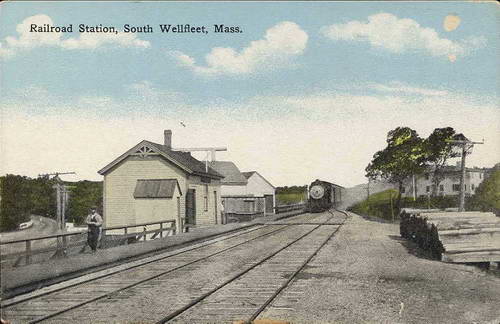
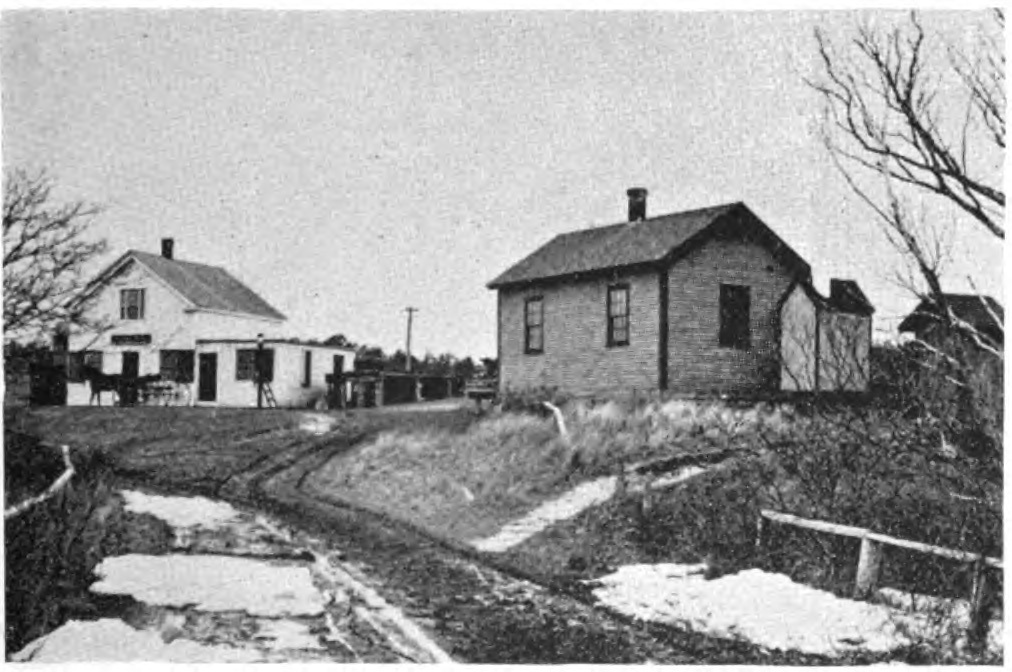
South Wellfleet Railroad Station

where a salute was fired. In Wellfleet, a large crowd gathered, and the Committee of Arrangements met the honored passenger-guests. They marched to the Methodist Church where a luncheon for three hundred was set up. Many speeches and recitations followed the lunch, including a poem:


                                              The great Atlantic Railroad for old Cape Cod! All Hail!

                Bring on the locomotive, lay down the iron rail,

                Across the Eastham prairies, by steam we are bound to go,

                The Railroad cars are coming, let’s take up and go.

Another speaker compared the Cape fisheries and their increased capacity to bring fish to market to the railroad’s impact on Chicago and its grain market.

When the railroad reached Provincetown on July 23, 1873, there was another big celebration, welcoming eight hundred to a luncheon program on “High Pole Hill”. A special train of thirteen cars was sent down Cape that day so that citizens of all the towns could mingle; it cost $1 to travel to the party from South Wellfleet. Later, in 1874, President Grant made the trip to the outer Cape, all the way to Provincetown; citizens probably gathered at the South Wellfleet station to wave him on.

There were two trains daily between Boston and Provincetown, a tradition that extended through the 1940s. Until 1883, Old Colony Railroad cars were painted bright yellow, with the names of the cars painted on the side of each car in fancy letters. Passenger conductors

Old Colony Railroad Map

wore frock coats with gold braid and monogrammed collars. Baggage masters and brakemen wore coats with silver monograms and buttons. The locomotives were sometimes given Cape names, including one called “Highland Light,” a 7500-pound American “iron horse” manufactured in Taunton.

The Barnstable County deeds database has a number of deeds and agreements with landowners that sold their land for the railroad and furthermore held the railroad company harmless from damages to their land. Asa N. Cole signed such a document that he would not hold the railroad company responsible if the flow of water along Fresh Brook should change. The railroad paid for the land of Stephen Hatch, John Cheever, Ephraim Stubbs, Whitfield Witherell, Richard Stubbs, John Wiley and Isaiah Hatch.

A railroad schedule in 1874 shows a train leaving Boston at 8 AM and arriving in South Wellfleet at 12:52 PM. The 4 PM train from Boston arrived at 8:24 PM in South Wellfleet.

South Wellfleet Station in 1910

The up-Cape train left South Wellfleet at 5:42 AM and arrived in Boston at 10:25 AM. A second train left South Wellfleet at 12:20 PM and arrived in Boston at 6:05 PM.

Based on newspaper reports, it appears that passenger discounts were offered on the train early on, perhaps to encourage train travel. An 1873 editorial in the Barnstable Patriot pleaded with Cape citizens to behave properly to their fellow passengers and the train workers in the months when the cars are especially crowded.  During the summer of 1885, the round trip fare from Boston to Wellfleet was $4.25.

In 1880, the Old Colony Railroad began posting the telegraphed weather reports from Washington in the railroad offices. Observing and then predicting the weather began early in the Nineteenth Century. The Weather Service was organized in 1848 when volunteers began transmitting weather information to the Secretary of the Smithsonian. By 1870, the Service was moved to the War Department and became the responsibility of the Signal Service Corps. Local officers posted “Farmer’s Bulletins” to rural American post offices. In 1894, the National Weather Service was moved to the Department of Agriculture. The telegraph helped communicate important information, making changes in the day-to-day lives of Cape Codders. One writer recalls the old sea captains who “hung out” at the South Wellfleet stores and post office, all predicting the weather based on their long years at sea — perhaps they made bets on their predictions vs. the official words posted there?

Starting in the 1880 Federal census, the pages for South Wellfleet list those whose occupation was serving the railroad. William Ward is listed as “depot master” in 1880; Arthur Newcomb is the “Railroad Station Superintendent” in 1900, 1910, and 1920. (In the 1920 listing, he is placed on “Dog Town Road, “ which puts him halfway between the two stations, so perhaps he may have been the Wellfleet Station manager.)

In 1894 the Old Colony Railroad leased its lines to the New York, New Haven and Hartford Railroad. In 1921 the Barnstable Patriot reported that the railroad was considering closing thirty stations in Massachusetts, noting that the South Wellfleet station was already closed during the winter months of 1921. This was at a time when the year-round population of the town was severely reduced, so the decision to close down is understandable.

One of the problems created by the railroad was the fires that started along the tracks by engine sparks, particularly during drought seasons when the brush and grass could catch fire easily. Mary Stubbs Magenau, in a tape she created for the “Tales of Cape Cod’ series, speaks of the efforts of South Wellfleet citizens to stamp out the fires, even enlisting the help of a seven-year-old Mary Stubbs.

News items reported such fires regularly. In 1913 the Barnstable Patriot reported an official hearing with railroad management when they proposed acquiring 1000 feet on either side of the track, so they could clear it of underbrush and grass. In the Spring of1914 the paper reported that the railroad was clearing 65 feet along the tracks and having great success in fire reduction. A New York Times article reported that fires along the Cape tracks that year were reduced to two, compared to 106 the year before. This effort was not the end, however. In 1933 the Boston Herald reported on a 500-acre fire in South Wellfleet, started near the railroad tracks north of the station, and threatening the cottages at “Wellfleet by The Sea” for a while.

The Boston Herald reported in a banner headline on February 26, 1948, “Old Colony Service Ends October 1.” The New York New Haven and Hartford Railroad was in financial trouble and cutting service. I have not been able to determine if service at South Wellfleet had already been cut. My brother, born in 1937, remembers our mother picking up my father at the South Wellfleet station in the 1940s, but this may have been a summer-only service.  On the other hand, when the depot building was moved – quite close to our summer cottage — to become the garage of William Sexton’s home, the date given is “the 1930s.” Mr. Sexton built his house in 1926, so he may well have moved the depot in the

South Wellfleet Depot re-worked

1930s when travelers no longer needed it. Our neighbors have memorialized their home with a railroad sign, so the South Wellfleet train memories live on!

Sources

Deyo, Simon. History of Barnstable County, New York, 1898.   Chapter VIII by Charles F. Swift covers these topics.

Barnstable Patriot  online  archive: http://www.sturgislibrary.org

Newspaper account on line at www.genealogybank.com

Barnstable County Deeds available at www.barnstablecountydeeds.org

Holman H. Spence “Only Yesterday on Cape Cod” , multi-part article  in The Cape Codder, 1970’s.

Fisher, Charles E., with revisions by Frank Dubiel  The Story of the Old Colony Railroad  1974

The New York Times  Archive

David Sexton .


Posted in Uncategorized | Tagged , | Leave a comment

South Wellfleet Stagecoaches, Packet Boats and Early Telegraph

As I started to gather my notes about the railroad’s arrival in South Wellfleet, I realized that I should travel back in time a bit further and write about two earlier forms of travel: stagecoaches and packet boats. When the railroad came along, the telegraph was an important part of its operation. However, the telegraph came to the Cape well before the railroad, so I wondered if it existed in South Wellfleet and where it was located.

We already know that South Wellfleet had “Aunt Lydia’s Tavern” which served stagecoach travelers on the King’s Highway as it traversed South Wellfleet. Some reports locate the tavern in Fresh Brook Village, and others place it closer to the later site of the Second Congregational Church. Lydia was the first wife of the first Reuben Arey, and she may have had her tavern in an Arey home she shared with her second husband, John Taylor. That would have placed it closer to the site of the church, which came later.

Stages were initially organized around 1790 along a route from Plymouth to Sandwich, and then extended along the Cape. Trips to and from Boston could take two days, due to the road conditions I’ve written about in an earlier post. The sandy, unpaved roads made for uncomfortable travel, and the boats were a better choice, especially in the fair-weather months.  Thoreau writes amusingly about the stage he had to use after “the cars” ended at Sandwich. “This coach was an exceedingly narrow one, but as there was a slight spherical excess over two on a seat, the driver waited until nine passengers had got in …”

Stages were linked to mail service.  Thoreau writes of this operation too, with his stage stopping regularly so that “a wheelwright or shoemaker in his shirt sleeves …holding up Uncle Sam’s bag, as if it were a slice of homemade cake…” When the railroads came along, mail service became an integral part of the train service. Prior to the scheduled stage, there was some regular service dependent on a man with a horse, and even earlier, mail transport was dependent on knowing a person who might be traveling to where your letter needed to go.

Packet boats from Wellfleet to Boston began a regular schedule after the War of 1812. Twenty passengers could be accommodated on a boat, and it became a matter of local pride to see how fast a sloop could make the trip across Cape Cod Bay. One writer, comparing the train service to the packet boats, found that the boats allowed for more socializing during the trip, an interesting comment! Of course the packets were also necessary for carrying cargo to Boston, one of the products being salt that the salt works were churning out. In Wellfleet, Benjamin Freeman, Joseph Higgins and Joseph Harding were the first packet captains, and many others followed. South Wellfleet’s South Wharf was the berth of The Herald, captained by Robert Paine. I do not know how long this packet boat operated from South Wellfleet.  Of course, the boats could be unsafe; in one accident in 1819, the Wellfleet packet ran aground on Minot Ledge near Boston in the fog, and two Methodist clergymen who were aboard were drowned.

The telegraph’s invention and application was another 19thCentury improvement. This one appears to have passed by South Wellfleet and Wellfleet initially, so far as I can discern. I’ve concluded that the Cape Cod developers of the magnetic telegraph service originally viewed the device as replacing and improving the communication put in place by earlier Semaphore Telegraph Company with offices in Boston on its Central Wharf. This service developed in 1819, based on services already operating in England, France and elsewhere, by placing a flag “telegraph” or semaphore system on hilltop signal masts in various locations between Edgartown and Boston. Telegraph hills were in Edgartown, Woods Hole, Sandwich, Plymouth/Manomet, Duxbury, Hull, and South Boston/Dorchester Heights – and on the Cape in Provincetown on their Telegraph Hill (now a gated condo community). While some hills had towers, I could not find such a structure in

Provincetown, but of course there were no trees to block a view there.

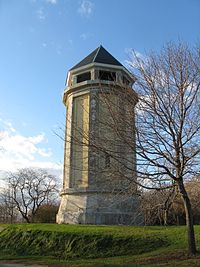
Telegraph Hill in Hull, Mass.

The signals could carry messages across 75 miles in ten minutes — the signals being sent to the ships returning to New England with valuable cargoes that could be re-deployed by their Boston or Salem owners to more southerly Atlantic ports, without a hazardous voyage around Cape Cod to Boston. One source credits Jonathan Grout for developing this Martha’s Vineyard-to-Boston optical telegraph. Grout also served in the first U.S. Congress, representing a portion of Bristol County. I don’t know if the system used semaphore flags or mirror-directed sunlight reflections, and I have not found much material on the operation on Provincetown’s Telegraph Hill.  Perhaps a reader might share additional such information.

Of course, many Cape towns appeared to have a “pole hill” used to signal the arrival of ships. Thoreau writes of this Cape tradition, “Every higher eminence had a pole set up on it, with an old storm coat or sail tied to it, for a signal, that those on the south side of the Cape, for instance, might know when the Boston packets had arrived on the north. “ He wondered if this use of old clothes left anything but a few rags for peddlers!

With the formal hill-based telegraph system in place, it makes sense that new telegraph service on the outer Cape would be used to replace it. The Barnstable Patriot reported in May 1855 that a charter had been granted to the Boston and Cape Cod Marine Telegraph Company to develop marine reports by telegraph for the Boston merchants. It would extend out to the Cape from a line already in place between Boston and Nantasket. The signal stations were to be at Woods Hole, at the highlands of Chatham, and at Truro, at Cape Cod/Highland Light.  An improved code of marine signals was to be used, the one recently invented by Henry J. Rogers, Esq., of Baltimore and adopted by the navy.

By June 1855, the work of bringing the line to the Cape was under the auspices of developers “Brewer and Baldwin.” The line reached Hyannis by September. I have not found a description of where the poles were placed as they traversed South Wellfleet — but perhaps they followed the new County Road that was built through the town in the mid-1850s. South Wellfleet’s citizens would have experienced this change as a difference in the landscape, but in these early days of reporting the movement of ships coming from afar, there was no role for Wellfleet. Newspaper reports in 1856 reported that vessels were able to “display their numbers” as they passed the Cape stations, and have their whereabouts telegraphed to Boston.

Soon, the Barnstable Patriot was also reporting human stories from the “Provincetown telegraph” and citizens must have seen the possibilities of communication beyond marine tracking.  Provincetown reported the death of a citizen in a house fire and the death of a seven year old who “fell from a sail” hitting his head on the wharf. Soon, other news stories reported on the wonders of the use of the telegraph, helping a young woman escape her father who had arranged her marriage, and helping a patient contact his far-away doctor for treatment. This is not unlike our recent adaption of the Internet as initially a telephone call replacement and later as way to pay for our coffee.

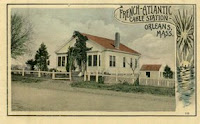
French Cable Station, Orleans

Meanwhile, the “sub marine” cables were laid between Nantucket and the Cape mainland in the summer of 1856, followed by a “Telegraph Ball” to celebrate the occasion. Newspaper reports chronicled the development of the Atlantic Cable, along with the development of a line to the north side of Prince Edward Island in the Gulf of St. Lawrence, to stay in touch with the Massachusetts fishermen who traveled there.

Finally, the Atlantic Cable, a transatlantic cable, was laid in 1858, although it took until 1865 to get it working correctly. This reduced communication time across the Atlantic from the ten days of ship travel to just a few minutes.  Perhaps of more direct interest to the citizens of South Wellfleet was the French Transatlantic Cable. It stretched across the Atlantic to St. Pierre, and then down to the Cape, terminating in North Eastham where a cable station was set up near Nauset Light in 1879. The station did not last long here, and was moved to Orleans in 1891.

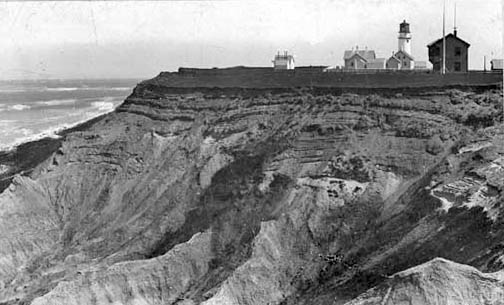
The Highland Light site is a whole separate story — off my topic of South Wellfleet, but an interesting sidelight.  The lighthouse keeper, Isaac Small, was appointed light keeper

Highland Light late 1800s

shortly after 1845. He regularly farmed by day and kept the light lit at night. If he had reporting duties using the telegraph, these did not appear to be a major task. His son, also Isaac Small, was put in charge of the telegraph office in 1863, serving as Marine Reporting Agent for more than 60 years. He described the job:

The station was equipped with signal flags, books and a powerful telescope, and an operator placed in charge whose duty it was to watch the sea from daybreak to sunset, and, so far as possible, to obtain the name of or description of every passing ship. This information was immediately transmitted over the wires to the rooms of the Chamber of Commerce in Boston where it was at once spread upon their books for the information of subscribers… Every half hour of every day of the year we stand ready to answer the call of the Boston Office …with our telescope we can, in clear weather, make out the names of vessels when four miles away. When a shipwreck occurs, either at night or during the day, we are expected to forward promptly to the city office every detail of the disaster.

Small wrote up some of his Cape and marine observations in small booklets and set up his hotel – Highland House — to accommodate summer visitors, and a place to sell his booklets and photographs.

Sources

Deyo, Simon. History of Barnstable County, New York, 1898.   Chapter VIII by Charles F. Swift covers these topics.

Barnstable Patriot  online  archive: http://www.sturgislibrary.org

Thoreau, Henry David Cape Cod. Quotes used here from Putnam’s Monthly Magazine Issue 30, June 1855.

Newspaper account on line at www.genealogybank.com

Description of the Highland Light operation: http://www.foghornpublishing.com

Lenney. Christopher  Sightseeing Clues to Landscape History New England, 2005

Posted in Uncategorized | Leave a comment

The South Wellfleet Post Office and Stores

The first Post Office in South Wellfleet was established in 1829 when Reuben Arey, Jr. was named the first postmaster. Naming a separate post office from Wellfleet’s, along with the establishment of the South Wharf and the Second Congregational Church just a few years later, indicated the growth of the South Wellfleet community. The first post office not located in the postmaster’s home was William Ward’s, starting in 1873, when he opened the office at the railroad depot.

The Deyo History mentions that there may have been very early stores in South Wellfleet: one at Aunt Lydia’s tavern; another at Reuben Arey’s home where he kept the first South Wellfleet post office; and still another at Daniel Higgins’ home, just after the War of 1812. This is the only mention of merchant activity prior to the Cole store described below.

For over 150 years, there has been a store near the head of Blackfish Creek.  The first merchant to set up his business there was Collins Smith Cole, who became a respected South Wellfleet citizen over the course of his career, earning the title “Squire Cole”.  He was born in 1797, the son of Ebenezer and Sarah Cole. Six generations before him was Daniel Cole, an original 1644 settler of Eastham, and part of the group of settlers that sought to expand Plymouth Colony for the next generation.

We know that Collins S. Cole’s house — still there, and facing  Lecount Hollow Road — was there in 1828, because when the Town voted to spend $30 to build the footbridge over Blackfish Creek that year, the record places the bridge “nearly south of Collins S. Cole’s house”. The house faced  the Old King’s Highway, but later, as the County Road became the focus of the community later, it turned its back to the owner’s merchant activity.

The Hurd history of Barnstable dates the building of Collins Cole’s store to 1844. The building referred to was the two-story frame building pictured here. The door was in the middle with a sign over it and there are two windows on either side of its door. The Deyo History mentions Collins S. Cole first in 1844, when he and Alvin Paine bought the South Wharf and Cole “took the store.” We know there was a fire that partially destroyed the South Wharf about that time. While the store was originally at the Wharf to supply the mackerel boats, it appears that either a separate store was developed over at the head of Blackfish Creek or the Wharf store was moved. The record is not clear.

1890’s RR Station and Store (left) built by Collins Cole

The building of the County Road in 1846 certainly improved the situation for the owner. Now the road came right to the store. One account says you could get whatever you needed there, from a paper of pins to a gallon of molasses. The farmers brought their butter and eggs to sell there.

Collins S. Cole married twice, first to Mary Jenkins Holbrook, whom he married in 1824. Their first son, William Henry Cole, was born in 1825, and was the grandfather of Charles Cole, whose memory book I have been using to document the history of South Wellfleet. A second son, Collins Smith Cole, died as an infant. Mary died in 1828 and is buried in South Wellfleet Cemetery.

In 1831, Collins Cole married Ann Gibbs Hapgood, and, in 1832, they had a daughter, Julia Ann Cole. In 1833, Mr. Cole purchased a pew in the new Second Congregational Church being built in South Wellfleet.

Until he became one of the owners of the South Wharf, Collins Cole was a mariner. After he became a merchant, he also became a Justice of the Peace, according to an 1850 listing which notes both he and Reuben Arey held this title in South Wellfleet. He appears to have funded the sale of a house in South Wellfleet from Reuben Arey to Captain Scotto Foster and Jonathan Doane, a house that still stands today. In the 1850s he gave a mortgage to Captain Foster on his home; perhaps the fishing had been less than optimal that year. Captain Foster named his second son Collins Cole Foster, honoring his neighbor. In 1861, Mr. Cole was listed as a County Commissioner in a news article.

Collins Cole died in 1868 at age 70, and the South Wellfleet Cemetery has an obelisk making his grave, those of his two wives (Ann Cole died in 1882), and his infant son. In Charles Cole’s memory piece, he remembers that Collins Cole left his family an estate valued between fifty and sixty thousand dollars.

Initially, the Cole family ran the store. One source indicates that William Cole built a house next door to his father’s — that would be today a second historic property on (now) Lecount Hollow Road. But in Charles Cole’s memory piece, he notes that his father, William H. Cole, built a carriage house, which his daughter Mary Ann and her husband Isaac R. Paine later converted into a dwelling house. It should be noted that this Isaac Paine is Captain Isaac R. Paine, not the Isaac Paine mentioned below. In 1871, before he turned fifty, William Henry Cole died of typhus that infected the family when Isaac R. Paine brought it back from a trip to the south to “freight oysters.”  Despite their father’s death, the family was well taken care of with the grandfather’s legacy.

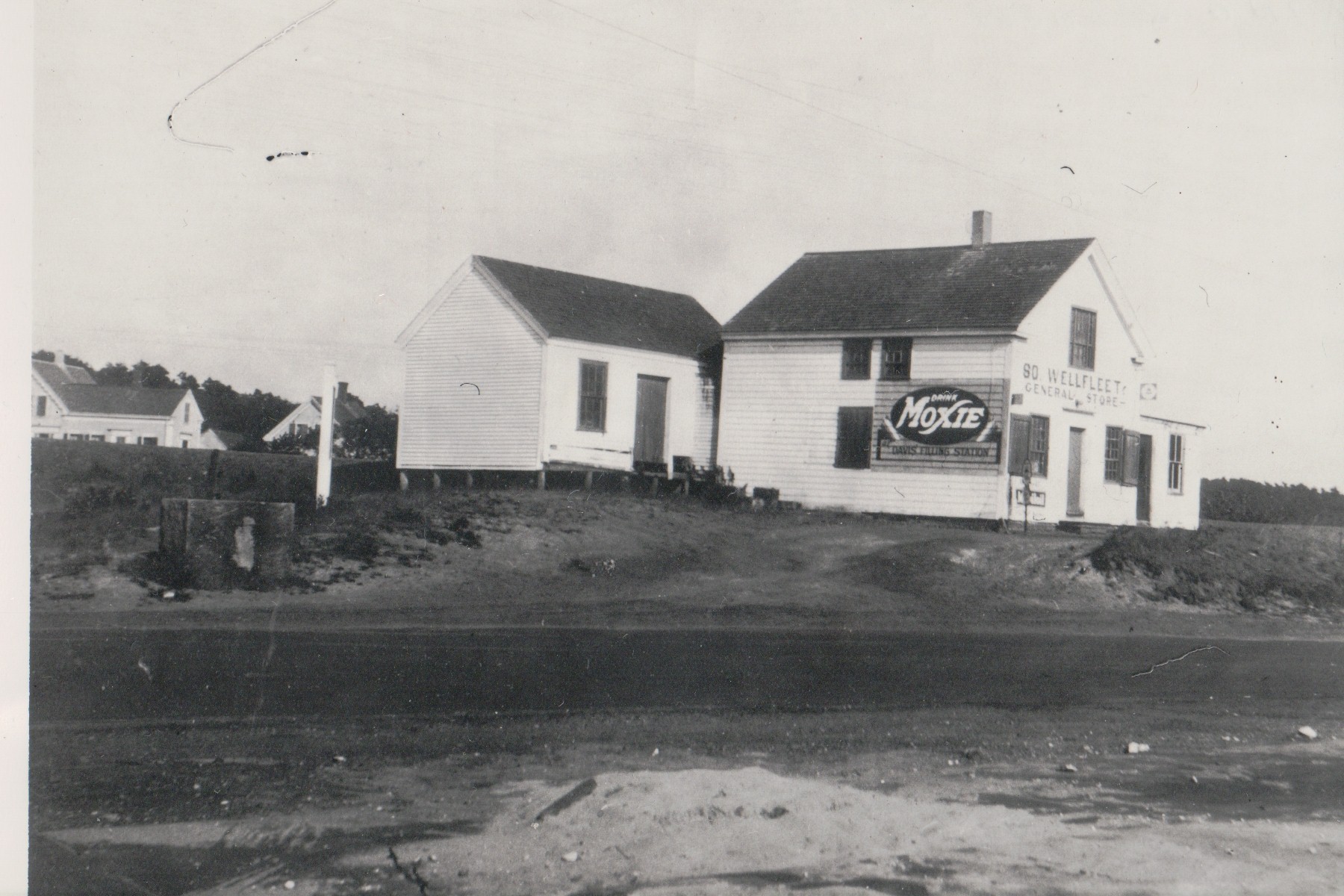
South Wellfleet General Store
Wellfleet Historical Society Photo

In 1872, the South Wharf Company took over the Cole store. They built the ell on the south side that became the separate post office.  In 1880, they sold it to Alvin Paine, and the sign over the door changed again, and a north ell was added for his grain business. Of course, by this time, there was another building in the “South Wellfleet business center” – the Old Colony Railroad depot.

Alvin Paine was one of the influential South Wellfleet Paines.  He was the grandson of Thomas Paine, the Wellfleet family founder who started out in Truro and then came to Wellfleet. Alvin Paine, born in 1837, was married to Eliza, the daughter of Captain Scotto Foster.

He purchased the Reuben Arey, Jr. home from the heirs of Reuben (3) in 1877 – the Areys having moved their lives to many other places off-Cape by that time. For a while longer, however, Oliver Arey kept the first Arey home.

A Barnstable Patriotarticle in 1884 announced that Alvin Paine was “having the grounds graded and sodded in front of his store” and noting that this work would make a great improvement.

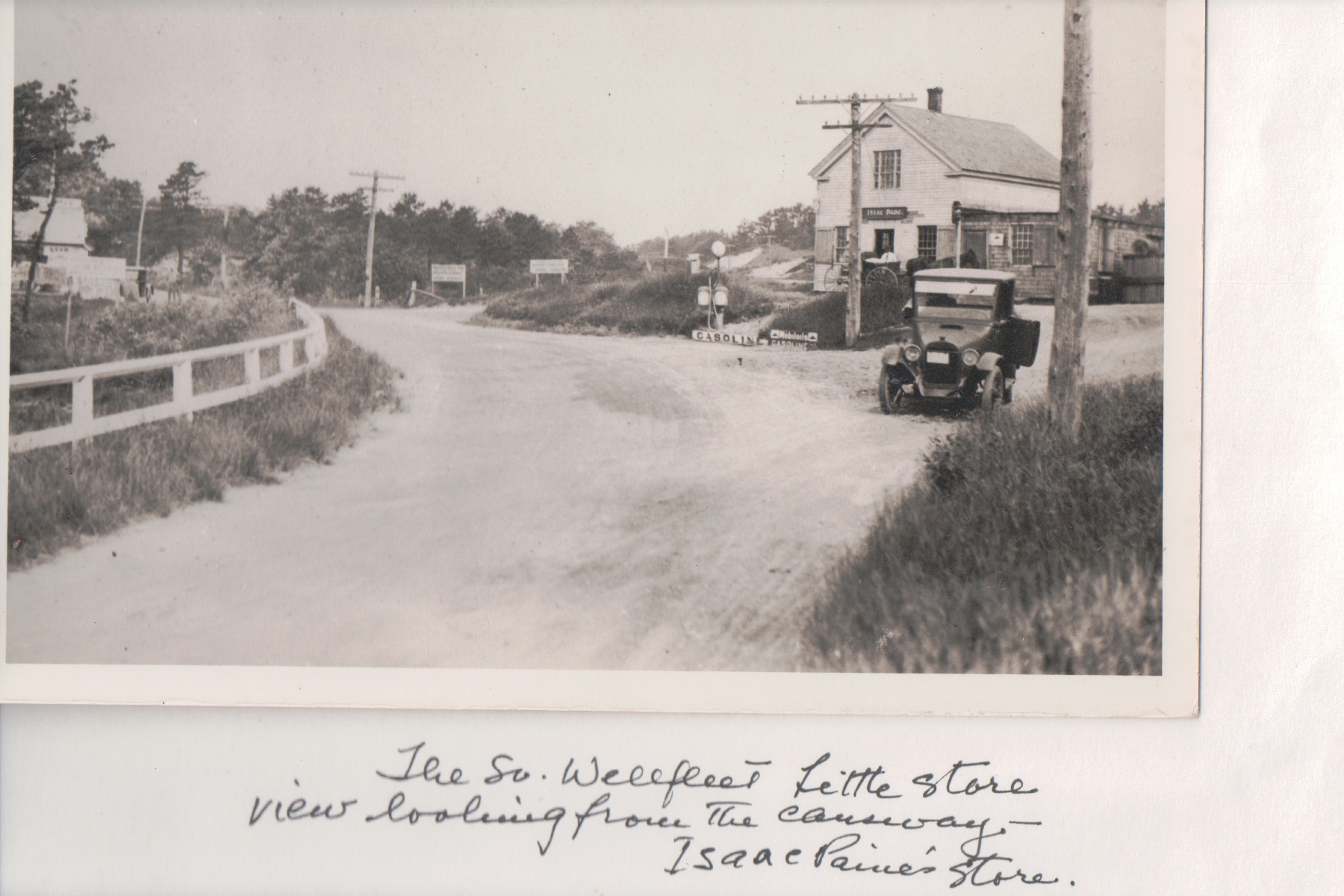
Isaac Paine’s store
Wellfleet Historical Society Photo

Alvin Paine died in 1889 or 1890 and left his store to his son, Isaac Paine (born in 1867) who over his lifetime became known as “Ikey Paine.”  One of the famous stories about Ikey Paine is that he would not sell the locally bottled Pilgrim Spring beverages because he did not want children to learn to drink out of bottles, perhaps teaching them about drinking liquor!

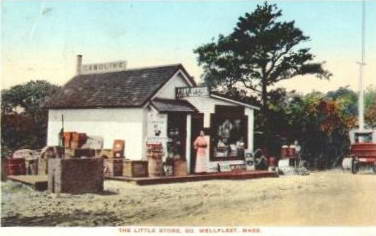
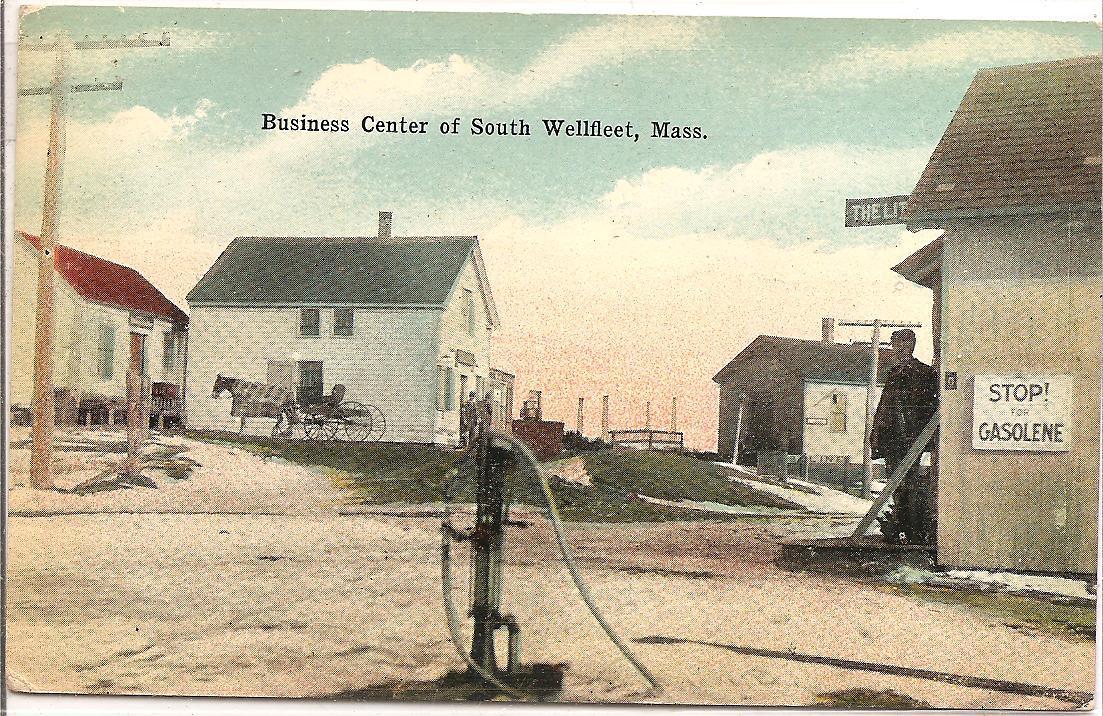
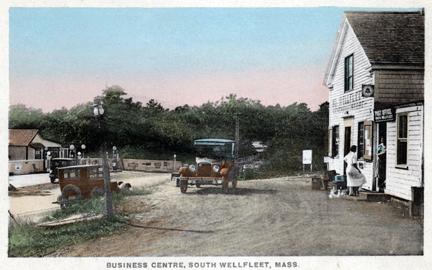
Another property became a store in the “South Wellfleet Business District”. Amos Rideout transferred the “property opposite the Alvin Paine store” to Jeremiah Rich in 1904 and discharged their mortgage in 1907. But when the property was sold to David Buitekan in 1914, it was Mr. Rideout who made the sale. This is what became known as “The Little Store” that appears in several early 20thcentury photographs. Initially, there are horses and wagons in the photos, and later there are gas pumps here. In 1914, Buitekan became the postmaster for South Wellfleet. In a 1916 photograph, the post office sign is hanging above the door.

Little Store on right, General Store and Mystery building on left

There’s one mystery about the stores that I have not solved. In an undated photograph, pictured here, with the Marconi Towers in the background, there is another building behind the Paine store but I have not figured out what this is. We know at some point the Little Store disappeared, and one person has remembered “another store up the hill”. Is this that store?

In 1923, Isaac Paine transferred the General Store to David Buitekan. Ikey Paine lived in South Wellfleet in the Reuben Arey Jr. house until 1943, when he died fighting a fire in his barn.

In a memoir by Holman Spence that appeared in The Cape Codder in the 1970’s, he describes life in South Wellfleet when his parents bought land and built a cottage on Indian Neck. By this time, Spence describes the “Little Store’ and its old gas Socony pumps as belonging to Emanuel J. Davis, while Buitekan owns the (former Paine) store and runs the post office, with his wife Annie Buitekan.

The Buitekans are in the 1920 Federal census for Wellfleet; Annie is 52 years old, with parents born in Scotland; he is 47 years old, with parents born in Holland. Her maiden name “Ross” appears in one of the deeds; Monroe Ross, presumably her brother, is living with them in 1920.

Holman Spence, in his 1970s’ memory piece of South Wellfleet, describes the Little Store as carrying “every need of the whole little community down to items that were called for once in every three or four years. In the glass cases on the counters was everything from rubberized gloves to mousetraps, harness parts, candy, 3-in-1 oil, lamp wicks, shoe laces, Beeman’s pills, scythe stones, boat caulking and “Never Leak.”  The walls were hung with more items; sometimes a customer really had to search for an item, and then left the store in even more disarray.

Spence describes the almost-ceremonial moment of the day when people would gather at the stores waiting for the mail that came in on the train. Frank Fisher would light a street lamp, and the train whistle could be heard from further up-Cape. Buitikan would be ready with his wheelbarrow to receive the bags, and would sort it while everyone waited. Eventually, everyone would drift away, the kerosene lantern would go out, and darkness would fall.

Sadly, David Buitekan committed suicide in 1928. The story was that he was in arrears in his post office accounts, and he shot himself in the store. In 1930 his wife, Annie, sold the old Paine store to Emanuel J. Davis in 1930, and the ”Little Store” to George M. Davis – no relation between the two men.

General Store with autos

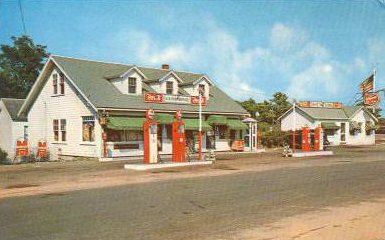
The Mr. Davis who purchased the Little Store converted it into a memorable doughnut store – the “Downeyflake  Doughnut Shop”. The two people who told me of their pleasant memories of those doughnuts sound a bit like the way I imagine someone describing the croissants we enjoy at a nearby location today!  Holman Spence, in his memoir, said that the doughnut shop lasted until the highway was widened – which may have been the early 1950s change. Or perhaps he moved into the mystery building?

Meanwhile, E. J. Davis had the old Cole/Paine store moved — “to a lot east of the Squire Cole house,” according to a 1930 article in the Hyannis Patriot. I think when I look at a Wellfleet Assessor’s Database contemporary photo, I can see the old store shape in the rebuilt property.

Emanuel J. Davis was from Provincetown, born in 1884, the son of two parents who were immigrants from the Azores. He was “Manuel” in the 1900 census, 16 years old and working as a “hack driver.” His father was a mariner, but it appears the son was choosing an alternative life. He married Elmena Avila on July 14, 1914. In the 1920 Federal census, he is a retail merchant for “provisions.”  In the 1930 Federal census, he and his wife have a niece, Charlotte Silva, living with them. There is no record of any Davis children.

Emanuel J. Davis built a new building for his General Store, the building we have there today. For a number of years, the post office was located at a window in the store, a feature  I remember from my childhood. Mrs. Davis was appointed postmistress after Buitekan died, and continued in that role until 1953. In 1955, a separate post office building was constructed next to the General Store.

E.J. Davis General Store

Frank Fisher, the man lighting the lamp mentioned earlier, pumped the gas for Mr. Davis. In Federal census documents, he is a single man, sometimes described as a dealer in ice. He was a small man, known as Frankie, whom I remember as a fixture at Davis’s as we called the store. Mr. Fisher died in 1963 at age 74 and is buried at the South Wellfleet Cemetery.

Obviously, the arrival of the Old Colony Railroad in South Wellfleet and Wellfleet in 1872 had an enormous impact on activity around the General Store and Post Office.  I’ll write about the railroad in a separate post, as well as information about other South Wellfleet stores that has turned up in my research.

Sources

Deyo, Simon. History of Barnstable County, New York, 1898.   Wellfleet chapter on line at www.capecodhistory.net

Barnstable Patriot (various) online  archive: http://www.sturgislibrary.org

“Federal Census Collection” database. Ancestry.com http://www.ancestry.com

Newspaper account on line at www.genealogybank.com

Hurd, Simeon D. Hamilton “Wellfleet Mass.” From History of Plymouth, 1884 online at http://history.rays-place.com/ma/wellfleet.htm

“Town Meeting Highlights” list supplied by Dawn Rickman, Wellfleet Town Clerk in 2007

David Kew’s Cape Cod History site: www.capecodhistory.us.

Barnstable County Deeds available at www.barnstablecountydeeds.org.

Holman H. Spence “Only Yesterday on Cape Cod” , multi-part article  in The Cape Codder, 1970’s.


Posted in Uncategorized | 5 Comments

Roads to South Wellfleet

Today, it’s just U.S. Route 6 that brings you down the Mid-Cape, around the traffic circle in Eastham, and then along four lanes – then two with shoulders – to South Wellfleet.  Route 6 has such a major impact on life in South Wellfleet–  it hums with traffic all summer, sirens wail when accidents occur, and, in the summer, trips and turns require pre-planning. I know someone who will not make left turns in July and August!

My “road research” looked into what was here before automobiles and prior to today’s Route 6.  Regarding the earliest routes, most historians acknowledge “Indian trails,” but there is no evidence of precisely where they were.  A 1984 report on the history of Massachusetts towns for the Massachusetts Historical Commission suggests that there was a trail along the Atlantic coast, on the top of the dunes, where drift whales may have been readily sighted.  There might have been a second trail along the Bay shore, skirting the wetlands, which would have linked settlements and led to shellfishing areas.

Enoch Pratt, in his 1844 history of Eastham and Wellfleet, asserts that by 1650 there was a rough cartway, Nauset to Pamet, going around the head of Blackfish Creek.  Of course, getting to the Meeting House was one of the main reasons for establishing roads.  In 1719, in response to the citizens of Harwich who needed to get to the meeting house that was closer to them, Eastham designated that a road be built from Harwich to Truro. Historians cite this record as evidence of the building of what became known as “the King’s Highway.”  However, it was not a multi-lane highway – it was just a simple cartway.

The deforestation of the Cape is another factor that had significant impact on road development.  Some say that deforestation was a fact after just thirty years of settlement, while others put it later, by 1700. As mentioned here later, the sand roads were difficult to traverse. Of course, another option for travel to and around the Cape was to go by boat, using Cape Cod Bay.

In his 1962 report to the National Park Service, William Hershey investigated the Cape’s 17th and 18th Century roads. He comments on the “myth” of the King’s Highway—that there was no effort to build a single highway, but instead the roads were simply a knitting together of old cartways. The 1719-20 Eastham decision to build did produce a forty-foot road, so that South Wellfleet had a road fairly early. Hershey has a note from “Eastham Lands and Ways” records that the road from Eastham to Billingsgate/Wellfleet, was widened to thirty feet as it went around the head of Blackfish Creek.  This road, called the “King’s Highway”, had to skirt all the creeks and brooks in South Wellfleet – Indian Brook, Fresh Brook, and Blackfish Creek.

One of the earliest actions of 1763, after Wellfleet became organized as a separate town, was its vote to make a new bridge over Duck Creek to connect the town with the King’s Highway.

Hershey references the 1794 Town Plans, created after the Revolution. After rejecting the King, the main road began to be called the “County Road” or the “Public Road”. In Hershey’s description of the Wellfleet Town Plan, the “County Road” goes around Blackfish Creek to Great Pond, and then to the head of Duck Creek. The road continues north, staying west of Long Pond and Gull Pond, and finally crossing Herring Creek to the Truro line.  In yet another document, the Notes of the Wellfleet Town meetings, the main road is called the “County Road” in a 1789 note.  Later, in the midst of the 19th Century when a new County Road was built, further to the east and closer to the activity on the Bay side, the old road seemed to revert once again to being called the King’s Highway.

Reverend Timothy Dwight, the President of Yale, took a sabbatical in 1800 to travel through New England, making observations on its development. His work was published posthumously in the 1820s and is one of the standard sources for Cape Cod historians because of the details Dwight observed. He writes of his trip along what must have been the King’s Highway:

Our journey through the forest was disagreeable. The surface was unpleasant, and     the trees were destitute of thrift and beauty. The road also became within a few miles (of Eastham) a mere bed of deep sand, through which our horses moved with excessive difficulty. …Our road passed Wellfleet on the right at such a distance that we saw little of this town until our return.

In the early 1800s, Wellfleet surveyed its roads and placed their boundaries on maps. There were eighteen roads in the town at that point.

The Wellfleet Town Records are full of decisions to build and improve the town’s roads. One of the early decisions of the Town was to build a bridge at Blackfish Creek in 1828-29, allocating $30 for the task.  In that same year, the Town voted to pay widow Lydia Goodspeed for her land that was taken to build the road to the South Wharf.  As mentioned in an earlier piece, the South Wharf was getting organized at that time, and a road to South Wellfleet’s center of fishing would have been essential. I think it’s likely this was the road that is more or less where “Old Wharf Road” is now.

The maps of the time show a second road to the South Wharf, leaving the King’s Highway, perhaps near Fresh Brook Village, and meeting the “Old Wharf Road” we know today. Pieces of this roadway might still be visible in the woods north of the Lt. Island Road – something I need to explore. One of my Barker family connections commented recently that the second road was still being used in the mid-20th Century, his family’s choice for getting to Route 6 when their trip was south to Orleans.

In early 1846 Bethuel Wiley, Elisha Freeman, and George Ward – Selectmen of Wellfleet – posted notices in the newspapers that they were ready to accept proposals to build a bridge and a sluiceway over Fresh Brook, and a causeway over Blackfish Creek, to be completed in the spring of that year. Another notice signed by “Obadiah Doane and 40 others” to the County Commissioners of Barnstable requested a County Road to be laid out through the north part of Eastham and the south part of Wellfleet. The road was to run:

North of Nehemiah Doane’s dwelling house and south of Josiah Lincoln’s woodland …running northwesterly and intersect the public road south of Daniel Atwood’s dwelling house in South Wellfleet … . Said road leads across the Dill bridge, and will shorten the public travel and be a better road that is now traveled.

This was the County Road that eventually became Route 6, while the King’s Highway became the “other road” used less often, and, when the railroad came through in the 1870s, was even less vital. Today the South Wellfleet portion of the King’s Highway is a fire road in the Cape Cod National Seashore. I was surprised recently to see how far east it is, well past the bike trail/former railroad tracks.

Charles Cole’s memories of Wellfleet in the document his family produced, include the County Road development. He remembers the County Road’s building in the 1850s, and the causeway over Blackfish Creek as a part of this road development. He remembers “Before this, the King’s Highway was the main road, and there was just a footbridge over the Creek.”

For the rest of the 19th Century and throughout the 20th, Town Meetings had regular actions taken to “accept” roads, and to oil or harden roads. Sometimes oyster shells were used to harden them. As more visitors began to “motor” to the Cape, travel books began to describe the roads.  A 1907 Auto Blue Book described five miles through South Wellfleet to Wellfleet as “macadam” while the road returned to sand over the hills from Wellfleet to Truro. It’s not hard to see why the Town wanted to keep the new motorists happy, providing good roads, so they would visit the Town and help grow the tourist economy.

In 1904/05, if I am reading the Town Meeting notes correctly, the County Road was made a State Road. My brief research on highway development indicates that in the 1920s a national “highway system” was conceived, and the State Highway became Route 6 in 1926. Routes would be designated with one  number no matter which state they were in, and signage would become uniform.

With the 1935 construction of the new Cape Cod Canal bridges, connecting to Route 6, traffic could move all the way down the Cape. This development had more of an impact on the Cape’s landscape than anything that had come before. Now vacation cottages became more accessible, along with motor courts, food/clam stands, beaches, and more.

Welcome sign

In 1953 Route 6 was designated as “the Grand Army of the Republic Highway”, named for the American Civil War Association.

During the Eisenhower years of nationwide highway development, Route 6 was widened and straightened. In July 1951 the Boston Herald noted that the Wellfleet and Eastham portion was just about completed, with the roadway widened from 20 feet to 36 feet. The article also points proudly to the smoothness of the road, with 2.5 feet of concrete for the roadbed.

South Wellfleet had one house I’ve identified that was moved at that time. And the little “side road” – now called Goss Lane – is still there as a remaining piece of the County Road/old Route 6.

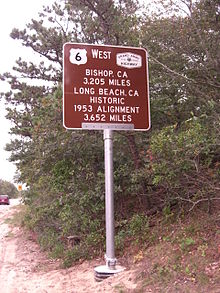
Route 6 has an interesting history, wending its way through the United States from Provincetown to Long Beach, California.  Until 1964 it was the longest highway in the U.S.

In that year, it slipped to Number 2 when a portion of it was cut from Long Beach back to Bishop, California.  Route 6 never developed the cachet of U.S. Route 66. It was cobbled together as a series of roads making a single east-west route across the country. An historian writing about it commented “Route 6 runs uncertainly from nowhere to nowhere, scarcely to be followed from one end to the other, except by some devoted eccentric.”

Sources

Hershey, William D. “Cape Cod 17th and 18th Century Roads with particular attention to the King’s Highway” manuscript prepared for the National Park Service, 1962, on file at the CCNS archive.

“Town Meeting Highlights” list supplied by Dawn Rickman, Wellfleet Town Clerk in 2007

Dwight, Timothy Travels in New-England and New-York, Volume III, available online at www.books.google.com.

Deyo, Simon. History of Barnstable County, New York, 1898.   Wellfleet chapter online  at www.capecodhistory.net.

Freeman, Frederick. The History of Cape Cod: The Annals of Barnstable County, Boston: George C. Rand and Avery, 1858 (two volumes).   Wellfleet chapter on line at www.capecodhistory.net

Barnstable Patriot (various) online archive: http://www.sturgislibrary.org

Newspaper account on line at www.genealogybank.com.

“The Notes of Charles F. Cole” manuscript from the Wellfleet Public Library.

Posted in Uncategorized | 1 Comment

South Wellfleet Methodists and Camp Meetings

Methodism came to North America in the 1760s. The Methodist Episcopal Church was formed in the United States in 1784, which one writer referred to as the first Christian denomination to be established in the new nation. The Congregationalists, the church already established, was a “state church” of the colonies with attendance required, and taxes collected to support it.  Of course, once the U.S. Constitutional principles were established, church and state began to separate.

In 1795, as the Methodists sought to expand, the movement came to Provincetown, but the Town Meeting voted against establishing a church building. When the Methodists tried to build anyway, a mob burned the structure. Several families left for Maine to gain their religious freedom. Eventually the Provincetown church was built, kept under close guard, and, over time, the Methodists were accepted.

In Wellfleet, the Methodist Episcopal Society was organized in 1802; in 1816, the first Methodist Church was erected.

In 1799, on the western edge of the United State — then Kentucky — spontaneous all-night camp meetings began to occur. The idea took hold, and moved east. In 1802 Haddam, Connecticut, hosted its first camp meeting. These activities helped increase the church’s membership. All of this activity was a part of the “Second Great Awakening”, a religious revival in America that started in the early 19th Century.

Cape Cod’s first camp meeting took place in South Wellfleet in 1819. One of the town’s historians, Everett Nye, indicates in his 1920 book that it took place “near where now stands the house of J. K. Lewis.” Others note (and it may be the same place) that it was on the Isaac Rich property, in Paine Hollow. Charles F. Cole’s family-published notes indicate that the meetings were held 1819-1821 “in a grove near the early home of Isaac Rich”. Rich was a wealthy Wellfleet citizen, a Boston fish dealer, a devout Methodist, and funder of Boston University, which was originally a school to train Methodist ministers.  Other histories of Wellfleet note that the meetings were on Bound Brook Island 1823-1825, and then removed to Truro.  These meeting helped increase the church’s membership.

In South Wellfleet, the increasing population and the growing number of Methodists led to building a second new church in 1835, just two years after the Second Congregational Church was built. But it did not last long. One writer indicates they ceased worshipping there by 1851. The Family History Library has microfilmed membership files available  (I have not reviewed them) and states that this group did transfer to the Eastham Church in 1859.  Perhaps the group kept worshipping in South Wellfleet into the 1850s. Nye notes that by 1869 the structure was re-located to the Village, and became the home of Dr. George T. Wyer. Checking the 1870 Federal census, Wyer was listed as the dentist. By the 1880 census, he was listed as a trial justice, an interesting career path.

Today, the South Wellfeet Fire Substation is located close to the site of the church, and there is a marker in the woods noting its one-time presence.

Methodist camp meetings, hosted in Eastham by 1828 or 1829 in their Millenium Grove, became fairly large multi-day events, and surely must have attracted South Wellfleet residents. The Grove was located near the Bay so that participants could arrive by boat, since the roads on the Cape were difficult to travel on.

Camp Meeting

The popularity of summer revivals continued throughout the 19th Century. Oak Bluffs became the revival meeting spot on Martha’s Vineyard. By 1862, the Yarmouth Camp Ground was established, and soon was reachable by train.  Eastham’s meetings ceased. In Yarmouth, cottages were built to accommodate the participants. Another Wellfleet note: Captain Lorenzo Dow Baker purchased and moved six of the distinctively shaped Yarmouth structures to Wellfleet, locating them on the hill near the Town Pier where they became known as “the Lemon Pie cottages.”

Sources

Lovell, Irving W. The Story of the Yarmouth Camp Ground and the Methodist Meetings on Cape Cod  1985

Nye, Everett History of Wellfleet from Early days to Present Time 1920 (online at Google Books)

“The Notes of Charles F. Cole” manuscript from the Wellfleet Public Library.


Posted in Uncategorized | 2 Comments

South Wellfleet Congregational Church

On February 2, 1833, fifty three residents of South Wellfleet met and formed themselves as the Second Congregational Society of Wellfleet. Charles F. Cole’s, “History of Colonial Hall, Wellfleet, Mass.” describes this process of forming the church organization with more detail that the other histories of Wellfleet contain. However, he does not cite his sources, nor have I been able to find papers of the Second Congregational Society at the Congregational Church Library on Beacon Street in Boston.  Coles’ description is the best we have, along with a few pages in the Cole Family history at the Wellfleet Public Library. Coles’ description of the church building as “Colonial Hall” came much later in the building’s history, after its abandonment as a church, and its move to the center of town.

In a second meeting on February 19,1833, the formative members of the Second Congregational Society passed four resolutions: first, that it was expedient that a Meeting House be built in the south part of Wellfleet; second, that a sum of fifteen hundred dollars be raised to build it; third, that the sum be divided into sixty shares of $25.00 each, and that no one person shall take more than two shares; and, fourth, that a Committee of seven be chosen to superintend the building of the Meeting House.

That Committee was: Reuben Arey, Esq., John Newcomb, Theodore Tarlton, Nathan Y. Paine, Richard Arey, John K. Higgins, and Elkanah W. Stubbs.  All of these men, except Tarlton, are in the 1830 and 1840 Federal Census.

Wellfleet’s population grew nearly sixty percent between 1820 and 1840.  No doubt this population growth spurred the movement of the South Wellfleet residents to have their own church.  In the 1720s, when the process of requesting a separate Meeting House began in Wellfleet, several residents in the south part of Billingsgate chose to object, and were allowed to stay as part of the Eastham church. The establishment of the Wellfleet Meeting House – which became the First Congregational Church — led eventually to the establishment of Wellfleet as a separate town.

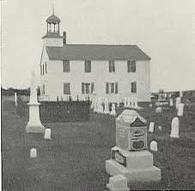
Erecting a Meeting House gave further definition to South Wellfleet as a distinct part of town. The term “Meeting House” originally meant the structure owned by the town that served primarily as a place of worship, but also as a setting for town meetings, social gatherings, and legal proceedings.  A white meetinghouse in the center of a village is an enduring symbol of early New England.

South Wellfleet Meeting House with graveyard

As the 19th century unfolded, support for the Meeting House became voluntary through the members rather than a compulsory tax paid by all the residents of a town, as “separation of church and state” became more practiced. Some of the extreme forms of Sabbath regulation began to be abandoned, including stopping travel on that day. Attending Sunday services was the norm, and those that chose not to may have risked being thought “ungodly” by the members of the community. By the 1900s there was a growth in denominations beyond the Congregationalist mainstream, and rural New Englanders began to worship as Methodists, Universalists, Episcopalians and Baptists. If there were a few Roman Catholics, they may have met for Mass in private homes.

The use of the word “Sunday” became more popular in the early part of the nineteenth century, replacing the word “Sabbath” to denote the day. The observance played an important role in day-to-day life of the community with preparations on Saturday to limit the amount of work done on Sunday while people attended long services in both the morning and afternoon. If the minister was popular and preached good sermons, all the better.

In his booklet, Mr. Cole describes the thrifty way in which the lumber to build the church may have arrived in South Wellfleet.  With the great number of fishing vessels owned by Wellfleet men, someone probably went to Maine and chose perfect building material, first growth timber that would have been sawed and seasoned, and then transported to Wellfleet in his ship, free of charge.  While there is no record for the South Wellfleet church, this is how the Pond Hill School house was erected, with wood brought from Maine by Captain Nathan Y. Paine in his schooner.

By December 3, 1834 the Congregational Society was officially organized in their new building, with 42 members withdrawing from the First Church.  While no list of original members has been found, in 1883, in an article in the Barnstable Patriot noting the church’s fiftieth anniversary, Mrs. Isaiah Barker, Ephraim Stubbs, and David Wiley are listed as the three still living originals.

There is a collection of Arey family documents at the Wellfleet Historical Society, donated fairly recently. One is a list of members with “principal” ” and “interest” earned, titled “Settlement Earned on the 2nd Congregational Meeting House.” The document is not dated, and some listed show no “principal” —making the document somewhat mysterious. The amount invested is $24, making it seem to be a list of some of the Church shares. A second document is a listing of amounts to be collected from parishioners, again, no date. Interestingly, the amounts due are referred to as “parish tax” as the old ways of taxation for religion are held onto.

The church faced east, and the County Road, built in the 1850s, was just a few feet from its door. In Mr. Cole’s booklet, he describes the church as having one entrance with a vestibule and windows later converted to doors. There was no heat until 1836 when a stove was put in, the partition between the vestibule and auditorium was taken down, and the two windows converted to doors.  He describes three galleries, the one for the choir opposite the pulpit. He writes, “In 1840 the Society voted that the seats in the North Gallery be finished into pews with doors, and the South Gallery the same without doors; and that the South Gallery pews were not to be sold but free.”

Seventeen more people joined the Society in 1838, making a total of 86 as of that time. A resolution passed on March 20 that year to raise $65.00 to purchase the land around the House. The earliest grave in the cemetery in the church yard is dated 1773. Several graves are dated prior to the Church’s establishment; the notes on them indicate they were moved from Paine Hollow.

Thanks to Charles Cole, we have a second document, available at the Wellfleet Public Library a lengthy set of notes his family prepared. He discusses the South Wellfleet Church on several pages, noting that “each family owned its pew and had a deed of it.”  To raise money for current expenses, members were canvassed in the fall after the fishing season was over and money was plentiful, as to the amount he would tithe for the coming year.  Again, Mr. Cole references parish records, but their whereabouts today must be discovered.

In the family notes, Mr. Cole describes a Christmas celebration at the church where John Cheever, a large man, played Santa Claus.  As he distributed the presents, he would make up a rhyme, such as “Here’s for the baby without a name, that belongs to Alvin and Elisa Paine.”  Mr. Cheever’s house was located near the present Old Wharf Road, as it winds its way to the Bay. His neighbors, the Barkers, gave his name to their third son, Lewis Cheever Barker.

A January 1865, article in the Barnstable Patriot notes a happy celebration at the church the last week of December, 1864, when two cedar trees were erected as Christmas trees and laden with gifts.  Besides the retiring superintendent of the Sunday School who received a life membership in the American Seamen’s Friend Society, the article notes that the pastor, Reverend G.F. Walker, and his  family were also “handsomely remembered in gifts and money in the amount upwards of fifty dollars.”  Another member of the community, who had been ill, received a “purse of forty dollars.”

Pratt noted in his history that the Church had no ordained pastor until May 6, 1842, and then were served by Reverends Timothy Davis, John Orcutt, Enoch Pratt, S. Hardy, and Wooster Willey.  In Pratt’s 1844 book, the church members numbered 160.

In a notice in the October 1872 Barnstable Patriot, posted by Alvin Paine,the reader is warned not to buy a Mas & Hamlin Metropolitan, as it had been stolen from the Church.

South Wellfleet Church later years

The 1884 Hurd history notes that the Church built a new pulpit and made other internal improvements.

It’s not definite when the “Parsonage” was built near the Church. The records of the home, still standing on Cemetery Road, note the Greek Revival style home was built in the mid-1800s. It was sold as a private home in 1902.

A Reverend Joshua S. Gay served the church until 1891 when he was stricken with a stroke and retired. He may have been the last regular minister.

South Wellfleet Parsonage

It’s not possible to establish the exact year when the Church began to dissolve, as the population of Wellfleet declined along with the fishing. One source said 1885, but another report had the Reverend Mr. Gay serving his congregation to 1891. Another source said that the congregation met at the Pond Hill School, then called the Social Union.

Mr. Cole’s booklet notes that the Church building was sold for $150.00 to Harry B. Swett, trustee for the Daughters of the American Revolution, in 1913. The funds were used to fence the burying ground with granite posts and an iron railing.  The sale agreement provided that the church be moved to Wellfleet, repaired, and used as a Memorial Hall, also called “Colonial Hall.” In 1919, it was moved “to its present site” which we can presume is where the Town Hall is now, but the site is not specified.

Colonial Hall

Until 1940, the building stood in a partially finished condition, and needed to either be repaired or torn down.  A group of interested Summer residents started a fund to restore it and make it available for Town Offices.  At a Special Town Meeting in November, 1940, the Town voted to take possession of the land and building by eminent domain proceedings due to flaws on the title.  In February, 1941, at the Annual Town Meeting, a committee who had surveyed the site reported the building was in sound condition, and the meeting appropriated additional funds to be added to the funds raised privately for the restoration of the building to house the Town Offices.

Town Hall Burns March 1961

The building was totally destroyed in March 1960 when it burned to the ground during a blizzard. It was quite an exciting event for the Town, but, luckily, the tax records were saved, along with the bills that were ready to put in the mail. The new Town Hall, meant to replicate the old one, is a slightly larger.

Sources

Town Hall Damage

Massachusetts Historical Commission, forms listing Wellfleet’s historic structures, No 77, available at the Wellfleet Historical Society

Hurd, Simeon D. Hamilton “Wellfleet Mass.” From History of Plymouth, 1884  online at http://history.rays-place.com/ma/wellfleet.htm

Freeman, Frederick. The History of Cape Cod: The Annals of The Thirteen Towns of Barnstable County, (two volumes), W.H. Piper & Co., Boston.  1869.   Wellfleet chapter on line at www.capecodhistory.net

Barnstable Patriot (various) online  archive: www.sturgislibrary.org

“The Notes of Charles F. Cole” manuscript from the Wellfleet Public Library

Cape Cod gravestones listings: www.capecodgravestones.com/swell.html

The Cape Codder March 3, 2000, page 3

Charles F. Cole “History of Colonial Hall, ,Wellfleet, Massachusetts” The Wellfleet Association, 1941. Available at the Sturgis Library.

E-News “Mass Moments” piece on Meeting houses in New England

Arey Family Papers at Wellfleet Historical Society

Old Sturbridge Village website: www.osv.org


Posted in Uncategorized | 4 Comments

The Barker Family of South Wellfleet — George Washington Barker and Lewis Cheever Barker

Isaiah Barker’s second son, George Washington Barker, was born in September 1844. In the 1860 Federal census, he is at home, and a mariner, like other South Wellfleet boys. He married Clara Bell, daughter of Edward Bell and Ruth Rich, in 1864. The marriage certificate lists his occupation as “seaman.”

George and Clara are not in Wellfleet in the 1870 census as I searched all the pages – both of George’s brothers are married by then, and they are living in separate homes in Wellfleet. His parents are in South Wellfleet, living with Betsey Arey, the unmarried daughter of Betsey Arey Barker. George and Clara cannot be found; the census may be poorly indexed or perhaps they are listed under another name.

In 1880 George and Clara are in Pittsfield, New Hampshire, with their first five children. By 1889, they would have two more children. George’s occupation in 1889 is “fish peddler.”  George and Clara’s oldest son, Scott Foster Barker, appears to have been named for a respected South Wellfleet sea captain, Scotto Foster. While he is referred to as “Scottie” in the census listing, when he married his formal name “Scotto F. Barker” is on the marriage record. Perhaps his father, George, sailed with Captain Foster.

George Washington Barker is an example of a South Wellfleet son who leaves the fishing business – he became the son who took the family land holdings and made them available for the “new” Cape Codders who would visit the Cape only in the summer, for recreation, or for “gunning” expeditions in the spring and fall.

In 1892 the Barker brothers and their spouses, along with the two living Arey daughters, disposed of their shares of the family property, giving all to George W. Barker. The deed does not reveal the amount they were paid by their brother. George already owned what became “Prospect Hill”, which he had purchased with his father in 1866. This was the land that Tully Crosby surveyed and laid out in lots which George Barker sold.

In the 1900 Federal census, George is living alone at the family homestead, while Clara is with the youngest children in Pittsfield. In the 1910 census, George and Clara are living in South Wellfleet, visited by various children as reported in the Barnstable Patriot in their short articles about the visitors to local families.

Barker Homestead front view

George W. Barker died in 1917. Clara Barker lived with her son, Dr. Ralph Barker, and his wife – also a doctor – and children, until1933 when Clara died. Both George and Clara are buried in the South Wellfleet Cemetery.

The third Barker son, Lewis Cheever Barker, born July 3, 1850, also started his work life as a mariner, but the records available about him and his work are less revealing. His life seemed to have a great deal of sadness. He married Ella F. Snow in 1869. She died of cholera in 1874, leaving Lewis and a young daughter, Leila. This child was living with her grandparents, Isaiah and Betsey Barker, in the Federal census of 1880.

Meanwhile, Lewis Barker remarried in 1876 to Emma Hamblett of Newburyport. His occupation in that record is “mariner”. There is an article in the Barnstable Patriot in October 1884, reporting that “Miss Leila Barker who has been living with her grandparents for some years has gone to her father’s in Philadelphia”.  Lewis and Emma Barker had another child by this time, Bertha Evelyn Barker. There is a record of her marriage to Carl Hurd in July 1905.

In May 1885, the Barnstable Patriot notes that George D. Brown of Philadelphia came to stay with Isaiah Barker in South Wellfleet “for a few days before he goes to Coney Island in New York to run a skating rink”. Leila Barker married George Brown in 1887 in Wellfleet. At that time he is a “mariner”. Leila May Barker Brown died in August 1895 of “abcess of the liver.” Her death record says that she was a widow. She is buried in the South Wellfleet Cemetery.

Two other facts about Lewis that tell more of his life: in the transfer of the Barker property from the sons to George W. Barker in 1892, Lewis is listed as “of Australia”. Finally, there was an article in the Barnstable Patriot in April 1905, that Miss Betsey Arey of South Wellfleet had received the sad news of the death of her brother, Lewis C. Barker, in California.

Two of the next generation of Barker children played a role in the ownership of the family’s South Wellfleet property. George Washington Barker, Jr. appeared to take over his father’s role in selling the land in the Prospect Hill development. He married Harriet Werts of New Jersey, a woman who came to visit one of my great grandfather’s cottages. She was a legal secretary and an unmarried “older’ woman and the daughter of a governor of New Jersey. George was either divorced from his first wife or widowed.  He and Harriet built a lovely home on Prospect Hill that is still there. George died in 1947, leaving much of his property to Harriet. When she died in 1952, she left it to a nephew.

The Barker homestead and surrounding property passed along to a granddaughter of George W. Barker – her father was Dr. Ralph Barker – and remains with that part of the family today.

Sources

Massachusetts Vital Records, online at the New England Genealogical and Historical Society

Vital records and census information at www.familysearch.org

Federal Censuses online at www.ancestry.com

Barnstable Patriot (various) online archive: http://www.sturgislibrary.org

Barnstable County Deeds available at www.barnstablecountydeeds.org.

Posted in Uncategorized | Leave a comment

The Barker Family of South Wellfleet — Isaiah Barker Jr. and the Lizzie D. Barker

Isaiah Barker, Jr., born in December 1841, followed the path of many other South Wellfleet young people, and became a mariner.  On December 15, 1863, he married Elizabeth (Lizzie) Doane Atwood, daughter of Daniel Atwood and Mehitable Holbrook of Wellfleet. They did not have any children.

In the 1870 Federal census, they are listed as a separate household, including Elizabeth’s father, Daniel Atwood.

In 1871, Isaiah Barker became the master of the schooner Lizzie D. Barker. She was built in Boston, 84 feet, 75.93 tons, breadth* 23 feet, depth 7.8 feet. She had one deck, two masts, square stern, billet head. She was registered in Wellfleet October 8, 1873. The owners of the Lizzie D. Barker were:

In Wellfleet:

  • Isaiah Barker Jr. 4/32,
  • Richard R. Freemen  4/32
  • Asa H. Rivers 4/32
  • David G. Pierce 2/32
  • Solomon A. Rich 2/32
  • William T. Snow 1/32
  • Nowell R. Rich 1/32
  • Benjamin H.L. Pierce 1/32
  • Isaiah Crowell 1/32.

In Boston:

  • Richard R. Higgins Co. 4/32
  • J.Y. and Simeon Baker, Co-partners 4/32
  • E.L. and T.D. Atwood, Co-partners 2/32.

In Dover, New Hampshire:

  • Henry D. Freeman 2/32.

The Barnstable Patriot printed an article in May 1871, about seven new vessels arriving in Wellfleet, and the need for new trained fishermen in the town. The writer called this “a handsome re-enforcement of the grand Armada which sails from here to capture the finny tribe of the deep.”

The life of a ship can be followed. On March 21, 1875, Lizzie D. Barker was mentioned in a “shipping news” column of The New York Herald, arriving in Boston. Then she sailed to Vineyard Haven the next day. Another shipping news item noted her arrival in Danvers from Baltimore. Lizzie D. Barker appears to have been both fishing and working the coastal trade.

In the 1880 Federal census, Isaiah and Elizabeth are living in Lot Hall’s “home” with other boarders – in other census documents, Mr. Hall always seems to have boarders – school teachers, seamen, etc. We do not know if Isaiah and Elizabeth’s move to become “boarders” is a sign of diminished resources. By 1880, we do know that the fishing for the Wellfleet seamen was not as lucrative as it once had been.

On February 7, 1882, the Barnstable Patriot reported a “probable fatal” accident on board the schooner Lizzie D. Barker, under a Captain Eaton, of Wellfleet.  A tugboat was about to tow the schooner through Hell Gate (in New York City) when a line snapped, striking a man in the head and “crushing it in a fearful manner.” The seaman was taken to the Marine Hospital on Hart Island.

Perhaps Isaiah Barker, Jr. left his position as master of the Lizzie D. Barker because in February 1884, a report from Norfolk, Virginia, told of a sinking of a schooner, the Eddie Atwood. The crew was taken in by E. Kemp, Isaiah Barker, and Isaac Paine, who were in Norfolk and who showed them “kindnesses and favors received” and they were put on a ship to Boston.

In 1900 Isaiah and Elizabeth were listed as residents of Norfolk, living on Bousch Street. His occupation was “oyster picker.”  We know that many seamen of Wellfleet, particularly when the mackerel fishing diminished, worked in various roles in the shellfish business, including the shipping of seed from the Chesapeake to Wellfleet. In the 1890s and in 1900 and 1901, the Barnstable Patriot reported that Captain and Mrs. Isaiah Barker visited Wellfleet from time to time, staying with Mary Newcomb (one of the Areys and his step-sister) and the Atwoods.

In June 1885, the Lizzie D. Barker was in the news again .She and another schooner, the Leila Linwood of Chatham, dragged their anchors and both went ashore on Block Island. The captain was listed as Captain Rogers. The New York Times reported that the schooner was a total loss, and that there was no insurance. The Barnstable Patriot reported that the Lizzie D. Barker “bilged” but was taken to Providence for repairs.

In April 1890, a news story told of a collision between the steamer City of Norwich and the schooner Lizzie D. Barker at Sands Point. Captain Hawes of the Lizzie D. Barker said there was a misunderstanding of signals when he attempted to pass. The Lizzie D. Barker was reported at a pier in Hoboken “pretty well damaged”.

A final story about the Lizzie D. Barker appeared on May 12, 1891,when the schooner was reported capsized near Virginia, between Hog and Smith Islands. The crew was rescued, but the cook died of exposure. The crew was taken by the schooner Horatio and carried to Norfolk. This article stated that the Lizzie D. Barker was owned by Richard R. Freeman of Boston. The Captain, still Hawes (no first name given), was “unfortunate to have been shipwrecked four or five times before.”  This article appears to be the final ending of the Lizzie D. Barker.

According to an October 8, 1907, obituary in the Boston Herald, Captain Isaiah Barker, Jr. died “suddenly” at age 66 in Norfolk, Virginia. A few days later, the newspaper announced his burial in Wellfleet “after the arrival of the morning train.”   However, when I searched for Captain Isaiah in Wellfleet, to see which cemetery he was taken to I did not find him. Instead, he is buried in North Weymouth. Elizabeth Atwood Barker died in 1927, in Quincy, Mass., at age 84 years.  In the 1920 Federal census, she was living in nearby Weymouth with her sister, Sarah Atwood, and Sarah’s daughter and son-in-law. Her funeral service was at their home. The gravestone for both Isaiah and Lizzie is in the North Weymouth Cemetery.

Isaiah Barker Jr. and Lizzie Barker’s grave

This Barker son, trained to be a mariner, stayed with the sea, adjusting through the economic change to become part of the shellfishing industry. Obviously, he gained enough income to buy a ship, with other investors, but did not keep it. The story of the Lizzie D. Barker  illustrates the life of a schooner, and the complexities of sea transportation in and around the East Coast.

*”Beam” is the nautically correct term as my finicky brother points out

Sources

Alphabetical List of Ship Registers, District of Barnstable, Massachusetts 1814-1913. Compiled from the original documents stored in the New Bedford Customs House. Prepared by The National Archives Project, Division of Women’s and Professional Projects, Works Progress Administration, The National Archives, Sponsor, Boston, Mass 1938.

Federal Censuses online at www.ancestry.com

Barnstable Patriot (various) online archive: http://www.sturgislibrary.org

The New York Times archive

Newspaper account on line at www.genealogybank.com.

Posted in Uncategorized | Leave a comment

The Barker Family of South Wellfleet – Isaiah Barker and Betsey Arey Barker

As I researched the history of the Barker family, I have come to view them as exemplifying the families of South Wellfleet who lived through the economic changes of the 19th Century.

I started my family research with the Barkers, since my great grandfather purchased his original lot of Cape Cod land from George W. Barker in 1892. Note my correction from my first blog where that purchase was dated 1906. A family member corrected me — the 1906 date was the date of the purchase entry onto the Barnstable County database, although the true purchase was in October 1892.  George Washington Barker was the second son of Isaiah Barker, the link to the Arey family.

In an earlier blog, “more on the Arey Family”, Asa Packard Arey, Richard Arey (2)’s third son, widowed, and then married Betsey Allen Higgins. They had four children, three of whom lived. Asa Packard Arey died of consumption in 1839. He was one of the Captains noted in Cole’s memoir as one of the generation of 1830s sea captains sailing from the South Wharf on Blackfish Creek. His house, on land he purchased from his neighbor John Witherell in 1828, is to the west of Old Wharf Road. The house is still there, facing the morning sun as old Cape houses do. Captain Arey added to his holdings with later purchases from Theodore Tarleton.

Mrs. Betsey Arey, daughter of Captain Thomas Higgins and Martha Swett — both old Wellfleet families — was the executrix of her husband’s estate. She took in a boarder, perhaps because the South Wharf was becoming a busy place by the late 1830s, and there was no hotel in South Wellfleet. Isaiah Barker, the boarder, was from Londonderry, New Hampshire. We do not know why he traveled to the Cape, but he was a cooper, and was perhaps seeking an employment opportunity in that growing town where the mackerel fishing had taken hold. He and Mrs. Arey married on November 11, 1840. Isaiah and Betsey had three more children: Isaiah Jr., George Washington, and Lewis Cheever Barker. The Arey and Barker children grew up together.

In addition to the land around the Arey homestead — referred to as the land of the “heirs of Asa P.Arey” in South Wellfleet deeds — Isaiah Barker acquired more land in South Wellfleet during his lifetime. John Newcomb who was Hannah Arey’s guardian, sold Hannah’s interest in Asa’s property to him. Barker bought land from Nathan Paine and John Doane. Most important to me, he and his son, George Washington Barker, bought what is now Prospect Hill from John Stubbs in 1866. The deed descriptions mention nearby property owners: John Cheever, the Witherell family, Josiah Lincoln, and David Wiley. Cheever must have been a respected neighbor, as the Barkers gave his name to their third son.

The Barker homestead

The Barkers, living near the South Wharf during the heyday of the fishing years, must have lived relatively comfortably. Isaiah lived to a remarkable age for a man born in 1808; he died in 1885 at age 77. Betsey Arey Barker died two years later, in 1887.  I have not researched Isaiah’s earlier life; in his death certificate, his parents are listed as Levi and Polly Barker of Bradford, Vermont. Both Isaiah and Betsey are buried at the South Wellfleet Cemetery.

As noted above, Asa Packard Arey’s first child, Hannah, did not come under the guardianship of Isaiah Barker as the other Arey children did; her guardian was John Newcomb, her grandfather. She married Seth Crowell first, and, then second, Nathaniel Myrick. She died in 1910; her step-sister, Betsey Arey, stayed in touch with her, and visited her in the Boston area, as noted in the Barnstable Patriot. Hannah is buried in the Dennis Village Cemetery.

Mary Arey, Asa and Betsey’s oldest daughter, married Benjamin Newcomb, a mariner, and lived in Wellfleet most of her life, finally as an old woman with her son Cecile Newcomb. She also had two daughters.

Asa Packard Arey Jr. lived in the Barker household, became a mariner, but died of consumption at age 24. He is buried in the South Wellfleet cemetery. There is no evidence that he married.

Betsey Allen Arey, born in 1838, shortly before her father died, never married, and lived with Isaiah and Betsey until they died. The Barnstable Patriot reported on her comings and goings, as it did for other South Wellfleet residents. She stayed in Wellfleet, but in the winter would visit her Barker relatives who had moved to New Hampshire. In 1895, she and her step-niece (Lewis Barker’s daughter) are reported as living in the nearby Scotto Foster home. She is shown on the 1910 map as the resident of the original Arey home near the County Road.

Next: reporting on the lives of the Barker sons.

Sources

Massachusetts Vital Records, online at the New England Genealogical and Historical Society

Federal Censuses online at www.ancestry.com

Barnstable Patriot (various) online archive: http://www.sturgislibrary.org

Barnstable County Deeds available at www.barnstablecountydeeds.org.

Posted in Uncategorized | 1 Comment

Wellfleet Marine Benevolent Society

As I was writing about the South Wharf on Blackfish Creek, I noticed that the organization of the Wellfleet Marine Benevolent Society appears to be a South Wellfleet venture. It was organized January 28, 1836.  The first officers were Richard Arey, President; Collins S. Cole, Secretary; and Nathan Paine, Treasurer, all South Wellfleet residents.  The annually-elected committee to manage its affairs was Levi Young, John Newcomb, Isaac Paine, Giles Holbrook, William Stone, Bethuel Wiley, Hezekiah Doane and Samuel Smith. While I haven’t done research on all of these gentlemen, a few are South Wellfleet property owners.

When the Society was incorporated on March 20, 1840, the incorporators were William Stone, Jr., Isaac Paine, Timothy Ward, and George B. Saunders.  Saunders was one of the owners of the South Wharf.

This was a time when most charity was private, usually through churches or benevolent societies. The towns did have an almshouse, although if there was no building, the town supported a person in the home of a willing host. People who might become a burden on the town were usually escorted to its border so that the support would not have to be given.

The oceanside huts for shipwrecked sailors were organized by the Massachusetts Humane Society. Churches gave support to widows. Children were taken in by relatives or neighbors if they were lucky, and sent to orphanages if not. Early on in the Massachusetts colony, there was recognition that widows and orphans needed assistance. In 1675, the General Court (legislature) sent 10 pounds to help Mrs. Knowles in Eastham whose husband, John, had died “serving the colony.” In 1771, the provincial government disbursed 118 pounds to the destitute families of the sailors lost in a destructive storm off the Grand Banks.

The Wellfleet Benevolent Society was organized for the relief of distressed mariners, their widows and orphans, and others who joined.  The Society also took care of shipwrecked sailors who might need temporary assistance. Later, the U.S. government organized the Life Saving Service for the shipwrecked seamen.

Certificate from the Wellfleet Benevolent Society

The Wellfleet Benevolent Society had members who paid one dollar a year for sixteen years, or twelve dollars at the time of joining for a life membership.

We have a fictional account of how the Society disbursed benefits from Irene Paine’s recent book when Eva Paine hears that her husband’s body has been found, and she will not have to wait for some time to get her widow’s benefit.

Between 1840 and 1890 the Society disbursed over $10,000. In 1904, the Society dissolved.

Sources

Hurd, Simeon D. Hamilton “Wellfleet Mass.” From History of Plymouth, 1884 online at http://history.rays-place.com/ma/wellfleet.htm

Rickmers, Ruth, Wellfleet Remembered, Volume 2, 1982

Paine, Irene M. Eva and Henry: A Cape Cod Marriage.

Posted in Uncategorized | Leave a comment