
This is the twelfth post in a series about life on the Outer Cape during World War II.
The summer of 1944 appears to have been relatively normal; the “Day Cape Codder” ran from New York to Hyannis, along with passenger trains from Boston to Hyannis. The ship Steel Pier made daily runs from Boston to Provincetown.
The war news continued; a Truro soldier, Marine Corporal Cleveland, was killed in the Saipan invasion. Most likely, his parents learned of the news upon receiving a Western Union telegram, as most families did. Sometimes an officer or a chaplain would accompany the delivery. Beginning in October 1944, all commanders stationed in the theater of war were ordered to write letters of condolence to the families of service members killed under their command.
The Primary election was held on July 11; only 68 people in Wellfleet voted.
The Principal of the Wellfleet Consolidated School, Antone Duarte, joined the U.S. Navy as a Lieutenant JG.
On July 20, the annual meeting of the Wellfleet Board of Trade, Wellfleet Associates, and the South Wellfleet Neighborhood Association took place at the Congregational Church. Mr. Melcher of Publishers’ Weekly spoke to the group about the town’s assets and achievements and emphasized the importance of attending to both the small and large factors that shape the town’s image. He spoke positively of the Wellfleet products, beach plums and clams, and how the town had “invented the banana.” He stressed that everyone must work together on the town’s image, taking care of the small things, such as planting petunias in an old dory or taking down an unsightly building.
Miss Margaret Dooly, the President of the SWNA, expressed her regret that the soldiers at Camp Wellfleet had been moved away. She expressed dismay at the amount of money spent to create the Camp, only for it to now be closed. Of course, during this summer of the war, more than two million troops were moved to Europe to begin the liberation of Western Europe.
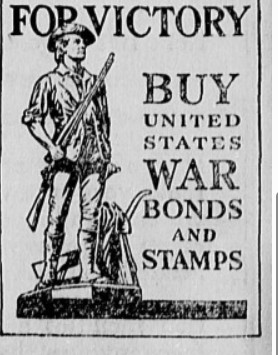
Elbert Blakeslee spoke about the importance of the War Fund Drive over the summer and highlighted events to support it. There would be a Swap Shop under the direction of Lydia Newcomb in the “Freeman building,” where Miss Elizabeth Freeman’s office was located. Later in the summer, a “Plummer’s Ball” was held at the Legion Hall, with admission a certain amount of beach plums. By August, it was reported that Wellfleet had raised $900, more than 40% of its quota for the war bonds.
Princess Juliana of the Netherlands came to the Chatham Bars Inn from her wartime home in Canada, bringing her three little princesses with her, for a relaxing six-week stay.
In August, The Barnstable Patriot reported that Kathleen Kennedy, wife of Lord Harrington of England, flew from England to Boston to join her parents as they mourned the death of their oldest son, Navy flier Joseph P. Kennedy, Jr., who was killed in a mission over France. She stopped at Charlestown Naval Hospital to visit her brother John, who was recovering from injuries suffered on the mission in the South Pacific. Less than a month later, her husband would be killed by a sniper’s bullet during a battle with the Germans in Belgium. Kathleen would die in a plane crash in France in 1948.
The Barnstable Patriot reported that several hundred German prisoners captured in Tunisia were being held at Camp Edwards. The POWs would be used to harvest strawberries in Falmouth that summer, and, in September, they would join soldiers from the Camp in cleaning up after that month’s hurricane. They were paid 80 cents per hour, or $6.00 per day, but were allowed to keep only one hour’s pay, and the remainder was taken by the U.S. Treasury Department.
As another sign that the soldiers were leaving the United States, the USO club in Hyannis was closed in September.
In September, Charles Frazier was spotted at the Flagship in Provincetown, enjoying an evening out with friends. He was on his way to the South Pacific, where he helped run the military government that the United States established on the conquered island of Okinawa.
The Provincetown Advocate reported on September 14 that the hurricane warning flag, a red flag with a black square in the center, was flying on Monument Hill. The U.S. Navy moved all craft to the Cape Cod Canal. The hurricane hit the Cape that night, and the next week, the Advocate would declare it “the worst blow in history.” Rumors would start about Provincetown being “under martial law.”
Wellfleet lost both electricity and phone service, and people used their hand pumps to get water. The Taylor Funeral Home was totally destroyed when two large trees fell on it. The funeral director assured the town that he would conduct funeral services in people’s homes and that the Home would be rebuilt.
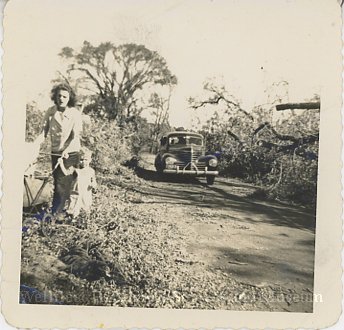
damage, 1944″
Looking ahead to the end of the war, the Provincetown Selectmen ruled that all liquor stores and bars would be closed for 24 hours when the declaration was made.
The bodies of two U.S. Navy fliers were found in a rubber raft ten miles off Provincetown.
In late September, Massachusetts residents were warned of a coal shortage and advised to endure a few cold mornings early in the winter to make their coal supply last through the season. In late December, a warning was issued that the U.S. supply of processed food was insufficient to sustain the population through the next harvest, and that more stringent rationing would be needed.
In the November election, Wellfleet voters chose Dewey and Bricker with 333 votes, and gave Roosevelt/Truman 126 votes. They also voted to continue to keep the town dry.
In early December, both The Barnstable Patriot and the Provincetown Advocate announced that the Cape Flotillas would be honored by the U.S. Coast Guard in a ceremony at Orleans High School. The Cape Flotillas were in Division 6B of the Coast Guard Temporary Reserve; Wellfleet’s Flotilla was numbered 614. The Flotillas were part of the Port Security Program, and men worked many hours on duty without pay. They patrolled the beaches on foot and the inshore waters by boat. Many turned their boats over to the Coast Guard. Now they were placed on “unassigned status,” which seemed to signal the end of the program.
In mid-December, the Massachusetts Department of Public Works announced that when Route 6 was completed past Eastham, the road in Wellfleet would not follow the old route through the town. Instead, it would turn west at Holbrook’s Filling Station and come back to the present route at Gull Pond Road. Of course, the work on the road would not begin until 1948, and the bypass in Wellfleet was constructed in 1949. I wrote about the roadbuilding project in this blog post.

 South Wellfleet, Massachusetts