
This is the tenth post in a series about life on the Outer Cape during World War II.
The Wellfleet Fourth of July parade had no gas-powered vehicles this year because of the rule prohibiting automobiles for pleasure drives. Jack Hall, dubbed “The Laird of Bound Brook,” led on a white horse. The parade concluded with a ceremony in front of “Colonial Hall,” a label still in use for the Town Hall, with a speech by Congressman Gifford, and an original song written and performed by Martha Atwood Baker, Wellfleet native and the “Cape Cod’s only Metropolitan Opera prima donna.”
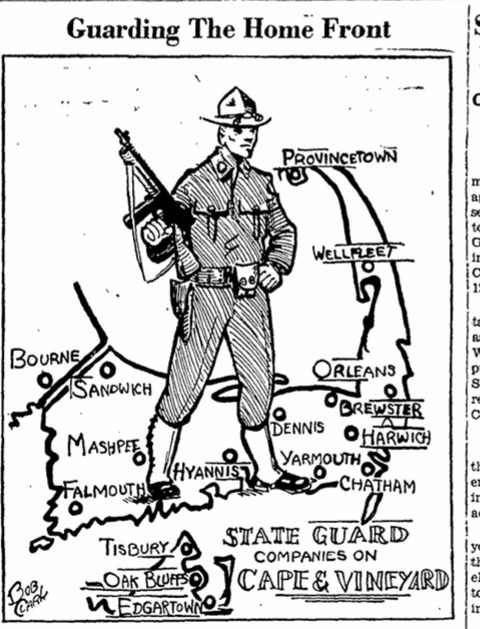
One of the units marching in the parade was the Wellfleet-Truro company of the Massachusetts State Guard. When the Massachusetts National Guard was federalized, the state began a State Guard, and soon many towns had a State Guard Company. Wellfleet and Truro combined their efforts, though this sketch pictured below shows the unit in Wellfleet. Selectman Lawrence Gardinier served as the Captain. High School Principal Cochrane served in the unit.
In July, urgent messages urged people to save and donate two items: tin cans and “kitchen waste grease.” The Provincetown Advocate took time to explain why. Tin cans were to be flattened, with the top and bottom inserted, before you stamped on them. The can “could save two lives,” as the tin would be used to make surrettes, small vials containing morphine, attached to a hypodermic needle. A wounded soldier could use the morphine himself to counteract shock and to relieve pain for ten to fourteen hours, thus arriving at a field hospital in better shape. In Wellfleet, the tin cans could be dropped at Mr. Daniel’s store.
Like every other town in Massachusetts, Wellfleet was assigned a quota for waste fats: 166 pounds. The fat was to be saved in a clean metal container and taken to the butcher. The waste was a source of glycerine used in many items needed for the war effort, including paint, medicines, and nitroglycerine for explosives.
In mid-July, a plane “on a training mission out of Camp Edwards” crashed into the ocean off Wellfleet, killing the pilot who stayed in the plane trying to land it. Three men parachuted out, one landing on shore, and the Coast Guard picked up the other two.
Wellfleet announced the formation of a committee to determine how to memorialize Dr. Clarence Bell. They planned a new building, knowing it could not be built until after the war, which would be either a library or a health center. The town would vote on the project.
On August 2, news broke of the purchase of land for a Boy Scout camp in Wellfleet. The Worcester Scouts made the purchase. This camp was on Duck Pond and is now labeled “the former Boy Scout Camp” when it was part of the Wellfleet Conservation Trust’s annual walk in 2019. The Scouts labeled the site “Treasure Cove.” It was shared with the Cape Cod Council of Boy Scouts. In October 1943, the Cape Council received a donation of 150 acres for a camp in Yarmouth.
August brought the sad news of three young women campers losing their lives. On a Friday, three canoes with two campers and one counselor each left from Camp Nobscusset in Dennis to paddle to Provincetown. The wind came up, the water in the bay became choppy, and one canoe was upturned, causing the drowning of three girls. Two bodies were found on the following Sunday, one in South Truro and one on Great Island in Wellfleet. A search continued the following week, with Coast Guardsmen, Boy Scouts, and others searching the shore. Finally, on Thursday, the last 12-year-old was found on the beach in Brewster. The camp was closed permanently.
In mid-August, the Commander of the Eastern Defense Command and First Army issued stricter regulations prohibiting the use of cameras and sketching along any Cape Cod shoreline. Anyone violating the rules was subject to a one-year prison term and a $5,000 fine.
Two hundred blackfish went ashore in Eastham. Eleven men worked through the night to remove the melon from the head, thus capturing the oil that was shipped to the processing plant in New Bedford.
Popular High School Principal Richard Cochrane announced his departure to become the principal of Sherburne High School. Mr. Duarte, a math and science teacher at Provincetown High School, was designated as his replacement. The Methodist Church held a reception for the Cochrane family.
Wellfleet women were included in an appeal from a Provincetown woman to send her their “cheap” jewelry, which could be used by soldiers in “South Seas Islands” as payment to local people who would dig foxholes and help move wounded soldiers.
On September 8, 1943, Italy unconditionally surrendered. The news reached the Provincetown Advocate at around noon that day, and the paper posted it on a board outside their office. Visitors who often lacked radios could see the news, and the town’s overall mood was cheerful. Of course, unknown at that point was that Germany would occupy the north, and the Allies the south of Italy, and more fighting would continue. Governor Saltonstall sent a message to all the Massachusetts local governments that churches should ring their bells or other signals could be used to acclaim the event.
At the Wellfleet Board of Trade meeting in late September, the Army announced that its engineers would build a “modern sewerage system” for Camp Wellfleet, and that waste would not be discharged into the ocean, as initially planned. Congressman Gifford led the negotiation.
An Army Chaplain who had served for two years in the Pacific and was now assigned to Camp Wellfleet addressed the Board on the work of Army chaplains. He described how loneliness could become a disease. He discussed the concerns soldiers have, ranging from global security to fears that “women will be more interested in business and industrial work than in cooking, sewing, and making homes.”
The meeting also included a discussion of using the town’s fire siren to give the location of a fire. Selectman Gardinier opposed this because people tended to get into their cars to go to the fire, which interfered with the firemen. He also reminded the group that the siren signaled air raid alerts and was used to call out the State Guard. The group decided to leave the fire location known to the telephone operator and planned a meeting with the telephone company to discuss the procedure to be followed.
In the summer and fall of 1943, letters published in the Provincetown Advocate by soldiers and sailors described their experiences, of course, without specific locations. The letters had usually been received by a family member who chose to share them. In the August 26 issue, a soldier wrote about fighting in Sicily and the ants they had to endure while sleeping. In the September 23 issue, Navy Master’s Mate 2 wrote about how he felt when he heard that the Coast Guard cutter Escanaba was sunk in the North Atlantic with the loss of 100 men he had served with, as part of a storm-tossed voyage from Argentina to Britain.
In early September, Wellfleet people expressed their hope for a successful scallop season, as the past year had been. A good year brought $75,000 into the town. The editor of the Provincetown Advocate commented in an editorial that Provincetown could also have this success if the harbor were cleaned up and the sewage from homes on the shore were captured instead of washing into the bay.
In early October, Isaac Paine, 77 years old, of South Wellfleet, died of burns he suffered when he attempted to extinguish a fire that destroyed his barn. He died at the hospital in Hyannis. Mr. Paine, known as Ikey, was the subject of an earlier blog post.
In October, another plane went down, this time in Cape Cod Bay, a “routine training flight” out of Squantum Naval Air base, with five British airmen losing their lives. For a few days, aircraft, including a blimp, searched the water for survivors. Wreckage from the plane was found by a dragger and brought to Provincetown.
Cape hunters were apprehensive about the hunting and shooting season due to ammunition shortages. Waterfowl, rabbits, and deer each had specific weeks designated for hunting. The Coast Guard continued to process identification cards for hunters and shooters. In December, a Wellfleet visitor shot a 150-pound buck.
There were additional reports of blackfish coming ashore. About 20 blackfish came ashore in Blackfish Creek after a flotilla of boats worked to prevent many others from washing up. Then another 140 blackfish came ashore in both Wellfleet and Brewster. These were harvested for their oil.
The Coast Guard closed its training center at the Provincetown Inn, but news reports indicated that the Navy and Air Force might be using the facility to house ground crews.
Wellfleet got a new doctor, Dr. Reuben Marvel, an old friend and classmate of Dr. Bell. Wellfleet’s new minister at the Congregational Church, Reverend Lynn Townsend, and his wife learned of the death of their son, Robert, a marine, in the South Pacific.
In mid-October, The Yarmouth Register reported that the Army engineers had issued two $200,000 contracts to two contractors to build housing at Camp Wellfleet for enlisted men and officers.
Later, in the Provincetown Advocate, the building program at Camp Wellfleet was expected to be completed by mid-November. The site was also called the “Camp Edwards Anti-Aircraft Artillery Training Center.” There were seventeen barracks buildings, five mess halls, four administration buildings, and other structures, forty-one in all, meant to serve a whole battalion. Had the men been in pup tents since the opening in late March? Early reports on the Army’s training sites had made it clear that the American people wanted their soldier sons to be adequately housed.
The Army Air Force civilian observers in Provincetown recently discontinued their 24-hour operation, and all 75 volunteers who maintained the 24-hour watch received pins to commemorate their service. The watch post was first at Beach Point and then at Standpipe Hill.
In early November, 734 copies of Ration Book Number Four were issued in Wellfleet. The first stamp in the book, pictured with an airplane, was for one pair of shoes. The Green stamps, A, B, and C, were for jams, jellies, and fruit spreads. Stamp 29 was good for five pounds of sugar until January 15, 1944.
There was a shortage of turkeys for Thanksgiving, so many people ate chicken instead. Perhaps this was when Jack Phillips and Hayden Walling began raising turkeys in small structures along the pond in North Wellfleet. The two may have undertaken this task because it would make them part of the food production industry and thus eligible for more gasoline. The tales of the bohemians in the Wellfleet woods would be told many years later.
In December of 1943, Frank Rose of Wellfleet was in charge of loading Provincetown sand onto boxcars, some 1500 each year, that were shipped to various industrial users, including the railroad itself. Provincetown sand was a valuable commodity from the 1920s through the 1960s.
The year ended with a report of 55,700 tons of paper collected on the Cape, 1,100 pounds in Wellfleet, and a reminder to save all Christmas wrapping paper for the next drive. The tin can collection mentioned earlier was successful, with 13 tons of tin cans shipped by freight car off the Cape in late December.

 South Wellfleet, Massachusetts
Thanks Pam, most interesting slice of life in Wellfleet.