
This is the ninth post in a series about life on the Outer Cape during World War II.
In January and February 1943, the story of a U.S. Navy antisubmarine patrol featured one of Wellfleet’s own: Wallace Pierce, Ensign, who was a part of the ten-man crew. In 1942, during the Battle of the Atlantic, an American airman signaled “sighted sub, sank same,” providing a morale boost to the battered Americans, even though the submarine was not sunk that time. Now, there was a story that, indeed, a submarine was sunk, and the Navy must have wanted the story posted widely to help cheer Americans.
Wellfleet’s Wallace Pierce was photographed with the crew at the British Ministry of Information in London; he also appeared on a British broadcast that his family and friends heard in early February, and The Boston Globe ran a detailed story about how the crew found and sank the U-boat. The crew’s base of operations and the location of the sinking were, of course, not disclosed.
In mid-January, a Coast Guard Auxiliary Flotilla was organized for Wellfleet by fisherman Wilton Hopkins, commanding the group. Joining other flotillas all around the Cape, this group would assist the Coast Guard with Wellfleet Harbor and inshore patrols, freeing up Coast Guard time for deep-water work.
In the 1940s, doing laundry was hard work for women. Few people had washing machines. Accordingly, when Acme Laundry in Chatham announced it would only do laundry for Army officers and others at Camp Edwards, there was outrage. Cape Cod Hospital also used Acme. The Cape’s Congressman got involved. It appears to be a complicated story about the two laundries in Chatham and Yarmouth, about how the Army did not include laundry facilities in the original plan for Camp Edwards, and about a new entity, “Defense Laundries, Inc.,” that displaced local customers. It took about two weeks, but the situation was remedied, and life continued on the outer Cape in the winter of 1943.
The U.S. Coast Guard announced recruitment for SPARS, the women’s reserve. It offered work at $40/week, a four-month training program, and a “smart Mainbocher-designed trim blue uniform sporting the Coast Guard insignia.”
Provincetown’s Katherine Young was now a Captain, assigned to the second WAAC Training Center in Daytona, Florida, where she was in charge of publishing the Daily Bulletin. The women assigned there were understudies for male officers, “preparing for the time when the WAAC would be completely run by women.”
In January, it was announced that the schools in Wellfleet would be closed for February to save on fuel oil. There would be no spring break in order to make up some of the time.
A woman applied to be a member of the Truro Highland Fish and Game Club, which had many Wellfleet members. The Club’s members were steadfast in saying no to the request and suggested that women form their own auxiliary.
Two Wellfleet women reported for duty at Camp Edwards’ Army Nurse Corps.
The Wellfleet women who sewed for the Red Cross reported finishing 45 garments and 75 surgical dressings in February. They moved their meetings to the parlor of the First Congregational Church and held them on Mondays.
The Wellfleet Town Meeting in February was “dispatched with speed and good feelings.” After it took a while to assemble a quorum for the 10:30 am meeting, it was decided to move the time to 1 p.m. in future years. Those who worried about losing the traditional lunch-time “church supper” were assured that a meal would be served in the early evening. The voters decided to continue the survey of town properties because it was identifying untaxed land that could be added to the tax rolls. The Selectmen were authorized to sell property taken through a tax title procedure.
In mid-February, residents of the outer Cape were given detailed instructions in the Provincetown Advocate on how to apply for their Ration Book Number Two. The application process in Wellfleet was planned to take place at Town Hall, with teachers handling the paperwork, under the direction of the Wellfleet High School principal. Applicants were reminded to bring Ration Book One and to complete the declaration form for each family member on a single form. For coffee and canned goods, people were instructed to enter only amounts exceeding the permitted limits.
For coffee, as of November 29, 1942, each person over 14 years old is allowed one pound on hand, so the new form requires only the excess. For canned goods, each person is permitted five cans of eight ounces or more. Cans under eight ounces and home-canned goods are not counted. In the same issue of the paper, an advertisement for a market in Provincetown noted that no canned goods could be sold between midnight on February 20 and March 1, when rationing goes into effect.
The Wellfleet Board of Trade announced a War Bond Rally for February 22. There would be films, including an afternoon matinee for children and an evening show for adults, as well as a minstrel show. Everyone who bought a bond between February 15 and 23 would be admitted free of charge.
War Bond sales were a massive government campaign to finance the war, using extensive propaganda and targeting one town against another in competitive races.

Wellfleet High School Principal Cochrane announced a High School Victory Corps. Both boys and girls were to be trained “to participate in the war effort more effectively.” Their course would include physical and military training, trade school courses, and opportunities for community service.
In late March, just a few lines in the Provincetown Advocate announced that an Anti-Aircraft Range had opened in Wellfleet, a part of the Camp Edwards operation. “It is a major AA training center and the new installation provides facilities for firing, bivouac, and tactical maneuvers for three full battalions.” The Standard Times of New Bedford described the range as offering a “perfect to-mile firing line” and the heavily wooded section suitable for troops testing field problems and maneuvers.” Brigadier General M.C. Handwerk was the Commander. Regular newspaper warnings began about dangerous areas off the coast of South Wellfleet during artillery firing.
Three battalions of men would put between 2,600 and 3,000 soldiers in Wellfleet. Later reports in November said there was one full battalion, or 821 officers and enlisted men assigned to Camp Wellfleet.
Under the South Wellfleet Neighborhood Association’s oversight, space was provided at Pond Hill School for soldiers to relax, read, and write letters. The building housed the South Wellfleet Library and was the site for community suppers as it is today. Miss Dooley of the Association was mentioned in news reports about the Camp in 1943 and 1944 for their work caring for soldiers. The Association asked local people to contribute games to help in their work.
A representative of “Massachusetts State College” came to Wellfleet and many other Cape towns in mid-April to teach people how to can meat and fish. The class was held at the “Community Building” next to the Curtain Factory. Home food supplies could be increased by raising chickens, pigs, rabbits, and squab.
The Wellfleet Board of Trade had its annual “Ladies Night” event in April, honoring Mary Heaton Vorse for her recent book, Mrs. Marie Echeverria for her Red Cross work, Francis Holbrook for his lifetime work in the town, and Frank Payne for his “courageous work” on the Wellfleet Rationing Board.
The Provincetown Advocate reported in May that three truckloads of soldiers from South Wellfleet drove into Provincetown for a short visit. The men were reportedly cold and hungry, and were living in pup tents at the anti-artillery base. They shopped at the Burch Bakery and went to the Atlantic House, “eating like 17-year locusts.”
People from Provincetown were watching a formation of planes off the Back Shore when one crashed, killing a young Navy radioman. The pilot parachuted out and was picked up by a fishing boat.
At the Wellfleet Board of Trade meeting in May, Andre Vulliet, a Wellfleet homeowner and the Director of the French Information Center in New York City, spoke about the French Vichy government and the military operations in North Africa. His office had recently been taken over by the Office of Strategic Services, the precursor to the CIA, and was moved to Washington, D.C.
In mid-May, all the civilian defense workers on the Cape were warned that the U.S. Army planned a Cape-wide surprise invasion maneuver, and they were to call in what they observed to the Hyannis 10,0000 number.
Wellfleet’s beloved doctor, Clarence Bell, died on June 6, 1943. His practice in Wellfleet opened in 1908.
In late June, the good news was announced that the Cape Cod Steamship Company’s steamer Steel Pier had been permitted to sail between Boston and Provincetown daily, with gasoline usage approved. The Coast Guard helped bring it back into service after a 1941 break, because the 1650-passenger ship could also be used to move men and supplies, saving truck trips. Another part of the good news was that there would be a bus service from Provincetown to Wellfleet and back each day, providing another way for outer Cape residents to reach Boston.
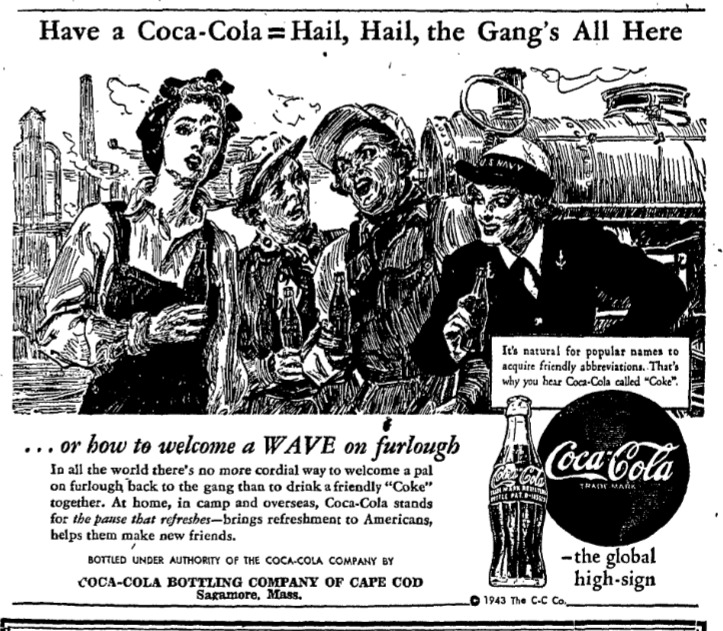
A note about working Wellfleet women
This advertisement featuring working women helped me realize that I had not mentioned the WWII phenomenon of women working. Did the War change the jobs that Wellfleet women could find? In 1942, an article in The Barnstable Patriot quoted a Massachusetts Director of Employment Services as urging companies to consider hiring women, as “women’s fingers are nimble and their brains are agile and receptive.”
I was surprised when I looked at the 1940 federal census pages and saw how many Wellfleet women held jobs outside the home. In fact, it made sense. Wellfleet was emerging from the Depression years, and Wellfleet men had jobs fishing, in a few government positions, in stores and other businesses, and supporting summer tourism. Women needed to work.
In the 1940 census, the largest employer in Wellfleet was the curtain factory, which employed sixteen women, some of whom were part-time. The next most popular job was “housekeeper in a private home,” listed by thirteen women. One woman said she took in laundry in her home. The town had four teachers, two librarians, three telephone operators, and one cook in a restaurant. Seven said they were “salesladies” in stores. Six were employed in their own family businesses — one as the proprietor of a shop, another in her own restaurant, two managing the family’s summer cabins, and one, Mrs. Austin, with responsible roles in the greenhouse and garden of the Austin business. There were four “practical nurses,” one registered nurse, and one school and district nurse. There was no opportunity on the Outer Cape to take on a “Rosie the Riveter” role.
Did Wellfleet women move off-Cape to find jobs? That question is more difficult to answer. In the “personal notes” section of the newspaper, in articles about what people were doing, the Wellfleet column often mentioned young women returning home from college, getting engaged, and marrying. Only one I recall, Helmi Lee, attended business college in Boston and then had a job “in business” there. There may have been others.
A few Wellfleet women joined the military: the Army’s WAACs began in 1942, followed by the Navy’s WAVES and the Marines. The Coast Guard SPARS followed in early 1943. Women were in non-combat roles to support the war effort. The Wellfleet Honor Roll (to be described in the upcoming Post-War note) names eight women who served in the Army and three in the Navy.

 South Wellfleet, Massachusetts