
This is the eighth post in a series about life on the Outer Cape during World War II.
There were no fireworks on the Fourth of July in Wellfleet in 1942. Instead, the Town had a longer parade that included military units from the Army Signal Corps and the Coast Guard from Cahoon Hollow Station. Frank Shay must have been back from Washington because he was one of the organizers. The parade ended in front of Town Hall, where 500 gathered for a ceremony. Prayers were read for the soldiers, the sailors, and the parents. Oliver Austin read the names of all those from Wellfleet who were serving in the military, and Mr. Paine, from Provincetown, dressed as Uncle Sam, penned their names on a scroll of honor. Later in July, three more young men were called up.
The Provincetown Advocate printed a denial on its front page that “the Atlantic seaboard is littered with bodies,” a rumor that Time Magazine, among other publications, had been circulating. The paper reported that Wellfleet, Truro, and Provincetown were peaceful, lovely, and enjoyable and that they were not under martial law.
In mid-July, the national head of civilian defense came to Provincetown to award the first citation to the workers who had handled the survivors of the torpedoed ship brought ashore on June 16th. There was a short ceremony: a scroll presentation, and lunch was served with clam chowder, lobster rolls, blueberry pudding, and coffee.
Women were now signing up for military service. Provincetown’s Katherine Young was the only Cape Codder to be chosen for officer training in the Women’s Auxiliary Army Corps. In six weeks, she would complete a tough training course to show “women could take it too,” and receive her second lieutenant bars with the class of 436 women who were the first ever to be commissioned.
At the annual meeting of Wellfleet’s Board of Trade, Wellfleet Associates, and South Wellfleet Neighborhood Association, the Sheriff of Barnstable County spoke to the groups, criticizing the censorship that “keeps the real truth from the people of Cape Cod so they do not realize the seriousness of the war situations.” He charged his audience to stay alert, noting that the Cape is a “logical place to land spies and saboteurs.” No doubt he was referring to this incident in June 1942 when German spies landed on Long Island.
At the same meeting, a lengthy discussion concluded that it was not appropriate for the town to hold a town fair and that some other effort should be made to raise funds for war work. Helen Hicks reminded the group that the men serving at the Cahoon Hollow Coast Guard station were no longer local men with homes nearby, and so they should be invited to Wellfleet homes for a “home-cooked meal, and home-surroundings.”
In late July, Oliver Austin Jr. was commissioned as a lieutenant in the U.S. Naval Reserve. He and his wife closed their greenhouse in Wellfleet and their two stores in Orleans and Provincetown. His father remained the owner and director of the Ornithological Station in South Wellfleet.
In late July, the Coast Guard clarified that picture-taking is allowed, but no photos of any waterfront location are allowed. The Peaked Hill Coast Guard station reopened. A liquor salesman in Truro was charged with illegally storing gasoline on his property; he was tried in August and fined $50.
Two more Wellfleet men were called up.
There was a surprise air-raid drill on the outer Cape in August; in Wellfleet, there was one staged incident: an imaginary bombing. The site was not reported. A canteen was set up at the Wellfleet Methodist Church for the workers.
Perhaps to use the energy he gave to the Wellfleet town fair, Frank Shay worked with the soldiers in the Army Signal Corps battalion stationed in Truro to produce an all-soldiers’ show. “This is The Army?” opened in Wellfleet on September 3, followed by shows in Truro and Provincetown on September 4 and 5. Frank Shay produced it and authored some of the sketches. One female role was played by Phyllis Dodd of Wellfleet. The soldiers were actors and vaudeville performers in their civilian lives. The show sold out, raising $1,000 for “items of comfort and entertainment not included on regular Army rations.” Frank Shay turned over all his rights to the material to the War Department.
In August, the U.S. Coast Guard took over the Provincetown Inn as a training site for newly recruited men, who underwent a two-week training program, 150 at a time.
The New England Rationing Executive announced that churches offering a church supper as a community event could get an extra allotment of sugar. Extra sugar would not be available for social events such as a bridge party, where ice cream and cookies were served.
In September, Wellfleet and other towns began accelerating their collection of scrap materials. The women of Wellfleet held leadership roles in the effort; Mary Freeman organized a house-to-house collection in October, telling people to set their donations outside, with a small American flag on top. Frank Payne of South Wellfleet contributed the cables and metal he had collected from the Marconi site.
After it ended, the summer season in Wellfleet was characterized as “dull.”
This was the year in the U.S. when Victory Gardens became popular. Massachusetts began urging people to grow vegetables at home during the winter, as half of the canned vegetables were expected to be used to feed the military and support Lend-Lease. A free course was offered in Hyannis. However, fertilizer was scarce, available only to people with home gardens, not for use on their shrubs and lawns. There was no reporting of growing vegetables in Wellfleet gardens, although I’m sure people did. Perhaps it was not worth commenting on.
Provincetown got a boost in the fall when NBC’s Maurice English, the chief editor of the network’s International Shortwave Division, broadcast the story of Provincetown in the war on the show “New York Calling London.”
In October, during the usual “gunning season,” the Army issued the Coast Guard regulations governing the areas where waterfowling was allowed. On the outer Cape, no shooting could take place on the Back Shore, and in only a limited area on the bay side. All hunters had to get identification cards issued by the Coast Guard.
Looking ahead to winter, Cape Codders were told they should switch from oil to coal for heating if they could. It was also announced that rubber boots would only be sold to people with jobs that required them. Massachusetts set the speed limit at 35 miles per hour, and the Cape bus schedules were adjusted accordingly.
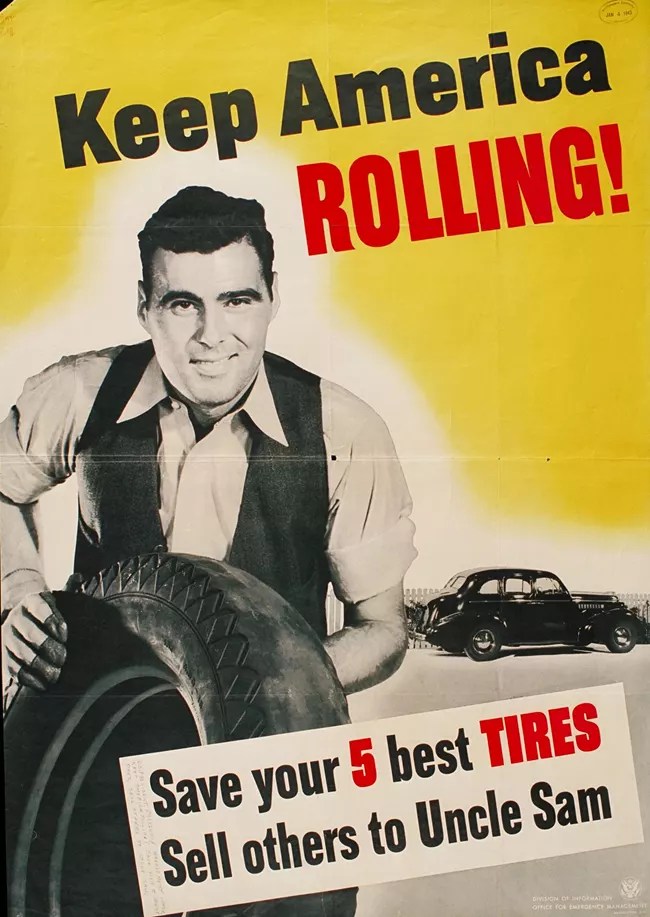
In October, after the business portion and dinner of the Wellfleet Board of Trade meeting, Wellfleet citizens were invited to watch three war films. It was still too early for the Frank Capra propaganda films of the war; the films that night covered life aboard a U.S. submarine, the life-giving properties of vitamins, and how a modern bakery makes bread. At the meeting, the Board of Trade appointed someone to keep a card index of all those serving in the military and voted to give each one a subscription to the Provincetown Advocate for Christmas.
Late October brought good news: the scallops returned to Wellfleet, and there was “hard cash” coming into town from the 15 boats engaged in the business, with eleven boats carrying two men each, and four boats with one man. Each man was allowed ten bushels per day. George Rogers handled gas rationing at the Town Hall and reported the numbers.
There were two warnings about rationing and dim-outs: beginning in late November, sugar rationing books would be used for coffee rationing, and new regulations would be announced requiring painting or taping the top half of your automobile’s headlights. Perhaps for those complaining about the coffee rationing, the rationing board said, “Our sailors risked their lives bringing coffee to us from South and Central America.”
In the November 3 election, Wellfleet voted overwhelmingly in favor of Governor Saltonstall’s third term. The voters also kept the town “dry” by voting No on three referenda to license all liquor, beer, and wine. They voted against referenda on horse and dog betting. But they voted for birth control, a referendum that exempted “certain contraceptive activities” from criminal penalties. However, the state of Massachusetts voted down the birth control referendum.
On Saturday night, November 28, Boston’s Cocoanut Grove fire occurred, killing 492 people. Private John Curtin of Eastham, stationed at Camp Edwards, had taken his wife there; she went to the powder room, they were separated, he escaped, and she did not.
On the night of December 3rd, gale-force winds came up, beaching two of Wellfleet’s scallop boats.
A practice blackout was announced for some time between December 4 and 8. The signals were reviewed ahead of the event so people would remember what to do. The “Alert” was three short siren blasts, followed by one long siren blast. The “Alarm” was a short signal for three minutes. The “All Clear” was a long blast, or the tolling of bells. Simultaneously, at this event, Army troops in vehicles dressed in field uniforms and helmets would “feign destruction of vital installations protected by State Guardsmen.” The actual event occurred at 6:30 am on Sunday, December 6. Lawrence Gardinier pronounced the Wellfleet event as successful. Mr. Gardinier, aided by the Army, chased a “paratrooper enemy” to the Eastham line. Mr. Kemp handled two other unspecified events.
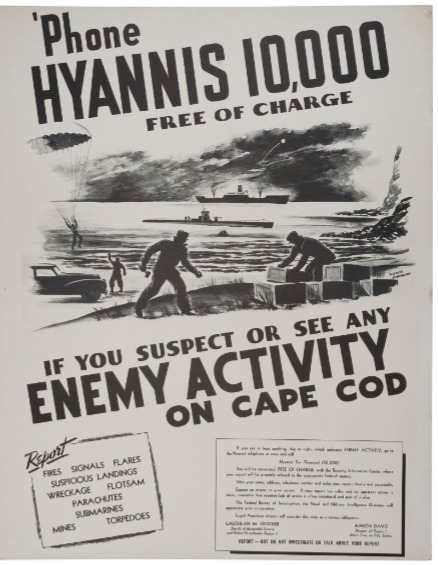
In mid-December, the regional director of the Cape and Islands Region 7 civilian defense area announced that a new phone number, Hyannis 10,000, was available for reporting any enemy activity. There would be no charge for the call. Residents were warned not to report morals, personal feuds, or short weight on pork chops, but to report fires, signals, flares, suspicious landings, wreckage flotsam, parachutes, submarines, mines, or torpedoes. They were warned not to investigate, just report, and not to talk about it. The reporting system was captured in a poster, pictured below. (One of these posters sold for $2300 in 2023.)
The year ended with a major snowstorm that stranded some Wellfleet residents in “outlying” areas. Jack Hall used a horse and sleigh to move his wife and young child off Bound Brook Island. The Cahoon Hollow Coastguardsmen rescued families isolated in the north Wellfleet woods, bringing them to Gull Pond Road. Edwin Dickinson had to walk two miles with a sled to get supplies. This storm story was featured in numerous Massachusetts newspapers.

 South Wellfleet, Massachusetts