
This is the seventh post in a series about life on the Outer Cape during World War II.
The new year, with the country now at war, brought a measure of seriousness to life on the Cape. While the economy had eased from the last decade of economic depression, it was now time to help the civilian defense effort, cope with rationing, and make do with what you had. There seemed to be more wedding announcements scattered throughout the local newspapers. The young men, and eventually young women, serving in the military were reported as they were called up and then assigned. Later, their letters home became news stories.
The Battle of the Atlantic entered full swing, with many German submarines (U-boats) on the prowl to destroy the shipping supporting the British in their war effort. In the first half of 1942, over 400 ships were sunk. There are many accounts of the Battle; I found Michael Gannon’s 1990 book Operation Drumbeat particularly helpful. Here is a review.
Our government actively suppressed news of the extent of the U-boat attacks and casualties to maintain public morale and to hide the Navy’s initial inability to protect shipping. Over the early months of 1942, the convoy system was strengthened, forcing the U-boats back into the mid-Atlantic by late in the year. Eventually, the U-boat codes were penetrated, more air defenses were deployed, radar was further developed, and the United States was able to build ships to replace those destroyed faster than ever. The Battle was won in 1943.
The Battle of the Atlantic was reflected in actions regarding blackouts, dim-outs, and other civilian defense efforts along the Eastern seaboard. While the Navy protected offshore, the U.S. Army was responsible for protecting the homeland, so many orders to the citizens of the outer Cape came from them. The Coast Guard at the various outer Cape sites often carried out the orders. All the Cape Cod ham operators were ordered to cease broadcasting.
In January, The Barnstable Patriot wrote with wonder about the “electric brain” machine used by the First Army Corps in Boston. The machine was fed cards 6 inches long and 2 inches wide, and it kept track of every soldier and his information, including skills and assignments.
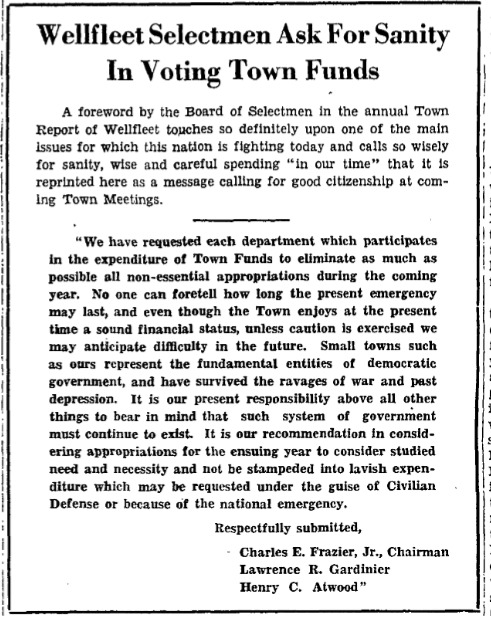
The Wellfleet Town Meeting on February 9th would be one with no new expenditures, with a few items related to property changes for road establishment. The three Selectmen published this appeal:
The American Legion was collecting old license plates; you could bring them to the South Wellfleet gas station or to Nickerson Lumber. Frazier complained that the telephone company was charging a monthly fee for the phone line the town had to install for civilian defense reporting. The annual meeting of the Massachusetts Selectmen was held in Boston. Wellfleet won the second prize for excellence of its Town Report. There was a special page in the report featuring a sketch of the new Town Hall, which the three selectmen paid for themselves.
The Wellfleet Board of Trade held its monthly meeting at the Congregational Church, with an excellent pot roast dinner prepared by the church’s ladies. Also invited were the 34 men of the Army Signal Corps, working at “High Head,” who were being housed at “Fort” Holiday House. President Austin expressed the town’s great concern about the upcoming season, mentioning the rubber shortage and the negative publicity surrounding the “submarine scare.”
Selectman Frazier spoke about the need for stronger advocacy for the return of passenger rail service. (Passenger service on the Cape has been in disruption since the 1935 bankruptcy of the New York, New Haven and Hartford Railroad, which had taken over the Massachusetts lines of the Old Colony Railroad, tried to shut them down, but was under orders from the Supreme Court to keep operating.) Frazier spoke of Wellfleet as an ideal place for women whose husbands were in the military to bring their children for the summer. Frazier, the Santa stand-in, thanked everyone who had donated to the Christmas party for 200, which made the cost far less than the previous year.
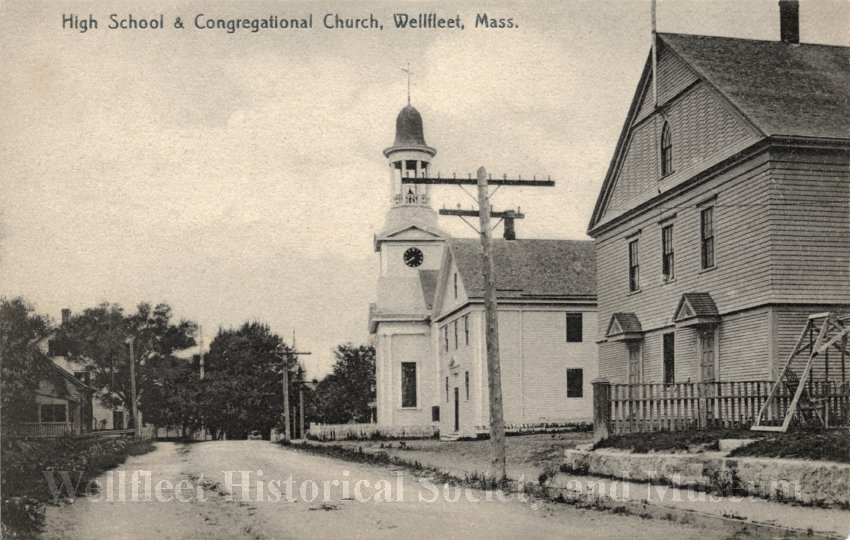
The Army Signal Corps men were asked how the town could help make their stay more enjoyable, and they requested that the movie theater be reopened. They would even pay full price. Henry Atwood, the owner, spoke of the trouble in priming the theater’s pump. Board of Trade members were encouraged to buy a few tickets each to help with expenses. The theater was in the old Lyceum building, next to the Congregational Church, pictured here.
Near the end of January, another meeting for representatives of several outer Cape towns was held at Wellfleet’s American Legion Hall to discuss railroad passenger service. There was a suggestion made that the towns consider a “railroad buggy,” a gas-powered railroad car to move passengers a short distance. As it turned out, service was not restored beyond Hyannis, and passengers had to switch to a bus to reach the outer Cape. There were five buses a day from Hyannis to Provincetown, the trip taking about two hours.
Late in January, at an event for 200 people at Wellfleet High School, 107 graduates of Civilian Defense courses were awarded their certificates. There were 23 Air Wardens, 17 for the Canteen Course, several for Motor Corps, and the remainder for Red Cross training. The instructors received a cash award and a handmade silver pin. The High School band played, and coffee and cake were served.
The Canteen volunteers made a chicken pot pie supper for the men at Holiday House, and then brought them to the high school basketball game, followed by a dance. The soldiers were also invited to an Open House at Mr. and Mrs. Cyril Downs’ home.
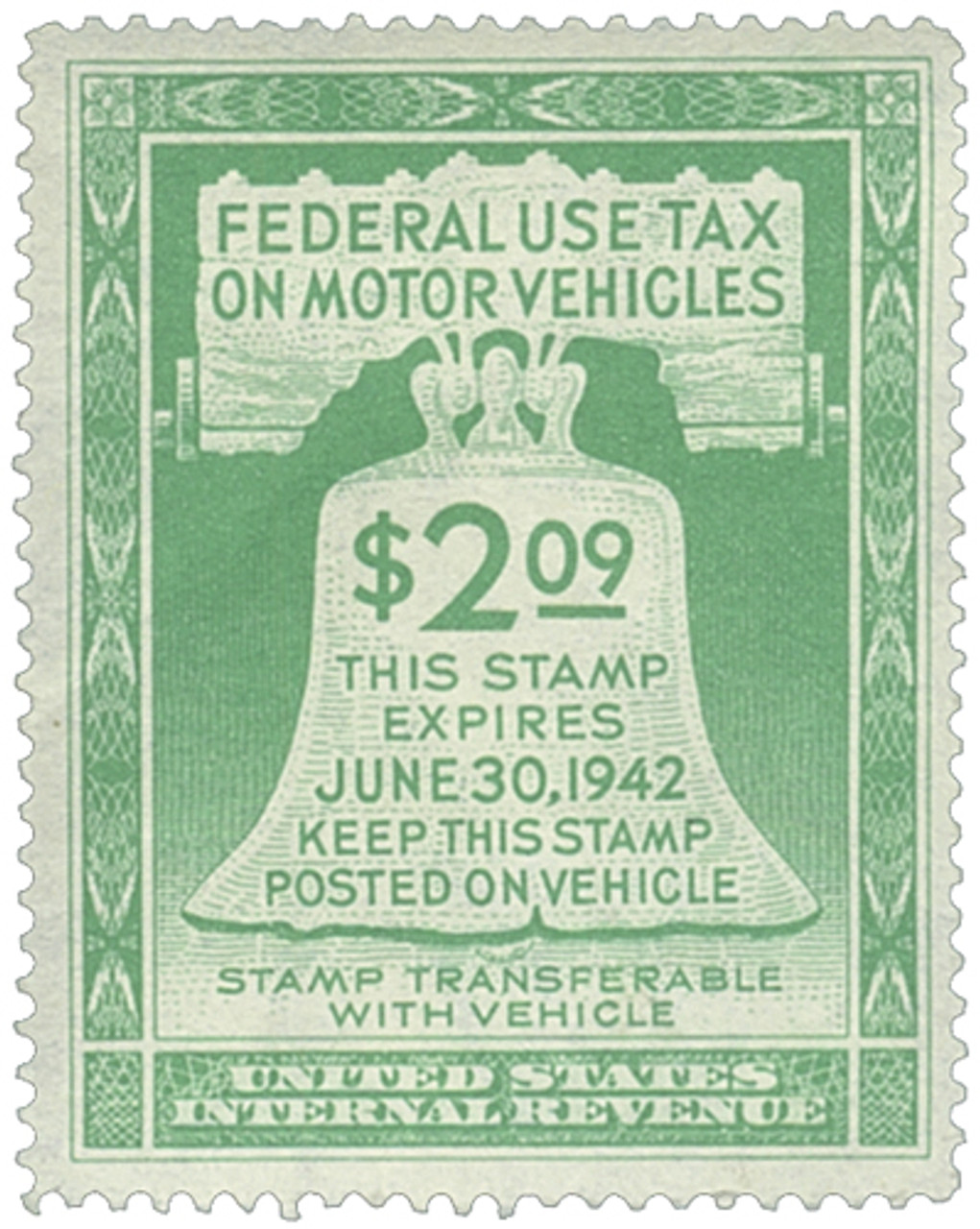
Before the end of January, many Wellfleet citizens went to the post office to buy their Car Tax Stamp, a green stamp that they paid $2.10 for, to display on their windshield or dashboard. The stamp covered the period from February to June 1942, and on July 1, the start of the next fiscal year for the federal government, the tax would be $5.00 for the year. This was a war tax for vehicle owners using public roads. The $2.09 stamp is pictured here. An additional one cent was used to send a postcard to the IRS to report the owner’s name and vehicle identification.
The State Rationing Administration announced that Provincetown, Truro, and Wellfleet would get one passenger vehicle tire each in February, a 30% reduction from January. Wellfleet and Truro would each get one truck tire, while Provincetown would get six. Drivers were warned not to speed, to save gas, and to take care of their tires.
At the February Town Meeting, it took extra time to assemble a quorum, and three teachers had to be brought over from the school. The 66 voters approved $71,588 in appropriations for the town and approved a slight decrease in the tax rate. There was the usual dinner at noon, and not much left to do after it. They voted to continue spending $1,000 per year to finish mapping the town because the process was identifying taxable property that was generating income. The town was described as encompassing 15,000 acres. (Today’s description of the town puts it at 13.200 acres of which 8,000 are in the National Seashore.) The Town Hall rebuilding was declared completed, and doing something with the second floor would have to wait until after the war. At the election a few days later, Frazier was re-elected with a wide margin, the only contested position.
The Board of Trade meeting discussed the train issue again; Frazier reported that there would be a daytime “Cape Codder” from New York to Hyannis, but no nighttime train. He was hopeful that the bus service from Hyannis to Provincetown would be improved; later, a schedule of five buses per day was established. The trip took about two hours.
Some of the machines at the Wellfleet curtain factory have been making bandages; Frazier wished for more defense work for the town, but machines to do the job are tough to get.
Mrs. Worthington of Fish Net Industries in Truro has started making fish net shopping bags called “Cape Cod Carriers” for women to save on paper bags and wrapping. They were on sale at Saks Fifth Avenue and Macy’s in New York.
The third Selective Service registration took place at “Boy Scout Hall” in Wellfleet on February 16th.
It was announced that Mrs. Downs and others have established a serviceman’s club on Main Street< on the “Freeman block.” In South Wellfleet, a legacy gift was made to the Library to purchase non-fiction books.
The Barnstable Patriot announced “The Cape Cod Plan” to promote a national spiritual awakening. Supported by Protestant, Catholic, and Jewish religious leaders, the Plan called upon individuals to pray in the morning, at noon, and in the evening, the following seven words: “Father thy will be done through me.” The Patriot also warned against criticizing the President, noting that he was the Commander-in-Chief to their sons, and they must respect him in order to serve their country.
The first “Practice Blackout” took place on Sunday evening, March 15th. The siren warning began at 10 pm, when all street lights were extinguished, and cars pulled over, turning off their lights. The all-clear sounded a half hour later. It was announced that a second practice would occur on April 7 at an unannounced time. During the April blackout, Wellfleet had five “incidents” to handle: three locations in town were bombed, and two cases of looting happened in two places, which civilian defense workers had to address. Frazier reported that the event was handled perfectly.
There was unease over an incident in which several windows at the Provincetown Light and Power plant were broken, a plant that had recently been placed under Coast Guard jurisdiction. Rumors circulated that it had been shelled, and even the Boston newspapers took up the investigation.
Word was out that gas rationing was coming, and the concern over summer tourism heightened. Wellfleet’s Frank Shay, now working in Washington for the government, reported that an authority had told him that cars on the road would diminish by 15% by October.
Mary Heaton Vorse was upset by The New York Times’s review of her new book, Of Time and The Town, in which Provincetown was described as having gone from a fishing village to a place of lawlessness, art, and literature.
People were advised on how to prepare a blackout room in their home with enough light so that basic functions could be carried out. There should be enough light to read or sew. Homes should have a light on the way to the basement so that the furnace can be tended.
The Town Hall flagpole was re-dedicated in Wellfleet. The pole was one that the town had dedicated earlier, near the old town offices. Selectman E.P. Cook had donated it, a mast salvaged from the 1912 wreck of the Quonnapowett off Wellfleet. The pole was moved to the new Town Hall, and Mr. and Mrs. Lawrence donated a new flag. The Lawrences were a retired couple living in Wellfleet, where Mary K. Lawrence’s father, Benjamin Witherell, was born.
In a move toward gas rationing, gas stations were limited to 72 hours per week; stations on the Cape were allowed to open on Sundays to accommodate visitors who might need to fill up before returning home.
In April, the Boy Scouts on the Cape participated in a Cape-wide practice of the age-old courier system, carrying a message from Provincetown to Camp Edwards in teams of two.
Orders finally came from the Army in late April that all homes and street lights visible from the water are to be blacked out under regulations designed to protect shipping that is in danger when silhouetted by shore lights. Initially, some thought the order referred to homes facing the ocean and not the bay. The Army clarified: if you can see the water from a window, that window must be blacked out. All outdoor signs were extinguished, and all street lights were dimmed or shielded.
The Coast Guard put out a warning to fishermen that objects found floating could be explosives and should not be picked up. Divers salvaged a sunken merchant ship near the Cape Cod Canal, retrieving cargo from India, including Persian lamb skins, Indian rugs, coconut and lemon oil, and badminton sets.
Sugar rationing began for commercial users in April, and for household users by May 1st. Every family had to register to receive Ration Book One of 28 stamps, which allowed one pound of sugar every two weeks. This was the country’s first rationing of a commodity.
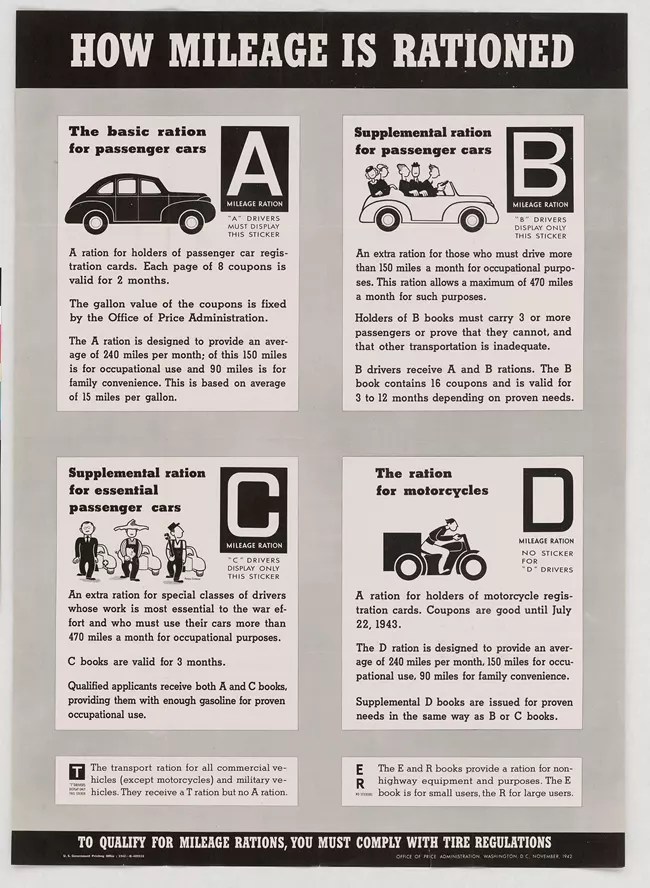
In the middle of May, gas rationing began on the East Coast, a result of the U-boat sinking tankers that brought fuel from the Gulf of Mexico; the government hoped to buy time to establish overland delivery systems. By December, the whole country would be rationing gas. Cape Codders applied for gas rationing cards; the categories were A for most motorists allowing 3-4 gallons per week; B with sub-categories for essential war workers and those sharing the car with three passengers, allowed eight gallons per week; C for essential workers such as doctors, clergymen, police officers and civilian defense workers, allowed unlimited amount; and D for VIPS and other important person, unlimited gas.
The Provincetown Advocate reported the number of Wellfleet residents who signed up, along with their categories; no Cs reported, but many Xs. Perhaps there was a mix-up. The numbers show how many cars were owned in Wellfleet at this time. Wellfleet A Cards: 58; 86 B cards, and 43 mysterious X cards with a total of 187. However, because there was no gas source in Wellfleet Harbor, some of this reporting may have covered obtaining gas for fishing boats.
Meat, coffee, and shoes would be rationed later in 1942 and in 1943.
On June 4, 1942, an event occurred at the Nauset Coast Guard Station that remained secret until after the war ended. A lifeboat with 20 men, exhausted and windburned, arrived after entering Nauset Inlet. They were from a British freighter, Mattawin, that had been torpedoed on the night of June 2, one of four lifeboats that got survivors to safety. The Coast Guard cut off all public contact while the men were cared for by local doctors and Red Cross workers who were sworn to secrecy. Nautical historian Eric Wiberg wrote about the event here.
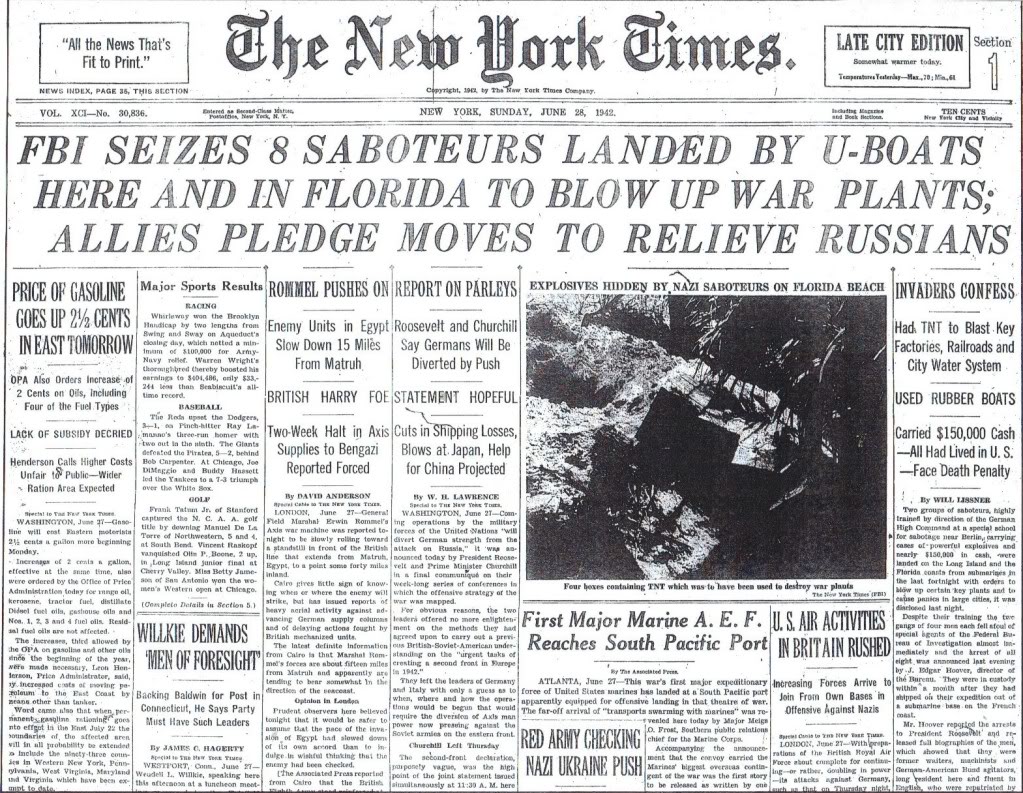
Then on June 12th, four men left a German submarine in an inflatable and rowed to shore, landing near Amagansett on Long Island. By late June, the story was in the national news; the details are here. The fact that German spies had actually landed on the East Coast surely must have increased the actions of the U.S. Army in protecting the homeland, as actions for the remainder of the year would demonstrate.
In mid-June, Charles Frazier left Wellfleet for Quonset Naval Station in Rhode Island, joining the U.S. Naval Reserve as a lieutenant in naval aviation, intelligence division. Admiral Turnbull of Provincetown had already been reactivated in the Navy. Truro’s fire chief and head of the Outer Cape Ambulance, Richard Magee, rejoined the Army Air Corps. He had been a pilot in the First World War.
An Eastham citizen, Warren Wilson, was reported as a casualty in mid-June; a torpedo hit his ship in the Caribbean. A Truro man, a Colonel in the Army Air Corps, was killed in the Far East.
The Provincetown Advocate announced that the U.S. Navy would be taking over the Provincetown Inn for Coast Guard training for 150 men. Both Provincetown and Wellfleet put out the word to collect the names of everyone serving in the military so that “walls of honor” could be created in each town before the upcoming Fourth of July celebrations.
The Wellfleet Board of Trade meeting in June was indecisive about planning events, as they thought hardly anyone would be there to participate. They finally decided to hold the Fourth of July parade and a formal dedication of the Town Hall, since the South Wellfleet Neighborhood Association had designed a plaque detailing the building’s history, and left a decision about the Town Fair for later.
On June 25th a significant event took place in Provincetown. The Provincetown Advocate reported the day’s events in great detail. Shortly before 7 am, the Civilian Defense Chair got a call from the Coast Guard to stand by for survivors coming ashore. All Civilian Defense workers, auxiliary police, doctors, and others trained in First Aid in the area were ordered to their posts. A hotel owner in the center of town opened his accommodation as a place to shelter the rescued people. The workers prepared the quarters, warmed sandbags, made soup and coffee, and assembled clothing items.
The event had happened “off the Back Shore” at around midnight, the night before—people as far south as Eastham had heard the explosions and seen bright flares. A “nest” of U-boats had torpedoed an American freighter and a passenger ship (unnamed). There was a loss of 94 men, including 14 American soldiers.
People came from their homes in Provincetown to watch the operation, standing grimly quiet.
From the late morning through the afternoon, ambulances, some created from beach wagons and trucks, brought the survivors from the wharf to the hotel. Late in the afternoon, Army, Navy, and Coast Guard officers assembled, and the bodies of two soldiers were brought in, placed in ambulances, and taken to undertakers. A group of additional ambulances was assembled, but there was no report of additional bodies.
The head of the Provincetown Civil Defense wrote his report, and it was printed in the newspaper with only a few redactions. He thanked the large group of volunteers who helped that day; the Canteen head, Mrs. Baumgarten, worked from the morning of the event until 2 pm the following afternoon.
This was the first Civilian Defense unit in the United States met the actual challenge of war.

 South Wellfleet, Massachusetts