
World War II began as the summer of 1939 came to a close; Germany invaded Poland on September 1, and on September 3, Great Britain and France declared war on Germany. Within days, Australia, New Zealand, and Canada were also at war. The war with Italy was not declared until June 10, 1940.
In Washington, Roosevelt immediately stated the United States’ neutrality and asked Congress to repeal the arms embargo and amend the Neutrality Act. By November, the “Cash and Carry Act” was enacted, allowing warring nations to purchase arms for cash but requiring them to transport them in their own ships.
The Battle of the Atlantic began, with German U-boats hunting down merchant ships to destroy the supplies, food, oil, and war material that the Allies needed to fight the war. Roosevelt declared that the U.S. Navy was on “Neutrality Patrols” and was ordered to report sightings of German U-boats. It would take another year for the U.S. to arm its merchant ships and fully end neutrality.
A few days after the war began, news reports heightened unease about activity in the Atlantic. A fishing trawler off Georges Bank reported seeing a large airplane with a German swastika clearly visible. There were reports of the number of Allied ships that German U-boats had sunk. There was a flurry of excitement in Orleans when two life buoys marked “Bremen” washed up on a beach. The German passenger ship had been ordered to leave New York and return home.
The Massachusetts National Guard began recruiting for the Coast Artillery Corps, with plans to establish a “military reservation in Bourne.” The Daily News in New York wrote about the possibility of the Germans setting up a submarine base off Martha’s Vineyard, a place that would be able to provide fuel and supplies. The United States was losing its sense of being impregnable. (It wasn’t until 1975 that an early 20th-century German plan to invade the United States, using Provincetown as a base of operations, would be revealed.)
Other news stories addressed the possibility that communication in the U.S. would need to be controlled and that the new medium, radio, would have to be included for the first time.
In mid-September, the Provincetown Advocate reported that the U.S. Navy and U.S. Coast Guard were investigating a mysterious vessel sighted near the Pollock Rip Lightship off Chatham, the east entrance to Vineyard Sound. It turned out to be the U.S. submarine Sea Dragon, undergoing trials out of Provincetown. The sighting was part of the new Atlantic patrols; in these early days, some coordination appeared to be lacking. The submarine trials in Provincetown continued, as reported in the Provincetown Advocate, with information provided by Mrs. Davis of Bradford Street, whose home hosted the Navy Trial Board and Electric Boat Company officials when they were in town.
The Advocate also reported in early October that two Navy destroyers had been at anchor at the entrance to Provincetown Harbor for two days, identifying them as the 395 and 397. The paper had not been able to learn whether they were part of the new patrol being established in the Atlantic. Formal censorship of war-related information would not be put in place until after the attack on Pearl Harbor. It took a while for “loose lips sink ships” to be a guideline.
After the war, The Cape Codder would characterize the war years on the Cape as a time when Cape Codders lived in a state of siege with “all kinds of hush-hush activities going on in the inner and outer waters of the Cape.”
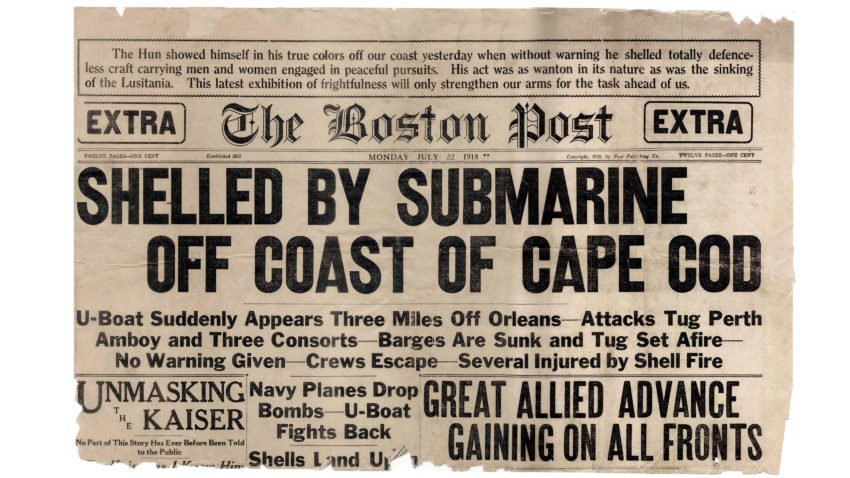
By late September, newspapers around the country were reminding Americans of the U-Boat incident off Orleans, now known as Nauset Beach, in July of 1918, when a U-Boat fired on a tugboat and barges, bringing the war to American waters. Chatham Naval Air Station sent two planes to bomb the sub, but it had submerged and disappeared. The wounded were brought to the Nauset Coast Guard station and then transported to hospitals in Boston.
An editorial in the Advocate welcomed FDR’s declaration of neutrality and appeared to try to soothe people with a prediction that Germany was in a bad economic shape and that the German people were against the war, so it would not last long —perhaps two years if “the French fight a defensive war.” Later in the month, the editorial focused on consumer goods, urging people not to worry or stockpile, as there were plenty of supplies available. It appears that some people, concerned about a lack of supplies and significant price increases, had been purchasing flour, sugar, and other staples, resulting in shortages in some areas and forcing store owners to limit purchases.
Another part of the war story was the effort to get all the Americans traveling in Europe onto ships and back home. On the third day of the war, the British ship SS Athenia was torpedoed by a German submarine near Ireland with the loss of 117 passengers and crew, including 28 Americans. This brought back memories of the sinking of the Lusitania in 1918, an event that led the Americans into World War I.
In Provincetown, the Advocate reported on September 14 that the Secretary of State had informed Mary Heaton Vorse’s daughter that her mother would arrive back in the United States in a few days. Vorse had been traveling and reporting in Europe for several years. In July of 1939, she’d written three articles for The New York Times about contemporary life in Germany, their economic recovery, the surge forward, and the strain it was putting on the German people.
In October, The Boston Globe published a story about a seven-foot apparition in a black cloak, chasing children through the streets of Provincetown and setting fires. The Globe reported that this “Black Flash” appeared every fall. Two days later, the Provincetown Advocate picked up the story with a Captain Blackstrap commenting that he’d met the Flash on the road to Helltown, a fishing community that was part of the town. In fact, there was an arson scare in the town, although the Police Chief was certain it was teenagers causing the trouble. The Black Flash remained part of Provincetown’s atmosphere throughout the war.
In November, South Wellfleet residents heard howling in Paine Hollow and named their apparition “Tarzan.” The men got out their shotguns and searched for it, but it was never found, although some people thought it was a steer that had gotten loose.
These incidents were perhaps a sign of the unease that began as the war got underway.
In November, one of Wellfleet’s newest residents addressed the Board of Trade, adding an international dimension to the Board’s regular work of making Wellfleet an attractive place for business. Paul Chavchavadze was a Georgian prince who’d been a cadet at Russia’s Imperial Cavalry Academy. When the Revolution broke out, he was ordered to join the “White Army” to defend the Czar. Paul’s father had been killed by the Reds. Paul had fled to London, where he met his wife, Princess Nina Romanov, a niece of the Czar.
Paul Chavchavadze and his wife, Nina, had moved to Wellfleet from New York earlier that year, purchasing the old home of a sea captain, Aaron Rich. To fund the purchase, they used an old brooch that Nina’s grandmother, Queen Olga of Greece, had given them as a wedding present. In the 1940 census, the family also includes their 15-year-old son, David.
The Board of Trade’s evening program at the First Congregational Church was an effort to better understand the Soviet Union. Perhaps they were moved by the disturbance between Russia and Finland, as there was a small Finnish community settled in Wellfleet. At the end of November, Russia invaded Finland, taking a portion of its land, in what is now called “The Winter War.”
Chavchavadze addressed the group on the last days of the Romanovs and the importance of the Cossacks to the Russian state; he stated that the secrecy of the current government prevented him from being informed about current events. He said that he was “happy to be chopping wood in Wellfleet while Europe seems to be again going mad.”
After a reportedly excellent chicken pie dinner prepared by the church’s Ladies Aid Society, the Board of Trade turned to other matters, including the plan to have an Information Bureau in Wellfleet by the summer.
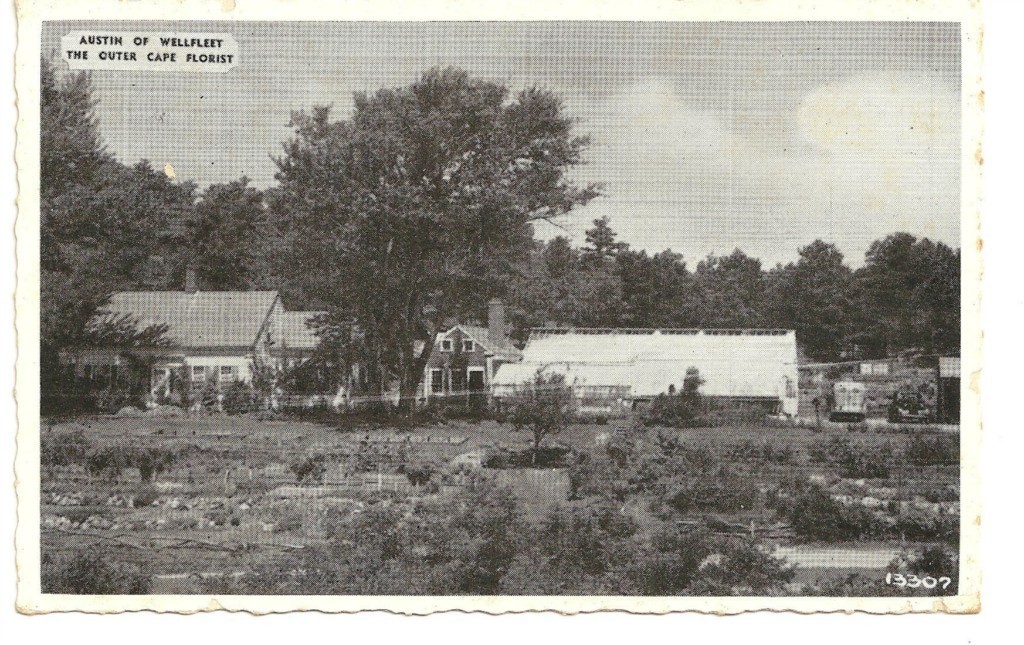
The Wellfleet Board of Trade was led by Oliver Austin, Jr., a successful Wellfleet florist who had recently opened another greenhouse and shop in Provincetown. Austin was also the ornithologist who, with his father, established the bird-banding station in South Wellfleet, which later became the Audubon Sanctuary.
In late November, Provincetown’s Police Chief received a letter from the “German Library of Information” located in New York City. In reporting this, the Provincetown Advocate asserted that it had also received regular mailings from the same source. The editor had received the German “White Book,” which asserted that British aggression was the reason the war had started in September. We now know that this agency was a part of the German government’s propaganda campaign that operated in the U.S. from 1936 to 1941 under Goebbels’ Ministry of Propaganda.
Wellfleet’s year ended with two destructive fires, one at the Floyd Atwood house and one at Louis Hatch’s house. The Atwood father and son were saved by Mrs. Atwood’s return home from a meeting, ensuring their escape from the fire. The elderly Mr. Hatch, who lived alone, was not so lucky. He died in the fire, and his home and barn near the South Wellfleet Cemetery went up in flames. At that time, the Wellfleet firemen had to run hoses over to Blackfish Creek to get water. A second issue concerning firefighting was the lack of a siren to alert the surrounding area. The Truro firemen arrived at the Hatch fire only after someone used a short-wave radio to call them.
The two fires spurred the town to get its siren reinstalled. It had been attached to the old school at the corner of Main Street, but was removed when the school was demolished.
A Cape tourist industry spokesman looked to 1940 as a successful year for the Cape, as no one was traveling to Europe. There was concern that the World’s Fair that had opened in New York in the spring of 1939 might draw visitors away from a Cape vacation.

 South Wellfleet, Massachusetts