
I’ve been curious for some time about what it was like to live in Wellfleet during World War II.
When I wrote this blog post about Camp Wellfleet, I shared the story of the family that had to temporarily relocate from their house so that the Army could conduct maneuvers on a nearby hill.
I was born during the war, so I was too young to have personal memories. My mother shared one: that during the war, you couldn’t take photos at “the Back Shore,” as she called the ocean beach, because there were military patrols there, and if you had a camera, it would be opened and the film exposed.
Another friend with a cottage on the dunes told me about the blackout shades there, still at the windows until just a few years ago.
I did not find a memoir written about those years in Wellfleet, although one may exist. Recent books about the bohemians who settled in Wellfleet have covered that time and were useful.
All of these stories made me want to learn more. How did the war and the addition of the military affect the lives of the people of the Outer Cape? I did not find anyone writing about the military activity that surrounded them. I pieced together the radar work in North Truro; most of the available material focuses on the 1950s rather than the war years.
Books and articles about “the Home Front” help explain the many government rules people had to follow in their day-to-day lives.
Since the war, there’s been a lot written about the Battle of the Atlantic, which affected Cape Codders, if not directly, then at least by causing unease about the possibility of an invasion.
Newspapers, thankfully digitized and online, were my primary source. I used The Barnstable Patriot, which regularly reported on town meetings and the military service of local young men. I could not find an online archive of The Cape Cod Standard Times, published from 1936 to 1975, though some microfilm is available at the Falmouth Public Library. There was some coverage of the Outer Cape in The Standard Times (New Bedford) that was available to me in the database newspapers.com. The Cape Codder did not start publication until 1946.
The Provincetown Advocate was the best source for reporting on the Outer Cape towns, from Eastham to Provincetown. The paper provided details of how the towns coped with the military presence, shortages, and the effort to provide for those fortunate enough to spend their summer vacation on the Cape. I was sadly surprised by the number of deaths in the Outer Cape area of young men in military training, events that the paper reported regularly.
During the war years, I also sensed a change in Wellfleet’s zeitgeist as the town of fewer than 1000 residents (1940), a fishing village, added layers of people from different walks of life. Bohemians, writers, artists, and intellectuals who may have moved to Provincetown earlier settled in Wellfleet. Different political views were expressed. There were a few immigrants, some exiles from other places in the world.
Over these years, town improvement projects were developed, and the town became more dependent on the tourist and summer-resident economy. The stage was set for the economic development of the 1950s.
I’ve widened my focus here, from South Wellfleet to the Outer Cape, Eastham to Provincetown, with a mention of Orleans if I found something of interest. Since I used the Provincetown Advocate, I learned a lot about that town; someone could write a book about the war years there. While I try to stay focused on Wellfleet, other towns get a mention when I find something interesting. Provincetown was much larger than Wellfleet and Truro, and so had much more to report.
I decided to organize this by year, starting in 1939, when the war broke out in Europe, and ending in 1945, when the war ended. Rather than summarize each year, I decided to report activities and events month by month, adding in war-related events as they happened. Each year is divided into two parts so that no one post will be too long. There were only a few contemporary photographs to share, so I added images of contemporary advertisements and movies.
PART ONE: 1939. WELLFLEET DURING THE WAR YEARS
World War II began in Europe in September, so I’m starting my Wellfleet war years project at the beginning of that year.
As the 1940 federal census will show, Wellfleet had 890 residents. It was heavily Republican, with 660 registered voters. Organizations were important: the churches, the Chequessett Grange, the Masons for the men, the Order of the Eastern Star for the women. Men also had the American Legion and the Highland Fish and Game Club, covering both Truro and Wellfleet.
Wellfleet had a Board of Trade, formed in 1937, and a group of summer residents called Wellfleet Associates, formed that year, to allow these property owners to express their views about the town. One of the first requests they had was to have the town name more roads. The South Wellfleet Neighborhood Association (SWNA) was also formed in 1937.
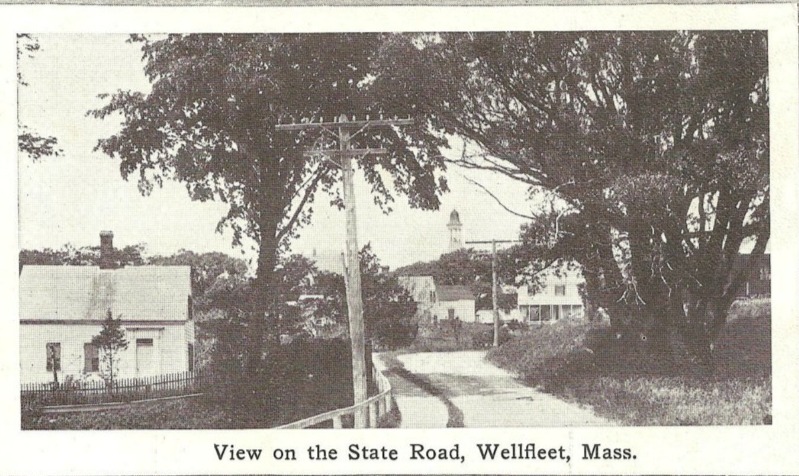
Whist parties were popular, and at many meetings, full meals were served, prepared by Wellfleet’s hard-working women. In the summer of 1939, Wellfleet Associates had a dance at Legion Hall, today’s Left Bank Gallery, where many gatherings were held. The SWNA had a card party at the recreation room at Cook’s Camps at Dallinger Heights, the old name for the hill near LeCount Hollow beach.
Scallops were more important than oysters in 1939, reflecting the change that had happened in the 1920s. In the summer of 1930, an effort was made to form a local cooperative to stabilize scallop prices, rather than have each shellfisherman sell to out-of-town buyers for whatever price was offered. The project never moved forward.
The Barnstable Patriot printed an article in 1939 about all the Cape Cod beaches. Wellfleet’s new beach on the harbor front (today’s Mayo Beach) was highlighted, along with mentions of Town Landings at Commercial Street, Indian Neck, and one near the Chequessett golf links. There were landings at freshwater ponds, and at several points where “town ways touch the ocean” on the back side of the Cape.
Another 1939 article in the Patriot named the “villages” of Wellfleet: Briar Lane, Great Beach Hill, Great Island, Griffin Island, Lieutenant Island, Money Hill, Pamet Point, Pucker Town, and South Wellfleet’s Spring Valley. An advertisement in The Provincetown Advocate offered 500 acres for sale on Great Island. The historian at the Wellfleet Historical Society and Museum found one reference to Pucker Town, which placed it in South Wellfleet, but there was no reference as to where.
Lawrence Gardinier was re-elected as a Wellfleet Selectman in 1939. Born in 1900, Gardinier had grown up in Wellfleet. In 1913, his father, George Gardinier, murdered his mother, Agnes, in her family home above the grocery store. The father had served some time in prison previously, convicted for smuggling Chinese immigrants into the country, and his wife had divorced him. After his release from prison, he came to Wellfleet hoping to be reunited with her, but she had declined.
The now orphaned Lawrence was taken in by the Taylor family. After serving in the Navy in World War I, he returned home to Wellfleet and married one of the Taylor daughters. He was first elected Town Moderator in 1936, after leading Wellfleet’s American Legion post since the 1930s, when the American Legion Hall was built on Commercial Street.
Gardinier is remembered today for his installation of the Town Clock, which tells the time on the hour and the half-hour in ship’s bell time. Wellfleet named the junction of Main Street and Holbrook Avenue “Lawrence Gardinier Square.”
1939 was the beginning of Charles E. Frazier Jr.’s political career. He defeated Charles Rich for the position of Selectman in February 1939. He was 30 years old and lived with his parents, Hattie and Charles Sr. His mother was a member of the Wellfleet Holbrook family, and his father was Canadian, from Nova Scotia. Frazier was educated in Boston at Boston College, where he received both his undergraduate and law degrees. He was a practicing attorney in Wellfleet.
Frazier’s work for the town before the war and his military achievements during the war led the citizens of Wellfleet to hold him in high regard. Much later, Frazier would be characterized as “controlling the town,” like a Tammany boss. He served as Selectman for 22 years, Town Moderator for almost as long, and Legal Counsel for 40 years.
It was a very cold winter in 1939, since the news reported that Captain Simon Berrio and his crew of the dragger Marion had to break up the ice in Wellfleet Harbor to clear the channel so that the fishermen could leave for their fishing grounds. The news also reported that the Town Meeting in February was brief, with $66,173 appropriated for the coming year. The schools were the most expensive, at $15,555, while the police were funded at $300. There were no police officers, as one of the Selectmen served in that capacity.
Mr. Frazier made news a couple of times in 1939 as he pushed the state of Massachusetts to finish the widening and paving of Route 6, which had been improved as far as “near the Wellfleet/Eastham Town Line.” The bumpy, curvy old road ran right through Wellfleet, taking a sharp turn to the left at the end of Main Street, today where Main Street, Holbrook Avenue, and West Main Street meet. The state advertised a contract for the roadwork in March but had to re-advertise in October. The Governor’s office had delayed the process for unspecified reasons.
On that corner stood Wellfleet’s old elementary school, which was condemned by a building inspector in 1937. After securing state permission, the town financed a new school in 1938, built on the hill on Long Pond Road, where it stands today. In the meantime, the students had to be housed in temporary classrooms around town.
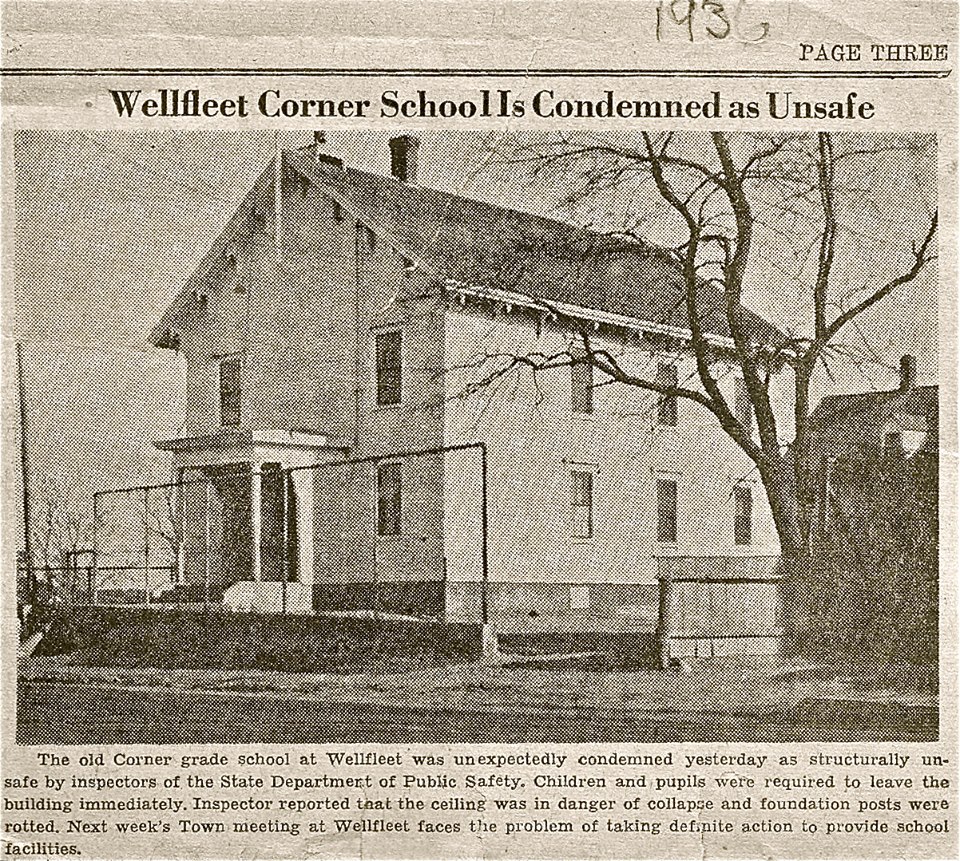
, image provided by Wellfleet Historical Society
In the Spring of 1939, the lieutenant governor came to dedicate the new school, and that fall, the first students began attending it. As the 1940 census shows, there were approximately 80 school-age young people in Wellfleet.
Summer resident Phoebe Atwood Taylor, a member of the Wellfleet Atwood family, was a popular mystery writer whose books were serialized in newspapers across the country. Her Asey Mayo character was a plain-speaking Cape Cod fisherman who solved crimes.
The South Wellfleet Neighborhood Association announced plans to place a new marker at the site of Marconi’s Wireless Station, replacing a crumbling concrete slab.
On Memorial Day, 1939, an annual ceremony was held at the South Wellfleet Cemetery. Later, the news reported that the cemetery had been “desecrated” with headstones broken, as “motorists used the shell-paved avenues as speedways.”
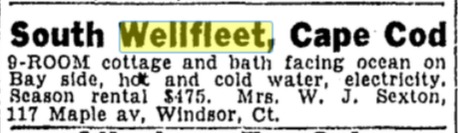
In the summer of 1939, the Wellfleet Board of Trade, the Wellfleet Associates, and the South Wellfleet Neighborhood Association held a joint meeting where the outlines their goals for the town: establish an Information Bureau to assist visitors, establish a new assessor’s survey map, establish a comfort station at the bathing beach, gain better control over gypsy moths and tent caterpillars, organize a town meeting in the summer, move the old church on Main Street, now called Colonial Hall, back to South Wellfleet. The SWNA sought a new directional sign to the Marconi Wireless site. The Wellfleet Associates wanted rubbish barrels set out around town.
In August, the Coast Guard celebrated the 150th anniversary of the Lighthouse Service, welcoming visitors to all the lighthouses: Highland (1798), Race Point (1816), and Wood End and Long Point (1827).
The Truro Neighborhood Association celebrated the restoration of the Old South Truro Meeting House.
The Provincetown Advocate reported proudly in August that Sinclair Lewis, the distinguished American author who wrote his first book while in Ptown in 1911, was at the Wharf Theater, rehearsing a role in the O’Neil play “Ah, Wilderness.” Lewis’s cautionary tale “It Can’t Happen Here” had been published in 1935.
In May, the Provincetown Library removed the works of John Dos Passos, allegedly at the request of the Catholic Daughters of America, because the books were judged to be “radical and obscene.” Later, the organization stated that only one of its members had requested the removal, and the Library clarified that only the Trustees could remove a book; Dos Passos’ books had been placed on the reserved shelf. Do Passos lived in Provincetown and later in Wellfleet.
Provincetown’s Catholic Daughters also sponsored a motion for the March special town meeting that everyone show “common decency in costume in public places” by forbidding the wearing of shorts and halters. The issue received widespread public attention and ridicule in newspapers across the country.
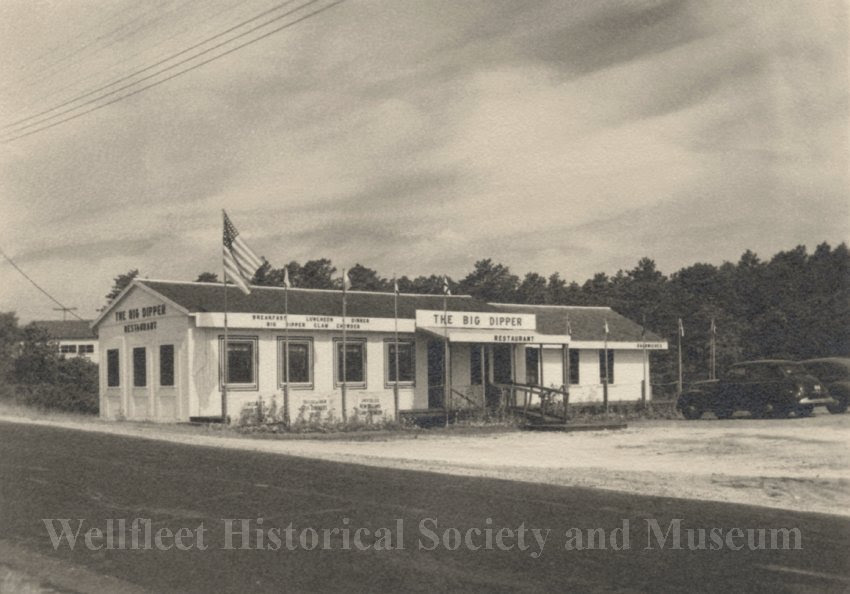
Also in the Spring, Lancaster Clark announced that he had purchased the Adams House, located on Route 6 in South Wellfleet. The restaurant dated back to 1918, and was described as a “former rendezvous of famous Provincetown painters, writers, and actors.” The restaurant’s name was soon changed to “The Big Dipper.”
The Fourth of July celebration in Wellfleet included a bonfire and a dance the night before, a morning parade on the Fourth that featured a Coast Guard delegation, the American Legion, and members of the Board of Selectmen. The Chairman of the Parade dressed as Uncle Sam, and Mrs. John Daniels appeared in a Statue of Liberty costume. Wellfleet schoolteacher Martha Porch dressed as Mrs. Washington, and Mr. Kemp was George. There were sports and swimming events at Mayo Beach in the afternoon. In the evening, the high school band held a concert followed by a fireworks display.
In the background of 1939 was the state of the world: aggression in Europe with Fascist Italy and Nazi Germany, and the beginning of World War II in Asia, as Japan was already at war with China. In his January State of the Union address, President Roosevelt called for strengthening the military and other American institutions. He submitted a $550 billion budget to Congress, which was later adopted.
Several news stories in 1939, before the war began, signaled the impending expansion of military activity on the Outer Cape. In February, work commenced on the reconstruction of the Cape Cod Canal, widening it from 315 to 480 feet and deepening it to 32 feet. The Canal would become a crucial element in moving merchant ships and oil tankers from the United States to Great Britain, keeping essential products flowing to the British.
In the Spring, there was a brief announcement of plans for a National Guard Camp in North Falmouth. This marked the beginning of Camp Edwards’ development.
In January, in Provincetown, the business community responded enthusiastically to the possibility that the U.S. Navy would build a naval base there. The businessmen also believed that constructing a large anchorage and parking for 300 cars would help develop tourism in the town and attract wealthy yacht owners. Later in the month, the local V.F.W. chapter sent a letter to Congress, detailing the advantages of the protected harbor for Naval training, a place of refuge, and a useful base, if needed, against German submarine activities.
For several years, Provincetown had been the site of testing newly built submarines. The submarines were brought there from the Electric Boat Company in Groton, Connecticut, and underwent a trial run. Provincetown was the site of the loss of the S-4 submarine in 1927, when 34 men were lost in the sunken submarine in the harbor, an event that is still commemorated every December.
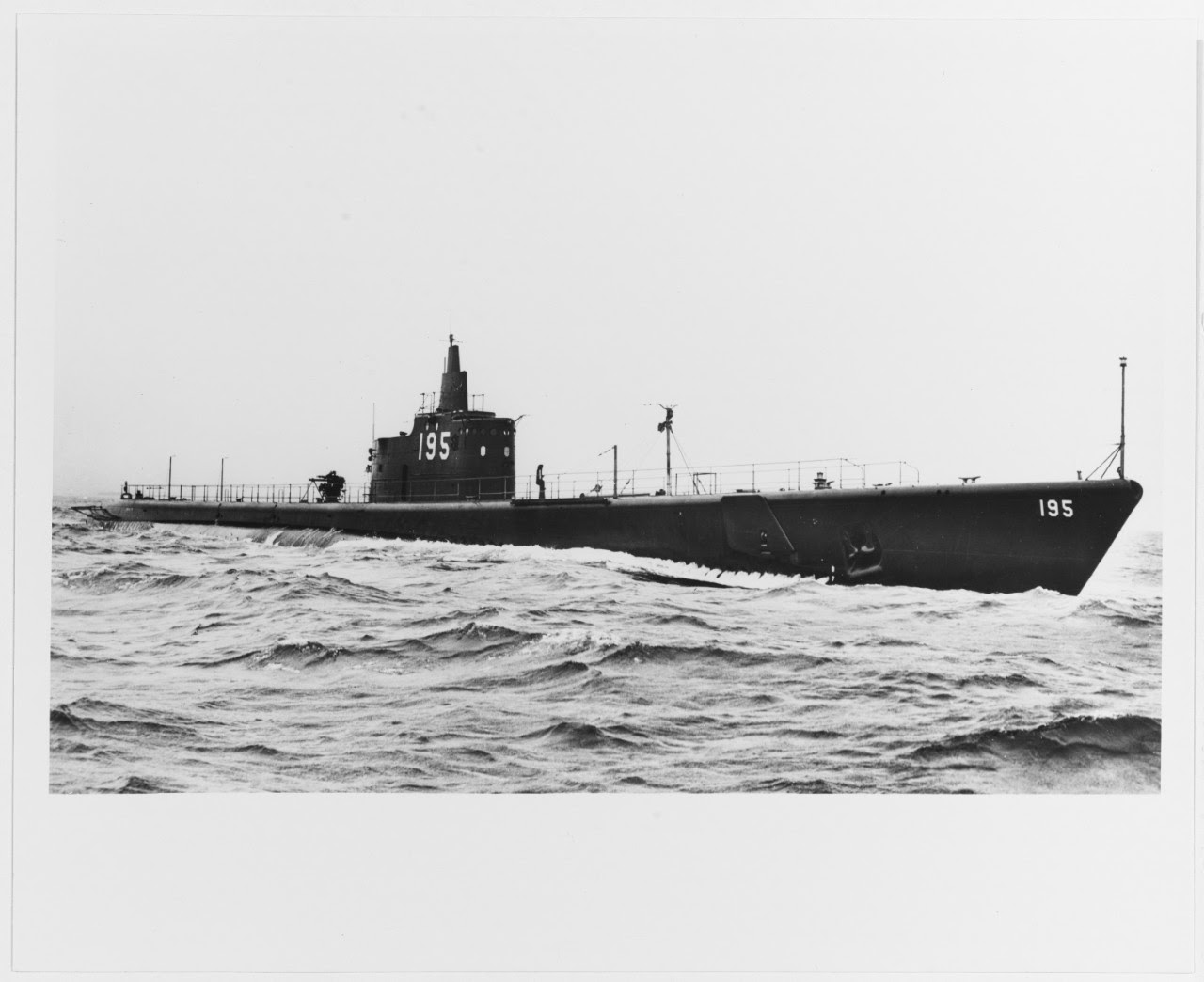
1939. U.S. National Archives
In March, two one-ton torpedoes were “lost” in the testing of the submarine Saury S-8, found by fishermen, and safely returned to the Sklaroff Wharf, where they were loaded onto a truck and returned to Connecticut. Turns out, they were dummies.
Submarines and their safety were front-page news in May 1939 when the U.S.S. Squalus sank off the coast of New Hampshire with the loss of 26 men, although a new rescue technique had been used and helped save 33 lives. In Chatham, the U.S. Naval Reserve held a ball to raise funds for the families of the lost men.
Note: 1939 will continue in Part Two

 South Wellfleet, Massachusetts