
I only discovered the “other Wellfleet” when a Google Alert announced that a rodeo was coming to town. Wondering why Wellfleet, Massachusetts would be planning such an event, I clicked on the news, and there was Wellfleet, Nebraska. Recently, I decided to explore the other Wellfleet’s origin, the only other one in the United States far from the Massachusetts coast.
Wellfleet is in west-central Nebraska, in Lincoln County, about 250 miles west of the Missouri River. The Platte River flows through the county from west to east.
Cape Cod journalists have written about Wellfleet Nebraska. In 2006, the Cape Cod Times reporter Eric Williams told the story of Wellfleet’s founding by a “real estate man from Massachusetts” named Carroll Hawkins and a British investor named Dr. Frederick J Tompkins. The story is found in numerous places, making it the official origin story of the town.
As I began to research the story of these two men, I expected to find that Hawkins had a Cape Cod connection. However, I found a different and more complicated tale. So, while this story has nothing to do with our Cape Cod Wellfleet, I thought I would write about it here, just to offer another point of view.
Researching the origin of Wellfleet required a brush-up on U.S. History. Nebraska’s land is part of the Louisiana Purchase (1802) and Its history includes the displacement of native people. The route to the west through Nebraska’s Platte River Valley was already established. Nebraska became a territory in 1854 with the Kansas-Nebraska Act which increased the tension in the country as the white settlers were allowed to vote on whether to allow slavery. In 1867 Nebraska became a state. The Homestead Act of 1862 increased settlement, giving individual citizens 160 acres of land if they could “prove” it by building a home and farm at least ten acres for five years.
Nebraska began to be settled by Americans after Lincoln signed the Pacific Railway Act of 1862 establishing the plan to build a railroad across the country to aid settlement. The Union Pacific’s Transcontinental Railroad was completed in 1869 and other railroads, including the Burlington, built interconnecting lines to move people and their farm crops. The federal government deeded thousands of acres to the railroad companies which they, in turn, could sell off to finance their operations.
Building railroads was at the forefront of everything from finance to technology in the mid-19th Century. Civil engineers were attracted to the industry just as high-tech is an attraction today. The profession developed its procedures for surveying and construction of tracks and bridges. As the roads were laid out, it was typical to designate a town every eight miles or so, as the steam engines needed water.
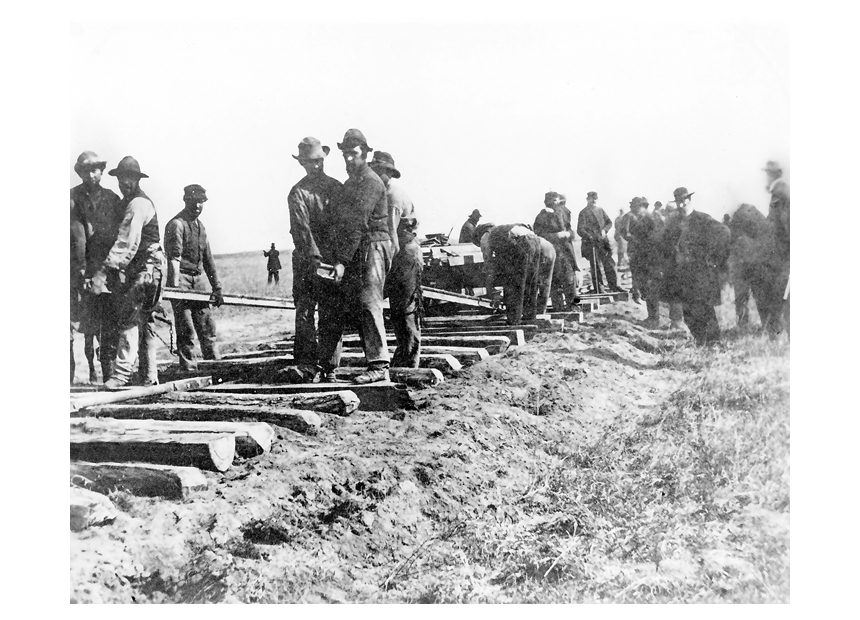
The railroads financed their operation by forming land companies that sold their land holdings, laid out the towns along their routes, and eventually “platted” or formalized the town by laying out the streets and blocks and defining property lines. The land company for the Burlington was the Lincoln Townsite Committee.
In my search for links between Nebraska and the Cape, I found a small notice in The Yarmouth Register on March 12, 1880 that A. H. Knowles, a Civil Engineer from Yarmouth, was headed for Nebraska to work on the Burlington and Missouri Railroad. A further notice was posted in June 1881 that Mrs. Knowles and their two children would join him. Knowles, the son of a sea captain, was pursuing a popular career choice. I matched Mr. Knowles’ stay in Nebraska with the fact that the Burlington Railroad was built through Lincoln County in 1880-1881, establishing stations in Ingham, Wellfleet, Somerset, Dickens, and Wallace. The Lincoln Townsite Committee platted the towns of Wellfleet and Wallace in 1887 and Dickens in 1889.
It was not possible to determine if Mr. Knowles or his wife bestowed the name “Wellfleet” on the Nebraska town. I looked for some connection between the Knowles family in Yarmouth to Wellfleet but did not find a certain match.
The Barnstable Patriot reported in September of 1881 that Mr. and Mrs. Knowles had returned to Yarmouth where they made their home for the remainder of their lives.
Mr. Knowles was not the only Cape Codder I found working in Nebraska. Thomas Doane of Orleans went to Nebraska in 1869 to work on the Burlington after making his reputation in New England as the chief engineer of the Hoosac tunnel project in western Massachusetts. Mr. Doane settled in Crete, building a large mansion, and convincing Burlington to donate land to establish a college, today’s Doane University.
Another engineer, Anselmo Smith, a civil engineer on the Chicago, Burlington, and Quincy Railroad named a town “Hyannis” in 1887, out in the sand hills of northwestern Nebraska. The Cape Cod Hyannis has regular news reports of people visiting the Nebraska town. In 1872, another engineer bestowed the name “Orleans” on a town in Harlan County.

With Wellfleet established, the newspapers began to cover the life of the town. In November 1885 the railroad company erected a fine station building and a section house. There was a lumber yard in the town. Nearby Medicine Creek reportedly produced a fine flow of water. The report goes on to cover the status of Somerset, Dickens, and Wallace.
In late 1887 the newspapers reported that the railroad was putting down a well in Wellfleet, and, in February 1888, building a water tower. There seemed to be some confusion in November 1887 whether the post office was open or not. Mr. A.L. Davis who owned a store there was working on building a boarding house. Mr. Davis would also provide a Christmas tree for the young people in Dec 1887. In February 1888 there was a report that a saloon would open, and, by March a complaint that the saloon was not properly licensed and that there should be a church instead. In June it was reported that Wellfleet was too small to have a Fourth of July celebration, so everyone would be in Wallace or Curtis instead. Two schoolhouses were covering the district. Farmers were “proving” their homesteads.
This is when Wellfleet’s other origin story begins. The story credits Carroll Hawkins and Dr. Frederick James Tompkins as either “founding” or “building” the town, although the town already existed. Hawkins is characterized as a “Massachusetts Real Estate Man” and Tomkins as a British barrister. It was popular for British capitalists to invest in the western United States during the land boom of the late 1870s and 1880s.
Carroll Hawkins was the son of an Episcopal minister, W.G. Hawkins. Born in Massachusetts in 1863, Hawkins came to Nebraska when he was 15 years old when his father was sent to Beatrice, Nebraska to be the Episcopal minister there. Hawkins first appeared in the newspaper in 1885 when his job as Deputy Clerk of the District Court in North Platte ended as the office did not have enough work to support his position. By 1886 he was elected as County Clerk. In the 1885 state census, he is in North Platte living in a hotel where he worked as the night clerk. North Platte is about 30 miles north of Wellfleet and the county seat for Lincoln County where Wellfleet is located.
There was no evidence gleaned from the local newspapers that Hawkins was “a real estate man from Massachusetts.” A historian from NE recently commented that perhaps he had become one later in life, and, indeed, in his obituary in 1941, Hawkins was a prominent citizen of Paonia, Colorado, a man with a real estate and insurance agency who had served his community for many years.
Dr. Frederick James Tompkins was described in the newspapers as an eminent barrister from England. His obituary in 1904 when he was 90 years old described his career beginning as a Congregationalist minister who was sent to Nova Scotia in 1847 where he organized and built Gorham Congregational College in 1855. In 1859, Tompkins returned to England and studied law. He was admitted to the bar at Lincoln’s Inn. During the Civil War in the United States, he was a war correspondent for the London Times and other British publications, reporting from General Grant’s headquarters. No mention was made in the obituary of his involvement in Nebraska.
In the spring of 1888, Dr. Tompkins was invited to give the commencement speech at the University of Nebraska in Lincoln. He was described as “one of the foremost barristers” of his country. He was in the U.S. attending an international law conference. There was no information found on what attracted him to Nebraska. Perhaps Tompkins envisioned himself as a British capitalist. in that role. Later, in October of 1888, Tompkins came to the state, visiting Lincoln where the state bar association asked him to speak. WE do not know if he was a friend of the Hawkins family before that time, or if they met in Lincoln.
The following year, In May, 1889, the local newspapers reported the founding of the Wellfleet Real Estate and Improvement Company, incorporated with the Secretary of State with a capital stock of $1 million, offering 10,000 shares at $100 each. Described as a powerful syndicate, the company was headed by Frederick James Tompkins. The Vice President was Reverend W.G. Hawkins, and the Secretary was Carroll Hawkins. The directors were from Halifax, Nova Scotia, and London, England. Another Hawkins son, Joseph, was on the board also. In this report Tompkins was credited with helping Birmingham, Alabama, get started on the road to prosperity with British capital, although my research showed no connection. Tompkins was described as a barrister at law for all the large steamship lines in England, a member of the historical society in New York, and a member of a council that sought to codify the laws of all nations. There is a kind of “hucksterism” around the reporting, making Tompkins a professional man of the highest order.
It was reported that the Reverend Hawkins and Tompkins had traveled around England together for the previous four months, giving lectures about Nebraska, and seeking to establish a colony of 100 Englishmen in Wellfleet. This fact appears to put the Hawkins-Tompkins connection between Carroll Hawkins’s father and the barrister.
The Wellfleet Real Estate and Improvement Company purchased twelve hundred acres in Wellfleet, announcing that they would build a townsite. True, other entities could build towns. But Wellfleet already existed. Their most significant project of the company was to be a beet sugar factory, but they also planned to build a hotel, and perhaps a flouring mill, a canning factory, a creamery, and a cheese factory.
In 1889 a beet sugar factory was in development at Grand Island, Nebraska, 150 miles to the east on the Platte River. Beet sugar was developed in the mid-19th century as an alternative to the more expensive cane sugar. The factory opened in 1890 and was a success, with a second factory in Norfolk, Nebraska. There were numerous reports in the fall of 1889 of laboratory tests of sugar beets grown near Wellfleet as perfect for production at a factory.
Cheerful stories of the promise of Wellfleet continued through 1890 and 1891. However, there were contradictory stories too. In November 1889, while plans were underway for a dance in Wellfleet to raise funds for an Episcopal church building, there was another story in the Omaha papers about a young Englishwoman of some means, a portrait painter, who had given Dr. Tompkins a check from her brother that Tompkins was supposed to cash for her and give her the money. He did not. Further, the story continues, his associates in Wellfleet may have lost confidence in him.
In the winter of 1890, it was announced that the new head of the Wellfleet Improvement Company was George H. Edbroeke of New York City. Mr. Edbroeke was a prominent architect who had developed several buildings in Chicago and had relocated to New York. During that winter, Carroll Hawkins traveled to New York City to meet with the new president and review the plans for the beet sugar factory. In the summer of 1890, Mr. Samuel Chafen of London came to Wellfleet to help develop both the hotel, the factory, and the dam that was needed to provide the water power for the factory. Later, in the fall of 1890, Tompkins himself wrote a newspaper piece about how he was wrongly accused of this slander, and that the unnamed person who reported it added his name by mistake.
To bring the story to an end, none of the projects promised by the Wellfleet Company came to fruition. Further, there was a drought in 1891 that affected Wellfleet. In July 1891, the partially built hotel in Wellfleet was brought down by a cyclone, the term used then for a tornado. A newspaper story in 1892 called Wellfleet a “sad exhibit of a busted boom.”
Of interest to Wellfleet, Massachusetts, is a report of the efforts of a Nebraska man named F.H. Crowell who lived in Beatrice. He was in touch with a church in Wellfleet, Mass, and had barrels of donated clothing and other goods sent to Nebraska for the “western sufferers.” Perhaps he had a connection with the Wellfleet Crowells, although his family was in Boston.

Wellfleet continued. In 1908, a bank opened. In 1932, a dam was built creating a lake for flood control and recreation. The population dropped in the 1940s when many people found war-related jobs elsewhere. The high school and the bank were closed. When a highway to North Platte was paved in the 1950s, shopping moved to the larger town and businesses closed. The railroad discontinued passenger service in 1950 and closed the depot in 1958.
In 1987, The Barnstable Patriot reported that a group from Cape Cod Wellfleet visited Nebraska Wellfleet to help celebrate the town’s 100th anniversary. Eric Williams also reported this event in his 2006 article; the visitors included a former Wellfleet Massachusetts selectman.
While the population is only 75 now, the September rodeo continues every year to celebrate the community, with horse races right down the main street.

Sources
Newspaper sources www.newspapers.com
Ancestry.com for family connections
The databases of The Barnstable Patriot and The Yarmouth Register are now at www.smalltownpapers.com
Nebraska State Historical Society “Railroad Development in Nebraska 1862-1980, A Historic Context,” June 2014. Downloaded August 2024.
Maywood Public Schools – Wellfleet, Nebraska (maywoodtigers.org)

 South Wellfleet, Massachusetts